
So, you’re asking the million-dollar question: what’s a good click-through rate?
The honest answer is, there’s no single magic number. A 2% click-through rate (CTR) might be a huge win for a broad display ad campaign, but for a highly targeted email sent to loyal customers, you might be aiming for 25% or more. It all comes down to context.
What Click-Through Rate Really Tells You
Click-Through Rate (CTR) is simply the percentage of people who click your link after seeing it.
Think of it like this: your ad or email is a shop window on a busy street. Impressions are all the people who walk past. Clicks are the ones who stop, like what they see, and decide to come inside. In that sense, CTR is a direct measure of how well your message, creative, and targeting are working together to grab your audience's attention.
A high CTR is a great sign. It tells you your content is relevant, compelling, and hitting the right notes. On the other hand, a low CTR often signals a disconnect. It’s a vital health check for your marketing, telling you whether your first impression is landing as you’d hoped.
Why Context Is Everything
Before you can set realistic goals, you have to understand what constitutes a good click-through rate across different platforms and industries. The definition of "good" shifts dramatically depending on where and who you're talking to.
Here are a few factors that can make or break your CTR:
- Channel: Someone actively searching on Google has a clear need, which naturally leads to higher CTRs. That’s a world away from a user passively scrolling through their social media feed, who needs a lot more convincing to click.
- Audience: If you email a warm audience of existing customers, they already know and trust you. Their CTR will almost always be higher than that of a cold audience seeing a display ad for the very first time.
- Industry: In super competitive markets, you're fighting for every click, which can drive average CTRs down. Niche industries with less noise, however, can often pull in much higher engagement.
A "good" CTR is less about hitting a universal benchmark and more about understanding what is achievable and effective for your specific goals, channel, and audience.
To give you a quick frame of reference, this table summarizes some typical CTR ranges you might see across major digital channels.
CTR At a Glance 2026 Quick Benchmarks
Remember, these are just ballpark figures. Email marketing, for instance, is a powerhouse of a channel. While the average global email CTR hovers around 2.5%, top-tier campaigns regularly hit anywhere from 2% to 5%. It all depends on your list quality and the type of email you're sending.
Ultimately, the best benchmark is your own historical performance. Track your results, test new ideas, and always aim to do a little better than you did last time.
CTR Benchmarks for Every Marketing Channel
Alright, so we’ve established that a “good” CTR is all about context. The next logical step is to dig into what those real-world benchmarks actually look like across different marketing channels in 2026. Once you understand these nuances, you can set realistic goals and get much better at diagnosing performance issues.
Not all channels are created equal, and it all boils down to user intent. Someone actively Googling a solution to a problem is in a completely different headspace than someone passively scrolling through their social media feed. This is exactly why CTRs can swing wildly from a massive 20% all the way down to a humble 0.5%.
Search Ads and Organic SEO
When a user types a query into a search engine like Google or Bing, they have a specific need they want to solve right now. This high-intent environment is why search channels consistently deliver some of the highest click-through rates.
- Google Search Ads: The average CTR for a search ad hovers around 3.17%. But this number can shoot up in certain industries. For example, the Dating & Personals sector can pull in an average CTR of over 6%, often driven by strong emotional copy that speaks directly to a user's desires.
- Organic Search (SEO): Earning that coveted top spot on the search engine results page (SERP) can lead to truly exceptional CTRs. The #1 organic result frequently enjoys a CTR of 28% or even higher. It makes sense—users inherently trust organic listings more than paid ads.
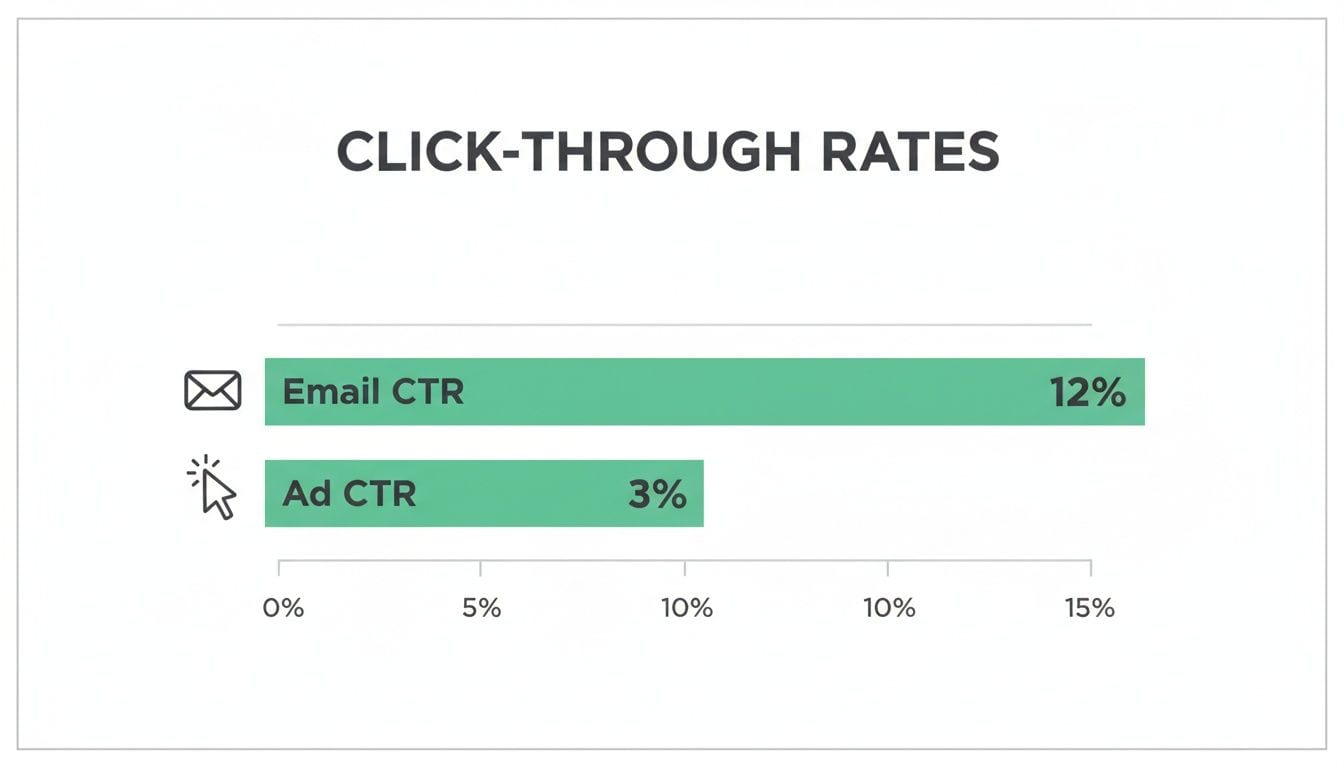
This chart gives you a quick visual on how channels built on direct communication, like email, tend to drive much higher engagement than broader advertising channels.
Email and Social Media Marketing
While search is fantastic for capturing existing demand, email and social media are all about creating that demand and nurturing relationships over time.
A "good" CTR on social media might be 2%, while a "good" CTR for a transactional email can exceed 15%. This is because transactional emails (like receipts or password resets) are expected and highly relevant, whereas social media ads are an interruption.
With email marketing, performance really depends on the type of message you’re sending. A promotional newsletter blasted to a wide audience might only see a 2-3% CTR. On the other hand, highly segmented campaigns or automated trigger emails can do much, much better. If you want to go deeper, you can learn more about improving your email click-through rates in our dedicated guide.
Even more impressive is SMS marketing, which has shown incredible engagement. In the Americas, SMS campaigns report an average CTR of 22.2%—that's roughly nine times higher than the typical 2.5% you might see from an email campaign.
Display and YouTube Ads
Display and video ads are primarily top-of-funnel tools for building brand awareness. Because of this, they usually have the lowest CTRs of any channel. People see these ads while they're busy doing something else, so their intent to click is naturally very low.
A decent CTR for a display ad on the Google Display Network is around 0.46%. It’s a similar story for YouTube video ads, where benchmarks vary by format and niche. Still, many creators find that the thumbnails for their organic videos get an average CTR somewhere between 4% and 10%. For these channels, success is often measured more by the impression itself than the click.
To give you an even more granular view, here’s a breakdown of what to expect across different channels and industries in 2026.
Detailed 2026 CTR Benchmarks by Channel and Industry
This table offers a detailed look at average click-through rates across various channels, segmented by common industries to provide context-specific performance goals.
Keep in mind that these figures are averages. Your own performance will depend on the quality of your creative, the relevance of your targeting, and the strength of your offer. Use these benchmarks as a starting point, not a final destination.
The Hidden Factors That Influence Your CTR
While channel benchmarks give you a map, they don't show you the actual terrain. If you want to really understand what drives a good click-through rate, you have to look past the averages and dig into the invisible forces that convince a user to click. These are the levers you can actually pull to see dramatic improvements.
Think of it this way: launching a campaign without considering these factors is like shouting into a crowded room, just hoping the right person happens to hear you. Real success comes from whispering the perfect message directly into the right person’s ear. It’s all about precision, not just volume.
Audience and Relevance
The single most powerful factor dictating your CTR is audience targeting. A generic ad blasted to a broad, undefined audience will almost always get crushed by a specific message sent to a niche, highly motivated group. Relevance is the name of the game here.
When your ad or content perfectly matches what a user is looking for at that exact moment, the click feels almost like a reflex. This is why a search ad for "emergency plumbing services" gets a sky-high CTR compared to a general display ad for a new soda brand. One solves an immediate, painful problem; the other is just a passive suggestion.
Ad Creative and Copywriting
Your ad creative—the images, the headlines, the call-to-action (CTA)—is your digital storefront. A boring, uninspired storefront gets walked right past. But a vibrant, compelling one pulls people inside to see what you're all about.
Here’s how these pieces directly impact clicks:
- Compelling Copy: Language that taps into emotion makes a huge difference. An ad for a dating service that pulls a CTR over 6% works because it speaks to a powerful, universal human need for connection.
- Striking Visuals: On platforms like YouTube or social media, your thumbnail is in a street fight for attention. A high-contrast image with a clear focal point can literally stop a user mid-scroll.
- A Clear CTA: Vague instructions like "Learn More" are weak. They can't compete with specific, benefit-driven CTAs like "Get Your Free Quote Now" or "Download the Checklist."
Your CTR is a direct reflection of how well you answered the user's unspoken question: "What's in it for me?" The more clearly and persuasively you answer it through your copy and creative, the more clicks you'll earn.
Contextual and External Factors
Finally, you have to account for external variables that can make your CTR rise or fall, even if you don’t change a single thing about your campaign. Knowing what these are will help you interpret your data correctly.
Positional Advantage: On a Google search results page, the #1 organic spot can command a CTR of 28% or more. Down at the 10th spot? You might be looking at less than 3%. The same goes for ads—one at the very top of the page will always get more clicks than one buried at the bottom.
Seasonality and Trends: A retailer selling winter coats will naturally see their CTRs spike in the fall and plummet in the spring. Being aware of these seasonal rhythms is crucial for setting realistic goals and not panicking over predictable dips. Your job is to diagnose performance by looking at these underlying drivers, not just staring at the final number and wondering what happened.
How to Measure Your Click Through Rate Accurately
Knowing your CTR is one thing; trusting that number is another. While the basic formula is straightforward, real-world complexities can easily corrupt your data, leading you to celebrate failures or kill winning campaigns. Accurate measurement isn’t just about math—it's about ensuring the data you're feeding into that formula is clean and reliable.
The fundamental calculation for CTR is simple:
(Total Clicks ÷ Total Impressions) x 100 = Click-Through Rate
For example, if your ad gets 10,000 impressions and generates 300 clicks, your CTR is 3%. But this simplicity hides a critical vulnerability: what if only half of those clicks were actually tracked? Your reported CTR would plummet to 1.5%, making a healthy campaign look like a dud.
The Non-Negotiable Role of UTM Parameters
To measure CTR accurately across different sources, consistent use of UTM parameters is non-negotiable. These are small tags added to your URLs that tell analytics tools like Google Analytics exactly where your traffic is coming from.
Without them, all your paid social, email, and affiliate traffic might get lumped together as "Direct" or "Referral," making it impossible to calculate a meaningful CTR for any specific campaign. Think of UTMs as precise mailing addresses for your data. A link without them is like a letter with no return address—you know you got mail, but you have no idea who sent it.
The Silent Killer: Bad Data
The biggest threat to accurate CTR measurement is "bad data." This isn't just a minor inconvenience; it's a silent killer that completely distorts your perception of performance. When your analytics setup is broken, you are flying blind.
Here’s what bad data looks like in practice:
- Broken or Missing Pixels: An ad platform pixel fails to fire on your landing page. Clicks are happening, but your analytics platform isn't recording them, artificially deflating your CTR.
- Misconfigured Events: A developer updates your website and accidentally changes the dataLayer structure. The "click" event you rely on stops tracking, and your reported CTR flatlines overnight.
- Inconsistent Naming Conventions: One team tags a campaign as
utm_source=facebookwhile another usesutm_source=Facebook. Your analytics tool sees these as two separate sources, fracturing your data and making accurate reporting a nightmare.
This is where a simple calculation becomes a major business risk. You might pause a high-performing ad or invest more in a failing one, all based on numbers that don't reflect reality.
The accuracy of your CTR is not determined by the formula you use, but by the quality of the data you put into it. Garbage in, garbage out isn't just a saying—it's a direct threat to your marketing ROI.
Using Analytics QA for Trustworthy Data
Manually checking every tag and campaign is impossible at scale. This is where an automated analytics observability platform like Trackingplan becomes essential. It acts as an automated safety net, continuously monitoring your entire analytics implementation.
The platform automatically discovers and monitors all your tracking, alerting you in real-time to issues like broken pixels or tagging errors that would otherwise go unnoticed.
Instead of discovering a data problem weeks later, you get an immediate alert that tells you exactly what broke and why. This allows you to trust the CTR figures in your dashboards, knowing they are built on a foundation of clean, verified data.
It is important to remember the difference between metrics like click rate vs. click-through rate, as precise data helps clarify the performance of each. By ensuring your measurement is accurate, you can finally make decisions with confidence.
Actionable Strategies to Improve Your CTR

Alright, now that we've got a solid handle on what a good click-through rate is and how to measure it without going crazy, it's time to roll up our sleeves and get to work. Boosting your CTR isn't a one-and-done task; it's a constant cycle of testing, learning, and fine-tuning.
Improving CTR boils down to making your ads, emails, and listings utterly irresistible to your audience. Think of it as crafting a powerful first impression that just begs to be clicked, whether it's a search ad, a subject line, or a YouTube thumbnail. This requires a mindset of continuous improvement, all fueled by data you can actually trust.
Master the Art of A/B Testing
The most reliable way to boost performance is through systematic A/B testing. The idea is simple: create two (or more) versions of an element—like a headline or call-to-action button—and show them to different slices of your audience to see which one performs better.
Think of yourself as a scientist running an experiment. By changing just one variable at a time, you can prove what truly works. For instance, a search ad headline like "Durable Work Boots" might go head-to-head with "Work Boots with a Lifetime Guarantee." A quick test will tell you which message truly connects with your customers.
Here are some common elements ripe for A/B testing:
- Headlines and Subject Lines: Pit emotional triggers against benefit-focused statements.
- Ad Copy and Meta Descriptions: Play with different lengths, tones, and unique selling points.
- Calls-to-Action (CTAs): Test direct commands like "Shop Now" against softer invitations like "Explore the Collection."
- Visuals: A/B test different images, thumbnail styles, or video creative to see what grabs the most eyeballs.
The golden rule of A/B testing is to stop guessing what your audience wants and let their actions do the talking. A higher CTR on one version is a direct signal from your audience telling you exactly what they prefer.
Optimize for Each Channel’s Unique Language
What crushes it on Google Search will likely fall flat on social media. Every platform has its own rhythm and user expectations, so tailoring your strategy is a must.
For Search (SEO & SEM):
- Optimize Meta Descriptions: While not a direct ranking factor, a well-written meta description is your organic ad copy. Pack it with your target keyword and a strong CTA to tempt searchers away from your competitors.
- Use Ad Extensions: In paid search, extensions like sitelinks, callouts, and structured snippets are your best friend. They make your ad bigger, more informative, and can give your CTR a serious lift.
- Implement Dynamic Keyword Insertion: This is a more advanced SEM trick that automatically swaps your ad text with the user's search query. The result? A hyper-relevant ad that practically screams "click me!"
For Email Marketing:
- Craft Irresistible Subject Lines: In a packed inbox, your subject line is your one and only shot to earn the open. Lean into personalization, curiosity, and urgency. A subject line like "Your Weekly Favorites Are Back in Stock, [Name]!" will always outperform a generic "Weekly Newsletter."
For Social Media and YouTube:
- Focus on Thumbnails: On visual platforms like YouTube, your thumbnail does all the heavy lifting. The most successful creators often see CTRs between 4% and 10% by using high-contrast images, expressive faces, and minimal, bold text. Your thumbnail should tell a mini-story that makes users desperate to know what happens next.
- Refine Audience Targeting: Dive into the platform's targeting options to get laser-focused. Showing your ad to a smaller, more engaged group will almost always deliver a higher CTR than blasting it to a broad, indifferent audience.
CTR FAQs: Your Questions Answered
As you dig deeper into optimizing your campaigns, you're bound to run into some tricky questions about click-through rate. Let's tackle some of the most common ones head-on, giving you clear, practical answers to master the nuances of CTR.
Is a High CTR Always a Good Thing?
Not always. A high CTR with a low conversion rate often points to a serious disconnect between your ad and your landing page. It might mean your ad copy is a bit too broad or even misleading, or that the page just doesn't deliver on the promise.
Remember, the goal isn't just clicks—it's attracting qualified traffic that actually converts. Always look at your CTR alongside business-critical metrics like conversion rate and cost per acquisition (CPA). A healthy CTR is one that fuels your business goals, not just one that looks good on paper.
How Does CTR Differ From Conversion Rate?
CTR and conversion rate measure two distinct, yet connected, stages of the customer journey. Think of them as a one-two punch.
- Click-Through Rate (CTR) tells you how good your ad is at grabbing attention and earning that initial click. It’s your first impression metric, calculated as (Clicks ÷ Impressions).
- Conversion Rate shows you how effective your landing page is at convincing that user to take the next step, like making a purchase or signing up. It’s calculated as (Conversions ÷ Clicks).
A high CTR paired with a low conversion rate is a classic red flag. It’s your data telling you there's a gap between the promise you made in your ad and the experience you delivered on your landing page.
My CTR Suddenly Dropped. What Should I Check First?
Before you hit the panic button and start overhauling your creative, check your data integrity. The culprit is often much simpler: broken tracking.
A single broken tag or pixel can stop clicks from being recorded, making it look like your performance has fallen off a cliff. An analytics observability tool can spot these issues instantly. Once you've confirmed your tracking is solid, then it’s time to investigate campaign changes. Did you recently tweak the ad copy, visuals, or audience targeting? If not, look at external factors like a new competitor or a major platform algorithm update. Always verify your data first.
How Can I Trust My CTR Data Is Accurate?
Real trust in your data doesn't come from tedious manual spot-checks. It comes from proactive, automated quality assurance. The most reliable way to achieve this is with an analytics observability platform that monitors your entire data pipeline in real time.
These tools are like a 24/7 watchdog for your analytics. They instantly catch problems like broken pixels, missing events, or flawed campaign tagging—preventing bad data from ever polluting your reports. This guarantees the CTR and other key metrics you rely on for critical decisions are consistently accurate, giving you true confidence in your data.
Stop flying blind with bad data. Trackingplan gives you a single source of truth by automatically monitoring your analytics and marketing tags, alerting you to errors before they impact your decisions. Ensure your CTR data is accurate and trustworthy.