Struggling with low email click-through rates? This guide unpacks benchmarks, common tracking errors, and actionable strategies to improve your CTR.
Your email click-through rate tells you exactly how many people found your email compelling enough to take action. Think of your open rate as someone window shopping—they’re just looking. The click-through rate (CTR), on the other hand, is the moment they step inside your store, ready to see what you have to offer. It’s the clearest sign that your content, your offer, and your call-to-action all hit the mark.
What Your CTR Reveals About Audience Connection
While it’s easy to get hung up on open rates, the click-through rate tells a much more interesting story. An open is passive. It can happen by accident or even be triggered automatically by new privacy features. A click, however, is a conscious choice. It signals real interest and is the first major step in turning a passive reader into an active lead.
This is the metric that proves your message isn't just being seen—it's resonating. A high CTR is a great indicator that your copy is persuasive, your design works, and your offer is genuinely valuable to your audience. On the flip side, a low CTR, even with a great open rate, points to a disconnect. It means your subject line made a promise that the email's content didn't deliver on.
To get a clearer picture of your email performance, it's helpful to see how CTR fits alongside other key metrics.
Core Email Engagement Metrics At A Glance
This table breaks down the essential metrics you should be tracking to understand how your audience interacts with your campaigns.
Each of these metrics provides a different piece of the puzzle, but CTR remains one of the most reliable indicators of true engagement.
The Simple Math Behind CTR
Calculating your email click-through rate is refreshingly simple. It’s just the total number of unique clicks divided by the number of emails that were successfully delivered, all multiplied by 100 to get a percentage.
CTR Formula: (Total Unique Clicks ÷ Number of Delivered Emails) x 100 = CTR %
Let's say you send a campaign to 10,000 subscribers. It gets delivered to 9,800 of them, and 245 people click a link inside. Your CTR would be 2.5%. This straightforward calculation gives you a solid benchmark to gauge how well your campaigns are doing and track your improvement over time.
Why CTR Matters More Than Ever
The importance of email click-through rates has shot up recently, largely thanks to shifts in data privacy. When Apple introduced Mail Privacy Protection (MPP) in 2021, it started pre-loading email content for users, which artificially inflates open rates. This has made opens an increasingly fuzzy and unreliable metric for engagement. Clicks, however, are still undeniable proof of user action, giving you a stable and trustworthy data point.
Across all industries, the average email click-through rate has been hovering around 2.00% to 2.62% in recent years, with the median sitting right at 2.00%. This benchmark shows that even getting two out of every hundred people to click is a solid performance, which really underscores the challenge of standing out in a crowded inbox.
Ultimately, focusing on CTR helps you gather much more accurate insights into what your audience wants. Every click is a direct source of first-party data, giving you clear signals about the products, topics, and offers your subscribers actually care about. Armed with that knowledge, you can start refining your content, improving your segmentation, and building a more responsive—and profitable—email list.
How Your Email CTR Stacks Up Against Industry Benchmarks
Knowing your email click-through rate is one thing. Understanding what it means is something else entirely. A "good" CTR isn't some universal number you can just pluck from the sky; it's a moving target that shifts based on your industry, your audience, and even where they live.
If you just chase a generic global average, you’re setting yourself up for disappointment. To have a real, strategic conversation about what’s working, you need context. Benchmarks ground your numbers in reality, turning abstract data into a clear picture of your performance. Without them, you’re just staring at stats in a vacuum.
This chart really drives home the difference between opens and clicks. Getting someone to open your email is the first hurdle, but getting them to act is the real challenge.
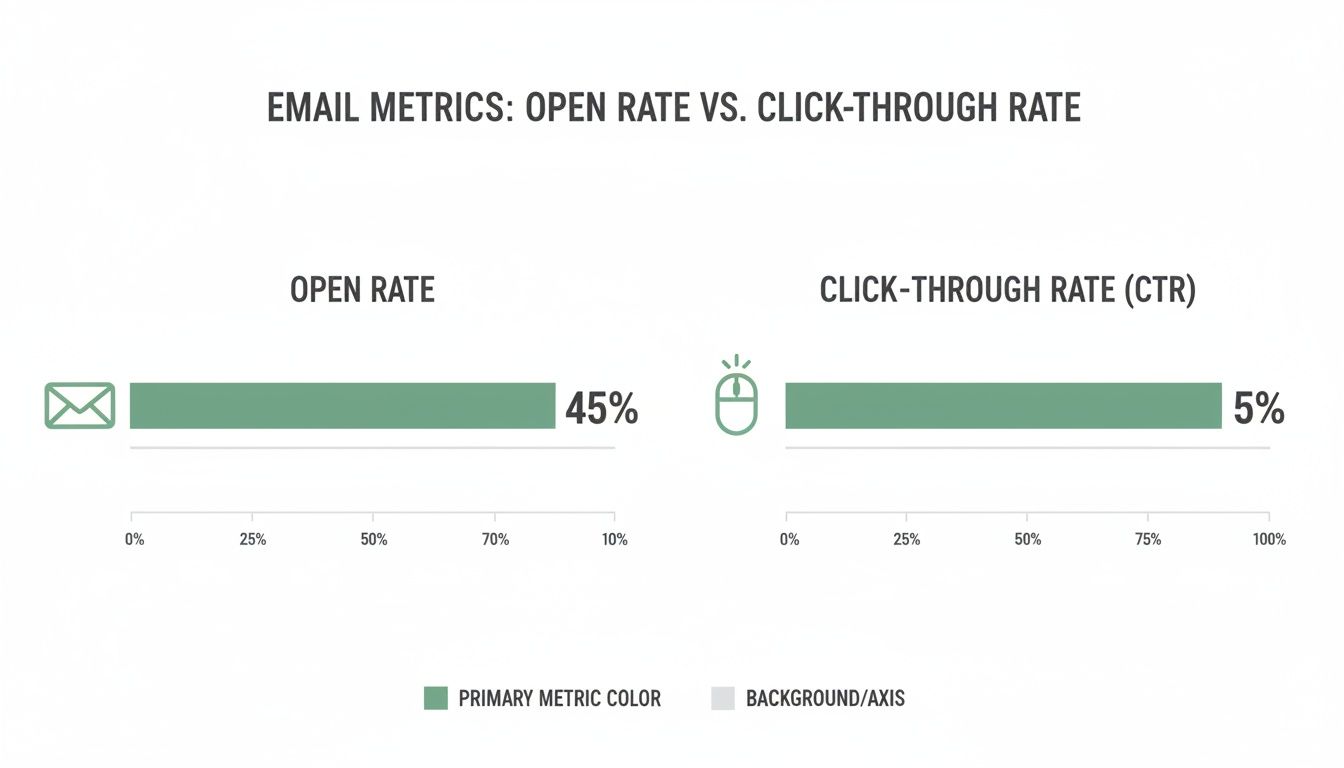
See that big drop-off? That’s where compelling content and a clear call-to-action make all the difference.
What A "Good" CTR Looks Like In Different Industries
Not all industries are created equal when it comes to email engagement. Some sectors naturally pull in more clicks simply because of the kind of content they share and what their audience expects.
Let's break it down with a few examples:
- Hobbies and Media: These guys often knock it out of the park. Why? Because subscribers want this content. They've signed up for their favorite gardening newsletter or updates from a publication they love, so they're already primed to engage.
- Government and Legal Services: On the other end of the spectrum, you have fields where emails are more informational or transactional. These communications are necessary, not exciting, so email click-through rates tend to be lower.
- Retail and eCommerce: This industry is a mixed bag. A killer sale or a new product drop can send CTRs soaring. A standard weekly newsletter? Not so much. It all comes down to the offer.
The bottom line is this: a 2% CTR might be fantastic for a law firm but a total dud for a popular media brand. Context is everything.
This isn't about success or failure—it's about understanding different audience behaviors and content goals. Knowing where you stand helps you set realistic goals and focus your energy where it counts.
How Geography Influences Engagement
It’s not just what you send, but where you send it. Cultural norms, market saturation, and data privacy laws all shape how people interact with email, creating distinct regional trends.
For instance, North America often leads the pack with CTRs between 2.96% and 4.77%, while Europe is right behind at 3.58%. Both are well above the global average, which sits between 1.89% and 2.3%. Why the difference? Things like advanced targeting in the US and Canada play a role, as does Europe’s GDPR-driven focus on clean, opted-in lists. You can discover more insights about email marketing statistics on Emailvendorselection.com.
This means a global team can't just look at a single, blended CTR. You have to segment your reporting by region. A strategy that crushes it with your European audience might completely fall flat somewhere else.
To put this all into perspective, here’s a look at some benchmark CTRs to help you see where you might fit in.
Average Email Click-Through Rates By Industry And Region
This table presents benchmark CTRs across various industries and key geographical regions to help you contextualize your campaign performance.
Remember, these figures are just a starting point. Your own historical data is your most valuable benchmark. Use these industry and regional numbers to frame your performance, but always aim to beat your own personal best.
Uncovering Hidden Issues That Skew Your CTR Data
You’ve calculated your email click-through rates, run the numbers against industry benchmarks, and set your goals. But what if the data you're relying on is fundamentally broken? Before you start tweaking subject lines or redesigning CTAs, you have to be certain your measurement foundation is solid. Bad data is far worse than no data at all—it tricks you into celebrating wins that never happened and fixing problems that don't exist.
The hard truth is that countless technical glitches can silently corrupt your tracking, painting a completely distorted picture of your campaign performance. These aren't marketing problems; they're data integrity problems. When your tracking breaks, the story your analytics tells becomes a work of fiction, leading to flawed strategies and wasted resources.

The Mystery Of Missing Email Traffic
One of the most common culprits behind skewed data is broken UTM parameters. These little tags tacked onto your URLs are supposed to tell your analytics platform exactly where traffic is coming from. But when they're built incorrectly—maybe with a typo, a misplaced space, or an inconsistent naming convention—they just fail.
What happens next? All that valuable traffic from your email campaign gets dumped into the dreaded ‘(direct) / (none)’ bucket in Google Analytics. It looks like those users just magically typed your URL into their browser, completely erasing any trace of your email marketing efforts. Your email CTR flatlines to zero, while your direct traffic mysteriously spikes.
This creates a few massive headaches:
- Inaccurate Reporting: You can’t prove the ROI of your email campaigns if none of the traffic is credited to them.
- Flawed Insights: You might mistakenly conclude your email strategy is a dud and slash its budget, even while it's secretly driving tons of engagement.
- Wasted Time: Your team ends up chasing its tail trying to figure out data discrepancies instead of focusing on actual growth.
To get ahead of these issues, you can learn more about UTM parameter best practices in our complete guide.
When Tracking Pixels Misfire
Beyond messy UTMs, another silent data killer is the misfiring tracking pixel. These tiny snippets of code are placed on your website to record what users do after they click through from an email. They're essential for tracking conversions, sign-ups, and other key events that truly define a campaign's success.
But pixels break all the time. A website update might accidentally delete the code, a consent management platform could block it from firing, or it might just be implemented wrong in the first place. When a pixel fails, a user can click your email, make a purchase, and your analytics will be completely blind to it.
You might see a healthy number of clicks in your email service provider, but your web analytics and ad platforms will show zero conversions. This data gap makes it impossible to measure the true business impact of your email click-through rates.
The Discrepancy Between Platforms
Ever notice that the click count in your email platform (like Mailchimp or Klaviyo) never quite matches the number of sessions in Google Analytics? This is a classic symptom of tracking misalignment. Your email service provider is just counting the initial click, but an analytics platform like GA has a much stricter definition of what a "session" is.
Here are a few reasons for the gap:
- Fast Bounces: A user clicks but leaves your site before the analytics tag fully loads. Your email platform counts the click, but Google Analytics never records a session.
- Bot Clicks: Email security scanners often "click" links to check for malicious content, inflating your click numbers without generating any real human traffic.
- Cross-Device Behavior: Someone might click on their phone but come back later on a desktop to complete the action, which can really complicate the attribution journey.
Trusting your email click-through rates means trusting your entire tracking setup, end to end. Without a reliable data foundation, any optimization effort is just a shot in the dark. The first and most important step to improving your CTR is ensuring you can actually measure it correctly from click to conversion.
Actionable Strategies To Increase Email Click-Through Rates

Now that you have a solid handle on how to measure CTR—and the common pitfalls that can throw off your data—it’s time to start improving your numbers. Boosting your email click-through rates isn't about finding a single magic bullet. It’s a systematic process of refining every piece of your campaigns.
This means crafting messages that don’t just grab attention but actually compel people to act. Let’s break down the most effective strategies into four key areas, giving you a clear playbook for creating emails that people genuinely want to click.
Craft Compelling Copy And Clear CTAs
Before anyone can click, they have to open your email. The first step is always to increase email open rates and boost engagement, because an open is the gateway to a click. Once they’re in, the copy and call-to-action (CTA) take over.
Your email content absolutely must deliver on the promise of your subject line. If you teased a 50% discount, that offer needs to be the first thing they see. Use clear, direct language that gets straight to the point and guides the reader toward what you want them to do next.
The CTA is arguably the most important clickable element in your entire email. Vague phrases like "Click Here" are tired and uninspiring. Instead, use action-oriented language that tells the reader exactly what will happen when they click.
- Weak CTA: "Submit"
- Strong CTA: "Get Your Free Ebook Now"
The stronger CTA not only creates a sense of urgency but also clarifies the immediate benefit, making it far more persuasive.
Implement Strategic And Mobile-First Design
With over 60% of emails now opened on mobile devices, a mobile-first design isn’t just a nice-to-have; it's essential. If your subscribers have to pinch and zoom just to read your message, they’re far more likely to hit delete than to hunt for a link. Your layout has to be responsive, period.
Beyond that, smart design uses visual hierarchy to guide the reader’s eye straight to the CTA. You're basically creating a visual pathway that ends at the click.
Use plenty of white space to avoid clutter, choose high-contrast colors for your CTA buttons so they pop, and even use subtle directional cues like arrows or images of people looking toward your link. The goal is to make clicking the most obvious and easiest thing to do.
This approach makes it effortless for subscribers to know what you want them to do, which is critical for driving up those email click-through rates.
Go Beyond Basic Personalization
Personalization is so much more than dropping a {{first_name}} tag into your greeting. Real personalization uses behavioral data to deliver content that’s genuinely relevant to each subscriber.
This is about moving from broad segments to micro-segments based on what your users actually do. For instance, instead of sending a generic "new arrivals" blast to your whole list, you could create hyper-targeted campaigns based on:
- Past Purchase History: Send recommendations for products that complement something they’ve already bought.
- Website Browsing Behavior: Follow up with users who looked at a specific product category but didn't buy.
- Email Engagement: Segment subscribers who always click on links about a certain topic and send them more of that content.
This level of relevance makes your audience feel seen and understood. Your emails transform from generic marketing messages into valuable, one-on-one communications they’ll actually look forward to opening and clicking.
Embrace Systematic A/B Testing
You can't improve what you don't test. A/B testing (or split testing) is the single most reliable way to figure out what actually resonates with your audience. The idea is simple: create two versions of an email, change just one thing, and see which one performs better.
The key here is to be methodical. Test one element at a time. This isolates the impact of that specific change, giving you clean, actionable data to inform your next campaign.
Here are some of the best elements to A/B test to improve your email click-through rates:
- Call-to-Action Text: Try different verbs and phrases. "Shop Now" vs. "Explore the Collection."
- Button Color and Size: Does a bright, bold button outperform a more subtle one?
- Email Layout: Test a clean, single-column design against a multi-column grid.
- Imagery and Visuals: Pit lifestyle photos against simple product shots to see what connects.
By consistently testing and applying what you learn, you’ll make small, incremental gains that compound over time, leading to significant and lasting growth in your email engagement.
Achieving Data Integrity With Analytics Observability
After seeing how easily tracking errors can sabotage your data, it’s clear that manual checks and last-minute fixes just don't cut it. The old way of discovering a data issue weeks later during a quarterly review is both inefficient and incredibly costly. This is where a modern approach, analytics observability, acts as a much-needed safety net for your entire marketing data pipeline.
Think of it as an always-on security system for your data. Instead of waiting for something to break and then scrambling to fix it, an observability platform works quietly in the background, continuously monitoring your analytics setup. It’s built to catch the very issues that silently corrupt your email click-through rates and other critical metrics before they cause any real damage.
From Reactive Audits to Proactive Monitoring
Traditionally, keeping data clean meant tedious, time-consuming manual audits. A data analyst might spend days digging through spreadsheets and dashboards, trying to reconcile numbers between platforms and hunt down the source of a single discrepancy. This reactive cycle is a constant drain on resources.
Analytics observability completely flips this model on its head. It automates the entire monitoring process, giving you a proactive shield against bad data.
Here’s a look at how it works:
- Continuous Scanning: Automated platforms scan your website and apps in real-time, validating every tracking pixel, event, and campaign tag the moment it fires.
- Instant Alerts: The second a broken pixel, a malformed UTM parameter, or a data inconsistency is detected, your team gets an immediate alert via Slack, email, or whatever channel you prefer.
- Root-Cause Analysis: These systems don't just flag a problem—they give you the context needed to pinpoint the exact cause, so you can resolve it in minutes, not days.
This strategic shift frees your teams from chasing ghosts in the data and allows them to focus on what actually drives growth. You can learn much more about how to ensure data integrity with a proactive strategy in our detailed guide.
Building a Single Source of Truth
One of the biggest headaches in measuring email performance is the disconnect between different tools. Your email service provider, your web analytics, and your CRM each tell a slightly different story, leaving you to piece together the truth. Analytics observability helps unify these separate data streams into a single, reliable source of truth.
By validating data at the source—the instant it’s generated—you can finally trust that the information flowing into your dashboards is accurate. This confidence is absolutely essential for making smart decisions. When you know your numbers are right, you can measure the true impact of your CTR optimization efforts with certainty.
For example, accurately assessing email performance means breaking down data silos. Think about how you can integrate email performance data in Klaviyo with other platforms to create a cohesive view of the entire customer journey.
The goal is to move from a state of data doubt to one of data confidence. With an observability strategy, you’re not just hoping your tracking works; you’re guaranteeing it.
The True Impact of Reliable Data
Ultimately, achieving data integrity isn't just a technical exercise. It has a direct and profound impact on your business outcomes. When you can trust your email click-through rates, you can confidently double down on the campaigns that work and stop wasting money on those that don’t.
Clean data leads to:
- Smarter Budget Allocation: You know exactly which email strategies are driving revenue, allowing you to put your resources where they’ll have the most impact.
- Faster Problem Solving: Teams can resolve tracking issues in minutes or hours, not weeks, preventing bad data from corrupting your analytics for long periods.
- Improved Collaboration: Marketers, analysts, and developers can all work from the same trusted dataset, which eliminates the friction and miscommunication that comes from conflicting reports.
By implementing an analytics observability solution, you create a foundation of trust. It ensures that every click is counted, every conversion is attributed correctly, and every strategic decision is based on a reality you can depend on.
Your Final Checklist for Mastering Email CTR
Boosting your email click-through rates isn't about finding one magic bullet. It’s about a steady commitment to both creative excellence and technical precision. Your journey to mastering this key metric comes down to truly understanding your audience, benchmarking your performance honestly, and making sure your data is rock-solid. When compelling marketing meets a solid data foundation, you get sustainable growth.
To wrap it all up, here’s a simple checklist to keep your efforts on track:
- Define and Benchmark: Don't just treat CTR as another number on a dashboard. See it as a primary health metric for your email program. Compare your rates against relevant industry and regional benchmarks to set goals that are ambitious but achievable.
- Prioritize Data Integrity: Make auditing your tracking a regular habit. Hunt down and fix broken UTMs, make sure your tracking pixels are firing correctly, and lean on observability tools to catch errors before they completely throw off your reports.
- Optimize Creatively: Never stop testing. Continuously experiment with your copy, calls-to-action, design, and personalization to figure out what genuinely gets your audience to click.
- Automate Your QA: It's time to shift from reactive data cleanups to proactive monitoring. An analytics observability platform like Trackingplan ensures you can always trust the numbers you're looking at.
Ultimately, the goal is to empower yourself. When you take full control of your data, you unlock the true potential of your email marketing—turning insights into action and, most importantly, clicks into conversions.
Frequently Asked Questions About Email CTR
Even after you get the hang of the basics, you'll run into specific questions when you're in the trenches trying to improve your email click-through rates. Let’s clear up some of the most common ones that pop up for marketers every day.
Think of this as a quick-reference guide to help you navigate the finer points of CTR measurement and optimization.
What Is The Difference Between Click-Through Rate And Click-to-Open Rate?
They sound almost the same, but CTR and Click-to-Open Rate (CTOR) tell two very different stories about your email engagement.
Click-Through Rate (CTR) is the big-picture metric. It tells you what percentage of all the people who received your email actually clicked a link. It's a solid measure of your campaign's overall pull, from the subject line to the final CTA.
On the other hand, Click-to-Open Rate (CTOR) zooms in on the people who were already interested enough to open your email. It measures the percentage of openers who then went on to click a link. This gives you a much better sense of how compelling your actual email content is. The catch? With Apple’s Mail Privacy Protection making open rates less reliable by artificially inflating them, many marketers now lean more heavily on CTR as the more stable performance indicator.
How Can I Fix UTM Tracking Errors For Accurate Data?
Untangling UTM errors is all about one thing: consistency. Without a shared system across your team, your email traffic can easily get mislabeled in your analytics, making your hard work look way less effective than it really is.
Here are three practical steps to get your UTM data clean and keep it that way:
- Standardize Your Conventions: Get everyone on the same page by creating a company-wide guide for UTM naming. A simple spreadsheet or a centralized link builder can work wonders, ensuring everyone uses the same format for
utm_source,utm_medium, andutm_campaign. No more typos or creative interpretations. - Audit Your Analytics Regularly: Make it a habit to peek into your analytics platform and look for traffic dumped into the
(direct) / (none)or(not set)buckets. If you see a sudden spike there right after an email goes out, it's a huge red flag that a UTM tag was likely broken or missing. - Automate Your Quality Assurance: Honestly, the best way to handle this is to let a tool do the heavy lifting. An automated analytics QA platform monitors your campaigns as they happen. It can instantly flag malformed or broken UTMs, letting you fix them before they have a chance to mess up your data for good.
Does A/B Testing Really Make A Difference For CTR?
Absolutely. A/B testing isn't just a marketing buzzword; it's one of the most powerful, data-backed methods you have for systematically improving your email click-through rates. It's how you stop guessing what your audience wants and start getting cold, hard proof.
By testing just one variable at a time—whether it’s your call-to-action (CTA) button color, the words on that button, or even where you place an image—you collect undeniable evidence of what works. You'd be surprised how small, incremental wins from consistent A/B testing can stack up over time, leading to some serious lifts in engagement and conversions.
The secret to good A/B testing is discipline. Test one element at a time, make sure your test group is large enough to give you statistically significant results, and always let the data, not your gut, make the final call.
Gain complete confidence in your email marketing data with Trackingplan. Our automated observability platform detects tracking errors, broken UTMs, and data inconsistencies in real time, so you can stop guessing and start trusting your metrics. Ensure your email analytics are accurate today at https://trackingplan.com.