Understand the true pii meaning and learn how to identify, manage, and protect sensitive user data to ensure compliance and build customer trust.
Let’s start with a simple question: What exactly is Personally Identifiable Information, or PII? Think of it as any piece of data that can be used to figure out who a specific person is. It’s like a trail of digital breadcrumbs that, when pieced together, leads directly back to an individual.
What Is Personally Identifiable Information

For any business collecting user data, truly understanding PII is non-negotiable. This isn’t just about the obvious stuff like names and Social Security numbers. It’s about any information that could, either on its own or combined with other data, unmask a real person. This very idea is the foundation of every modern data privacy regulation out there.
Imagine you have a couple of puzzle pieces. One piece, like a full name, is a direct identifier. It points straight to someone without needing any other context. Easy enough.
But then you have another piece, like a zip code. By itself, it’s pretty harmless. Now, what happens when you combine that zip code with another seemingly innocent piece of data, like a date of birth? Suddenly, you have a powerful combination. These are called indirect identifiers (or quasi-identifiers), and they're often the sneakiest source of compliance risk in analytics and marketing data.
The core idea here is all about context. A single data point might look anonymous, but its power to identify someone grows exponentially when you link it with other information. This is why a solid grasp of PII is so critical for data governance.
Direct vs. Indirect PII
To manage your data properly, you have to know the difference between these two categories. Each comes with its own level of risk and needs to be handled differently.
- Direct Identifiers: This is the data that explicitly and uniquely identifies a person. It’s the low-hanging fruit for data privacy and is almost always treated as sensitive. Think of it as information that needs zero translation to pinpoint an individual.
- Indirect (or Linked) Identifiers: This is data that becomes powerful when combined with other information. While one piece might seem anonymous, linking two or three together can quickly narrow down the possibilities to a single person. This is where a ton of accidental data leaks happen.
PII vs. Non-PII Common Examples
To make this crystal clear, here’s a quick reference table your teams can use to instantly distinguish between PII and generally safe, non-PII data.
This table should help clarify the gray areas, but remember the golden rule: context is everything.
Grasping the difference between direct and indirect PII is the first real step toward building a secure data environment. So many organizations focus only on the obvious direct PII, leaving themselves wide open to risks from linked data hiding in their analytics events or marketing parameters. You can learn more about how to protect both types by exploring our guide on PII examples and protection strategies. Getting ahead of this prevents very expensive compliance headaches down the road.
The Global Regulations Shaping PII Protection
Understanding the technical side of PII is only half the battle. Its real teeth come from the law. Across the globe, a strong framework of data privacy laws has taken shape, all centered on one thing: protecting personally identifiable information. These aren't just friendly suggestions—they're strict rules, and ignoring them comes with massive financial and reputational consequences.
These regulations shift PII from an abstract concept into a concrete business responsibility. They lay out exactly how you must collect, process, store, and get rid of user data. A slip-up isn't just a minor mistake; it can lead to penalties that crater a company's bottom line and shatter customer trust, which is far more difficult to win back.
The Major Players in PII Regulation
While many countries have their own privacy laws, a few key regulations have really set the global standard and heavily influence others. For any business operating online, getting to know these is non-negotiable.
- The General Data Protection Regulation (GDPR): As the EU’s landmark privacy law, GDPR is arguably the most influential piece of data protection legislation in the world. It gives individuals serious control over their personal data and hits non-compliant organizations with severe fines, no matter where they’re based.
- The California Consumer Privacy Act (CCPA): This is the most comprehensive state-level privacy law in the United States. The CCPA grants California residents the right to know what personal data is being collected about them and the power to have it deleted. Its reach is so wide that many companies just apply its principles across the entire country.
These two are just the tip of the iceberg. Similar laws are already in place or popping up in places like Brazil (LGPD) and Canada (PIPEDA). The common thread here is a worldwide movement toward giving consumers more power and holding businesses accountable for how they handle PII.
The Financial Stakes of Non-Compliance
The penalties for messing up PII handling are no joke; they're designed to hurt. The sheer size of the fines shows just how seriously regulators are taking data privacy. For example, as of the start of this year, data protection laws now cover 6.3 billion people, or 79% of the world's population. In Europe, GDPR has been leading the charge since 2018, and by September, total fines had hit a staggering €6.714 billion. The largest single penalty was a €1.2 billion fine handed down to Meta by Ireland's Data Protection Commission. You can dig into more of these trends with these data privacy statistics.
The takeaway is crystal clear: regulators aren't just handing out warnings anymore. They're enforcing the law with penalties big enough to get the attention of even the largest companies on the planet.
This legal landscape makes proactive PII management a non-negotiable part of doing business. For a deeper look into the specific requirements you need to meet, you might find our guide to achieving PII data compliance helpful. Staying on top of these regulations is fundamental to building a modern business that people can trust.
How PII Leaks Happen in Analytics and Marketing
Most PII breaches aren’t the result of a shadowy hacker breaking through your firewalls. The reality is far less dramatic but just as damaging. These leaks often happen quietly and by accident, hiding inside the everyday tools your marketing and analytics teams rely on.
This makes them a massive blind spot for many companies, turning standard operations into major compliance risks. The truth is, your data stack can easily become a minefield of sensitive information. A simple misconfiguration or an overlooked detail in a new campaign can send a user's personal data straight into platforms like Google Analytics, Segment, or Amplitude, where it was never meant to be.
The Unintentional Data Trail
Accidental PII leaks are usually born from harmless marketing and development work. Teams are always moving fast—launching campaigns, updating web forms, and adding new tracking scripts. Without rigorous oversight, it's incredibly easy for sensitive data to get caught in the crossfire.
A classic example is the URL parameter. A developer might set up a password reset link that includes the user's email directly in the URL. When the user clicks it, their email is captured as part of the page view event and piped directly into your analytics platform. Just like that, you have a PII violation.
Another frequent offender is form submissions. Imagine a "contact us" form that isn't configured correctly. When a user hits "submit," it might capture their full name or phone number within an analytics event, creating a permanent, non-compliant record of their PII.
The core problem is a disconnect between action and consequence. A marketer creating a UTM campaign or a developer setting up a form isn't trying to cause a data breach, but without proper controls, their actions can lead to exactly that.
The flowchart below visualizes just how quickly these small mistakes can spiral, leading to massive financial penalties under global policy frameworks.
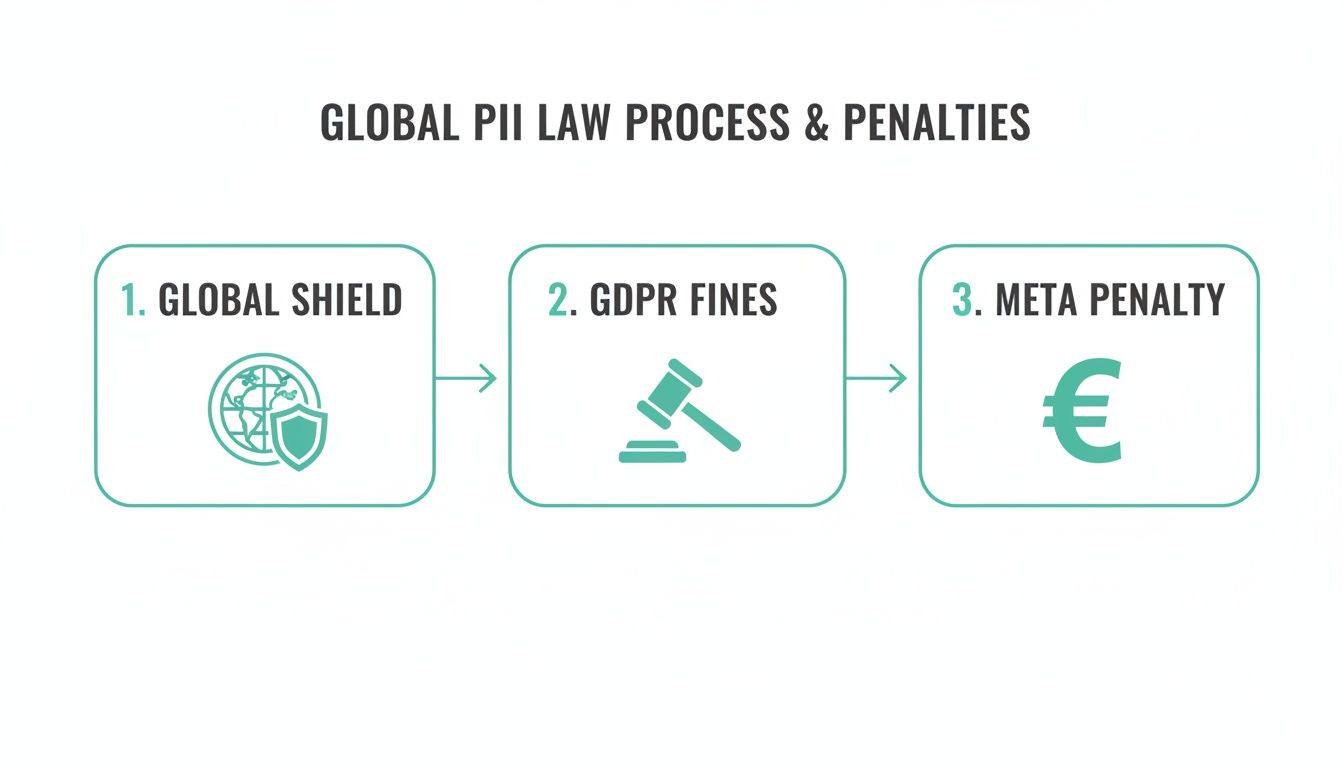
It’s a sobering look at how a minor technical slip-up can escalate into a major compliance headache with serious legal consequences.
Common Hiding Spots for PII
Sensitive data can hide in plain sight right inside your analytics implementation. Knowing where to look is the first step toward plugging these leaks for good.
Here are the most common places PII pops up:
- UTM Parameters: Marketers live by UTMs to track campaign success. But sometimes, an email or user ID gets mistakenly included in a parameter like
utm_content=user_email@example.com, sending sensitive data to analytics with every single click. - Event Properties: Custom events are great for capturing rich context, but they can be too rich. A
signup_completeevent could accidentally include properties for "fullName" or "phoneNumber" if the data layer isn't properly scrubbed. - User IDs: While often anonymous hashes, sometimes a user ID is set to a person's actual email address or another direct identifier instead of a randomly generated string, creating a direct link back to an individual.
These aren't just theoretical risks. This screenshot shows a real-world example of PII appearing directly within Google Analytics event data. You can clearly see how easily sensitive user information gets captured where it absolutely doesn't belong, often going completely unnoticed.
The True Cost of a PII Breach
When a PII breach hits the news, everyone talks about the massive regulatory fines. But those fines are just the tip of the iceberg. The real cost isn't a single penalty; it's a cascade of financial and reputational damage that can haunt a business for years. A data leak isn’t a one-time event—it’s the start of a long, expensive, and painful recovery.
The bleeding starts right away with the immediate response. You're on the hook for forensic investigations to figure out what happened, notifying every affected customer, and setting up credit monitoring services. These initial steps are not only expensive but also pull your best people away from their real jobs, grinding business momentum to a halt.
Beyond the Initial Fallout
After the initial chaos dies down, the long-term financial damage begins. Legal fees from class-action lawsuits pile up fast. Your insurance premiums will likely shoot up, reflecting your company's new, higher-risk profile. The damage is all too real in events like the massive leak of credit and debit cards fueled by the rising threat of infostealer malware.
But the biggest cost is often the hardest one to put a number on: the loss of customer trust. Once customers feel their data isn't safe with you, they walk. A damaged reputation can take years, if not a decade, to rebuild, leading to a steady drain on revenue and a weaker market position that your competitors will happily take advantage of.
A PII breach redefines your relationship with your customers overnight. It transforms your brand from a trusted partner into a source of risk, a perception that is incredibly difficult and expensive to reverse.
The numbers paint a pretty grim picture. Global data breaches have exposed billions of PII records. We’ve seen monumental cases like Alibaba’s leak impacting 1.1 billion users and the $575 million Equifax fine after a breach hit 150 million users. Globally, the average cost of a data breach is $4.35 million, but that figure skyrockets to $9.44 million in the United States alone. To discover more about these trends, you can explore key data privacy regulations and their impact.
Ultimately, investing in solid PII protection isn't just a compliance checkbox—it's a core business strategy. Preventing a leak is exponentially cheaper than cleaning one up, making it one of the most critical investments you can make for long-term survival and growth.
A Modern Playbook for Preventing PII Leaks
Shifting from just worrying about PII leaks to actively stopping them requires a clear, modern strategy. The best playbooks empower data and engineering teams by blending reliable manual processes with the speed and precision of automation. This two-pronged approach is the only realistic way to stay ahead of risks in today’s fast-moving development cycles.
The whole strategy rests on a foundation of strong data governance. This just means creating and enforcing clear policies that define what PII is, where it’s allowed to live, and who gets to touch it. But policies are only as good as their execution.
Foundational Manual Safeguards
Think of manual controls as your first line of defense—a human-centric firewall against common PII exposure. While they aren't foolproof, they establish a critical baseline for how your teams should handle sensitive data and build organization-wide awareness.
A few essential manual steps include:
- Data Masking and Anonymization: This is the practice of systematically swapping out sensitive data with realistic but fake equivalents. For instance, replacing a real customer's name, "John Smith," with a placeholder like "User 12345" before that data ever makes it to a development environment.
- Access Control Policies: It’s fundamental: strictly limit who can view or handle raw PII. Not every marketer or analyst needs access to the entire customer database. Implementing role-based permissions is a simple way to minimize your attack surface.
- Regular Data Audits: Periodically scanning your databases and analytics platforms for rogue PII is a necessary chore. These audits can catch issues that slip through the cracks, but they’re often too infrequent to prevent leaks in real time.
The core limitation of manual processes is speed and scale. In an environment with constant updates and new marketing campaigns, a manual audit can be outdated the moment it's completed.
The Power of Automated Observability
To get past the limits of manual checks, modern teams are turning to automated observability platforms. Think of these tools as a 24/7 security guard for your data pipelines, constantly scanning every single event for potential PII violations as they happen. This turns PII protection from a reactive, after-the-fact chore into a proactive, continuous process.
This shift is more critical than ever, especially as the enforcement bite of PII regulations gets fiercer. We’re seeing multi-billion dollar GDPR fines become almost common across Europe, with a huge year-over-year jump tied to mishandled PII like emails ending up in analytics tracking. For performance marketers, this means any PII in UTMs or data layers has to be flawless; real-time monitoring catches these mistakes before they become massive compliance failures.
Automation doesn't just find problems; it helps you fix them faster. Platforms like Trackingplan provide instant alerts and root-cause analysis, so your team can pinpoint and resolve a leak in minutes, not weeks. Adopting this playbook lets your teams build with confidence, knowing a safety net is always in place. To develop a robust strategy, businesses must also implement rigorous practices for safeguarding sensitive information through data destruction. For a deeper dive, check out our guide on how to prevent data loss.
Building a Data Culture That Puts Privacy First
Ultimately, world-class protection for personally identifiable information isn’t about a single tool or a quick technical fix. It's a cultural commitment. This means embedding the principle of privacy by design deep into your company's DNA, making data protection a shared responsibility across marketing, product, and engineering.
This shift moves your entire organization from a reactive stance—scrambling to fix problems after they happen—to a proactive one.
When privacy becomes a core value, it fundamentally changes how teams work. Marketers start asking what data is truly necessary for a campaign, not just what they can collect. Developers begin building safeguards directly into new features from day one. This proactive mindset is the difference between a company that’s always one step behind compliance and one that builds customer trust with every single interaction.
This kind of cultural shift is what finally breaks down the silos that so often lead to accidental PII leaks. Instead of each department operating in its own world, everyone works from a common understanding of what PII means in practice and why it’s so critical to protect it.
Creating a Single Source of Truth
For this collaboration to actually work, teams need a single source of truth for their data. Automated observability tools create this shared reality by providing a unified view of the entire data pipeline that everyone—from analysts to engineers—can understand and trust. No more confusion, no more finger-pointing when issues arise.
When everyone is looking at the same data and getting the same alerts, collaboration becomes seamless. An automated system that validates every event against your governance rules ensures your data practices stay airtight, even as your products and campaigns constantly evolve.
Imagine getting a real-time alert that lets you find and fix a PII leak in minutes, not after a painful, months-long audit. That's the power of turning data governance from a periodic, manual chore into a continuous, automated part of your daily operations.
This approach transforms data governance from a roadblock that slows everyone down into an enabler of innovation. By catching potential issues early, automated platforms like Trackingplan give your teams the confidence to move quickly without ever compromising on compliance or customer privacy. This is how you build a trustworthy, powerful, and compliant data operation from the ground up.
PII FAQs: Your Questions Answered
Even when you feel you’ve got a handle on the basics, real-world scenarios always throw a few curveballs. Here are a couple of the most common questions we see data and engineering teams grapple with.
Is an IP Address Considered PII?
Yes, almost universally. Major regulations like GDPR classify an IP address as PII. While it won't tell you someone's name, it's a powerful indirect identifier that can pinpoint a user's rough location and connect all their online activity back to a single household or device.
This is a really important point in the whole pii meaning debate. Data doesn’t need a name attached to it to be considered personal. Because it can be used to single out a user, regulators treat IP addresses with the same seriousness as other sensitive data, and it needs to be protected.
The acid test for PII is simple: can the data be reasonably used to identify a person? An IP address passes that test easily, especially when you combine it with other browsing data. This is why it needs to be handled with care.
What Is the Difference Between PII and PHI?
While they're both types of sensitive data, they aren't interchangeable. PII is the broad umbrella term for any data that can identify a specific person. Protected Health Information (PHI), on the other hand, is a very specific subset of PII that deals exclusively with healthcare.
Here’s a simple way to think about it:
- PII covers things like names, email addresses, and financial details.
- PHI is all about medical records, health insurance information, and diagnoses.
So, all PHI is technically PII, but not all PII is PHI. The distinction is critical because PHI falls under even stricter regulations, like HIPAA in the U.S., which comes with its own set of severe penalties. Getting this right is fundamental to proper data governance.
Ready to stop PII leaks before they happen? Trackingplan provides automated observability to continuously monitor your data pipelines, detect PII in real-time, and alert your teams instantly. Gain confidence in your compliance and build a data culture that puts privacy first. Discover how Trackingplan can protect your business.