
TL;DR:
- Attribution has evolved beyond cookies, with privacy regulations and browser restrictions prompting a shift to privacy-preserving measurement standards.
- Advanced protocols like ADMaP, W3C APIs, and data clean rooms enable accurate, aggregated campaign attribution without relying on individual identifiers, ensuring compliance and future-proofing marketing efforts.
Attribution didn’t break when third-party cookies started disappearing. It evolved. Privacy regulations like GDPR and CCPA, combined with aggressive browser-level restrictions, have forced a fundamental shift in how marketers measure campaign performance. But here’s what most articles get wrong: this isn’t a crisis. Advanced privacy-preserving standards, new browser APIs, and secure data environments are already operational, giving you a clear path to accurate measurement without relying on the old cookie-based infrastructure. This guide walks you through exactly how to navigate that path.
Table of Contents
- Why cookieless attribution is the new normal
- How privacy-preserving attribution works
- Comparing attribution methods: Cookies vs cookieless
- Common pitfalls and troubleshooting in a cookieless world
- Cookieless attribution: What to implement now
- Why cookieless attribution makes marketers smarter—if you embrace its strengths
- Take the next step: Future-proof your attribution
- Frequently asked questions
Key Takeaways
| Point | Details |
|---|---|
| Adapt to privacy standards | New attribution models require adopting privacy-preserving techniques like aggregation and encrypted measurement. |
| Beware of measurement loss | Cookieless environments can introduce data noise and gaps, making troubleshooting essential for accuracy. |
| Implement modern frameworks | Use recognized standards such as ADMaP and W3C APIs to future-proof attribution systems. |
| Optimize attribution processes | Regular audits and robust parameter handling help maintain clear and actionable insights. |
Why cookieless attribution is the new normal
Third-party cookies powered cross-site tracking for decades. They let you follow a user from a display ad click to a product page to a purchase, stitching together a journey across multiple domains. That era is ending fast. Browsers are eliminating tracking cookies by default, and regulations are making consent-less tracking legally risky in most markets.
The practical consequences are significant:
- Cross-site user tracking via third-party cookies is no longer reliable in Firefox or Safari, and Chrome’s ongoing Privacy Sandbox initiative continues to reshape what’s possible.
- Fingerprinting and device IDs are increasingly blocked or restricted, removing common workarounds.
- Retargeting and frequency capping based on individual identifiers are losing accuracy across the open web.
- Multi-touch attribution models that depend on persistent user IDs are producing incomplete journey maps.
What’s replacing these methods isn’t a single tool but a set of standards. IAB Tech Lab is advancing secure matching and measurement for data clean rooms via privacy-preserving standards like ADMaP. Meanwhile, the W3C is developing browser-native APIs that handle attribution without exposing individual user data to any party.
“The shift to privacy-preserving attribution is not optional. Marketers who treat it as a future problem will find themselves flying blind when their current measurement stack stops working.”
The good news: tracking for marketing success is still achievable. Marketers who adopt ethical marketing strategies alongside privacy-first measurement actually gain a competitive edge. Users trust brands that handle data responsibly, and that trust translates to better engagement and conversion rates over time.
How privacy-preserving attribution works
Understanding the mechanics behind cookieless attribution helps you make smarter implementation decisions. These aren’t abstract concepts. They’re live specifications with real browser support and industry adoption.
ADMaP: Encrypted matching without identifiers
ADMaP (Ads Data Match Protocol) is IAB Tech Lab’s framework for enabling measurement inside data clean rooms. ADMaP enables measurement without third-party cookies by using encrypted keys and adding noise and aggregation to results. Here’s how it works in simple terms: both the advertiser and the publisher encrypt their user data using a shared mapping service. The encrypted keys are matched without either party seeing the other’s raw data. The output is aggregated conversion reporting, not individual user paths.
W3C Privacy-Preserving Attribution API
The W3C privacy-preserving attribution specification introduces a browser API that handles attribution natively. Instead of a third-party cookie tracking a user across sites, the browser itself stores ad interaction data locally. When a conversion happens, the browser sends an aggregated, noise-added report to the advertiser. Two key concepts make this work:
- Aggregation means results are combined across many users, so no single user’s behavior is identifiable.
- Differential privacy adds mathematical noise to the data, making it statistically impossible to reverse-engineer individual records.
Data clean rooms in practice
A data clean room is a secure, neutral environment where two parties (say, an advertiser and a retailer) can match their datasets without sharing raw records. Think of it as a locked room where both parties submit their data, a trusted process runs the matching, and only aggregate insights come out the other side.

| Technology | How it works | Privacy method | Output type |
|---|---|---|---|
| ADMaP | Encrypted key matching via mapping service | Noise addition, aggregation | Aggregate conversion reports |
| W3C Attribution API | Browser-native ad interaction storage | Differential privacy, aggregation | Aggregate campaign reports |
| Data clean rooms | Secure environment for dataset matching | Encryption, access controls | Aggregated audience insights |
| First-party data | Direct user consent and collection | Consent-based, owned data | Individual or aggregate |
Here’s a numbered breakdown of how a typical cookieless attribution flow works end-to-end:
- A user sees an ad on a publisher site. The browser records this interaction locally.
- The user converts on the advertiser’s site. The browser records the conversion event.
- After a delay (to prevent timing-based identification), the browser sends an aggregated, noisy report to the advertiser’s measurement endpoint.
- The advertiser receives campaign-level data showing which ad placements drove conversions, without any individual user being identified.
- The advertiser uses this data to optimize bids, creative, and targeting at the campaign level.
Pro Tip: Start testing the W3C Attribution Reporting API in a staging environment now, even if you’re not ready to rely on it fully. Early familiarity with how the reports look and how noise affects your data will save you weeks of confusion when you need to act fast.
Explore the modern attribution guide and the attribution tool guide to see how these methods map to real campaign measurement workflows.
Comparing attribution methods: Cookies vs cookieless
With an understanding of the tech, the next step is to see what you gain and lose when moving to cookieless models. This comparison isn’t about declaring a winner. It’s about helping you set realistic expectations and make informed decisions about your measurement stack.
| Dimension | Cookie-based attribution | Cookieless attribution |
|---|---|---|
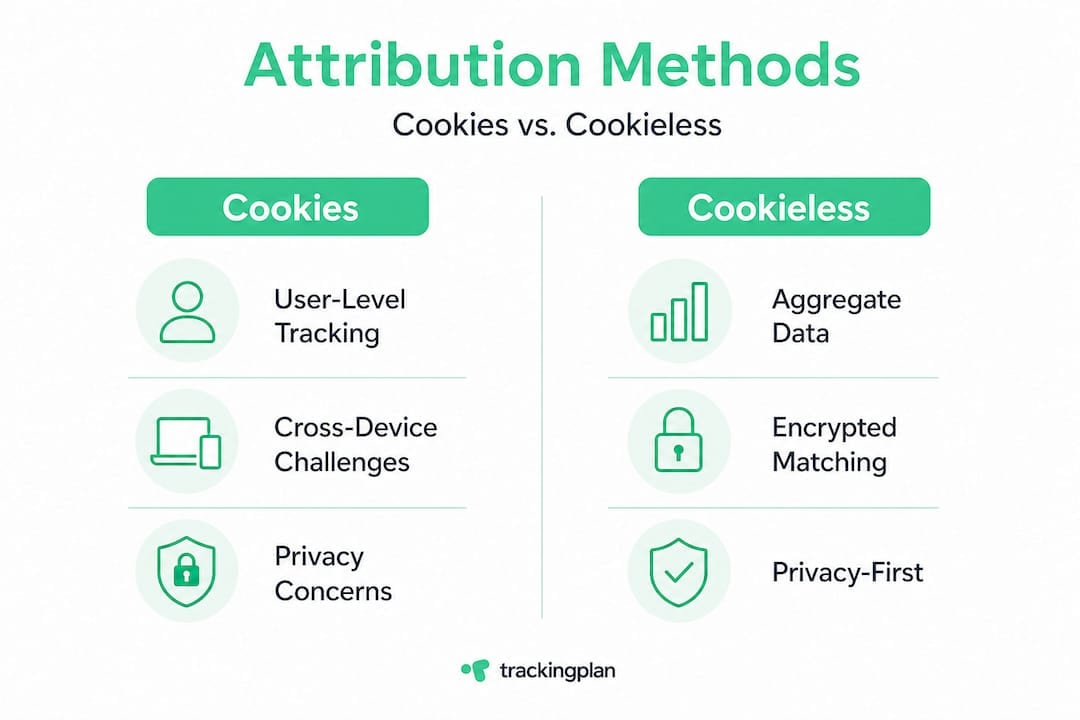
| User identification | Individual-level, persistent IDs | Aggregated, no persistent IDs |
| Cross-site tracking | Supported natively | Limited, requires clean rooms or APIs |
| Privacy compliance | High risk under GDPR/CCPA | Designed for compliance |
| Data freshness | Real-time, user-level | Delayed, aggregate reports |
| Accuracy for trends | High for individual paths | High for campaign-level trends |
| Long-term viability | Declining rapidly | Built for the future |
| Setup complexity | Relatively simple | Requires new integrations |
What you gain with cookieless attribution:
- User trust, because your measurement doesn’t rely on covert tracking
- Regulatory compliance by design, not by retrofit
- Future-proofing against further browser and policy changes
- Stronger first-party data relationships with your audience
What you lose:
- Granular individual user journey data across sessions and domains
- Easy cross-device tracking without explicit user consent
- Some real-time reporting speed, since aggregated reports often include a delay
ADMaP and W3C specs create cookieless measurement standards that rely on aggregation and privacy rather than identifiers. The trade-off is real but manageable. Aggregate data is still highly actionable for budget allocation, creative testing, and channel optimization. You just need to shift your mindset from tracking individuals to understanding patterns.
Pro Tip: Use smarter attribution modeling techniques like data-driven attribution and media mix modeling to compensate for the loss of individual-level paths. These models work well with aggregate inputs and can actually outperform last-click models that relied on cookie data.
Common pitfalls and troubleshooting in a cookieless world
Understanding new pitfalls is essential so you don’t misinterpret data or lose trust in performance metrics. Several specific failure modes appear frequently when teams transition away from cookie-based tracking, and each one has a clear fix.
Pitfall 1: Misreading direct traffic spikes
One of the most disorienting effects of cookieless measurement is a sudden increase in “Direct/(none)” traffic in your analytics platform. Attribution models in cookieless contexts can increase “Direct/(none)” traffic due to data loss rather than genuine direct visits. When referral data is stripped or cookies are blocked, sessions that should be attributed to a paid channel or organic search get bucketed into direct. This makes your paid campaigns look less effective than they are and inflates your direct channel numbers.
Pitfall 2: Click identifier stripping
Browsers like Safari may strip click identifiers such as GCLID from URL parameters, which breaks Google Ads attribution for a significant share of your traffic. This isn’t a hypothetical edge case. Safari holds a substantial share of mobile traffic, and if your attribution relies on GCLID passing through cleanly, you’re already losing data.
Common attribution pitfalls and their fixes:
- Inflated direct traffic: Audit UTM parameter coverage across all campaigns. Every paid link should have consistent, complete UTM tagging.
- Missing GCLID data: Implement server-side tagging to capture and store click identifiers before the browser can strip them.
- Broken referral attribution: Check that your analytics platform correctly handles cross-domain tracking with updated linker configurations.
- Consent-related data gaps: Implement a consent mode solution so your platform can model conversions for users who decline cookies.
- Pixel failures after browser updates: Set up automated monitoring to catch pixel fires that stop working after browser policy changes.
“Every browser update is a potential attribution event. Teams that treat QA as a one-time setup will find their data quietly degrading between audits.”
A practical troubleshooting checklist helps you optimize attribution tracking systematically. Run it after every major browser release and after any significant changes to your site or tag management setup. Also, regularly detect unauthorized trackers on your site, since rogue scripts can interfere with your legitimate attribution setup and create compliance risks at the same time.
Cookieless attribution: What to implement now
With context and pitfalls outlined, here’s how to make the shift to cookieless attribution actionable today. Prioritization matters. You don’t need to rebuild everything at once, but you do need a clear sequence.
-
Inventory your current tracking scripts. List every tag, pixel, and SDK firing on your site. Identify which ones rely on third-party cookies or cross-site identifiers. This audit is your baseline.
-
Audit for third-party cookie dependencies. Use browser developer tools or an automated platform to flag scripts that set or read third-party cookies. Categorize them by business criticality so you know which to replace first.
-
Implement server-side tagging for high-priority campaigns. Server-side tagging moves data collection off the browser and onto your own server, bypassing many browser restrictions. Start with your highest-spend paid channels where attribution accuracy has the most financial impact.
-
Integrate privacy-first measurement solutions. Evaluate ADMaP-compatible clean room solutions and test the W3C Attribution Reporting API in your environment. IAB Tech Lab and W3C privacy-preserving standards are ready for implementation by marketers today.
-
Set up automated QA workflows. Manual audits can’t keep pace with browser updates and policy changes. Automated monitoring catches pixel failures, parameter stripping, and consent-related data gaps in real time.
-
Build a first-party data strategy. Encourage logged-in experiences, email capture, and direct user relationships. First-party data is the most durable signal in a cookieless world and the foundation for clean room matching.
-
Communicate changes to stakeholders. When your attribution numbers shift during the transition, stakeholders will notice. Prepare a clear narrative explaining that changes in reported performance may reflect measurement methodology updates, not actual campaign performance changes. This protects your credibility and keeps leadership confident in your analytics.
Understanding the importance of accurate ad attribution is what separates teams that optimize effectively from those that make budget decisions based on corrupted data. Every step above reduces the gap between what’s actually happening in your campaigns and what your reports show.
Why cookieless attribution makes marketers smarter—if you embrace its strengths
Here’s the perspective most articles skip: the forced transition to cookieless attribution is actually making measurement teams more rigorous. When individual user paths were easy to track, many teams never questioned whether their attribution model was actually correct. They just assumed the data was right. It often wasn’t.
Cookie-based attribution had its own serious flaws. Last-click models misattributed credit. Cross-device journeys were stitched together with probabilistic matching that was less accurate than it appeared. Duplicate conversions from cookie syncing inflated reported performance. The old system felt precise because it produced granular data, but granular and accurate are not the same thing.
Cookieless attribution forces a different kind of discipline. When you can’t track individuals, you have to invest in better campaign design, cleaner data structures, and stronger cross-team collaboration between marketing, analytics, and engineering. The teams that are thriving in this environment are the ones who treat measurement as a strategic function, not a technical afterthought.
There’s also a trust dimension that’s easy to underestimate. Brands that visibly respect user privacy are building a long-term asset. Users who trust your data practices are more likely to consent to first-party data collection, which gives you a higher-quality signal than third-party cookies ever provided. Crucial tracking for success in 2026 and beyond means building that consent-based relationship deliberately.
The marketers who will lead in this environment are not the ones waiting for a perfect replacement for third-party cookies. They’re the ones building measurement stacks that are accurate, auditable, and resilient to the next round of browser changes. That means embracing aggregate measurement, investing in first-party data infrastructure, and treating QA as an ongoing operational function rather than a one-time project.
Take the next step: Future-proof your attribution
Transitioning to cookieless attribution requires more than reading about new standards. It requires a measurement infrastructure that catches problems before they corrupt your data and adapts automatically as browser policies evolve.
Trackingplan monitors your entire analytics and attribution stack in real time, alerting you the moment a pixel breaks, a parameter gets stripped, or a tracking schema drifts out of spec. From digital analytics tool integrations that ensure your data quality stays high, to web tracking monitoring that catches failures before they affect campaign decisions, to a dedicated privacy hub for compliance-aware measurement, Trackingplan gives your team the visibility to operate confidently in a cookieless world. Stop discovering attribution gaps after the fact and start catching them the moment they happen.
Frequently asked questions
What is cookieless attribution?
Cookieless attribution measures marketing performance without relying on third-party cookies, using privacy-preserving protocols and aggregated data. ADMaP enables measurement without third-party cookies by using encrypted keys shared via a mapping service.
Are privacy-preserving attribution APIs accurate?
They are accurate for aggregate trends but may lose some user-level detail due to differential privacy and aggregation. The W3C privacy-preserving attribution specification uses trusted aggregation and adds noise to maintain privacy while preserving campaign-level signal.
How do I handle loss of click identifiers like GCLID in browsers?
You should regularly audit tracking setups and use server-side tagging to minimize attribution gaps. Browsers like Safari may strip GCLID, impacting attribution without mitigation strategies in place.
Can I use existing attribution platforms with cookieless solutions?
Many platforms are updating for cookieless support, but you must confirm their privacy-preserving protocols and integrations before relying on their reported numbers.
What is a data clean room in attribution?
A data clean room is a secure environment where marketers match and measure data without accessing identifiable user-level information. IAB Tech Lab’s ADMaP and secure matching enable attribution in data clean rooms without revealing individual identities to either party.
Recommended
- Why accurate ad attribution is critical for smarter campaigns | Trackingplan
- Marketing Attribution Tools: How to Measure Campaign ROI Accurately | Trackingplan
- What is attribution modeling? Unlock smarter marketing | Trackingplan
- Ways to optimize attribution tracking for digital accuracy | Trackingplan