
In an era of complex data privacy regulations like GDPR and CCPA, relying on manual checks for website cookies is a recipe for compliance failures and data blind spots. Unidentified trackers, misconfigured consent banners, and rogue scripts can lead to hefty fines and erode user trust. The solution lies in automation, a shift that streamlines complex workflows and ensures accuracy. To gain a broader understanding of how automation drives efficiency and growth across various business functions, explore these powerful business process automation examples.
This guide dives into the 12 best cookies audit tools designed to automate discovery, scanning, and consent management. We'll explore how these platforms, from comprehensive Consent Management Platforms (CMPs) to specialized observability tools like Trackingplan, can help you maintain compliance, ensure data quality, and protect your marketing analytics from the ground up. Instead of just listing features, we provide a detailed analysis of what makes each tool unique.
This resource is built for digital analysts, marketers, developers, and data governance teams who need to make an informed decision. For each of the 12 tools, you will find:
- A concise overview of its primary function and ideal user.
- An analysis of core features, pros, and cons.
- Clear pricing information and screenshots of the user interface.
- Practical use-case scenarios and notes on integration.
Our goal is to help you move beyond reactive, manual audits and implement a proactive, automated strategy for managing website cookies and trackers effectively. Let's find the right tool for your stack.
1. Trackingplan
Trackingplan distinguishes itself by moving beyond traditional, point-in-time website scans. It operates as an always-on, automated observability platform that provides a complete, real-time picture of your entire MarTech and analytics ecosystem. Instead of just identifying cookies, Trackingplan automatically discovers and monitors every analytics event, pixel, and data property as they fire, effectively creating and maintaining a live tracking plan for you. This makes it an exceptionally robust solution for teams that need to ensure data integrity and compliance continuously, not just periodically.
Its core strength lies in its proactive, real-time monitoring. Once the lightweight tag is installed, the platform immediately detects anomalies like broken pixels, malformed events, or unexpected PII leaks. This transforms the often-reactive process of data quality assurance into a preventative one, saving teams countless hours in debugging and protecting ad spend and revenue attribution. For any team managing complex data stacks, Trackingplan serves as a single source of truth for how data is collected and where it's sent.
Why It Stands Out
What elevates Trackingplan is its ability to connect the dots between technical implementation and business impact. The platform doesn't just list technical errors; its AI-assisted root-cause analysis provides context, pinpointing the source of a problem, such as a specific UTM parameter causing campaign data to be miscategorized. This detailed insight is crucial for performance marketers and analysts who rely on accurate data for daily decisions. Furthermore, its continuous monitoring is invaluable for identifying consent misconfigurations, helping to bridge the gap between technical compliance and actual user-level enforcement.
Here's a short video from Trackingplan that explains how their system validates analytics in real-time, offering a glimpse into its proactive approach:
Core Features & Use Cases
Website: https://trackingplan.com
2. Cookiebot by Usercentrics
Cookiebot, part of the Usercentrics family, is a mature consent management platform (CMP) that excels as a comprehensive cookies audit tool. Its core strength lies in its automated scanning technology, which inventories all cookies and trackers on your site, categorizes them based on their purpose, and automatically generates a compliant cookie declaration for your privacy policy. This automation makes it a go-to choice for teams needing reliable, set-and-forget compliance monitoring.
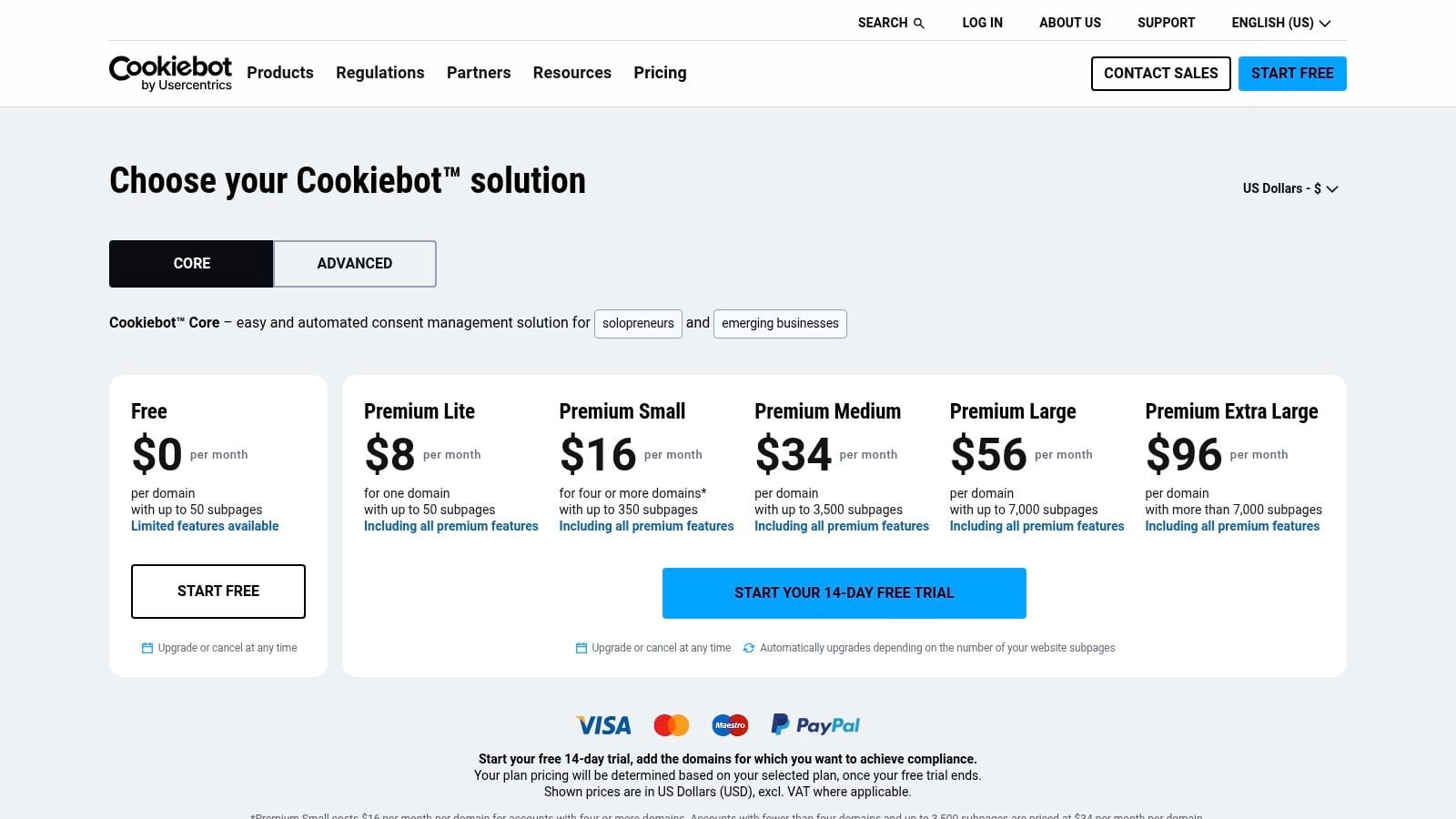
The platform is designed for ease of use, making it suitable for both small businesses and large enterprises managing multiple domains. It supports Google Consent Mode v2 out of the box and offers features like cross-domain consent sharing, which streamlines the user experience across a company's web properties. For a deeper understanding of how such tools interact with your data layer, you can watch this video on how to audit cookies and your CMP.
Core Features & Use Case
- Automated Scanning: Conducts monthly scans to detect new or changed cookies, ensuring your declaration is always current.
- Consent Logging: Securely stores user consents as required by GDPR, providing a verifiable audit trail.
- Domain Grouping: Allows agencies or large organizations to manage consent settings for multiple websites from a single account.
- Ideal Use Case: Best for organizations that need a robust, automated solution for maintaining GDPR and CCPA compliance across one or multiple websites with minimal manual intervention.
Pricing & Limitations
Cookiebot offers a tiered pricing model that starts with a free plan for single domains with fewer than 50 subpages. Paid plans scale based on the number of pages on your website, starting at around €12/month for up to 500 pages. While this model is flexible, costs can increase significantly for very large, content-heavy sites. A key limitation is that subdomains are often treated as separate entities, which may require additional subscriptions depending on your setup.
3. Usercentrics (Web CMP)
Usercentrics is an enterprise-grade consent management platform (CMP) that functions as a powerful cookies audit tool. It stands out with its combination of automated and manual scanning capabilities, providing deep insights into consent activity and cookie behavior. The platform is built for organizations that require granular control over their compliance efforts, offering advanced banner styling, multi-regulation support, and robust analytics to optimize user consent rates across global web properties.
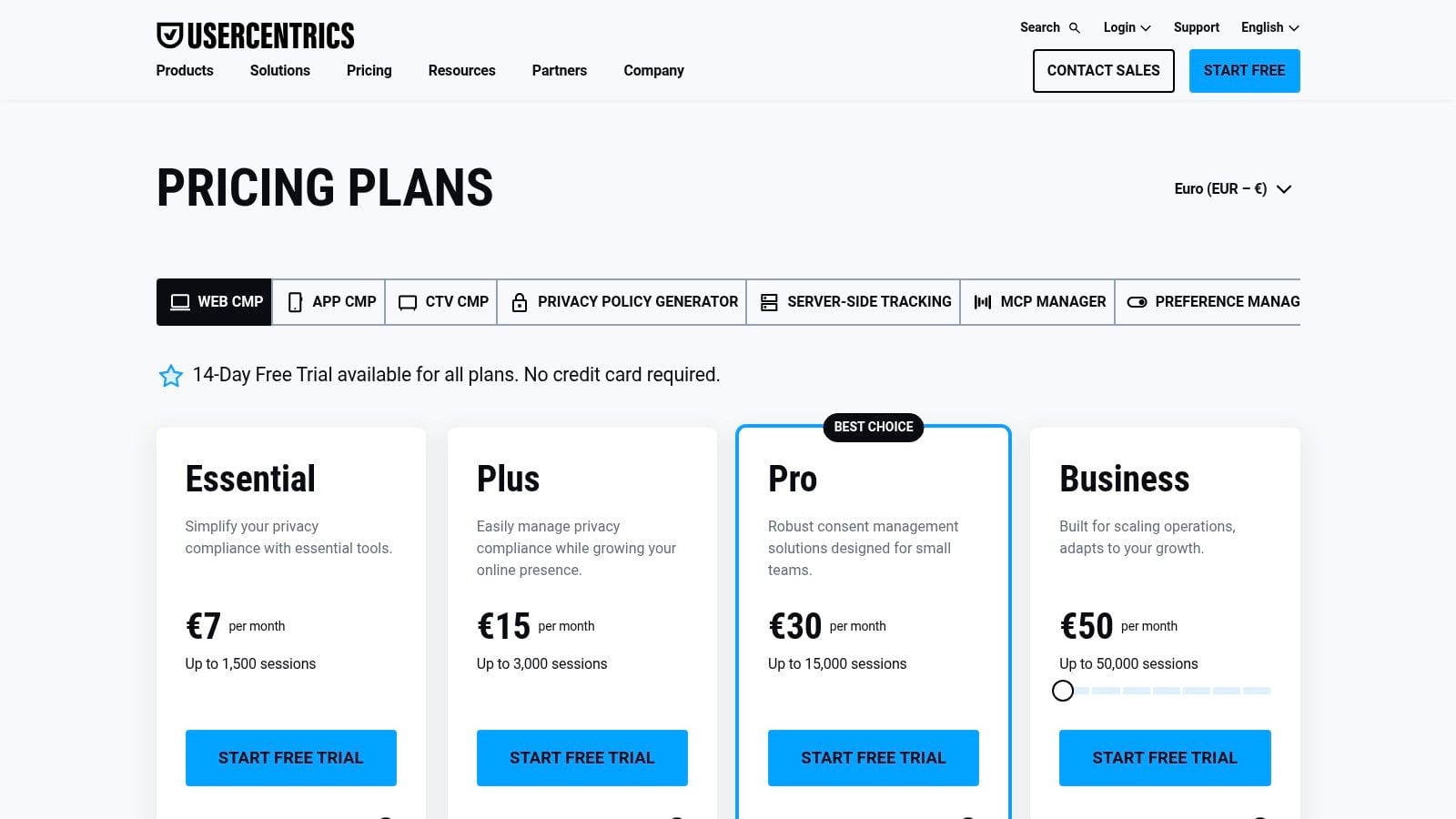
This CMP is designed for scalability, serving both growing businesses and large corporations with complex needs. It fully supports Google Consent Mode v2 and Microsoft UET, ensuring marketing and analytics data flows correctly based on user preferences. Its detailed analytics dashboard allows teams to monitor consent interactions and A/B test banner designs, making it a strategic tool beyond simple compliance. To understand the intricacies of managing consent, check out this video on the challenges of consent implementation.
Core Features & Use Case
- Advanced Scanning & Analytics: Offers both automated and manual scans, paired with a dashboard that provides detailed insights into consent activity.
- Multi-Regulation Support: Provides multi-language banners that adapt to regulations like GDPR, CCPA/CPRA, and others, with advanced styling options.
- Enterprise-Ready Security: Higher tiers include features like Single Sign-On (SSO) and Multi-Factor Authentication (MFA) for enhanced account security.
- Ideal Use Case: Best for medium to large businesses and enterprises that need a highly customizable and data-driven CMP to manage compliance and optimize consent rates across multiple regions and web properties.
Pricing & Limitations
Usercentrics offers a transparent, session-based pricing model, starting with an "Essential" plan for smaller sites and scaling up to a "Corporate" plan for extensive needs. Free trials are available to test the platform's capabilities. While this model is clear and scales predictably with traffic, the depth of features in the higher-tier plans may be overkill for very small websites or blogs. Some advanced customization and security options are locked behind the more expensive tiers, which could be a limitation for smaller teams needing specific functionalities.
4. OneTrust (Consent & Preferences/CMP)
OneTrust is a leading enterprise-grade privacy and consent management platform (CMP) that offers powerful cookies audit tools as part of its broader suite. Its key differentiator is its massive, auto-updating cookie database, which provides deep intelligence for categorizing trackers across web, mobile, and even connected TV (CTV) environments. This makes it an ideal choice for large, complex organizations managing consent across multiple digital properties and channels.
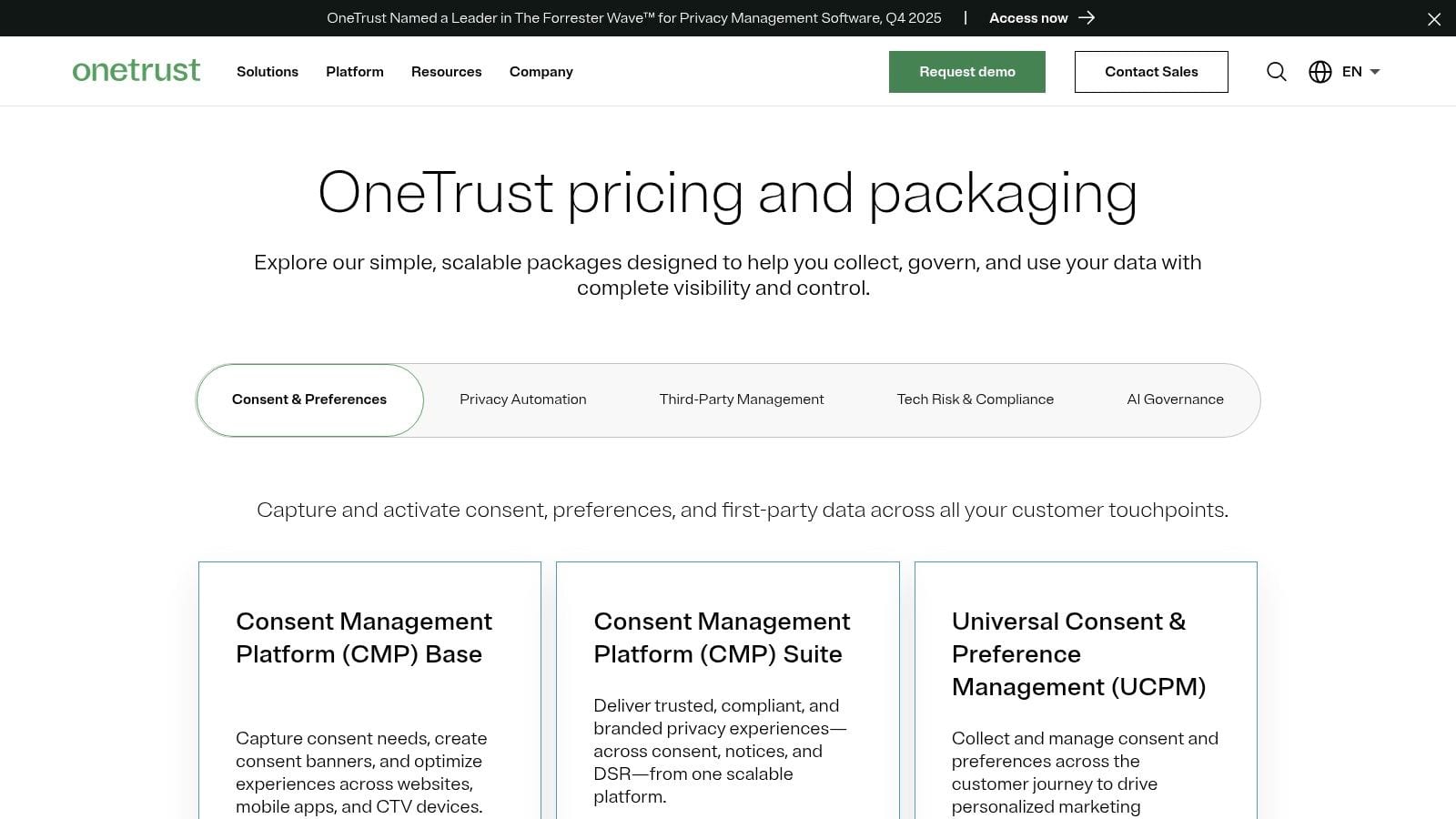
The platform is built for scale, providing APIs and integrations necessary for high-traffic, cross-channel deployments. OneTrust excels at creating branded user experiences and centralizing consent notices, ensuring a consistent approach to compliance. For teams grappling with the direct impact of consent on their marketing efforts, it's helpful to understand the relationship between cookies and marketing strategies. OneTrust's comprehensive nature means it addresses not just cookie banners but the entire data privacy lifecycle.
Core Features & Use Case
- Automated Technology Discovery: Continuously scans and inventories all tracking technologies, leveraging an extensive database for accurate categorization.
- Omnichannel Consent: Manages user consent seamlessly across websites, mobile applications, and CTV, centralizing preferences in one place.
- Branded Experiences: Offers extensive customization options to ensure consent banners and preference centers match your brand's look and feel.
- Ideal Use Case: Best for large enterprises with complex, multi-property digital ecosystems that require a robust, scalable, and legally defensible privacy management solution.
Pricing & Limitations
OneTrust operates on a quote-based pricing model, typically aligned with average daily visitor counts across all channels. This enterprise focus means costs are generally higher compared to SMB-oriented tools. The platform's breadth and complexity can introduce significant overhead, making it a less practical choice for smaller businesses or teams looking for a simple, plug-and-play cookie consent tool.
5. Osano
Osano positions itself as a data privacy platform that simplifies compliance, making it an effective cookies audit tool for teams prioritizing risk management. It combines automated scanning and AI-powered cookie classification with a standout legal guarantee, promising to cover fines related to its configuration. This focus on legal backing makes it particularly appealing for organizations that need to demonstrate rigorous compliance efforts, especially with complex US state laws like the CCPA and CPRA.
The platform is engineered for a smooth user experience, from a straightforward implementation to an intuitive admin dashboard with clear reporting. Osano’s automation handles much of the heavy lifting, including generating “Do Not Sell/Share” links and managing consent records. For a deeper understanding of how these consent mechanisms impact data collection and require auditing, you can watch this video on how to monitor consent mode and your CMP to see how tools like Trackingplan can verify everything is working as expected.
Core Features & Use Case
- Automatic Scanning & Blocking: Discovers cookies and trackers on your site and blocks them pre-consent to ensure compliance by default.
- AI Cookie Classification: Leverages artificial intelligence to categorize cookies automatically, reducing manual classification efforts.
- Consent Archiving: Maintains detailed logs and archives user consents, providing a clear audit trail for regulators.
- Ideal Use Case: Best for US-based companies or global organizations that need to navigate complex US state privacy laws (CCPA/CPRA) and want a platform with a legal guarantee to reduce compliance risk.
Pricing & Limitations
Osano’s pricing is based on website traffic, specifically the number of monthly visitors or requests to its script. It offers a free plan with basic features for low-traffic sites, but full automation and advanced compliance tools are reserved for its paid tiers, which start at $99/month. While Osano is excellent at blocking most trackers, its ability to block certain HTTP-only cookies may sometimes require manual configuration, representing a potential limitation for teams without technical resources.
6. TrustArc Cookie Consent Manager
TrustArc offers an enterprise-grade consent management platform, the Cookie Consent Manager, which serves as a powerful cookies audit tool for large, complex organizations. It excels at providing deep governance capabilities, combining automated scanning and tracker discovery with robust support for a wide array of privacy frameworks. Its strengths lie in detailed compliance features, such as handling Global Privacy Control (GPC) signals and integrating with the IAB TCF/GPP, making it ideal for businesses navigating diverse regulatory landscapes, particularly in the US.
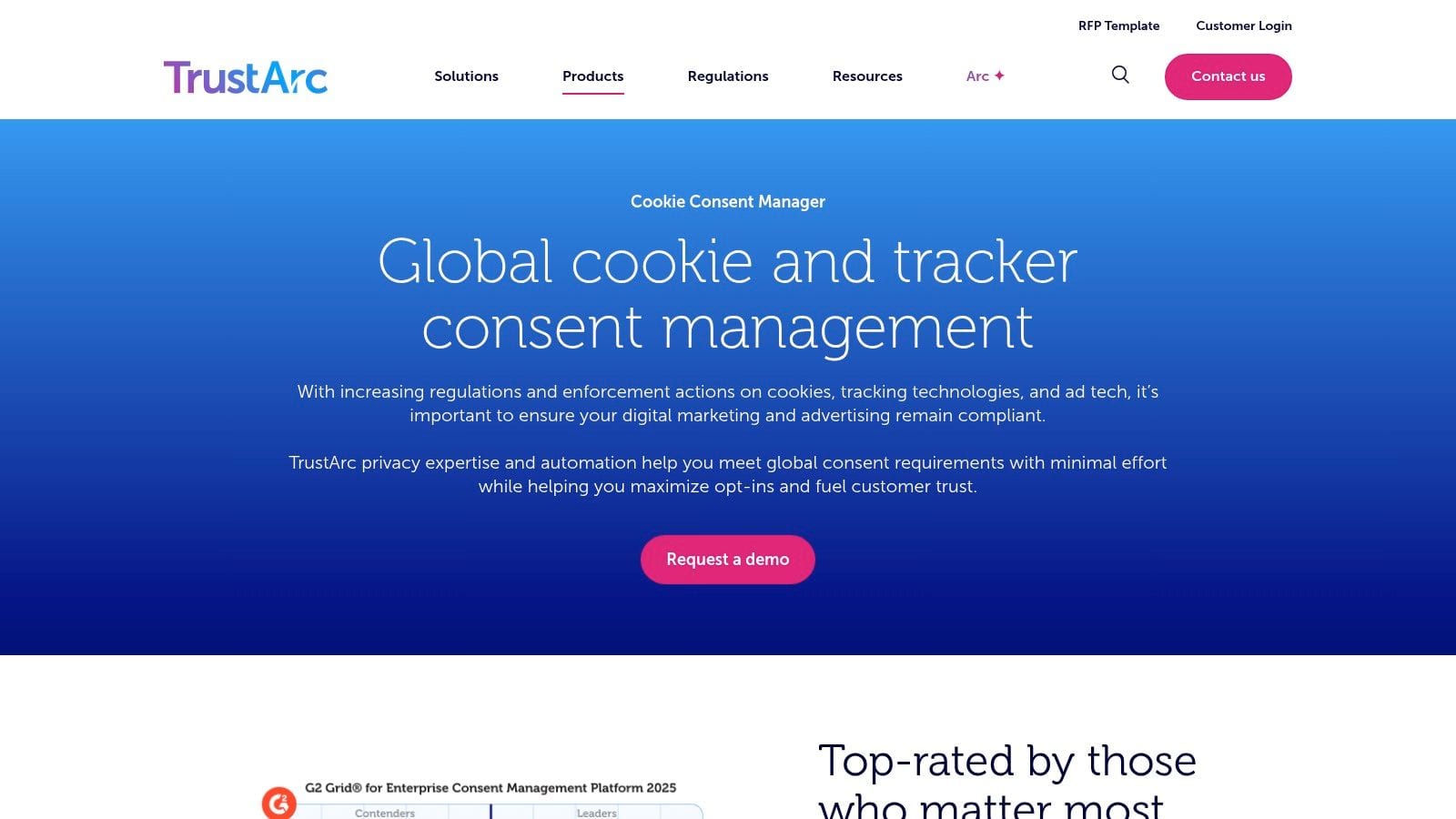
The platform is built for enterprises that require more than just a simple cookie banner. It provides real-time dashboards, mobile SDKs for app compliance, and strong support for accessibility standards like WCAG and ADA. This focus on enterprise needs is also reflected in its integrations with systems like Adobe Tag Manager and Shopify. While it offers extensive control, organizations should be prepared for a more involved setup process compared to SMB-focused solutions.
Core Features & Use Case
- Frequent Automated Scanning: Conducts unlimited scans to discover and categorize trackers, ensuring your cookie inventory is consistently up-to-date.
- Broad Framework Support: Supports Google Consent Mode, IAB TCF/GPP, and respects GPC signals for comprehensive compliance.
- Accessibility and Localization: Designed with WCAG/ADA conformance in mind and offers extensive multi-language support.
- Ideal Use Case: Best for large US-based or multinational corporations with complex digital ecosystems that require a high degree of governance, detailed reporting, and compliance with multiple state-level privacy laws.
Pricing & Limitations
TrustArc's pricing is available only upon request and is tailored to enterprise clients, meaning it is significantly higher than off-the-shelf tools. The platform’s complexity and extensive feature set require a more substantial implementation and governance effort, making it less suitable for small or mid-sized businesses looking for a quick, simple solution. Its power is best leveraged by dedicated privacy or legal teams.
7. CookieYes
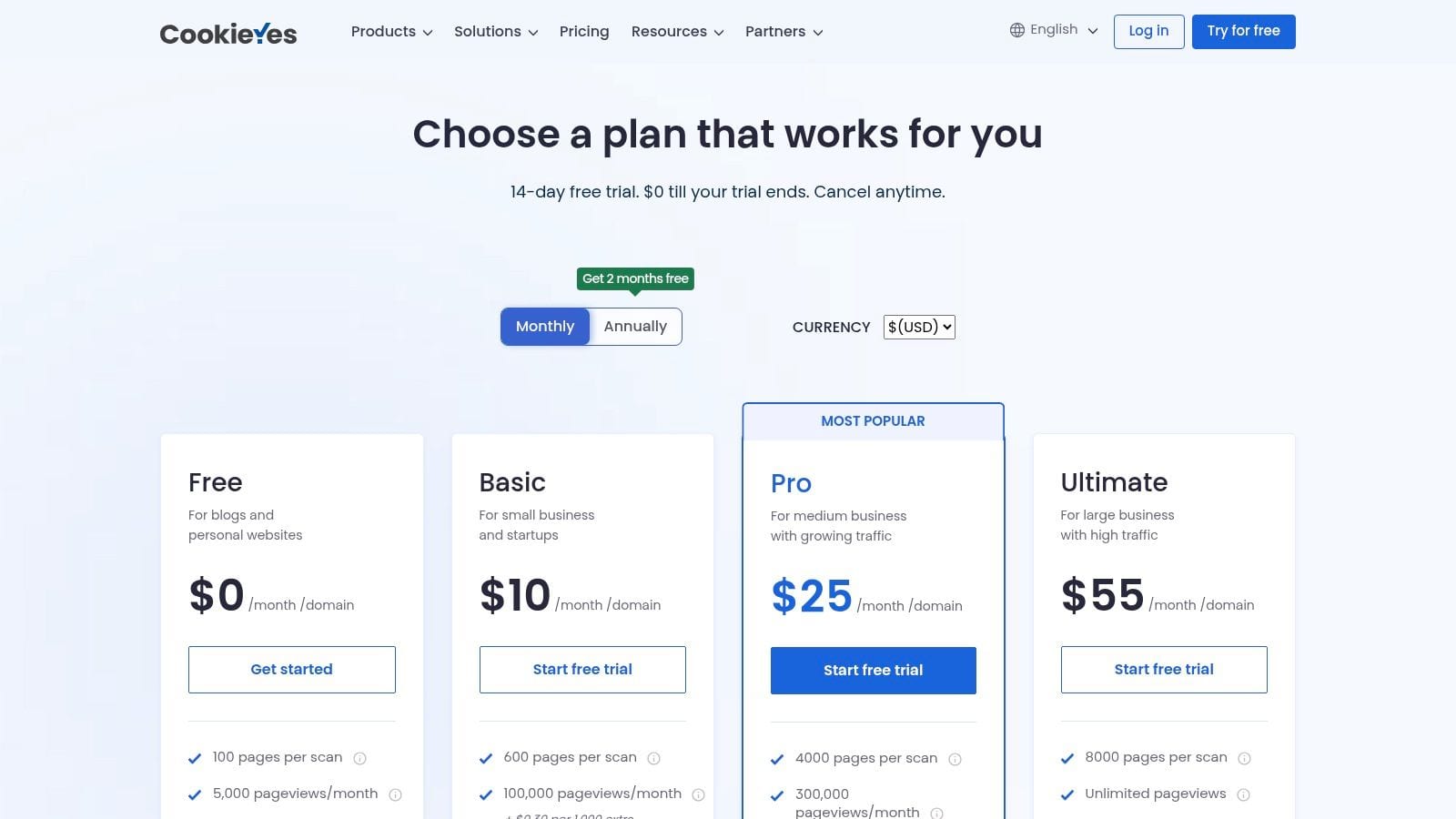
CookieYes is a widely recognized consent management platform that serves as an accessible cookies audit tool, particularly for small to medium-sized businesses and agencies. Its appeal lies in its straightforward onboarding process and strong integrations, especially with WordPress. The platform automates cookie discovery through scheduled scans, categorizes cookies for you, and helps generate the necessary consent banners and logs to comply with regulations like GDPR and CCPA.
This simplicity makes it a favorite among marketers who need a capable yet uncomplicated solution for managing website compliance. CookieYes provides the essential features for a cookies audit, including automatic script blocking prior to consent and a detailed consent log for auditability. For those looking to understand the broader implications of user consent on their analytics, this video on how to audit your CMP and analytics implementation offers valuable context on verifying what data is collected pre- and post-consent.
Core Features & Use Case
- Scheduled Scans: Automatically scans your website to find and categorize cookies, keeping your compliance documentation up-to-date.
- Script Blocking: Offers automatic blocking of third-party cookie scripts until user consent is obtained, a critical feature for compliance.
- CMS Integrations: Provides excellent plugins and integrations, most notably a popular and highly-rated WordPress plugin for easy setup.
- Ideal Use Case: Best for SMBs, bloggers, and marketing agencies managing WordPress sites who need a cost-effective, easy-to-deploy CMP with reliable cookies audit functionalities.
Pricing & Limitations
CookieYes offers a free plan that supports up to 25,000 pageviews per month, making it a great entry point. Paid plans are transparently priced, starting at $10/month for the Basic plan, which adds more features like geo-targeting and scan scheduling. The primary limitation is that advanced customization and branding removal are reserved for higher-tier plans (Pro and Ultimate). While the free plan is generous, its feature set is limited, pushing businesses that need more control over appearance and functionality toward paid subscriptions.
8. Termly
Termly positions itself as an all-in-one compliance solution, making it a strong contender among cookies audit tools, particularly for small to medium-sized businesses. Its platform bundles a capable cookie scanner and consent banner with a suite of policy generators for privacy policies, terms of service, and more. This integrated approach simplifies compliance management by keeping essential legal and technical components under one roof, which is a major advantage for teams without dedicated legal or privacy personnel.
The platform supports regional consent rules, including Google Consent Mode v2, and its auto-blocker prevents scripts from firing before consent is granted. For businesses managing multiple client sites, Termly's agency-friendly licensing and straightforward policy tooling offer significant value. A US data storage option also makes it an appealing choice for US-based companies concerned with data residency requirements.
Core Features & Use Case
- Integrated Policy Generators: Create and manage privacy policies, cookie policies, and EULAs directly within the platform, linking them to your consent banner.
- Flexible Scanning Frequency: Offers monthly, weekly, or quarterly cookie scans depending on the plan, allowing you to match scanning intensity to your needs.
- Script Auto-Blocker: Automatically identifies and blocks third-party scripts until a user provides explicit consent, simplifying technical implementation.
- Ideal Use Case: Best for SMBs, e-commerce stores, and digital agencies that need a cost-effective, bundled solution for cookie consent, policy management, and DSAR forms.
Pricing & Limitations
Termly provides a free basic plan, with paid tiers starting at $10/month (billed annually) for the Pro+ plan, which includes unlimited banner views and multi-language support. While the pricing is highly competitive, especially with bulk licensing, its limitations become apparent for larger enterprises. Advanced branding customizations and more frequent scanning are reserved for higher-tier plans, and it lacks the sophisticated enterprise governance features found in more specialized CMPs.
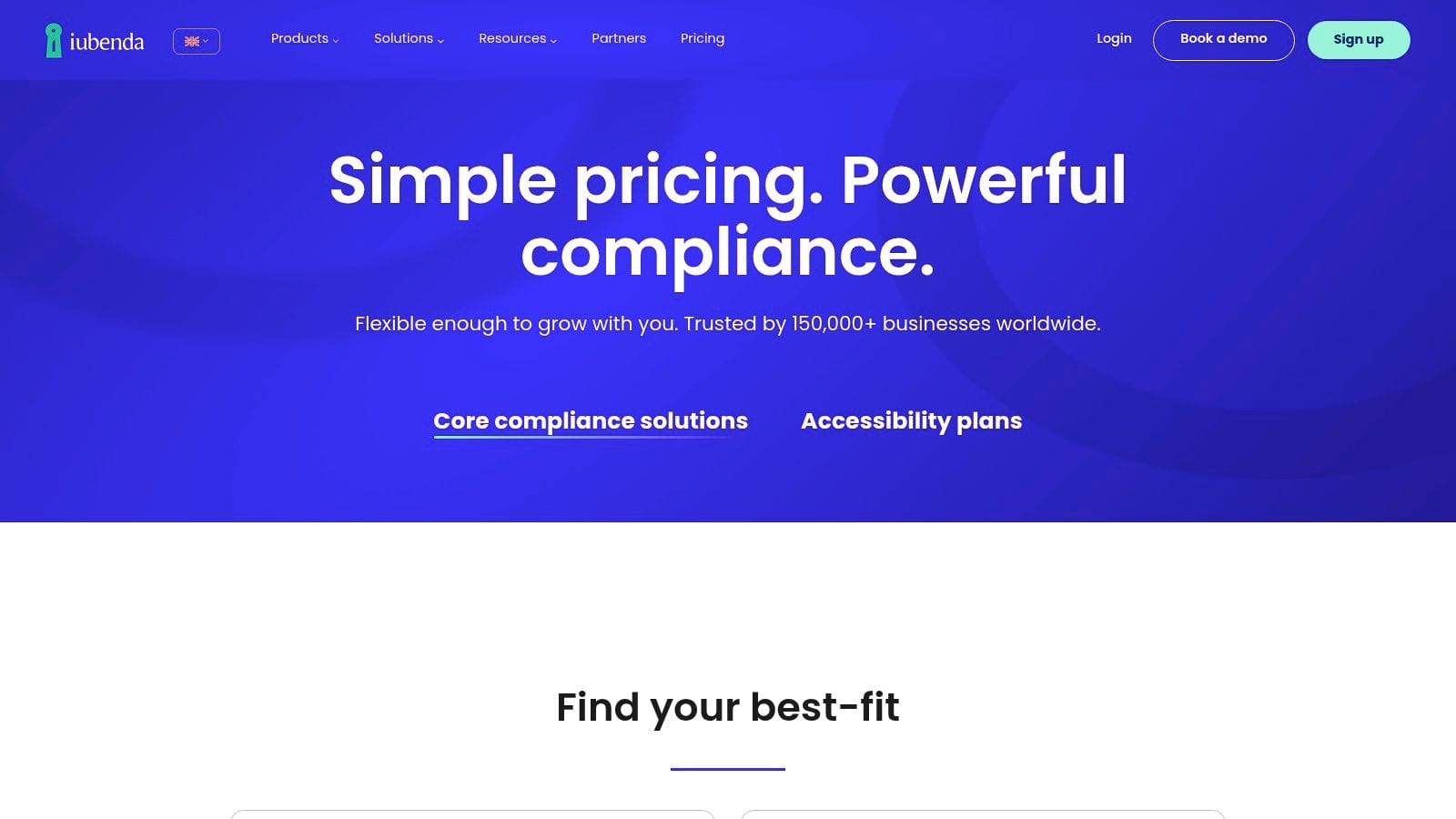
9. iubenda
iubenda offers a unique, all-in-one solution that combines a powerful cookies audit tool with comprehensive legal document generation. Its main advantage is integrating a Consent Management Platform (CMP) directly with privacy and cookie policy generators, making it an excellent choice for businesses needing to streamline their entire compliance workflow. The platform is designed for international use, with features like geo-targeted banners and multi-language support to ensure compliance across different legal jurisdictions.
This integrated approach simplifies managing legal requirements by connecting your cookie consent banner directly to an auto-generated, legally vetted policy. The system performs automated scans to identify cookies and trackers, then helps you categorize them and populate your policy accordingly. For businesses managing compliance across regions, this synergy between consent management and legal documentation is a significant time-saver and reduces the risk of inconsistencies.
Core Features & Use Case
- Integrated Policy Generator: Automatically creates and updates privacy and cookie policies based on scan results and a vast clause library.
- Automated Scanning: Offers scanning frequencies ranging from monthly to hourly, depending on the plan, to keep your cookie list current.
- Geo-Targeted Banners: Displays customized consent banners and legal notices based on the user's geographical location (e.g., GDPR vs. CCPA).
- Ideal Use Case: Best for small to medium-sized businesses and agencies that need a single platform to manage cookie consent, privacy policies, and terms of service for websites operating in multiple regions.
Pricing & Limitations
iubenda's pricing is primarily based on pageviews, starting with a free plan that includes basic features for low-traffic sites. Paid plans begin at $9/month per site for the Privacy and Cookie Policy generator and $29/month for the full CMP, with costs increasing based on traffic. While this model is transparent, high-traffic websites may face significant overage costs if they exceed their plan's pageview quota. Additionally, more advanced features like hourly scanning and the removal of iubenda branding are reserved for the highest-tier plans.
10. CookieHub
CookieHub is a Google-certified Consent Management Platform (CMP) known for its straightforward, session-based pricing and rapid implementation. It functions as a capable cookies audit tool by providing automated scanning and categorization, making it a strong contender for teams prioritizing quick setup and transparent costs. The platform’s alignment with Google Consent Mode v2 is particularly beneficial for media, publishing, and e-commerce sites heavily reliant on Google's advertising and analytics ecosystem.
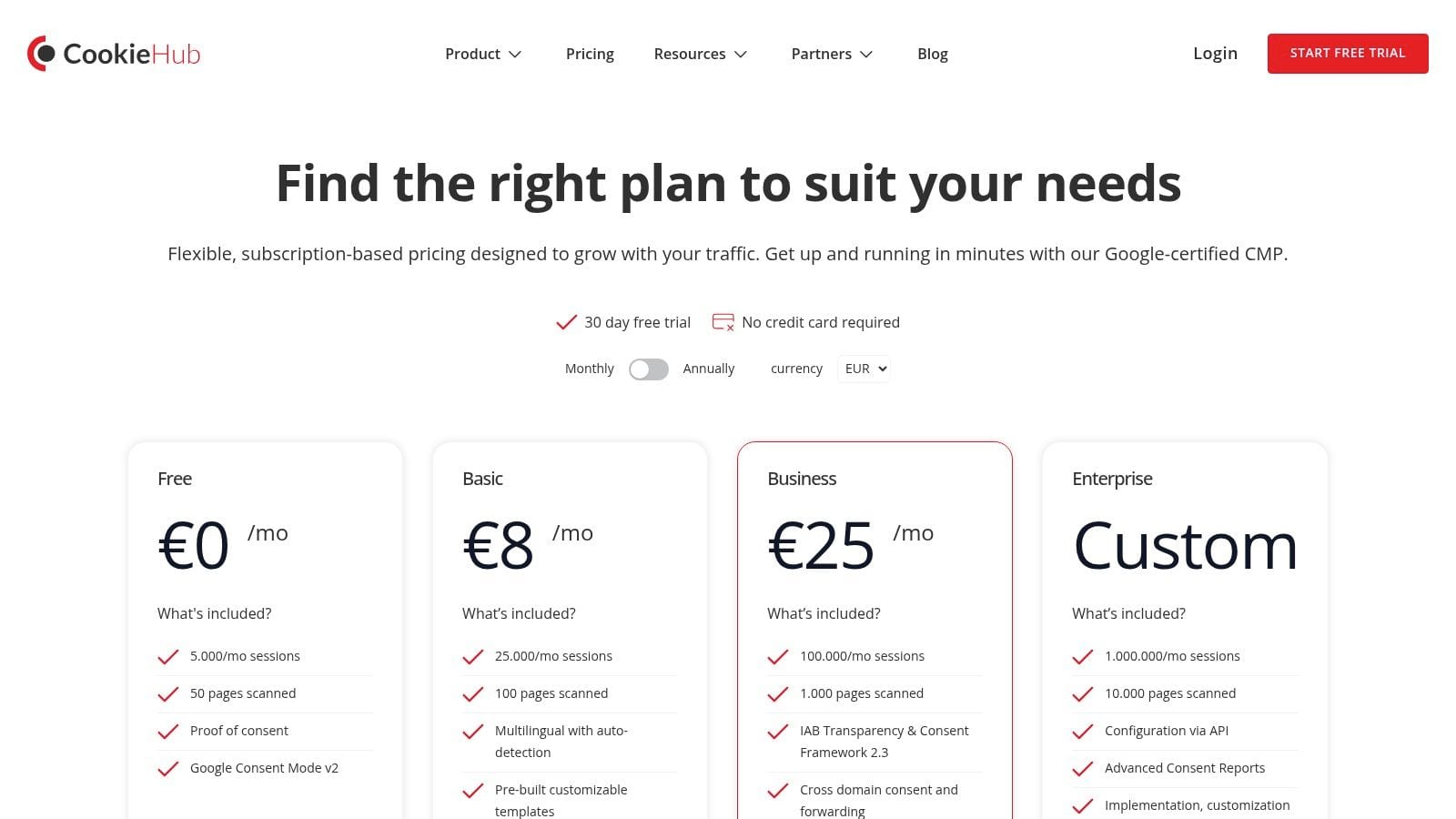
The platform stands out with its transparent session-based tiers, which are easy to understand and scale from small blogs to websites with millions of monthly sessions. This model provides cost predictability, though it's important to monitor for traffic spikes that could incur overage fees. For a deeper understanding of how CMPs like CookieHub fit into a broader data governance strategy, watching a video on how to audit your analytics implementation can provide valuable context on connecting consent with data accuracy.
Core Features & Use Case
- Automated Scans: Performs automated cookie scans, with the frequency (daily, weekly, or monthly) determined by the subscription plan.
- Audit Log: Provides a detailed log of user consent actions, which is essential for demonstrating compliance during an audit.
- Session-Based Pricing: Offers clear pricing tiers based on the number of user sessions per month, complete with overage rates.
- Ideal Use Case: Best for small-to-medium-sized businesses, publishers, and e-commerce sites that need a Google-certified CMP with a simple setup and predictable, scalable pricing.
Pricing & Limitations
CookieHub offers a free plan for up to 5,000 sessions per month, which includes limited scanning frequency. Paid plans start at €8/month for up to 25,000 sessions and scale up to Enterprise tiers for high-traffic sites. A 30-day free trial is available without a credit card. The main limitation is that the free plan is quite restricted in features and scan frequency, and unexpected traffic surges on paid plans can lead to overage fees, requiring careful monitoring. Multi-user support is also reserved for Business and Enterprise tiers.
11. consentmanager
consentmanager is a consent management platform specifically engineered for publishers and the ad-tech ecosystem, making it one of the more specialized cookies audit tools available. Its strength lies in deep integration with advertising frameworks like the IAB TCF and GPP, combined with highly customizable scanning frequencies. The platform conducts automated crawls to discover and classify cookies, offering options from weekly scans to over 100 per day on higher-tier plans, which is crucial for dynamic, ad-heavy websites.
The platform provides robust analytics and A/B testing for consent banners, allowing publishers to optimize opt-in rates without compromising compliance. This focus on performance metrics, alongside core compliance features, distinguishes it from more general-purpose CMPs. By supporting Google Consent Mode and providing detailed reporting, it helps organizations that rely on programmatic advertising to maintain both revenue streams and regulatory adherence.
Core Features & Use Case
- High-Frequency Crawling: Offers scanning schedules from weekly up to 100+ times daily, ideal for sites with frequently changing ad-tech vendors.
- Ad-Tech Framework Support: Native support for IAB TCF 2.2 and GPP, ensuring compliance within the complex digital advertising supply chain.
- A/B Testing & Analytics: Built-in tools to test different consent banner designs and measure their impact on user consent rates.
- Ideal Use Case: Best for publishers, ad-tech companies, and large advertisers who need a highly compliant and performance-oriented CMP that aligns with industry-specific frameworks.
Pricing & Limitations
consentmanager uses a flexible pricing model that starts with a free Basic plan for up to 30,000 page views. Paid plans like Essential and Professional scale based on page views and feature needs, offering high view allowances beneficial for high-traffic sites. While this structure is cost-effective, the user interface can present a learning curve for those unfamiliar with ad-tech terminology. Some of the most valuable features, such as advanced A/B testing and more frequent crawls, are reserved for higher-tier plans.
12. Secure Privacy
Secure Privacy positions itself as an accessible yet powerful consent management platform (CMP) that doubles as an effective cookies audit tool. It provides automated cookie scanning, classification, and blocking, with geo-targeting capabilities to adapt consent banners to specific regulations like GDPR and CPRA. Its approachable pricing and feature set make it a strong contender for small to medium-sized businesses, particularly those in the US needing to manage CPRA opt-outs alongside global privacy laws.
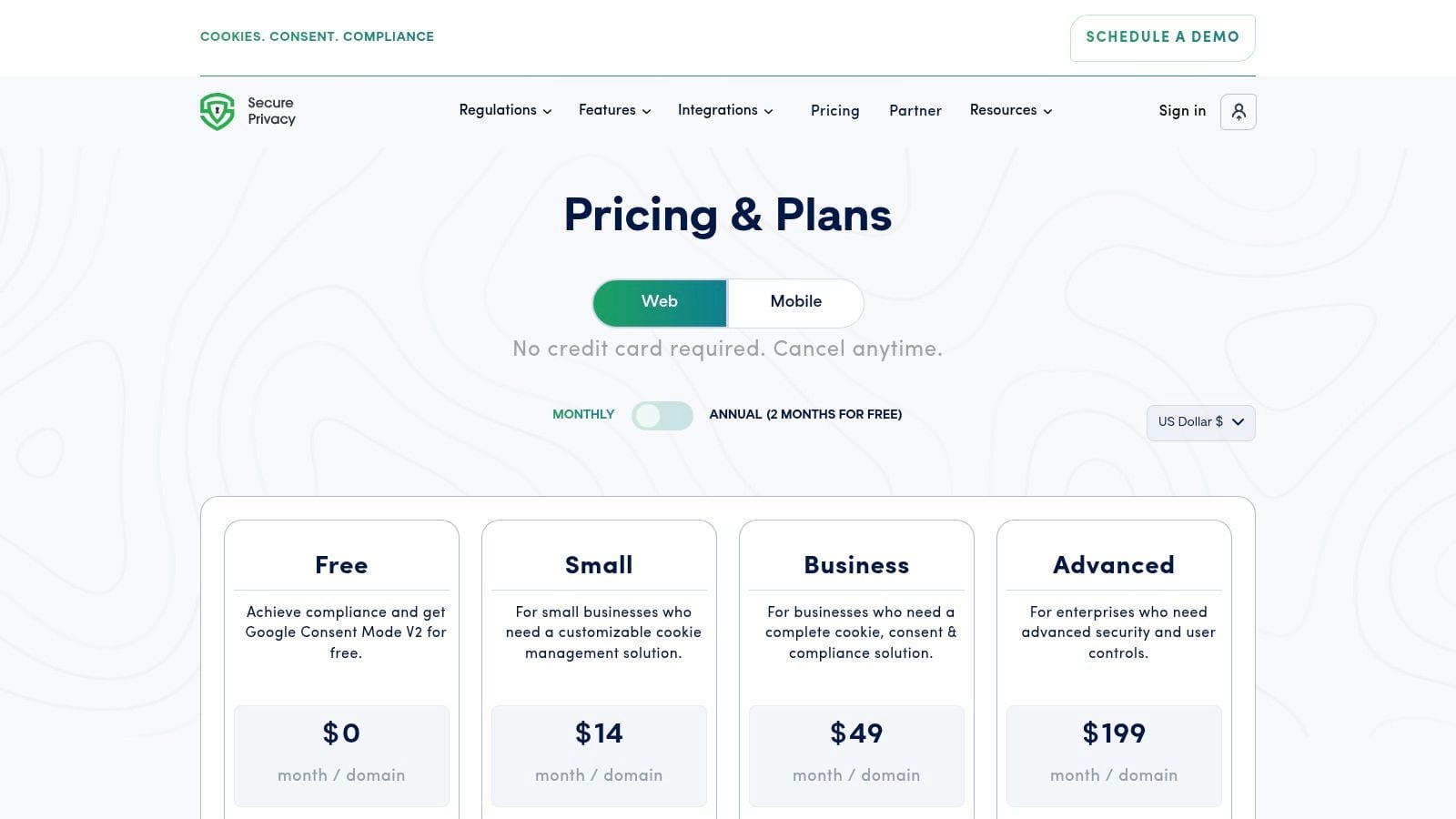
The platform is built for straightforward implementation, offering integrations with popular content management systems like WordPress and customizable banner templates. For businesses managing multiple web properties, higher-tier plans include cross-domain consent sharing, streamlining user experience and compliance efforts. Features like consent logging and DSAR forms (on Business+ plans) provide the necessary documentation for a complete audit trail. To learn more about the technical side of compliance, this video explains how to fix Google Consent Mode v2 errors.
Core Features & Use Case
- Automated Cookie Management: Scans your website to discover cookies and trackers, then automatically categorizes and blocks them prior to obtaining user consent.
- Geo-Targeted Compliance: Displays customized consent banners based on the user's location, ensuring compliance with both GDPR and CPRA/CCPA.
- Consent Logging & DSAR: Securely logs all user consents for audit purposes and provides Data Subject Access Request (DSAR) forms on higher plans.
- Ideal Use Case: Best for US-based SMBs and marketing agencies that require a cost-effective solution to manage both GDPR and CPRA compliance without needing enterprise-level features.
Pricing & Limitations
Secure Privacy offers a free tier and several paid plans starting from $19/month, priced based on monthly consent quotas rather than pageviews. This model can be predictable for businesses with stable traffic. However, advanced features like SSO, scanning behind a login, and cross-domain consent are reserved for the more expensive Business and Enterprise tiers. A potential limitation is its consent-based pricing, which can be less intuitive to forecast compared to the session or pageview models used by some competitors.
Top 12 Cookie Audit Tools Comparison
Choosing Your Tool: A Practical Checklist for Actionable Audits
Navigating the landscape of cookies audit tools can feel overwhelming, but the journey from uncertainty to clarity is achievable with the right approach. We've explored a dozen powerful solutions, from comprehensive Consent Management Platforms like OneTrust and Usercentrics to more focused tools like Cookiebot and CookieYes. The central theme is clear: modern digital governance requires more than just a surface-level scan; it demands a deep, continuous understanding of the data flowing from your digital properties.
Your choice ultimately hinges on your specific organizational needs, technical maturity, and primary objectives. A small business or content site might find CookieYes or Termly perfectly adequate for achieving baseline compliance. In contrast, a large enterprise with complex data ecosystems and stringent regulatory requirements will naturally gravitate towards robust, feature-rich platforms like OneTrust, Usercentrics, or TrustArc to manage consent on a global scale.
Key Takeaways and Final Considerations
As you evaluate these options, remember that a tool is only as effective as the strategy behind it. The goal isn't just to install a banner and forget it. True data governance is an ongoing process of discovery, management, and validation.
Recap of Core Insights:
- CMP vs. Observability: Traditional cookies audit tools and CMPs excel at front-end user consent management. They scan your site, categorize cookies, and present consent banners. However, they often lack the ability to validate what happens after consent is given or withheld.
- The Validation Gap: A critical blind spot for many organizations is confirming that their consent policies are correctly implemented in their analytics and marketing tags. A misconfigured tag can easily fire and collect data despite a user's "reject all" choice, creating a significant compliance and data quality risk.
- Beyond Cookies: The audit scope is expanding. With the rise of server-side tracking and cookieless technologies, your focus must broaden to include all data points and pixels being sent to third-party vendors, not just the cookies stored in a user's browser.
Your Actionable Implementation Checklist
Before you commit to a subscription, use this practical checklist to guide your decision-making process and ensure you select one of the best cookies audit tools for your specific context.
- Define Your Primary Goal: Are you driven by a strict need for GDPR/CCPA compliance? Are you trying to improve data quality for your analytics team? Or is your main goal to build user trust? Your primary objective will heavily influence which features matter most.
- Assess Your Technical Complexity: Evaluate your current tech stack. How many third-party marketing and analytics tools are you using? Do you rely heavily on Google Tag Manager? Do you operate across web and mobile apps? Ensure the tool you choose integrates smoothly with your existing systems. For example, a platform like Trackingplan is built to automatically detect and monitor your entire analytics implementation, making it invaluable for complex setups.
- Scan your actual production website to test the accuracy of its cookie discovery.
- Evaluate the user interface. Is it intuitive for your team?
- Test the customization options for the consent banner.
- Plan for Ongoing Maintenance: Implementing a cookie audit tool is not a one-time project. New scripts and tags are added by marketing and development teams constantly. Your chosen solution should include automated, recurring scans and alerts to detect new cookies and unclassified services, preventing compliance gaps from emerging over time.
- Combine Consent with Validation: For the most robust strategy, pair a front-end CMP with a back-end data observability and validation platform. Use the CMP to manage user choices and a tool like Trackingplan to continuously verify that those choices are respected across all your analytics and marketing pixels. This dual-layer approach closes the loop, ensuring both legal adherence and the data integrity that drives critical business decisions.
Ultimately, taking control of your website's data ecosystem is a powerful step toward building a more trustworthy and efficient digital presence. By selecting the right tools and adopting a proactive, validation-focused mindset, you can transform a complex compliance requirement into a strategic advantage.
Ready to move beyond surface-level scans and gain true visibility into your analytics implementation? Trackingplan automatically discovers and validates all your marketing and analytics tags, ensuring your consent policies are actually enforced and your data is 100% accurate. See what scanners miss and start your free Trackingplan trial today.