Discover the top 10 data integrity best practices for your analytics stack. Learn to prevent, detect, and validate data quality for reliable insights.
In a data-driven organization, decisions are only as good as the data they're built on. Yet, silent errors like broken tracking, inconsistent tagging, and schema mismatches continuously corrupt analytics, leading to flawed insights and wasted marketing spend. The dashboards your teams rely on might be telling a convincing but dangerously inaccurate story, pointing you in the wrong strategic direction. This unreliability forces teams into a reactive cycle of manual audits and debugging, undermining trust and slowing down crucial business decisions.
The key to reclaiming trust in your analytics lies in a proactive, automated approach. When data pipelines are polluted with inconsistencies, manual cleanup is often insufficient. Exploring advanced methods like AI Data Cleaning can provide crucial solutions for restoring accuracy at scale, but a preventative framework is the ultimate goal. This guide moves beyond the basics and outlines 10 essential data integrity best practices that shift your strategy from reactive fire-fighting to proactive prevention and continuous validation.
We will provide a holistic framework covering everything from prevention and detection to governance and operationalization. You will learn actionable steps to build a resilient analytics stack that delivers reliable, trustworthy insights for your marketing and analytics initiatives. By implementing these specific strategies, you can finally stop questioning your data and start making decisions with confidence. This listicle will cover:
- Prevention: Establishing robust schema design, instrumentation standards, and tagging conventions.
- Detection: Implementing automated monitoring, anomaly detection, and real-time alerts.
- Validation: Creating rigorous schema checks, property validations, and QA test plans.
- Governance & Privacy: Defining access controls, PII handling protocols, and consent management.
- Operationalization: Building incident response playbooks, assigning clear ownership, and setting service-level agreements (SLAs).
1. Institute Rigorous Data Validation and Schema Enforcement
Think of a schema as a non-negotiable contract for your data. Rigorous data validation and schema enforcement is the process of ensuring every single data point adheres to this contract before it pollutes your analytics ecosystem. This practice acts as a gatekeeper, specifying required fields, data types (e.g., string, integer, boolean), and even acceptable value formats (like ISO 8601 for timestamps).
Its primary job is to prevent malformed or unexpected data from corrupting your datasets and triggering a cascade of downstream analytics failures. By programmatically rejecting or flagging events that don't match these predefined structures, you catch implementation mistakes at the source, not weeks later when a critical dashboard breaks. This foundational layer is non-negotiable for any team serious about data integrity best practices.
Why It's a Top Priority
Without schema enforcement, your data pipeline is vulnerable to silent errors. A developer might accidentally change a property name from product_id to productId, or an analytics tool update could start sending a number as a string. These subtle changes can go unnoticed for months, invalidating reports, skewing A/B test results, and eroding trust in your data.
Key Insight: Proactive schema enforcement shifts your data quality strategy from reactive firefighting to preventive maintenance. You fix problems at their origin, saving countless hours of debugging and data cleaning down the line.
How to Implement It
- Define Your Schemas: Start by documenting the structure of your key events. For an
e-commerce_purchaseevent in Google Analytics 4, your schema might require atransaction_id(string),value(number), andcurrency(string, limited to ISO 4217 codes). - Leverage Platform Tools: Many platforms have built-in validation. Segment’s Protocols feature allows you to define a tracking plan and enforce it, while data warehouses can use tools like dbt to test schemas post-load.
- Automate with Observability Platforms: For comprehensive, real-time enforcement, tools like Trackingplan automatically detect schema mismatches across your entire marketing and analytics stack. If a new event property appears without being in your tracking plan, or if a data type changes, it’s flagged instantly, preventing it from ever reaching your BI tools. For a deeper look, you can learn more about optimizing data validation within your analytics schema and how it protects your data integrity.
2. Automated Continuous Monitoring and Anomaly Detection
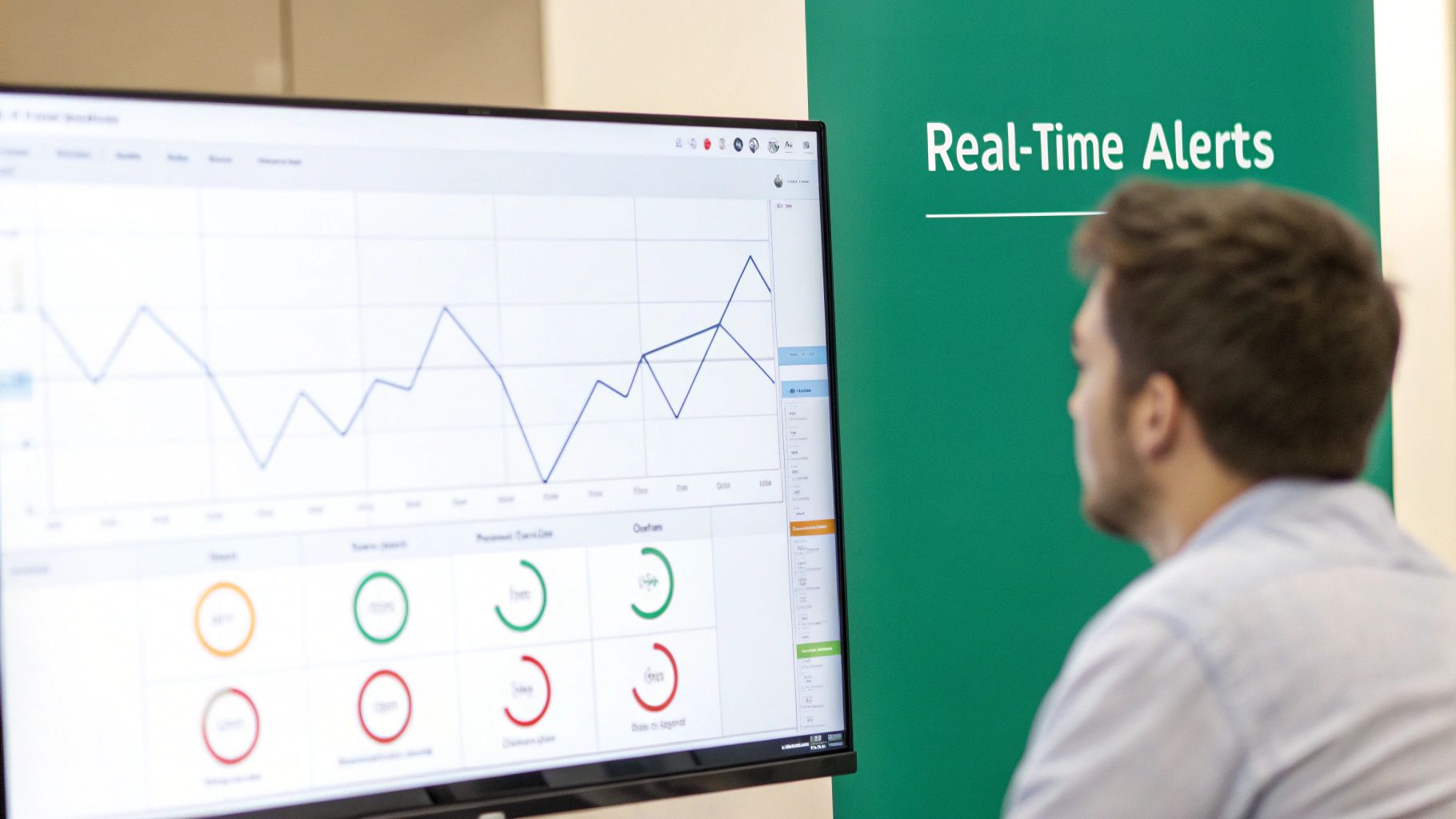
If schema enforcement is your gatekeeper, then automated monitoring is your 24/7 security patrol. This practice involves using systems that continuously track data flow, volume, and structure against established baselines. It’s about moving from periodic, manual audits to a state of constant vigilance, where any deviation from the norm triggers an immediate alert.
These systems are designed to spot anomalies as they happen: a sudden drop in add_to_cart events, a spike in null values for the user_id property, or a new, unexpected traffic source sending malformed data. By identifying these issues in real-time, you can intervene before corrupt data contaminates your entire analytics pipeline, making this one of the most critical data integrity best practices for agile teams.
Why It's a Top Priority
Manual data checks are always a step behind. By the time a data analyst notices a broken dashboard or a marketing manager questions a report, the problematic data has already spread. This leads to time-consuming cleanup, rerunning queries, and, worst of all, making business decisions based on flawed information.
Continuous monitoring catches these problems at the point of entry. It can flag a botched analytics deployment within minutes, not weeks, protecting downstream processes and preserving trust in your data infrastructure.
Key Insight: Real-time anomaly detection transforms data quality from a historical review exercise into a proactive, operational discipline. It's the difference between reading an incident report and preventing the incident from happening in the first place.
How to Implement It
- Utilize Native Platform Alerts: Many analytics tools offer basic anomaly detection. Google Analytics 4 can alert you to unusual traffic changes, and platforms like Amplitude and Mixpanel have features to detect shifts in user behavior patterns. These are excellent starting points.
- Configure Granular Alerting Rules: Avoid alert fatigue by setting intelligent thresholds. Configure different severity levels (e.g., warning vs. critical) and account for known business cycles like seasonality or marketing campaigns. A spike in traffic during a Black Friday sale shouldn't trigger a critical alert.
- Adopt a Dedicated Observability Platform: For comprehensive coverage, tools like Trackingplan provide always-on monitoring across your entire stack. It automatically detects traffic anomalies, missing events, and unexpected property values, then provides root-cause analysis to pinpoint the exact source of the error. This holistic approach ensures that no data quality issue goes unnoticed, regardless of where it originates.
3. Tracking Plan Documentation and Version Control
A tracking plan is the single source of truth for your analytics. It's a living document that specifies every event, property, and user attribute you collect, detailing what each piece of data means, where it's tracked, and why it matters. By implementing a formal tracking plan with version control, you create a shared language and centralized reference for developers, marketers, and analysts alike.
This practice transforms data collection from a chaotic, ad-hoc process into a governed, strategic initiative. It ensures that every team understands the data landscape, preventing redundant tracking, undocumented events, and misinterpretations that lead to flawed analysis. This disciplined approach is a cornerstone of maintaining long-term data integrity best practices, ensuring your data remains consistent, trustworthy, and aligned with business goals.
Why It's a Top Priority
Without a central tracking plan, teams operate in silos. Marketing might implement a new tool that tracks user_signup, while engineering is already tracking account_created. This redundancy creates confusion, inflates data processing costs, and makes it impossible to build a unified view of the customer journey. Over time, this "data drift" erodes the reliability of your entire analytics stack, making accurate reporting a constant struggle.
Key Insight: A version-controlled tracking plan is not just documentation; it's a governance framework. It forces a collaborative and intentional approach to data collection, ensuring every tracked event has a clear owner, purpose, and documented structure.
How to Implement It
- Establish a Central Repository: Start with a collaborative tool. While spreadsheets are a common starting point, dedicated platforms like Segment’s Protocols or visual tools like Figma can provide more structure. The goal is to have one universally accessible location for all data specifications.
- Define Comprehensive Event Metadata: For each event, document more than just the name and properties. Include the business question it answers, the team that owns it, the platforms where it should fire, and any associated privacy or consent requirements.
- Integrate and Automate: The most effective tracking plans are not static documents. Tools like Trackingplan automatically discover all your existing tracking and generate a live plan. This eliminates manual upkeep by continuously monitoring your implementation, detecting any changes, and flagging deviations from the documented plan in real time, ensuring your documentation always reflects reality.
4. PII Detection and Prevention
Think of PII detection as your analytics stack’s dedicated privacy officer. This practice involves systematically identifying and blocking sensitive customer data-like names, emails, and phone numbers-from ever being collected by your analytics and marketing tools. It’s a critical security layer that prevents accidental data leaks, ensuring you don’t inadvertently store personally identifiable information (PII) where it doesn’t belong.

Its primary function is to enforce privacy compliance with regulations like GDPR and CCPA automatically. By setting up rules and patterns to recognize sensitive data formats, PII prevention mechanisms can redact or completely block this information before it’s transmitted. This safeguards your organization from hefty fines and, more importantly, protects your users' trust by upholding stringent data integrity best practices.
Why It's a Top Priority
A single PII leak can have catastrophic consequences, leading to severe legal penalties, brand damage, and a complete loss of customer confidence. Often, these leaks aren't malicious; a developer might accidentally capture the full URL string containing an email address as a parameter, or a form submission event could mistakenly include a phone number. Without automated detection, such incidents can go unnoticed until a compliance audit or a data breach occurs.
Key Insight: Proactive PII prevention transforms your compliance posture from a manual, hope-for-the-best approach to an automated, auditable system. It’s about building a safety net that catches human error before it becomes a crisis.
How to Implement It
- Activate Built-In Platform Features: Many tools offer native PII detection. Google Analytics 4 provides warnings for common PII formats, while CDPs like Segment have features to detect and redact sensitive data. Enable these features across all properties by default.
- Establish Strict Allow-lists: Instead of creating exceptions for blocking PII, adopt an "allow-list" approach. Only permit specific data points to pass through for legitimate business needs, and ensure they are sent to authorized, secure destinations, often after being hashed or tokenized.
- Leverage Automated Observability: For complete, real-time protection, specialized tools are essential. Trackingplan automatically scans every event payload for PII patterns-like emails, credit card numbers, and IP addresses-and alerts you instantly. This allows you to block leaks at the source before they ever reach downstream tools. To better understand these risks, you can read more about how to navigate PII data compliance effectively.
5. Implement Robust Consent and Compliance Validation
Think of consent validation as the ethical and legal gatekeeper for your data collection. This practice involves systematically verifying that your analytics and marketing tags only fire after a user has given explicit, appropriate consent. It’s not just about having a cookie banner; it’s about ensuring the technical implementation respects the user’s choices across every tool in your stack, from analytics platforms to advertising pixels.
This process confirms that data is only sent to the destinations a user has approved and that your entire instrumentation adheres to the rules set by your consent management platform (CMP). In an era of GDPR, CCPA, and other global privacy laws, failing to validate consent isn't just a data quality issue; it's a significant legal and financial risk that undermines both data integrity and customer trust.
Why It's a Top Priority
Without active consent validation, your organization is exposed to silent compliance failures. A new marketing tag added via a tag manager could easily bypass your CMP rules, or a website update could break the integration, causing all tags to fire regardless of user choice. These breaches often go unnoticed until a regulatory audit or a customer complaint, leading to hefty fines and severe reputational damage.
Key Insight: Proactive consent validation transforms compliance from a one-time setup into a continuous, automated process. It ensures your data collection practices remain aligned with both legal requirements and user expectations, safeguarding one of your most critical data integrity best practices.
How to Implement It
- Audit Your Consent Framework: Start by mapping all data-collecting scripts and pixels on your site. Use your CMP (like OneTrust or Cookiebot) to categorize them and document the consent signals required for each one to fire legally.
- Automate Regional Testing: Manually testing consent banners for every geographic region is impractical. Use browser automation tools or a VPN to simulate visits from different locations (e.g., California for CCPA, Germany for GDPR) and verify that the correct consent logic is applied.
- Deploy Continuous Monitoring: For real-time assurance, leverage an observability platform. Tools like Trackingplan automatically monitor your CMP integration, detecting when tags fire without the required consent or when new, unclassified vendors are added. It can instantly alert you to misconfigurations, ensuring compliance issues are caught before they escalate into major incidents.
6. UTM and Campaign Tagging Standardization
Think of your UTM parameters as the universal language for your marketing attribution. Standardization is the process of creating a strict, shared dictionary for that language, ensuring every team member speaks it fluently. This practice establishes and enforces clear rules for utm_source, utm_medium, utm_campaign, utm_content, and utm_term across all marketing channels.
Its core function is to eliminate the data fragmentation that cripples attribution reporting. By preventing inconsistent tags like 'facebook', 'Facebook', 'facebook.com', and 'FB_cpc' from all representing the same source, you ensure that every campaign’s performance is aggregated correctly. This disciplined approach is a cornerstone of data integrity best practices, turning chaotic marketing data into a reliable source of truth.
Why It's a Top Priority
Without standardized UTMs, your marketing analytics are built on a foundation of quicksand. A simple capitalization error can create a duplicate campaign entry in Google Analytics, splitting your conversion data and making it impossible to accurately assess ROI. This leads to misallocated budgets, flawed channel analysis, and a complete breakdown of trust in your performance metrics.
Key Insight: Consistent UTM tagging is not just a 'nice-to-have' for tidy reporting; it is the fundamental mechanism that powers accurate marketing attribution and budget optimization.
How to Implement It
- Create a Naming Convention Document: Establish a single source of truth that defines your UTM structure. For example, mandate that all sources be lowercase (e.g.,
google,facebook), mediums follow specific categories (cpc,social,email), and campaign names use a consistent format likeproduct-launch-q3-2024. - Use UTM Builders and Templates: Minimize manual entry errors by providing teams with pre-configured UTM generators or spreadsheet templates. Tools within platforms like HubSpot or standalone builders can enforce your defined conventions, making it easy for marketers to do the right thing.
- Automate Validation and Auditing: Implement automated checks to catch non-compliant UTMs before they pollute your analytics. Analytics observability tools can monitor incoming campaign data in real-time, alerting you to deviations from your established naming conventions. This allows you to fix tagging issues at the source and maintain clean historical data for reliable trend analysis.
7. Establish a Clear Event Naming Convention and Taxonomy
A clear event naming convention and taxonomy is the shared language your entire organization uses to describe user actions. Think of it as a dictionary for your data, providing consistent, predictable, and understandable names for every interaction. By establishing clear rules like an object_action format (e.g., product_viewed, form_submitted), you make event data instantly discoverable and dramatically reduce ambiguity for anyone working with it.
This practice is essential for transforming a chaotic stream of raw data into a structured, queryable asset. A well-defined taxonomy ensures that when an analyst looks for purchase events, they find order_completed and not a confusing mix of purchase, completed_purchase, and checkout_success. This consistency is a cornerstone of data integrity best practices, making analytics reliable and self-serve.

Why It's a Top Priority
Without a standardized taxonomy, your data becomes a tangled mess that only a few tribal-knowledge keepers can decipher. Teams will inevitably create redundant or conflicting events, leading to inaccurate reports and wasted engineering effort. For example, the marketing team might track lead_gen_form_submit while the product team tracks contact_form_submission, describing the exact same action and splitting your data into unusable silos.
Key Insight: A strong naming convention democratizes your data. It empowers team members across the organization to understand and use analytics confidently, without needing a developer to translate what an event means.
How to Implement It
- Choose a Simple Pattern: Adopt a clear, intuitive format like
object_actionornoun_verb. For instance, clicking a login button would always bebutton_clickedwith a propertybutton_text: 'Log In', rather than creating a uniquelogin_button_clickedevent. This model is scalable and easy to understand. - Centralize and Document: Create a single source of truth for your taxonomy, like a Confluence page or a spreadsheet. Document the name, description, trigger, and associated properties for every event. This living document should be the go-to resource for developers and analysts.
- Enforce with Automation: Manual enforcement is prone to error. Use tools like Trackingplan to automatically validate event names against your defined taxonomy in real-time. If a developer instruments a non-compliant event like
productView, the system can immediately flag it as an "Unexpected" event before it contaminates your datasets, ensuring adherence to your data governance standards. - Be Consistent with Casing: Decide on a single casing convention and stick to it. Whether you choose snake_case (e.g.,
product_added_to_cart) or camelCase (e.g.,productAddedToCart), consistency is key to making your data predictable and easy to query.
8. Cross-Destination Data Consistency Validation
Your analytics data doesn’t live in a single tool; it’s sent to a dozen different destinations like Google Analytics, Mixpanel, ad networks, and CRMs. Cross-destination data consistency validation is the critical process of ensuring the same event is reported accurately and completely across every one of these platforms. It verifies that data sent to multiple tools is identical, complete, and correctly formatted for each destination’s unique requirements.
This practice is essential because each marketing and analytics tool has its own schema, naming conventions, and data-type expectations. Without validation, an event like purchase might successfully reach your analytics tool but fail to fire the conversion pixel for your ad platform due to a missing property. This creates dangerous reporting discrepancies, making it impossible to reconcile ad spend with reported revenue and undermining multi-touch attribution models.
Why It's a Top Priority
Inconsistent data across destinations leads to a fragmented view of customer behavior and campaign performance. Your product team might see one set of user actions in Mixpanel, while your marketing team sees a completely different picture in GA4 or Facebook Ads. These discrepancies erode trust, lead to poor strategic decisions, and make it nearly impossible to calculate a reliable return on investment.
Key Insight: True data integrity isn't just about the quality of data at the source; it's about maintaining that quality consistently across your entire, interconnected marketing and analytics stack. Every destination must receive the same truth.
How to Implement It
- Map Your Data Flows: Document every destination an event is sent to. For a key
sign_upevent, create a map that details its required properties and naming conventions for Google Analytics 4, your CRM, and your email marketing platform. - Automate Cross-Platform Audits: Use an analytics observability platform to automatically compare the data received by each destination in real-time. Tools like Trackingplan can monitor event delivery and alert you instantly if an event fires to GA4 but fails for a critical ad pixel, or if a property like
user_idis present in one payload but missing in another. This makes it one of the most reliable data integrity best practices for a complex stack. - Leverage Browser and CDP Tools: During QA, use browser DevTools to see which network requests (pixels) fired successfully and which failed. If you use a Customer Data Platform (CDP) like Segment, utilize its event delivery monitoring features to see which destinations are successfully receiving data and troubleshoot failures from a central hub.
9. Automated Testing and QA for Tracking Implementations
Think of your tracking code as a critical piece of application logic, because it is. Automated testing applies the same software development discipline to your analytics instrumentation, ensuring it functions as intended before, during, and after deployment. This practice involves creating scripts and frameworks that simulate user actions (like clicking a "buy" button) and then verifying that the correct analytics events are fired with the right properties and values.
This systematic approach replaces unreliable and time-consuming manual checks, which are nearly impossible to scale. By integrating tracking tests into your development lifecycle, you create a safety net that catches regressions, typos in event names, and other implementation bugs automatically. This is a non-negotiable step for teams wanting to treat their analytics stack with the same rigor as their core product features, making it a key data integrity best practice.
Why It's a Top Priority
Without automated QA, every new feature release or website update is a gamble. A minor code change in one part of the application can unknowingly break a critical conversion event, rendering your performance dashboards useless. These issues often go undetected until someone notices a sudden, inexplicable drop in a key metric, leading to frantic, reactive debugging.
Key Insight: Automated testing for analytics transforms data quality from a hopeful outcome into a verifiable requirement. It shifts the responsibility for data integrity from the data team to the development process itself, catching errors at the earliest possible stage.
How to Implement It
- Integrate into CI/CD Pipelines: Use tools like GitHub Actions or Jenkins to run your tracking tests automatically on every code commit. This ensures that no change that breaks analytics can be merged into your main codebase.
- Leverage Browser Automation: Employ frameworks like Selenium or Playwright to script end-to-end user journeys. For example, a test could automate adding a product to a cart, proceeding to checkout, and verifying that the
begin_checkoutandadd_to_cartevents are triggered correctly. - Utilize Observability and QA Platforms: Modern data observability tools like Trackingplan include features designed for this purpose. You can set up automated tests that not only confirm events fire but also validate the entire payload against your predefined schema. These tests can run continuously in production, providing a constant health check on your tracking implementation and offering a powerful layer of protection for your overall data integrity strategy.
10. Implement a Data Governance Framework and Role-Based Access Control
Think of a data governance framework as the constitution for your data ecosystem. It’s the formal set of policies, procedures, roles, and responsibilities that dictates how data is collected, managed, accessed, and used across the organization. This framework, combined with role-based access control (RBAC), ensures that only the right people can make changes or access sensitive information, creating clear lines of accountability.
Its purpose is to move your data management from an uncontrolled free-for-all to a structured, compliant, and scalable operation. By defining who can approve new tracking requests, who can modify schemas, and who can view sensitive datasets, you prevent unauthorized changes, reduce the risk of compliance breaches, and ensure that your data practices align with business objectives. This is a critical practice for maintaining data integrity in complex organizations.
Why It's a Top Priority
Without formal governance, data ownership becomes ambiguous, leading to chaos. A marketer might add a new event that captures personally identifiable information (PII) without legal review, or a developer might deprecate a key property without notifying the analytics team, breaking critical reports. A strong governance framework prevents these scenarios by establishing clear protocols and approval workflows, safeguarding data quality and compliance.
Key Insight: Effective data governance isn't about restricting access; it's about enabling the right access. It empowers teams to use data confidently by providing clear guardrails and a predictable process for managing data assets.
How to Implement It
- Define Roles and Responsibilities: Start by creating a lightweight governance committee with representatives from marketing, product, engineering, and legal. Clearly document who owns the tracking plan, who approves changes, and who is responsible for data quality.
- Establish Clear Policies: Document your standards for event naming, property definitions, and PII handling. Create a centralized, accessible tracking plan that serves as the single source of truth for your analytics implementation.
- Use RBAC in Your Tooling: Implement access controls within your platforms. For instance, in a CDP or analytics tool, grant "editor" access only to specific engineers or data stewards, while giving marketers and analysts "viewer" access.
- Automate Workflows: Leverage tools like Trackingplan to operationalize your governance. Its collaborative workflows and role-based permissions allow you to create automated approval processes. When a developer proposes a change, designated stakeholders are automatically notified to review and approve it, ensuring every modification aligns with your established policies. To explore this further, you can get a detailed view of data governance best practices and how to apply them.
10-Point Data Integrity Comparison
From Data Chaos to Data Confidence
The journey toward impeccable data integrity is not a one-time project but a continuous, strategic commitment. Throughout this guide, we've navigated the essential pillars that transform analytics from a source of frustration into a powerful engine for growth. By moving beyond reactive fire-fighting and adopting a proactive, systematic approach, you build a resilient foundation for every data-driven decision your organization makes.
The ten data integrity best practices we've explored serve as a comprehensive blueprint. They address the entire data lifecycle, from the initial instrumentation and schema design to ongoing monitoring, governance, and privacy compliance. No single practice exists in a vacuum; their true power emerges when they are integrated into a cohesive strategy. Schema enforcement without continuous monitoring is incomplete, just as a robust governance framework is ineffective without standardized tagging and taxonomy.
Synthesizing the Core Principles
Let's distill the most critical takeaways from these practices into a unified philosophy:
- Prevention Over Correction: The most effective strategy is to prevent bad data from ever entering your systems. This is the core idea behind rigorous tracking plans, standardized naming conventions, and automated schema enforcement. Fixing data downstream is exponentially more costly and time-consuming.
- Automation as a Force Multiplier: Manual checks and periodic audits are destined to fail in the face of modern data velocity and complexity. Embracing automation through continuous monitoring, anomaly detection, and automated QA testing is the only scalable way to maintain data quality. This frees your team from tedious manual validation and allows them to focus on generating insights.
- Trust as a Tangible Asset: The ultimate goal of data integrity is to build organizational trust in your data. When marketing, product, and leadership teams have confidence in the numbers, they can make bolder, faster decisions. This trust is earned by implementing transparent governance, clear ownership, and reliable validation processes.
Your Actionable Path Forward
Translating these principles into action can feel daunting, but the path forward is clear. Start by assessing your current state against the ten best practices. Identify your most significant vulnerabilities, whether it's inconsistent UTM tagging causing marketing attribution chaos or a lack of PII detection exposing you to compliance risks.
Prioritize your efforts based on impact. A great starting point is often establishing a formal tracking plan and implementing an automated monitoring solution. This combination provides immediate visibility into your existing data flows and establishes the "source of truth" needed to enforce other standards. Empower a cross-functional team with clear roles and responsibilities to champion this initiative.
Key Insight: Achieving data integrity is a cultural shift. It requires moving from a siloed mindset, where developers "implement" and analysts "use," to a collaborative model where everyone shares responsibility for the quality of the data pipeline.
Ultimately, mastering these data integrity best practices is an investment in your organization's future. It unlocks more accurate personalization, higher campaign ROI, better product development, and a stronger competitive advantage. You are not just cleaning up data; you are building a system of intelligence that is reliable, compliant, and ready to scale with your ambitions. The result is a transition from a state of data chaos, defined by doubt and manual effort, to a state of data confidence, where every insight is actionable and every decision is informed.
Ready to automate your data quality and implement these best practices with ease? Trackingplan offers a comprehensive observability platform that automatically discovers, monitors, and validates your entire analytics implementation, ensuring your data is always accurate and trustworthy. Take the first step toward complete data confidence by exploring how Trackingplan can transform your analytics governance.