
A data retention policy is no longer just a legal document tucked away in a compliance folder. It's a critical component of your data strategy, risk management framework, and a direct reflection of your commitment to customer trust. In an environment governed by complex regulations like GDPR and CCPA, knowing what data to keep, for how long, and for what specific purpose is not just best practice-it's mandatory. Yet, most organizations are stuck sifting through generic advice that doesn't apply to their unique operational needs.
This guide moves beyond theory to provide practical, industry-specific data retention policy examples that you can actually use. We'll break down templates tailored for diverse sectors, from healthcare and finance to marketing and SaaS. More importantly, we'll analyze the strategic thinking behind each one. An effective policy isn't just about setting expiration dates; it's about defining a lifecycle for every piece of data. This includes not only collection and storage but also secure disposal. To craft a data retention policy that truly works, organizations must align their data destruction practices with established standards like NIST SP 800-88, the authoritative guide to secure data sanitization.
Whether you're a data engineer, marketer, or compliance officer, the following examples will equip you with actionable insights, strategic analysis, and sample language. Our goal is to help you build a policy that is both compliant with global regulations and intelligently aligned with your business objectives, turning a potential liability into a strategic asset.
1. GDPR Data Retention Policy Template (EU/EEA)
A GDPR-compliant data retention policy is the cornerstone of responsible data management for any organization processing the personal data of EU residents. This framework is built on the "storage limitation" principle, one of the core tenets of the regulation. It mandates that personal data must be kept in a form which permits identification of data subjects for no longer than is necessary for the purposes for which the personal data are processed.
This means you cannot hold onto user data indefinitely. Instead, you must define and justify specific retention periods for every category of personal data you collect, based on a clear legal basis for processing (e.g., consent, contractual necessity, legitimate interest). For organizations operating in the EU/EEA, a comprehensive understanding of GDPR compliance is essential for crafting effective data retention policies that stand up to regulatory scrutiny.
Real-World Examples
- Spotify: The music streaming giant retains clickstream and listening data for analytics and personalization for 13 months before it is anonymized, striking a balance between business needs and privacy.
- Google Analytics: The platform's default setting for user-level and event-level data retention is 26 months, but it offers shorter options (like 2 months) to help companies align with their specific policies.
- Meta (Facebook): Meta employs varied retention schedules. For instance, cookies linked to advertising have a 90-day lifespan, while conversion data from its pixel is retained for 180 days.
Actionable Takeaways and Implementation
Implementing a GDPR-focused retention schedule requires a systematic approach. This is a critical component of any list of data retention policy examples because it directly addresses one of the world's strictest privacy laws.
- Map and Justify: Begin by mapping all personal data types you process. For each type, document the purpose of processing and the legal basis, then assign a specific retention period.
- Automate Deletion: Implement automated scripts or use platform-native features in your data warehouse and analytics tools to enforce these retention schedules. This minimizes the risk of manual error and ensures consistent compliance.
- Integrate with Consent: Your data retention periods, especially those based on consent, must be linked to your consent management platform (CMP). When consent is withdrawn, it should trigger the data deletion or anonymization process. You can explore how managing PII data intersects with these policies to ensure robust compliance.
- Document Everything: Maintain a clear record of your retention policies, including the justification for each period. This documentation is crucial for demonstrating accountability during an audit.
2. HIPAA Data Retention Policy Template (Healthcare)
A HIPAA-compliant data retention policy is a non-negotiable requirement for healthcare organizations and their business associates handling Protected Health Information (PHI). This framework is governed by the Health Insurance Portability and Accountability Act, which mandates specific rules for the storage, access, and disposal of sensitive patient data. The core requirement is to retain health information for a minimum of six years from the date of its creation or the date when it was last in effect, whichever is later.
This means you must establish and enforce strict retention schedules for all categories of PHI, including medical records, insurance claims, and billing information. The policy must also cover data derived from PHI, such as analytics, ensuring it is de-identified or handled with the same security protocols. Understanding the nuances of the HIPAA Privacy Rule in digital analytics is crucial for maintaining compliance while leveraging data for operational improvements.

Real-World Examples
- Epic Systems: This leading Electronic Health Record (EHR) provider implements configurable retention policies that often default to state-specific requirements, which can range from 6 to 10 years or more for patient medical records.
- Cerner: Another major EHR vendor, Cerner ties its data retention schedules to key events like a patient's discharge date, adding the state-mandated minimum retention period to that date to calculate the final disposal timeline.
- Optum Health: As a large health services provider, Optum often standardizes a 7-year retention period for many records, building in overrides to accommodate stricter state laws and ensuring a conservative approach to compliance.
Actionable Takeaways and Implementation
Implementing a HIPAA-compliant retention schedule is a critical exercise in risk management and regulatory adherence. This is a vital part of any list of data retention policy examples because it addresses the highly sensitive nature of healthcare data.
- Segment and De-identify: Separate clinical PHI from analytics data wherever possible. For analytics purposes, retain data in a de-identified or anonymized form to reduce risk and compliance scope.
- Automate Secure Disposal: Implement retention policies directly within your data warehouse and EHR systems. Tie PHI encryption keys to retention dates so that data becomes cryptographically inaccessible after the retention period expires.
- Monitor for Leaks: Use tools to continuously monitor your analytics for accidental PHI leaks, such as patient IDs in event names or IP addresses captured in custom dimensions. This proactive step is crucial for preventing breaches.
- Document and Log Everything: Maintain meticulous logs of all data destruction activities to demonstrate compliance during audits. Also, document Business Associate Agreement (BAA) requirements for any third-party analytics vendors that might process PHI-derived data.
3. CCPA/CPRA Data Retention Policy Template (California/US States)
A data retention policy aligned with the California Consumer Privacy Act (CCPA) and the California Privacy Rights Act (CPRA) is essential for businesses handling the personal information of California residents. This framework is now a model for numerous other U.S. state privacy laws, making it a critical benchmark for national compliance. The core principle is "purpose limitation," which dictates that personal information should only be retained for as long as is "reasonably necessary and proportionate" to achieve the disclosed purposes for which it was collected.
Unlike GDPR's stricter consent-first model, the CCPA/CPRA framework is more flexible but demands explicit transparency. Organizations must clearly state in their privacy policies why they collect data and how long they intend to keep it for each specific purpose. This approach places a strong emphasis on honoring consumer rights, particularly the right to request the deletion of their personal information, which must be a seamless and accessible process.
Real-World Examples
- Apple: Through its App Privacy Labels, Apple enforces transparency by requiring developers to disclose their data retention practices directly. For example, a developer might state, 'Contact info used for app functionality is deleted after 30 days.'
- Amazon Web Services (AWS): AWS provides customers with CCPA-compliant data processing addendums and tools that allow them to manage data retention within their cloud environment, empowering users to align their storage with their stated business purposes.
- Salesforce: The platform offers configurable retention windows within its various clouds, enabling customers to set data expiration policies that align with their specific, disclosed business needs, such as retaining customer service records for a defined period.
Actionable Takeaways and Implementation
Building a CCPA/CPRA-compliant retention schedule requires a purpose-driven mindset. This is a vital inclusion in any list of data retention policy examples because it reflects the direction of privacy legislation across the United States.
- Document Your Purposes: Clearly define and document the specific business purpose for every category of personal information you collect. In your privacy policy, link these purposes to concrete retention periods (e.g., "We retain user-generated content for 2 years to improve our service").
- Automate Deletion Requests: Implement an automated workflow to handle consumer "right to delete" requests. This system should be integrated with your CRM, analytics platforms, and data warehouses to ensure complete and timely data removal upon a verified request.
- Align Retention to Purpose: Avoid indefinite data storage. Set and enforce retention periods that are genuinely necessary for the stated purpose. For instance, data for fraud detection might be kept for two years, while data for short-term product optimization might only be kept for one year.
- Monitor Data Sharing: The CPRA has strict rules around the "sharing" of data for cross-context behavioral advertising. Continuously monitor data flows to third parties and ensure you provide clear and accessible "Do Not Sell or Share My Personal Information" opt-out mechanisms.
4. Financial Services Data Retention Policy Template (SEC/FINRA)
A financial services data retention policy is an exacting framework dictated by regulatory bodies like the Securities and Exchange Commission (SEC) and the Financial Industry Regulatory Authority (FINRA). This is not optional; it is a mandatory requirement for any investment firm, fintech company, or financial institution. The core of this policy is driven by rules like SEC Rule 17a-4, which sets strict standards for how electronic records, including communications and transaction data, must be preserved.
The primary mandate is to ensure transparency, prevent fraud, and facilitate regulatory audits. This involves retaining vast amounts of data for extended periods, often a minimum of six years, in a non-rewritable, non-erasable format (often called WORM, or "Write Once, Read Many"). This policy is a crucial inclusion in any list of data retention policy examples because it highlights the severe consequences of non-compliance and the technical challenges of managing data under strict legal hold requirements.
Real-World Examples
- JPMorgan Chase: The banking giant maintains a dedicated trading data lake with a certified 17a-4 compliance solution, ensuring that all trade-related records are immutable and auditable for the required retention period.
- Fidelity: Brokerage records and client communications are retained for a minimum of six years to comply with FINRA rules, while a separate, immutable logging system captures all trading activities.
- Charles Schwab: The firm uses specialized archival systems like Actiance to capture and store electronic communications, placing a seven-year compliance hold on them to meet and exceed regulatory requirements.
Actionable Takeaways and Implementation
Implementing a FINRA/SEC-compliant policy requires a clear separation between data held for regulatory reasons and data used for operational analytics. This distinction is critical to avoid accidental deletion or modification of legally required records.
- Segregate and Isolate: Store compliance-related data (trades, client emails, account records) separately from analytics or marketing data. Use immutable storage solutions like AWS S3 Object Lock or Azure Immutable Blobs to enforce WORM requirements.
- Audit All Access: Implement strict role-based access controls (RBAC) on all archived financial data. Maintain a comprehensive, unalterable log of every access event to provide a clear audit trail for regulators.
- Manage Deletion Requests Carefully: Document and process data deletion requests under GDPR or CCPA separately from SEC retention holds. Your system must have a "legal hold" capability that overrides a standard deletion request for data that falls under regulatory retention rules.
- Prevent Data Leakage: Ensure that sensitive transaction details or client identifiers are not inadvertently sent to marketing or analytics platforms. This prevents commingling of data and avoids serious compliance violations.
5. LGPD Data Retention Policy Template (Brazil)
An LGPD-compliant data retention policy is a legal necessity for any organization processing the personal data of individuals in Brazil. Mirroring many principles of GDPR, Brazil's Lei Geral de Proteção de Dados (LGPD) is built upon the idea that personal data should only be kept for as long as is strictly necessary to fulfill the specific, legitimate, and explicit purpose for which it was collected.
This framework prohibits the indefinite storage of user data. Organizations must establish and justify precise retention periods for each category of personal data they handle, linking them directly to a legal basis for processing, such as consent, contractual obligation, or legitimate interest. For any company with a user base in Brazil, understanding LGPD's requirements is fundamental to creating defensible data retention policies that avoid significant regulatory penalties from the Autoridade Nacional de Proteção de Dados (ANPD).
Real-World Examples
- Nubank: The Brazilian fintech giant clearly outlines LGPD-compliant retention windows in its privacy policy. It retains marketing data for 30 days and transactional data for a minimum of 5 years to comply with financial regulations.
- Mercado Livre: The e-commerce leader provides configurable retention settings for its marketplace sellers and buyers, allowing for data management aligned with both user preferences and legal requirements.
- Natura & Co: The global cosmetics group has implemented a comprehensive, group-wide LGPD program that governs its subsidiaries, ensuring consistent data handling and retention practices across its Latin American operations.
Actionable Takeaways and Implementation
Crafting an LGPD-focused retention schedule is a core component of any list of data retention policy examples due to Brazil's massive digital economy. A structured approach is essential for compliance.
- Map and Justify in Portuguese: Document all personal data types, their processing purposes, and the legal basis for each. Crucially, maintain this documentation in Portuguese to be prepared for ANPD inquiries. Assign specific periods, such as "90 days for fraud detection" or "6 months for customer service records."
- Automate Enforcement: Use automated scripts and platform settings in your data infrastructure to enforce these retention schedules reliably. This prevents manual oversight and ensures consistent application of your policy.
- Manage Granular Consent: Implement a robust consent management system. LGPD requires clear and granular consent, which must be directly linked to your retention policies. Withdrawing consent should automatically trigger the data deletion or anonymization workflow.
- Establish a DPO: Appoint a Data Protection Officer (DPO) or a dedicated data protection team. This function is vital for managing communications with the ANPD, overseeing compliance, and adapting to any regulatory changes.
6. eCommerce & Retail Data retention Policy Template (PCI-DSS, Payment Card Industry)
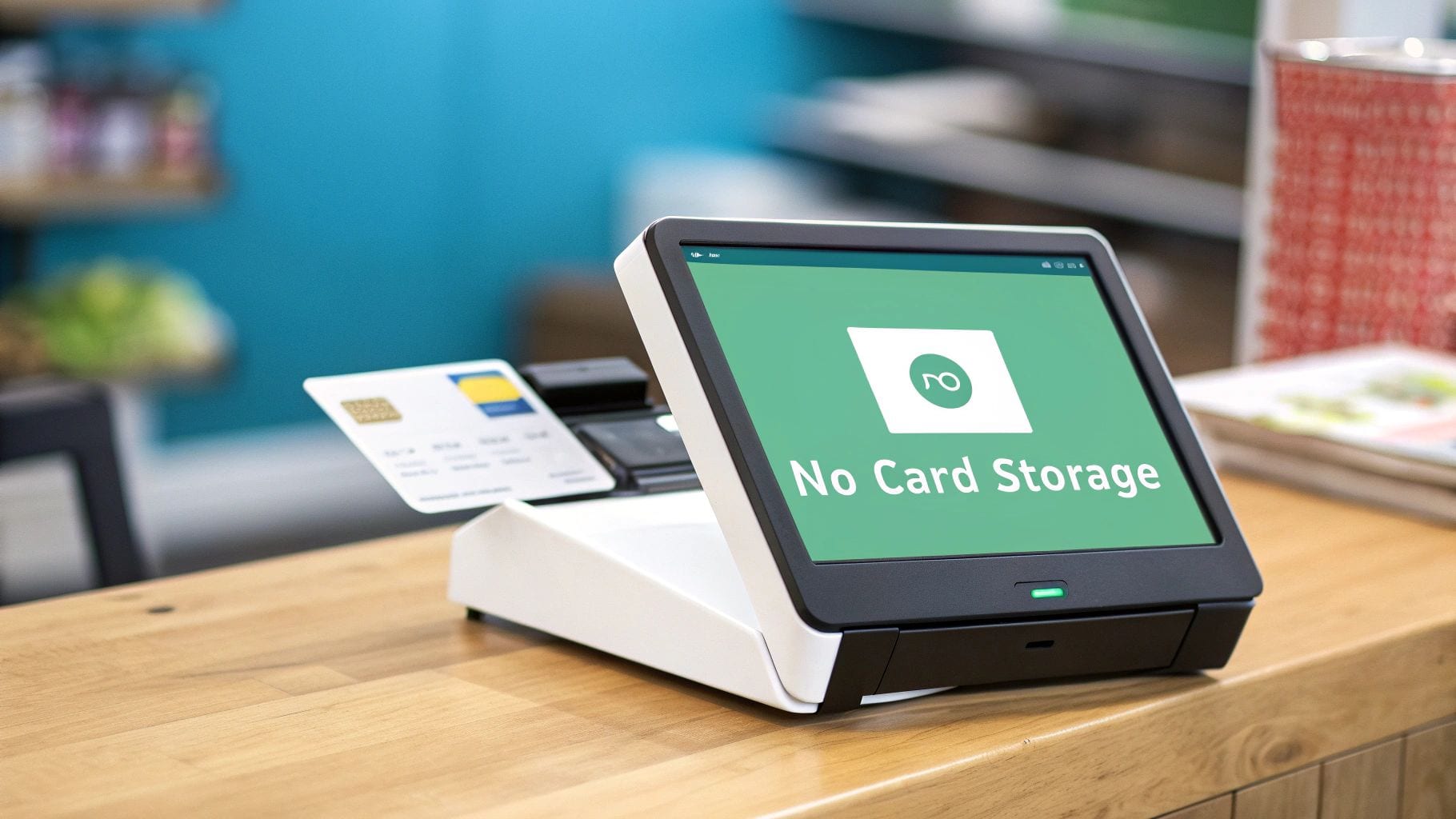
For eCommerce and retail businesses, a data retention policy governed by the Payment Card Industry Data Security Standard (PCI DSS) is non-negotiable. This framework is designed to protect cardholder data and strictly limits the retention of what's known as sensitive authentication data (SAD). The core principle is that if you don't need it, you shouldn't store it, as this minimizes the risk and scope of a potential data breach.
PCI DSS mandates that data like CVV codes, full magnetic stripe data, and PINs must be deleted immediately after a transaction is authorized. While broader transaction details (e.g., amount, merchant, date) can be kept for business needs like refunds and analytics, they must be stored securely and separately from any cardholder data. This distinction is vital for creating effective data retention policy examples for the retail sector.
Real-World Examples
- Shopify: As a PCI Level 1 compliant provider, Shopify tokenizes all card data, meaning merchants using its platform never store or even see full card numbers in their accounts. This offloads a significant part of the compliance burden.
- Stripe: The payment processor acts as an abstraction layer, handling PCI compliance on behalf of its users. Merchants interact only with tokens and the last four digits of a card number, not the raw, sensitive data.
- Amazon Pay: By centralizing payment handling, Amazon ensures that merchants using its service never directly touch or manage raw card data, which dramatically simplifies their PCI DSS obligations.
Actionable Takeaways and Implementation
Implementing a PCI DSS-aligned policy is about minimizing your data footprint and securing what remains. This approach is essential for any business processing card payments.
- Embrace Tokenization: Use a payment processor like Stripe, Adyen, or Square that specializes in payment tokenization. Never store raw card data in your own databases or data warehouse.
- Segregate Data: Keep general transaction data (amount, date, merchant ID) separate from any sensitive payment information. The former can be retained for longer periods to support analytics and financial reporting.
- Audit and Document: Implement annual PCI DSS audits and maintain clear documentation proving that sensitive authentication data is securely deleted immediately post-transaction.
- Train Your Teams: Educate developers, marketers, and analysts on what data is prohibited from being tracked or stored. This includes full card numbers, CVV codes, and full expiration dates, ensuring they are not accidentally sent to analytics tools or marketing pixels.
7. SaaS & Enterprise Software Data Retention Policy Template (ISO 27001, SOC 2)
For SaaS and enterprise software providers, a data retention policy is a critical component of security, compliance, and customer trust. This framework is heavily influenced by industry standards like ISO 27001 and SOC 2, as well as specific customer contracts. It governs how customer-uploaded data is managed, balancing the provider's operational needs with the customer's ownership and right to erasure.
This policy model often permits longer retention of customer data, frequently defined by the duration of a service agreement. However, it mandates secure and complete deletion upon customer request or at the end of a contract, typically after a short grace period. This approach is fundamental for B2B services where data security and auditable processes are non-negotiable, making it a key part of any list of data retention policy examples.
Real-World Examples
- Salesforce: The platform defaults to a 90-day deletion period for customer data after a subscription ends. However, data within backups for disaster recovery may be retained for longer, isolated periods.
- HubSpot: Following a contract termination, HubSpot provides a 90-day window before permanently deleting customer and contact data. For security purposes, audit logs are retained for 180 days.
- Slack: The retention schedule for Slack varies by plan. After a workspace is deleted, there is a 30-day data export window, with full deletion occurring within 30 to 90 days, depending on the subscription tier.
Actionable Takeaways and Implementation
Implementing a SaaS-focused retention policy requires a clear distinction between customer data and internal operational data, with rigorous controls for both.
- Define Contractual Defaults: Clearly state a default retention period in all customer contracts and terms of service. For example, specify "data will be permanently deleted 90 days post-cancellation, including from all backup systems."
- Separate Data Tiers: Classify customer-owned data (Tier 1) separately from internal product analytics and usage telemetry (Tier 2). While Tier 1 data is subject to strict deletion upon contract termination, Tier 2 anonymized or aggregated data can be retained longer for product improvement.
- Automate Deletion and Audits: Implement automated workflows to handle data deletion requests and end-of-contract purges. Crucially, audit these processes to ensure data is removed from all systems, including backups and third-party analytics destinations like Mixpanel or Amplitude.
- Document Compliance Holds: Establish and document a clear protocol for "compliance holds." This ensures that data subject to litigation, regulatory investigations, or other legal obligations is preserved beyond its standard retention period.
8. Marketing & AdTech Data Retention Policy Template (Programmatic Advertising, CDPs)
For marketing teams, demand-side platforms (DSPs), and customer data platforms (CDPs), a data retention policy must walk a fine line between regulatory compliance and marketing effectiveness. This framework is designed to manage audience segments, behavioral data, and attribution windows, balancing the need for historical data against privacy obligations under laws like GDPR and CCPA.
The core principle is to define retention periods based on the data's maturity and purpose. Raw event data, which is highly granular and often contains identifiers, requires a shorter lifespan than aggregated, anonymized audience segments used for high-level analysis. This tiered approach allows marketers to retain valuable insights for strategic planning while minimizing the risk associated with holding identifiable user data for extended periods.
Real-World Examples
- Google Marketing Platform: The platform offers configurable retention for event-level data, typically between 14 to 26 months, while aggregated and anonymized audience data may be kept indefinitely.
- The Trade Desk: This DSP often ties audience segment retention to a user's last activity, with windows ranging from 60 to 365 days depending on the segment's source and purpose.
- Tealium CDP: As a Customer Data Platform, Tealium provides highly configurable retention schedules. A common default for raw event data is 13 months, but this can be adjusted by audience segment to meet specific business and legal needs.
Actionable Takeaways and Implementation
Implementing an AdTech-focused retention schedule is a crucial part of any list of data retention policy examples because it addresses the high-velocity, high-volume data environment unique to modern marketing. A well-defined policy ensures that audience building and ad attribution do not create unnecessary compliance risks.
- Define Retention by Data Maturity: Create a tiered policy. Set short retention periods for raw event data (e.g., 3-6 months), moderate periods for processed user-level data (e.g., 6-13 months), and longer or indefinite periods for fully anonymized, aggregated segments.
- Separate First-Party and Third-Party Data: Apply stricter retention rules to data acquired from third-party sources. Your policy for first-party data, collected directly from your own digital properties, can be aligned more closely with your documented business purposes and user consent.
- Link Retention to Consent: Automate processes to shorten or trigger the deletion of data when a user withdraws consent or exercises their right to opt-out. This is a non-negotiable requirement for GDPR and CCPA compliance.
- Monitor Your Data Payloads: Continuously monitor the data sent to marketing destinations to ensure PII is not inadvertently stored in long-term contexts like audience segments. Implementing robust data governance for analytics is essential for maintaining control over data flows.
Comparison of 8 Data Retention Policy Templates
Putting Policy into Practice: The Key Takeaways
Navigating the landscape of data retention is far more than a compliance checkbox; it is a strategic imperative that directly impacts your organization's legal standing, operational efficiency, and customer trust. The diverse data retention policy examples we've explored, from HIPAA's stringent healthcare requirements to the dynamic needs of SaaS and AdTech, reveal a core truth: context is king. A one-size-fits-all policy is not just ineffective, it's a significant risk.
The journey from understanding these examples to implementing a robust policy within your own organization requires a deliberate, multi-faceted approach. Your policy must be a living document, not a static file stored away on a server. It must be a practical framework that guides day-to-day operations while being flexible enough to adapt to the relentless pace of regulatory change and technological evolution.
Synthesizing the Core Principles
Across all the templates and industry-specific scenarios, several foundational principles emerge as non-negotiable for building a successful data retention strategy. These are the strategic pillars that support every well-crafted policy.
- Principle of Data Minimization: This is the bedrock. Only collect what you absolutely need, and only keep it for as long as you have a legitimate, documented purpose. This single principle drastically reduces your risk surface area and simplifies compliance.
- Purpose-Bound Retention: Every piece of data should have a "why" and a "how long" attached to it. The examples for marketing cookies versus server logs illustrate this perfectly; their value and legal justification for retention have vastly different timelines.
- Documentation is Your Defense: If it isn't written down, it didn't happen. A clear, accessible, and version-controlled policy document is your primary line of defense in an audit or legal inquiry. It demonstrates intent and due diligence.
- Automation as a Safeguard: Manual enforcement of data deletion and anonymization is prone to human error and is simply not scalable. Automating these processes wherever possible is crucial for ensuring your documented policies are actually followed in practice.
Your Actionable Next Steps
Translating these principles into action is the most critical step. Based on the detailed data retention policy examples provided, here is a clear roadmap to get started or refine your existing framework.
- Conduct a Comprehensive Data Audit: You cannot protect what you do not know you have. Start by mapping all your data assets. Identify where data is collected, where it is stored, who has access, and its current retention period (if any).
- Assemble a Cross-Functional Team: Data governance is a team sport. Involve stakeholders from Legal, IT, Marketing, and Data/Analytics. This ensures all business needs and legal obligations are considered, leading to a more practical and respected policy.
- Draft Your Policy Using Relevant Templates: Use the examples in this article as a starting point. Select the templates that most closely align with your industry (e.g., HIPAA, PCI-DSS, GDPR) and customize them based on your specific data types and business justifications.
- Define and Automate Enforcement Workflows: For each data category, define the specific technical process for deletion or anonymization. Work with your engineering teams to implement automated scripts and lifecycle policies in your databases, cloud storage, and analytics platforms.
- Monitor, Review, and Iterate: A policy is only effective if it's followed. Implement continuous monitoring to detect deviations from your policy. Schedule regular reviews (at least annually) to update the policy in response to new regulations, technologies, or business objectives.
Ultimately, mastering your data retention strategy is about transforming a perceived compliance burden into a powerful competitive advantage. A well-executed policy fosters deep customer trust, streamlines data management, and fortifies your organization against significant financial and reputational risk. It's a clear signal to the market that you are a responsible steward of the data entrusted to you, building a foundation of integrity that will pay dividends for years to come.
A meticulously crafted data retention policy is your blueprint, but how do you ensure your real-world data collection and processing actually follow the plan? Trackingplan provides the essential observability and governance layer, automatically scanning your data flows to detect any discrepancies between your policy and reality. See how our platform can act as your automated safeguard, ensuring your data practices perfectly align with your documented policies, by visiting Trackingplan.