
You already did the creative work. You tested copy, rotated audiences, adjusted bids, and watched Meta’s recommendations. But the account still feels slippery. ROAS is flat, attribution breaks between dashboards, and nobody fully trusts the conversion numbers.
That usually points to a measurement problem, not just a media buying problem.
A broken pixel does not announce itself. A missing purchase event can sit unnoticed for days. A bad UTM convention can split reporting across campaigns and make a winning ad look average. Consent misconfigurations can stop tags from firing. Server-side events can drift from browser events. By the time someone notices, the team has already made budget decisions on incomplete data.
This is why a serious facebook ads audit tool should do more than score campaign structure or flag weak creatives. It should help you verify the technical layer that determines whether Meta is receiving the right signals in the first place. That means checking pixels, event schemas, attribution settings, UTMs, consent behavior, and the handoff between your site, app, server, and analytics stack.
The need for that deeper audit is not theoretical. Active accounts with consistent spend typically need quarterly full audits, while measurement and permissions deserve monthly spot checks because data integrity issues compound quickly, according to AdManage’s Facebook ads audit guidance. The problem is simple. Manual audits leave long gaps between reviews.
The tools below help in different ways. Some are best for continuous data QA. Others are stronger for creative diagnostics, account scoring, or enterprise workflow control. If your biggest risk is silent tracking failure, start with the platforms built for observability. If your issue is account hygiene, creative fatigue, or scale, there are solid options for that too.
1. Trackingplan
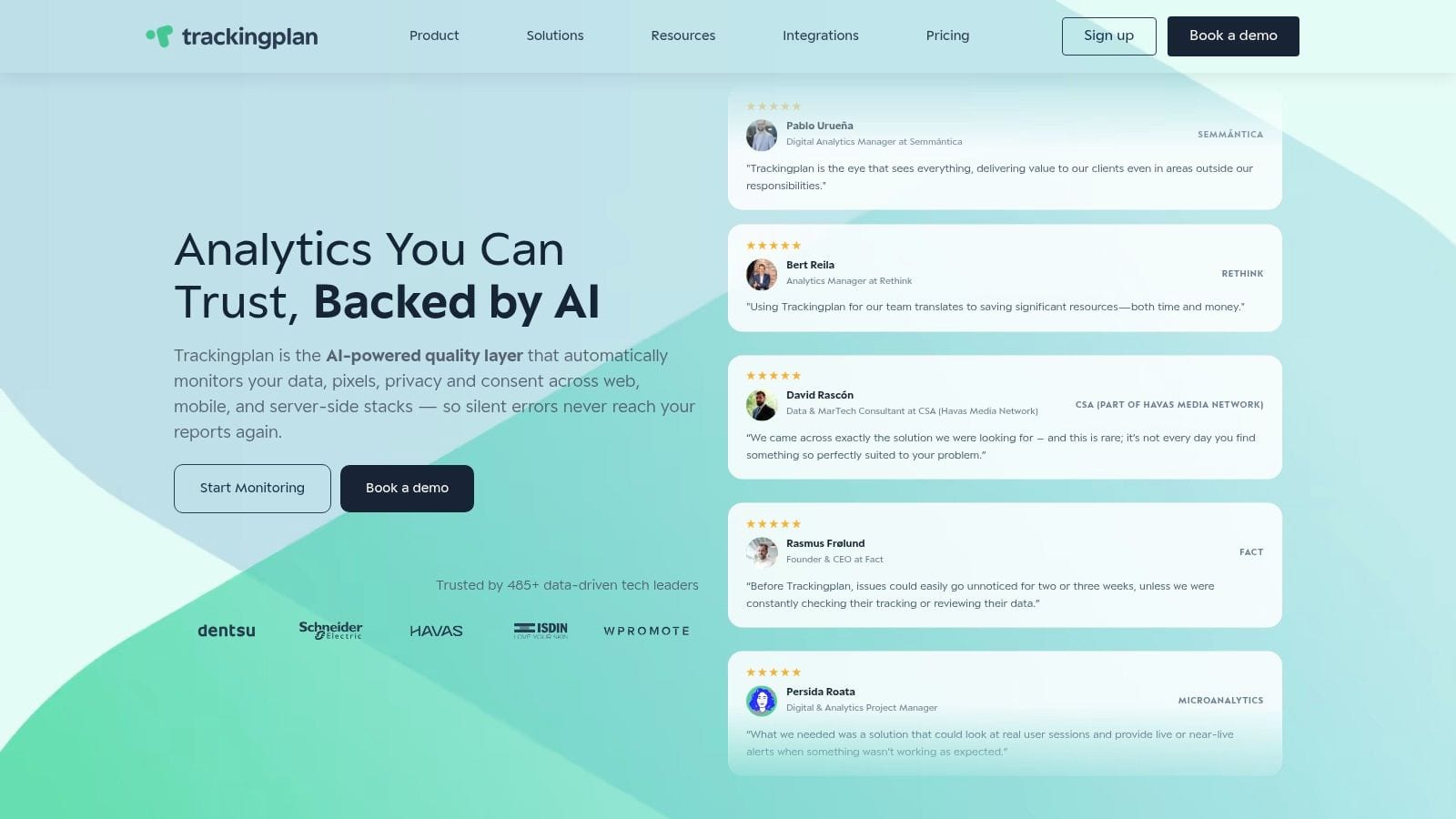
A common failure looks like this. Meta spend is stable, creative is working, and reported ROAS drops after a site release. The problem is not bidding. A purchase parameter disappeared, consent blocked the pixel on part of the traffic, or UTMs started arriving in inconsistent formats.
Trackingplan is built for that kind of audit. It focuses on the measurement layer behind Facebook performance, including pixels, events, UTMs, destinations, and server-side tracking across web and app environments. That focus matters because weak data integrity can distort optimization decisions long before anyone reviews campaign settings.
Why it stands out
Trackingplan discovers the tracking setup automatically instead of depending on a spreadsheet that someone has to maintain by hand. It maps events, properties, pixels, UTMs, and downstream destinations, then monitors live traffic continuously. This distinction matters because point-in-time audits often miss the exact issues that break attribution between reviews.
In practice, that means teams can catch specific failures early. A deploy strips a purchase parameter. A rogue event starts firing. Campaign tags stop matching the naming convention used in reporting. A consent banner blocks Meta on one device type but not another. Trackingplan can alert the team through email, Slack, or Microsoft Teams before those gaps spread into Meta reporting and budget decisions.
That always-on approach fills a gap many audit tools leave open. It is much closer to observability for marketing data than a traditional account grader.
A useful detail for lean teams is the setup. The platform uses a lightweight tag or SDK, so teams can start monitoring without turning the rollout into a long engineering project.
To get a feel for how the platform works in practice, this video is a good starting point:
Where it fits best
Trackingplan is a strong fit for teams that need to verify whether Meta is receiving clean, stable signals.
- Analysts validating attribution: It helps confirm that event schemas, parameters, and destinations are consistent enough to support reporting and model-based optimization.
- Performance marketers running multiple channels: It catches UTM and pixel issues that can distort Meta comparisons against Google, CRM, or analytics data.
- Agencies managing several accounts: It reduces implementation drift across clients and makes hidden tracking failures easier to spot before review meetings.
- Privacy-conscious teams: It can flag possible PII leakage and consent-related firing issues before they become reporting or compliance problems.
The AI-assisted debugger also adds practical value. A lot of platforms can identify that tracking changed. Fewer help teams narrow down likely root causes and prioritize fixes based on business impact.
Trade-offs
- Pricing visibility is limited: Public pricing detail is not fully exposed, so smaller teams may need a longer buying process before they can compare it against simpler audit tools.
- Low-traffic properties take longer to evaluate: If the site or app does not generate much volume, the platform needs more time to observe patterns and surface the most useful anomalies.
For teams that care more about data quality than surface-level account scores, Trackingplan belongs at the top of the list. It covers the part of a Facebook ads audit that usually decides whether performance analysis is reliable in the first place.
2. Adzooma
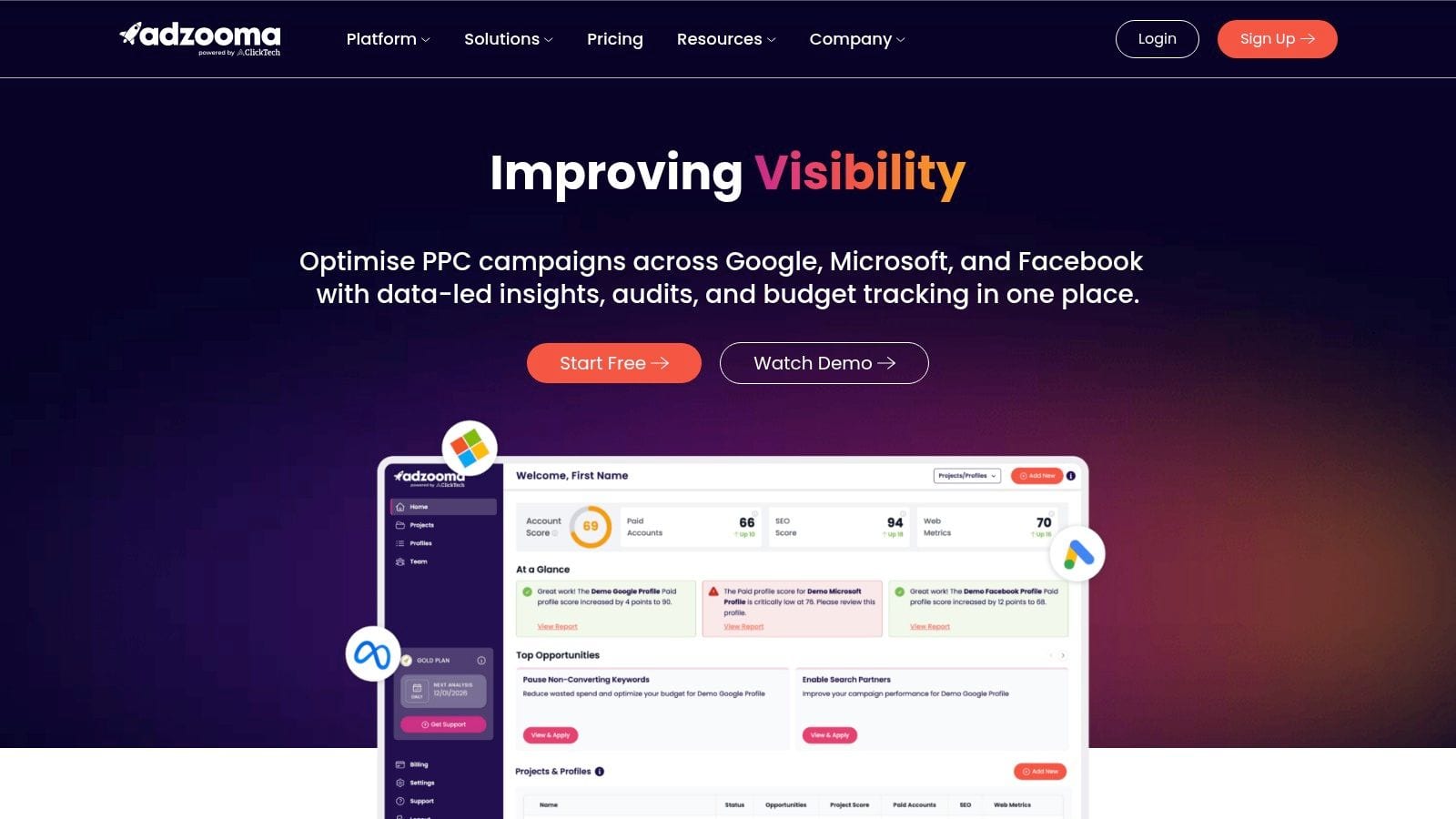
Adzooma is useful when you need a fast health check rather than deep technical observability.
Its Meta audit is built for speed. Connect the account, run the audit, and get a practical read on campaign setup, delivery blockers, wasted spend patterns, and optimization opportunities. That makes it a solid first pass for in-house teams, freelancers, and agencies that want a recurring baseline without building a full QA workflow around it.
Best use case
Adzooma works well in three situations:
- Pre-engagement audits: Agencies can use it to assess a prospect’s account before proposing changes.
- Recurring account reviews: It gives account managers a simple way to revisit setup issues and performance patterns.
- Cross-channel teams: If your team also manages Google or Microsoft, the broader PPC context is helpful.
The main strength is accessibility. Some tools overwhelm users with technical detail before they answer the obvious question: is the account healthy enough to scale? Adzooma gets to that answer quickly.
It is also a better choice than many “free grader” style tools if you want something that can move from one-off review into a more regular operating rhythm.
Where it falls short
Adzooma is not the tool I would choose for validating event quality, schema consistency, consent issues, or server-side tracking health. It can surface tracking-related concerns at a high level, but it is not built to monitor your implementation in the way a dedicated observability platform does.
That distinction matters because measurement issues often sit underneath apparent media performance issues. A campaign can look inefficient when the underlying problem is incomplete conversion capture.
Use Adzooma when you need triage. Do not use it as your only line of defense against broken data collection.
Paid tiers unlock more reporting depth and agency-friendly features like white-label outputs, which is useful. But if your core question is “Did a deploy break Meta purchase tracking yesterday?”, you need a different class of tool.
3. Madgicx
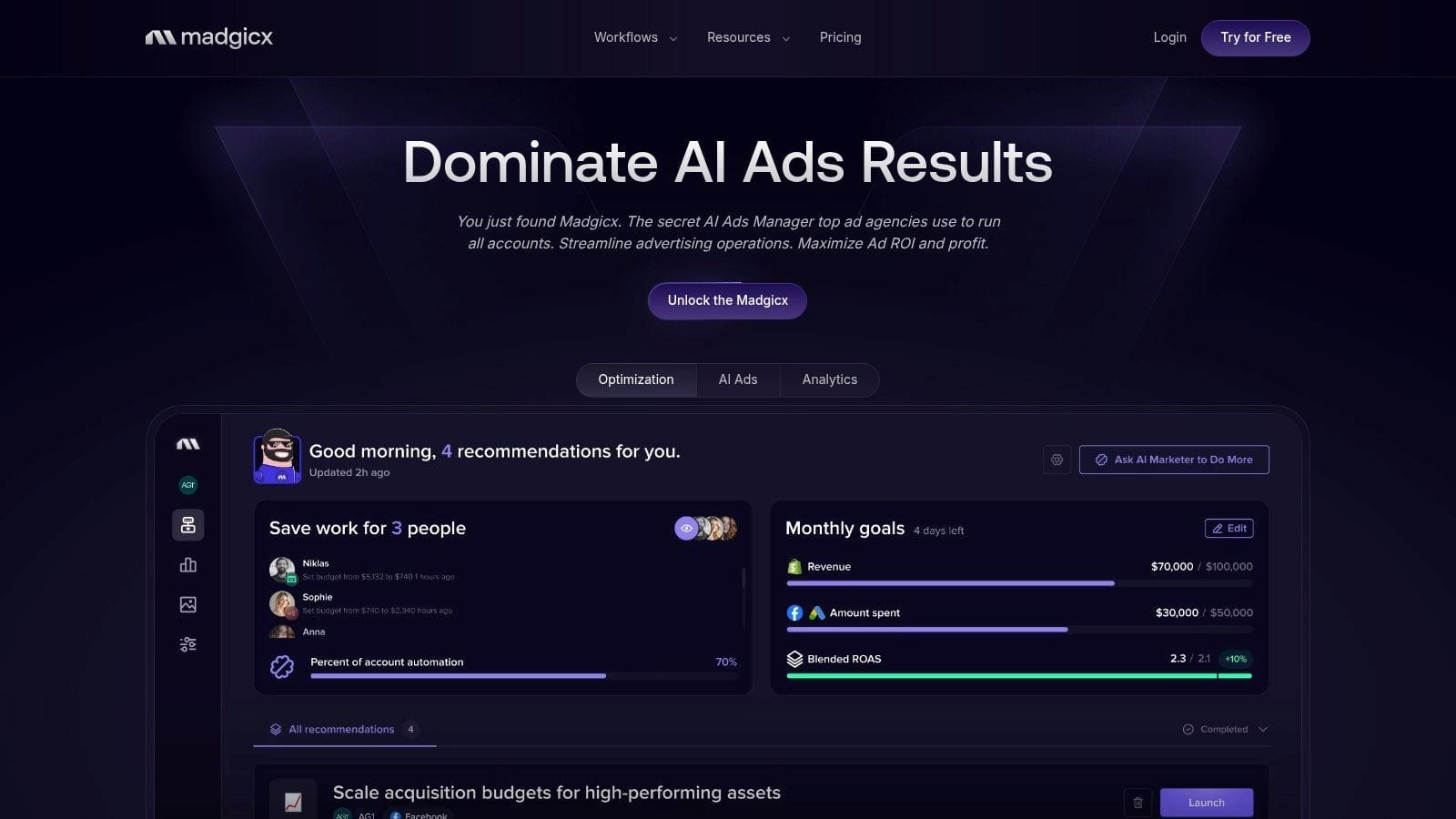
Madgicx is for teams that want audit and optimization in one operating layer.
Instead of treating an audit as a separate report, Madgicx ties account analysis directly to automation. It scans account structure, budget allocation, creative fatigue, and other Meta account signals, then pushes recommendations that can be acted on inside the platform.
What it does well
Madgicx is strongest when the problem is execution at scale.
Creative fatigue is a good example. In Facebook audits, one common sign of fatigue is rising costs, lower engagement, and increasing frequency without better results. Benchmarks commonly used in audits include CTR above 1% as a healthy sign and ROAS above 2x as a profitability threshold (depending on margins), according to Bestever’s Facebook ads audit guide. Madgicx fits that workflow because it connects creative diagnostics to action, rather than leaving the analyst with a static observation.
Its Meta-first orientation is also a plus. Generic PPC tools often spread themselves too thin. Madgicx is designed around how Meta teams work, especially when many campaigns, audiences, and creatives need attention at once.
Practical trade-offs
Madgicx is less compelling if your main concern is technical tracking integrity. It helps identify symptoms in campaign performance, but it does not specialize in monitoring broken event pipelines, UTM drift, or consent configuration issues.
The other concern is cost clarity. Spend-scaled pricing can make sense for serious media buyers, but teams should watch billing fit closely as account complexity grows. Some buyers love having optimization and workflow automation in one place. Others decide the additional layer is not worth it compared with Meta’s native tools plus a separate analytics QA product.
If your team wants a Meta-native optimization cockpit, Madgicx deserves consideration. If your team needs hard proof that the conversion data itself is clean, it should sit beside, not replace, a tracking-focused tool.
4. Lebesgue
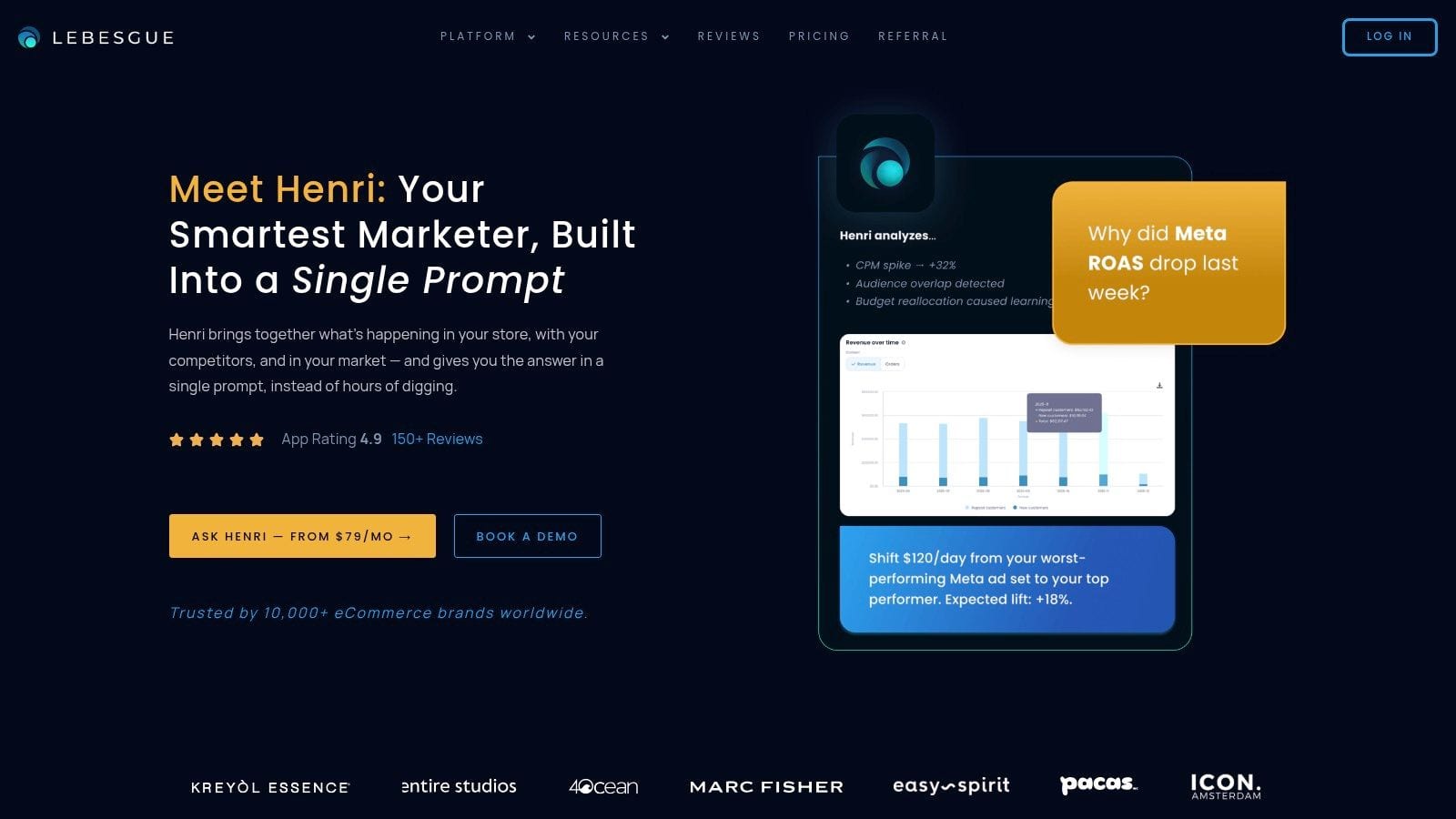
Lebesgue is built with ecommerce operators in mind, especially Shopify brands that want Meta audit guidance tied to merchandising and growth decisions.
That focus matters. A general facebook ads audit tool may tell you the campaign structure is messy. Lebesgue is better at answering the ecommerce version of the question: are you spending efficiently, are your campaigns aligned with store economics, and what should you change next?
Why Shopify brands like it
Lebesgue combines ad account checks with benchmark context, AI recommendations, and optional first-party attribution tooling. That package is appealing for DTC teams that do not want six separate products just to understand what is happening across Meta and Google.
A practical advantage is transparent pricing. Compared with enterprise-style tools that require a call before you can even estimate budget fit, Lebesgue is easier for smaller brands to evaluate.
It also helps bridge the awkward gap between diagnosis and action. Many audits identify problems but leave the team with generic advice. Lebesgue tends to push more concrete next steps around budget use, creative direction, and account hygiene.
What to watch
This is not the best pick for non-commerce advertisers. Lead gen teams, apps, publishers, and multi-brand enterprises may find the Shopify-centric framing too narrow.
Its optional attribution layer is useful, but it also means the full picture may require an additional paid component rather than the base product alone. And like most performance analytics platforms, it is stronger on strategic interpretation than on continuous validation of every event and parameter in your implementation.
For ecommerce brands that want a practical audit plus merchant-friendly recommendations, Lebesgue is easy to shortlist. For technical measurement governance, pair it with something deeper.
5. WordStream by LOCALiQ
WordStream’s Facebook advertising tools are the classic “start here” option.
If you want a quick baseline without budget approval, this is one of the easiest ways to get directional feedback. It flags issues like wasted spend, weak audience setup, mismatched objectives, and performance gaps against broader benchmarks.
Why it still earns a spot
Not every audit needs enterprise software. Sometimes a team needs a fast read before deciding whether to invest in a deeper tool, bring in an agency, or clean up the account internally.
That is where WordStream works. It is fast, accessible, and useful as a sanity check. For smaller advertisers, that may be enough to spot obvious account hygiene issues.
The hard limitation
It is a grader, not a monitoring system.
That means it does not solve the problem this article is really centered on: silent data quality failures. It can tell you the account looks inefficient. It cannot reliably tell you whether the purchase event is firing with the right schema, whether UTMs are fragmenting campaign reporting, or whether browser and server signals are aligned.
So the value here is context. WordStream can tell you whether the top layer looks healthy. It cannot certify the measurement foundation underneath it.
For teams early in their audit process, that is still useful. Just do not confuse a broad score with technical assurance.
6. CreativeX
CreativeX takes a different angle. It audits the creative itself.
That sounds narrower than a full facebook ads audit tool, but for large brands it is often exactly the missing piece. Media teams can spend months debating CPM, CPC, and targeting while the creative operation remains inconsistent across markets and formats.
Where CreativeX is strongest
CreativeX scores ad assets against creative quality and compliance standards, then connects those assessments to media performance. For enterprise teams, that makes it easier to answer questions like:
- Are our Meta ads following platform best practices consistently?
- Which brands or regions produce assets that meet standards most often?
- Are we spending behind low-quality creative without realizing it?
This is particularly helpful when many stakeholders touch the ad pipeline. Brand teams, agencies, local markets, and paid media managers rarely work from one unified review process. CreativeX gives them one.
Why it is not enough on its own
CreativeX is not trying to be your optimization engine or your tracking QA layer. It complements those systems.
That distinction matters because creative underperformance and data underperformance can look similar in the dashboard. If conversion rates drop, one team may blame weak hooks while another blames broken event capture. CreativeX can help settle the creative side of that question. It cannot validate whether your measurement implementation is intact.
For enterprise advertisers, that makes CreativeX a high-value specialist. For smaller teams, it may feel too process-heavy unless creative governance is already a major operational problem.
7. Motion
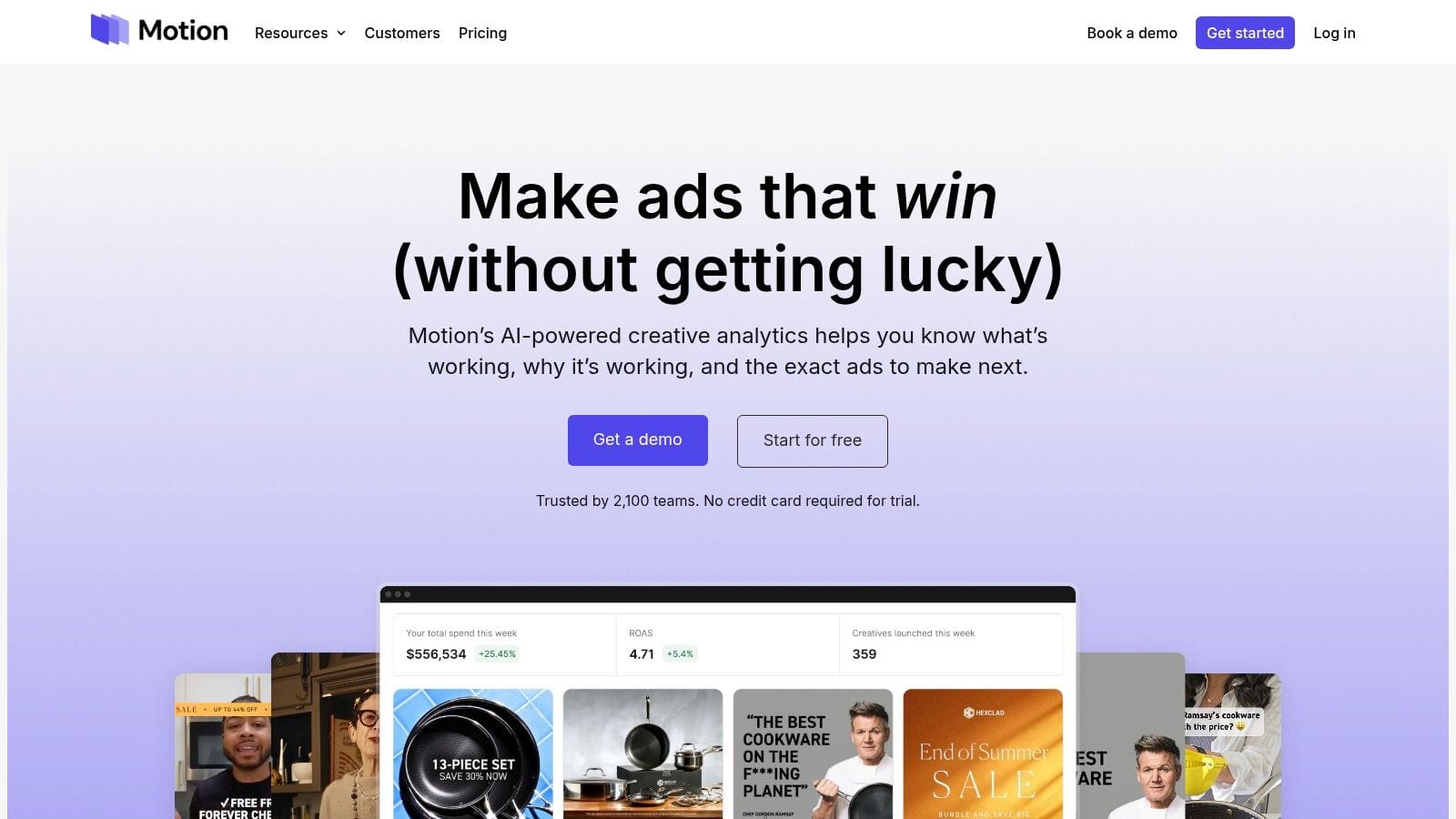
Motion is one of the better tools for creative analytics when the team wants to know why certain Meta ads win.
Its orientation is visual and production-friendly. Instead of dumping users into raw ad account data, Motion groups creatives, tags patterns, builds leaderboards, and helps teams connect hooks, formats, and themes to outcomes.
Why creative teams adopt it quickly
Media buyers and creative strategists often look at separate dashboards. Motion closes that gap better than most.
A creative team can see which concepts are tiring out, which angles are holding attention, and which formats deserve another round of production. That makes it useful as a recurring creative audit system rather than a one-time report.
For teams dealing with fatigue, this matters. Meta accounts often decline not because targeting suddenly failed, but because the creative stayed in market too long.
What it does not cover
Motion is not built to diagnose structural account issues or technical implementation problems. It is focused on creative performance analytics.
That means it should not be your only facebook ads audit tool if your organization struggles with event quality, attribution discrepancies, or broken tagging. But if your data plumbing is already strong, Motion can help answer the next question: what should the creative team make next, and what should they stop making?
8. Vaizle
Vaizle is a practical option for smaller teams that want an AI-assisted audit experience without buying into a heavier enterprise stack.
Its appeal is straightforward. The product guides users through Meta account auditing, highlights likely issues, and adds a chat-style AI layer that can answer account questions in plain English.
Who gets value from it
Vaizle makes the most sense for:
- Small in-house teams: It lowers the expertise barrier for basic audit work.
- Consultants and freelancers: It speeds up triage and client-ready observations.
- Teams that prefer guided workflows: The AI assistant helps people who do not want to dig manually through every account view.
This style of product is useful when the main bottleneck is time and audit confidence, not advanced infrastructure control.
Where caution helps
AI explanations are convenient, but they still need source-data validation. That is especially true in ad accounts with messy attribution, old campaigns, or inconsistent naming conventions.
I would treat Vaizle as a strong assistant, not the final authority. It can help surface what deserves attention. But for high-stakes decisions, teams still need to confirm the underlying account and tracking details directly.
In other words, Vaizle is good at making audits easier to start. It is less suited to becoming the permanent measurement backbone for a complex martech stack.
9. Smartly.io
Smartly.io is what large advertisers use when Facebook auditing is inseparable from creative production, automation, and market-level execution.
This is not a lightweight audit app. It is an operating system for scaled social advertising.
Why enterprise teams choose it
Smartly is built for advertisers managing many campaigns, markets, catalogs, and creative variants. In that environment, “audit” means more than checking a few settings. It means validating account structure, creative coverage, dynamic ad setups, and production workflows across a large operation.
That is where Smartly shines. It supports high-volume asset generation, testing, and media automation in one environment.
The broader trend also supports tools like this. Meta’s Advantage+ automated detailed targeting has reached adoption rates in the 50 to 75 percent range among advertisers, according to Uproas’ roundup of Facebook ads statistics. As Meta pushes more automation, teams need stronger governance around how campaigns, audiences, and creative systems work together.
Why it is not for everyone
Smartly is powerful, but it is heavy.
Smaller brands usually do not need this much process, and many will not want the implementation load or quote-based pricing. It is best for enterprises where scale itself creates operational risk.
Even then, Smartly still does not replace a dedicated observability layer for event validation and data QA. It improves the machine that runs campaigns. It does not specialize in monitoring every possible break between your site, app, server, and destinations.
10. Skai
Skai is the right fit when Meta is important, but not the whole story.
Some teams do not need a Meta-first audit environment. They need a cross-channel command center where Facebook sits alongside search, retail media, and other paid channels. Skai serves that audience well.
Where Skai earns its keep
Its strength is governance and scaled workflow control across large programs. If a team manages campaigns in multiple channels and multiple markets, a Meta-only audit product can create another silo. Skai avoids that by putting diagnostics, editing, reporting, and oversight into one enterprise layer.
This matters for organizations where budget allocation decisions happen across channels, not within one platform.
The reporting side also benefits from established tooling in this category. Platforms for Facebook reporting and audit workflows are already used widely. For example, Social Status notes that Swydo is used by more than 2,000 companies across 80 countries, which reflects how much demand there is for centralized visibility and reporting discipline in paid social operations.
What it cannot solve alone
Skai is still an enterprise management platform, not a purpose-built tracking QA product. It can help teams organize and review campaigns at scale, but it is not the first tool I would choose to detect rogue events, UTM schema drift, or consent-related signal loss.
That is the core trade-off with many enterprise suites. They are excellent at operational control. They are less specialized in the low-level integrity checks that determine whether ad data is trustworthy in the first place.
Top 10 Facebook Ads Audit Tools Comparison
A Facebook ads audit usually starts with spend, structure, and creative. The harder problem shows up later. Meta reports conversions, GA4 shows a different story, UTMs are inconsistent, and no one is fully sure whether the pixel, the Conversions API, or the consent setup is dropping signal. That is the gap this comparison needs to address.
The tools below do different jobs. Some grade account performance. Some help creative teams review output at scale. A smaller group helps verify whether the tracking layer behind those results is reliable.
| Product | Core capability | Key benefits | Best for | Unique selling point | Pricing (entry) |
|---|---|---|---|---|---|
| Trackingplan | Always-on analytics QA across web, app, server, pixels, events, and UTMs | Detects broken or changed tracking early; monitors real traffic; flags privacy and naming issues | Analysts, marketers, engineering, agencies | Continuous tracking assurance with root-cause clues and impact estimation | From $99/month (Starter); 9-day free trial; Enterprise via PoC |
| Adzooma: Meta Ads Performance Audit | Instant Meta Ads account audit focused on campaign setup and account health | Quick recommendations; recurring reports; agency-friendly output | Agencies and in-house teams that need a fast account review | One-click audit workflow for Meta accounts | Freemium; paid tiers add refreshes and reports |
| Madgicx: 360° Meta Audit and Optimization | Meta-focused audit, automation, and AI recommendations | Connects audit findings to optimization actions; supports scale inside Meta | Advertisers running larger Meta programs | AI recommendations that can be turned into account changes | Paid; scales with ad spend |
| Lebesgue: Advertising Audit + AI CMO | Audit and recommendation layer for ecommerce, with strong Shopify alignment | Benchmarking, decision support, and merchant-friendly reporting | DTC brands and Shopify merchants | Ecommerce-specific analysis with optional attribution tooling | Transparent pricing; attribution add-on extra |
| WordStream (LOCALiQ): FB Ads Performance Grader | Automated Facebook ads grader with benchmark-style scoring | Fast baseline review; easy for non-specialists to use | Advertisers who want a quick health check | Free grader with simple comparative scoring | Free |
| CreativeX: Creative Quality Audit | Creative governance and quality scoring | Standardizes creative review and links quality signals to media outcomes | Enterprise creative and brand teams | Creative Quality Score and quality-spend measurement | Enterprise, quote-based |
| Motion: Creative Analytics for Meta | Creative analysis focused on hooks, formats, and performance patterns | Helps teams review fatigue, winning concepts, and creative mix | Creative strategists and media buyers | Strong visual reporting and creative grouping | Paid; scales with ad spend |
| Vaizle: Meta Ads Audit and AI Agent | Guided audit workflow with AI-assisted recommendations | Accessible recommendations, calculators, and benchmark support | Small teams and agencies | Chat-style audit assistant for Meta reviews | Free or low-cost entry; upgradeable AI Pro |
| Smartly.io: Enterprise Creative + Media Automation | Large-scale creative production, testing, and media execution | Supports high-volume workflows and automated testing | Enterprise advertisers with heavy production needs | Tight connection between creative operations and paid social delivery | Quote-based enterprise pricing |
| Skai (formerly Kenshoo): Cross-Channel Management | Omnichannel management, reporting, and diagnostics | Cross-channel oversight, governance, and bulk workflow control | Large enterprises managing multiple paid channels | Cross-channel audit and management model | Enterprise, annual program pricing |
A practical way to read this table is by audit depth.
If the goal is a quick account review, tools like Adzooma, WordStream, and Vaizle are useful. They surface campaign-level issues fast. That helps with account hygiene, but it does not answer whether your event schema changed last week or whether broken UTMs are corrupting downstream attribution.
If the goal is Meta optimization at scale, Madgicx can be a stronger fit. If the goal is creative governance, Motion and CreativeX are better aligned. If the goal is enterprise execution across channels, Smartly.io and Skai make more sense.
Trackingplan stands apart because it addresses the measurement layer directly. That matters when the audit question is not just "Are these campaigns set up well?" but "Can we trust the conversion and attribution data behind these decisions?" For teams dealing with pixel drift, duplicate events, server-side mismatches, missing parameters, or UTM inconsistency, that is a different class of audit problem.
That distinction matters in practice. A campaign can look healthy in Ads Manager while the underlying tracking is degrading. A useful audit tool should match the failure mode you are trying to catch.
Meta ads audit checklist
Whichever tool you pick, these are the checks to run on a Meta Ads account, and the rules worth automating once the audit is done.
This checklist is designed to be versatile. You can follow it for a one-off manual review, but its real power comes from using it as a blueprint to set up rules and alerts in your audit tool. Doing so transforms a periodic check into a constant, 24/7 data governance system that works for you.
Pixel and Tag Health
This is ground zero. If your Meta Pixel isn't firing correctly, none of the downstream data can be trusted. Your audit tool should be set to continuously verify that your pixel is present and performing as expected across every critical user journey.
Here’s what your checks need to cover:
- Pixel Presence: Is the Meta Pixel actually loading on all your key pages? Don't just check the homepage; look at landing pages, product pages, every step of the checkout flow, and especially the thank-you pages.
- Correct Pixel ID: Are you positive you’re firing the right Pixel ID? In agency settings or businesses with multiple accounts, it’s surprisingly common to accidentally deploy a client's pixel on the wrong site.
- No Duplicate Pixels: Is the same pixel firing more than once during a single page load? This is a classic mistake that inflates your traffic metrics and can seriously disrupt your event tracking.
Event Integrity and Schema Validation
Once you’ve confirmed your pixel is healthy, the focus shifts to the quality of the data it sends. Event integrity means making sure every user action is captured once, captured correctly, and includes all the necessary information. An automated audit tool is practically a necessity for maintaining this level of detail.
Your validation rules should focus on these key areas:
- Critical Event Firing: Are your core conversion events like
ViewContent,AddToCart, andPurchaseactually firing when users perform those actions? You'd be surprised how often they don't. - No Duplicate Events: Is a single user action, like a customer clicking "Complete Purchase," triggering multiple
Purchaseevents? This is a notorious budget-waster that leads to wildly inflated conversion numbers. - Schema Adherence: Does every event consistently match its predefined schema? For instance, does your
Purchaseevent always includevalueandcurrencyproperties with the correct data types?
To give you a clearer picture, here’s a prioritized list of critical checks and how an automated tool helps manage them.
Automated Meta Ads Audit Checklist
| Audit Checkpoint | Common Problem | Automated Solution |
|---|---|---|
| Pixel Presence | Pixel fails to load on key conversion pages or new landing pages. | Continuously scans all site pages and alerts if the pixel is missing from any defined user journey. |
| Duplicate Events | A single user action triggers the same event multiple times, inflating metrics. | Monitors event streams in real time and flags any duplicate event instances for immediate investigation. |
| Schema Mismatch | An event fires but is missing a critical property (e.g., Purchase without a value). | Validates every event against a predefined schema and sends an alert if properties are missing or have the wrong data type. |
| UTM Compliance | New ad campaigns are launched without mandatory UTM parameters. | Scans all inbound traffic from ads and flags any URL that doesn’t adhere to your established UTM conventions. |
| Consent Violations | Tracking fires before a user gives consent, risking non-compliance. | Integrates with your consent management platform to verify that pixels only fire after consent is granted. |
This table illustrates how automation turns a reactive, manual process into a proactive, reliable data governance system.
Campaign Tagging and Attribution
Inaccurate campaign tagging makes reliable attribution a fantasy. Your audit tool should act as the strict enforcer of your UTM conventions, alerting you the moment a non-compliant ad goes live. This is absolutely critical for connecting your ad spend to real business outcomes.
Make sure your automated rules are set up to verify:
- Required UTM Parameters: Are all your ads properly tagged with mandatory parameters like
utm_source,utm_medium, andutm_campaign? - Consistent Naming Conventions: Do your campaign, ad set, and ad names follow the logical structure your team agreed on? Consistency is key for clean analysis later.
By methodically working through these checkpoints, you can build a foundation of clean, reliable data. For a deeper dive, you can learn more about how to audit marketing pixels to ensure truly accurate analytics. This checklist gives you the framework for creating a trustworthy data engine for all your Meta Ads activities.
From Reactive Audits to Continuous Assurance
A one-time Facebook audit still has value. It can catch obvious account issues, highlight weak campaign structure, surface creative fatigue, and show whether your team is following basic best practices. But it only captures a moment in time.
That is a weakness of the traditional audit model.
Your tracking setup can change any day. A developer ships a new checkout flow. A consent banner update changes tag behavior. A mobile release drops an event parameter. A server-side connector starts sending malformed data. Someone launches a campaign with broken UTMs. None of those failures wait politely for the next quarterly review.
That is why the best facebook ads audit tool is no longer just a scoring engine or a checklist app. The more useful category is continuous assurance.
Manual reviews still matter. They help teams step back and evaluate strategy, creative coverage, structure, and governance. But if your business depends on Meta for serious revenue or lead volume, you also need a system that watches the technical layer continuously. Otherwise, you are optimizing on top of unstable measurement.
This gets even more important as Meta automation expands. Advantage+ adoption has grown significantly among advertisers, and that means more decisions happen inside systems your team does not fully control. The more automation you accept from the ad platform, the more discipline you need around data quality, event integrity, attribution settings, and consent handling on your side.
There is also a practical team issue. Analysts, marketers, developers, and agency partners rarely work from the same source of truth. The media buyer sees rising CPA. The analyst sees reporting drift. The developer says nothing changed. The agency blames creative. Without shared observability, those conversations stay vague and expensive.
A strong audit workflow fixes that by separating three layers clearly:
- Performance layer: Are campaigns, ads, placements, and audiences working?
- Creative layer: Are assets fresh, compliant, and likely to hold engagement?
- Measurement layer: Are pixels, events, parameters, UTMs, and destinations firing correctly?
Most tools on this list handle one or two of those layers well. Very few handle the third in a serious, continuous way.
That is why Trackingplan stands out. It is built for the failure mode many teams discover too late. Silent data loss. Broken event mapping. Schema drift. Consent issues. UTM inconsistency. Pixel breakage that makes a healthy campaign look broken or a broken campaign look healthy. Those are not cosmetic problems. They distort budget decisions.
The strongest setup is usually a combination. Use a creative-focused platform if ad fatigue is a recurring issue. Use an account-level optimizer if you need faster operational execution. But anchor the stack with continuous monitoring for data quality. That gives every other decision a trustworthy foundation.
If your team is still relying on periodic spot checks and Ads Manager screenshots, you do not have an audit system. You have a hope-based process.
The teams that spend confidently on Meta are not just better at bidding or testing. They are better at protecting the measurement layer underneath those actions.
If Meta performance matters to your business, do not wait for the next broken dashboard to discover a tracking problem. Trackingplan gives analysts, marketers, developers, and agencies continuous visibility into pixels, events, UTMs, consent behavior, and destination health so they can catch issues early and fix them before attribution breaks.