
TL;DR:
- First touch attribution assigns all credit to the initial customer interaction, mainly measuring brand awareness. Its effectiveness depends on accurate tracking and is limited by ignoring subsequent touchpoints in complex buying journeys. Combining it with other models and robust technical implementation provides more reliable marketing insights.
First touch attribution is defined as a single-touch marketing model that assigns 100% of conversion credit to the very first interaction a customer has with your brand. It is the simplest form of marketing attribution, and it answers one specific question: which channel introduced this customer to us? The model is most effective for measuring brand awareness and top-of-funnel demand generation, where knowing what sparked initial interest matters more than tracking every subsequent step. Understanding its mechanics, its limits, and when to move beyond it is what separates marketers who allocate budgets well from those who guess.
What is first touch attribution and how does it work?
First touch attribution assigns 100% of conversion credit to the initial customer interaction, ignoring every touchpoint that follows. The mechanics are straightforward: when a prospect first lands on your site through a paid search ad, that channel receives full credit for any conversion that eventually occurs, regardless of how many emails, retargeting ads, or sales calls came after.

The model works in three steps. First, your analytics or CRM system captures the initial traffic source using UTM parameters, referrer data, or a tracking pixel. Second, that first-touch value gets stored in a persistence layer, such as a cookie or a CRM field. Third, when a conversion fires, the system looks up the stored first-touch source and credits it fully.
The clearest use cases for first touch attribution include:
- Brand awareness campaigns where you want to know which channel generates net-new prospects
- Top-of-funnel content programs, such as SEO or podcast sponsorships, where the goal is audience introduction
- Early-stage companies with short sales cycles and limited touchpoints
- Measuring which paid channels pull in first-time visitors before any nurture sequence begins
Pro Tip: Set up UTM parameters consistently across every awareness channel before you launch. Inconsistent tagging is the fastest way to corrupt first-touch data at the source.
The model’s strength is its clarity. You get a direct read on which channels are doing the work of introducing new prospects. For teams running awareness campaigns, that signal is exactly what they need.
What are the limitations and common pitfalls of first touch attribution?
First touch attribution ignores 100% of subsequent touchpoints, which makes it unsuitable for complex buying journeys. A B2B prospect who first finds you through a LinkedIn ad, then reads three blog posts, attends a webinar, and finally converts after a sales demo: the LinkedIn ad gets all the credit. The webinar and the demo get nothing.
This creates real budget risk. Teams that rely only on first-touch data tend to overvalue awareness channels while undervaluing nurture and closing efforts like email sequences, retargeting, and sales follow-ups. The false conclusion is that nurture channels had no impact on revenue. That assumption leads to cutting the channels that actually close deals.
The most common pitfalls include:
- Ignoring nurture channels: Email sequences and sales follow-ups receive zero credit, even when they directly drive conversion decisions
- Mismatched lookback windows: A default 30-day lookback window is insufficient for B2B sales cycles that run 180 days or longer, causing misattribution to direct traffic or last touch
- Data overwrite: If your CRM or analytics tool overwrites the first-touch value with a later interaction, the model becomes unreliable
- Skewed budget decisions: Overinvesting in top-of-funnel channels based on first-touch data alone can starve mid-funnel and closing programs of budget
Pro Tip: Before trusting any first-touch report, audit whether your CRM fields are locked after the first write. A field that updates on every visit is not storing first-touch data. It is storing last-touch data mislabeled as first-touch.
The attribution model choice must map to sales cycle length. For sales cycles under 30 days with simple journeys, first touch can suffice. For anything longer or more complex, it produces a distorted picture.
How does first touch attribution compare with other attribution models?
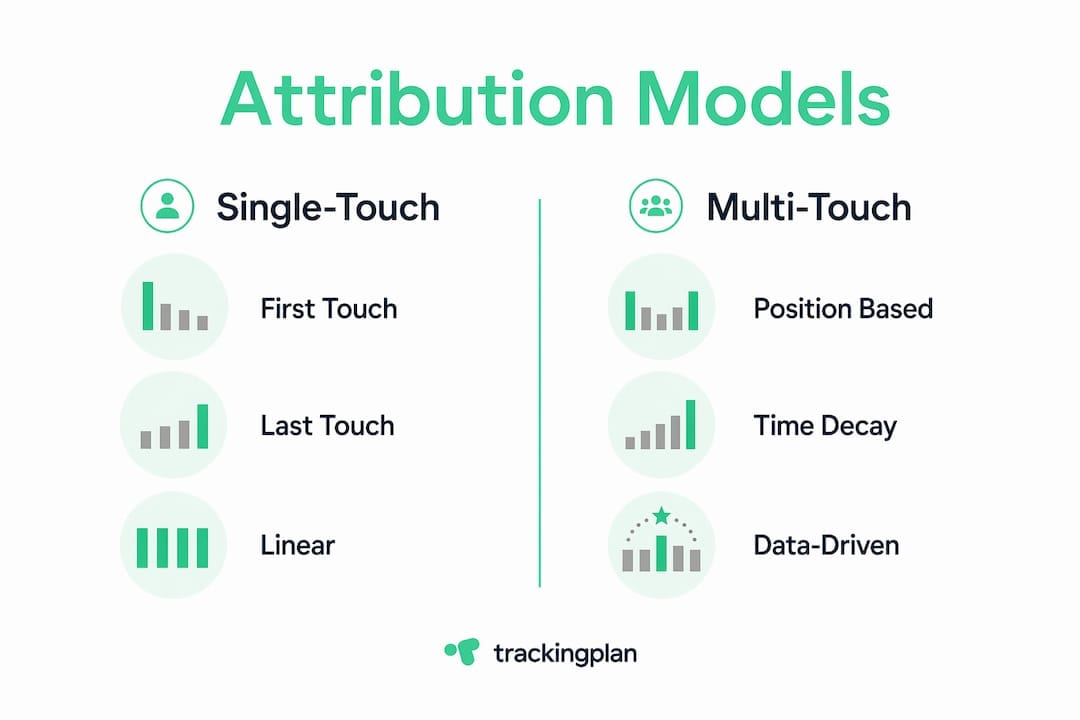
Single-touch models like first touch and last touch are simple but narrow. Multi-touch models distribute credit across multiple interactions and give a fuller picture of the customer journey. The right model depends on your sales cycle, conversion volume, and what question you are trying to answer.
| Model | Credit distribution | Best use case | Key bias |
|---|---|---|---|
| First touch | 100% to first interaction | Brand awareness, top-of-funnel | Overvalues acquisition channels |
| Last touch | 100% to final interaction | Conversion optimization, closing | Overvalues closing channels |
| Linear | Equal credit to all touchpoints | Long journeys with consistent nurture | Treats all touches as equal |
| Time decay | More credit to recent touches | Short sales cycles, promotional campaigns | Undervalues early awareness |
| Position-based | 40% first, 40% last, 20% middle | B2B with defined acquisition and close stages | Undervalues mid-funnel |
| Data-driven | Credit based on statistical impact | High-volume teams with 600–1,000+ conversions per month | Requires large data sets to be valid |
Marketing experts recommend first-touch attribution for awareness campaigns, but advise mature teams with high conversion volumes to shift to multi-touch or data-driven models. The reason is statistical: data-driven models need enough conversions to find meaningful patterns. Running data-driven attribution on 50 conversions a month produces noise, not insight.
The position-based model is a practical middle ground for B2B teams. It gives significant weight to both the first and last touch while acknowledging that something happened in between. For teams with complex B2B journeys and multiple defined stages, position-based attribution credits both the channel that opened the door and the channel that closed the deal.
First touch works best as one lens among several, not as the only measurement you run. Pairing it with last-touch data tells you both where customers come from and what closes them. That combination is more useful than either model alone.
When should marketers integrate first touch attribution into their strategy?
First touch attribution fits cleanly into awareness measurement, but it needs to sit inside a broader measurement framework to be useful. Running it in isolation produces directional data at best and misleading conclusions at worst.
- Start with first touch for new channel testing. When you launch a new awareness channel, such as a podcast sponsorship or out-of-home campaign, first-touch data tells you whether it is generating net-new prospects. That is the right question at the right stage.
- Run parallel models from day one. Do not wait until you have a problem to add a second model. Set up last-touch and linear attribution alongside first touch so you can compare signals and spot where they diverge.
- Add incrementality testing as volume grows. In 2026, 52% of US marketers integrate incrementality testing with attribution models to validate channel performance. Incrementality testing tells you what would have happened without a given channel, which no attribution model can do on its own.
- Transition to multi-touch or data-driven models at scale. Once you reach consistent conversion volume, first touch becomes a supporting signal rather than the primary one. Use it to track top-of-funnel health while data-driven models handle budget allocation.
- Align your model choice to your sales cycle. A SaaS product with a seven-day free trial and a self-serve checkout can run on first-touch data effectively. An enterprise software sale with a six-month cycle cannot.
Pro Tip: Use first-touch data to inform your content and SEO investment. If organic search consistently appears as the first touch for your highest-value customers, that is a strong signal to invest more in content before expanding paid channels.
Measuring brand awareness with AI analytics has made it easier to connect top-of-funnel signals to downstream outcomes. Pairing those tools with first-touch data gives you a richer picture of how awareness converts over time.
What technical considerations ensure accurate first touch tracking?
Accurate first touch attribution depends on your technical setup more than your model choice. A well-chosen model running on broken tracking produces wrong answers with high confidence.
The critical technical requirements are:
- Persistent storage: Hardcoding first-touch values into CRM fields and persistent cookies prevents overwrites. If your CRM updates the lead source field on every new session, you are not running first-touch attribution. You are running last-touch attribution by accident.
- Correct lookback window configuration: Setting the lookback window too short relative to your sales cycle causes inaccurate attribution. A 30-day default window misses the first touch for any prospect who converts after 31 days. Match your lookback window to your actual median sales cycle length.
- Cross-domain tracking: If your marketing site and your product or checkout live on different domains, you need cross-domain tracking configured correctly. A broken cross-domain setup makes every conversion look like it came from direct traffic.
- Session timeout settings: Default session timeouts can split a single visit into multiple sessions, creating a false “first touch” mid-journey. Adjust timeout settings to match realistic browsing behavior for your audience.
- UTM parameter consistency: Every paid and owned channel needs consistent UTM tagging. A single untagged campaign contaminates your first-touch data for every prospect who enters through it.
Platform-reported attribution data should be treated as directional rather than exact. Privacy restrictions degrade tracking accuracy across browsers and devices, which means no single data source gives you the complete picture. Combining first-touch data with server-side tracking and CRM records reduces the gaps.
Trackingplan monitors your tracking implementation in real time, flagging broken pixels, missing UTM parameters, and schema mismatches before they corrupt your attribution data. Catching those errors at the source is far cheaper than discovering them after a quarter of bad budget decisions.
Key Takeaways
First touch attribution is a useful but narrow tool: it answers where customers come from, not how they convert, and its value depends entirely on clean technical implementation and the right business context.
| Point | Details |
|---|---|
| Core definition | First touch assigns 100% of conversion credit to the initial customer interaction. |
| Best use case | Use it for brand awareness and top-of-funnel measurement, especially with short sales cycles. |
| Primary limitation | It ignores all subsequent touchpoints, which skews budget decisions in complex journeys. |
| Technical requirement | Lock first-touch values in CRM fields and set lookback windows to match your actual sales cycle. |
| Strategic fit | Run first touch alongside multi-touch and incrementality testing for complete measurement coverage. |
Why I think first touch attribution gets misused more than any other model
Most attribution debates focus on which model is most accurate. That is the wrong question. Every model has bias. All attribution models should be used consistently to guide directional decisions, not treated as exact revenue counts. The real question is whether the model you are using matches the question you are trying to answer.
First touch gets misused because it is easy to implement and easy to understand. Teams adopt it by default, then make budget decisions as if it were telling the full story. I have seen companies cut email programs entirely because email never appeared as a first touch. Those same companies later discovered that email was the channel that converted the most first-touch organic leads into paying customers.
The shift in tracking privacy has made this worse. Cookie restrictions and browser-level blocking mean that first-touch data is less complete than it was three years ago. Treating incomplete data as complete data is how you end up with confident wrong answers. The move toward MMM, MTA, and incrementality testing in parallel is not a trend. It is a correction.
My advice: use first touch as a permanent fixture in your measurement stack for top-of-funnel health, but never let it drive budget allocation alone. Pair it with at least one multi-touch model and run incrementality tests on your highest-spend channels twice a year. That combination gives you the directional clarity of first touch without the blind spots. You can read more about building this kind of layered approach in Trackingplan’s guide on attribution in marketing strategy.
— David
How Trackingplan helps you protect attribution data quality
Attribution models are only as good as the data feeding them. A misconfigured pixel, an overwritten CRM field, or a missing UTM parameter silently corrupts every report you run.
Trackingplan monitors your entire analytics and attribution implementation automatically, detecting broken pixels, tracking errors, and campaign misconfigurations across your website, app, and server-side environments. Real-time alerts via Slack, email, or Teams mean your team catches data issues in hours, not at the end of a reporting cycle. For teams that need to maintain digital analytics data quality across complex Martech stacks, Trackingplan removes the manual audit work and replaces it with continuous monitoring. The Privacy Hub also helps teams stay compliant while preserving the measurement integrity that accurate attribution depends on.
FAQ
What is first touch attribution in simple terms?
First touch attribution gives 100% of conversion credit to the first channel or interaction that brought a customer to your brand. It tells you which channel introduced the prospect, nothing more.
When should I use first touch attribution?
First touch attribution works best for brand awareness campaigns and top-of-funnel measurement, particularly when your sales cycle is short and your customer journey has few touchpoints.
What is the biggest risk of relying only on first touch attribution?
The biggest risk is undervaluing nurture channels like email and retargeting, which receive zero credit even when they directly influence conversion decisions.
How does first touch attribution differ from last touch attribution?
First touch credits the initial interaction; last touch credits the final interaction before conversion. Both are single-touch models that ignore everything in between.
How do I keep first touch data accurate over time?
Lock first-touch values in a dedicated CRM field that does not update after the first write, set your lookback window to match your actual sales cycle length, and audit your UTM tagging across every channel regularly.
Recommended
- Why Last-Touch Attribution Is Blinding Your Marketing Strategy | Trackingplan
- Why accurate ad attribution is critical for smarter campaigns | Trackingplan
- What is marketing attribution? Guide for modern marketers | Trackingplan
- What Is Marketing Attribution A Guide To Proving Marketing ROI | Trackingplan