
Last-touch attribution is a marketing measurement model that gives 100% of the credit for a conversion to the very last interaction a customer has with your brand. Think of it as the final assist in a long, team-based play; every other touchpoint that came before is completely ignored. This simplicity makes it a breeze to implement, but it often paints a dangerously incomplete picture of your marketing performance.
Decoding Last-Touch Attribution

Picture a championship basketball game in its final seconds. The point guard expertly dribbles past defenders, a forward sets a perfect screen to create an opening, and the center delivers a flawless pass. Right at the buzzer, the shooter sinks the game-winning basket. The crowd goes wild for the final shot, but everyone knows the victory was a full-team effort.
Last-touch attribution is the marketing equivalent of giving that final shooter all the glory. It’s a single-touch model that assigns the entire value of a sale or lead to whatever marketing event happened right before the conversion, ignoring the crucial plays that made the shot possible.
All those earlier interactions—the blog post that built awareness, the social media ad that sparked interest, the email newsletter that nurtured the lead—get absolutely zero credit.
Why Is This Model So Common?
Despite its obvious blind spots, this model is incredibly popular. The main reason? It’s simple.
It’s straightforward to set up, easy for stakeholders to understand, and gives you quick, clear answers about which channels are "closing" deals. At its core, attribution is all about understanding marketing ROI by assigning credit to various touchpoints, and the last-touch model offers the most direct path to an answer, however flawed it may be.
This simplicity is why last-touch attribution remains so dominant, with a surprising 41% of marketers still actively using it to measure their online channel performance. Organizations often lean on it because it requires minimal technical setup and delivers immediate insights without getting bogged down in complex calculations. Its popularity is also a holdover from its time as the default setting in widely-used platforms like Google Analytics.
Last-touch attribution is like reading only the last page of a novel and trying to understand the entire plot. You know how it ends, but you have no idea about the character development, the rising action, or the critical conflicts that led to the conclusion.
A Quick Snapshot
To establish a clear baseline, let’s quickly break down the core characteristics of this model. Grasping these traits is the first step toward recognizing both its uses and its significant blind spots. For a deeper dive into the broader topic, check out our guide on what marketing attribution is and how it works.
The table below summarizes its key features, highlighting why it’s so often the starting point for marketing teams.
Last-Touch Attribution at a Glance
This snapshot makes it clear: while last-touch offers a simple answer, it often hides the much more complex truth of the customer journey.
The Hidden Biases That Skew Your Results
While last-touch attribution looks simple on the surface, it doesn’t just simplify the customer journey—it actively rewrites it with a dangerous and predictable bias. The model systematically overvalues bottom-of-the-funnel channels, the ones designed to capture existing demand, while completely ignoring the top-of-funnel workhorses that created that demand in the first place.
Channels like branded search and remarketing ads almost always look like heroes under this model. Why? Because they're usually the very last step a customer takes. Someone who already knows your brand and is ready to buy will naturally search for your company name or click a retargeting ad to get to your site.
This creates a powerful "last-click bias," rewarding the final nudge rather than the foundational work that built awareness and trust from the get-go.
A Tale of Two Funnels
Let's walk through a real-world example. Imagine a customer, Sarah, who's looking for a new project management tool.
- Touchpoint 1 (Awareness): Sarah first discovers your brand by reading a detailed blog post titled "Top 10 Project Management Tools for Remote Teams," which she found through a generic, non-branded Google search.
- Touchpoint 2 (Consideration): A few days later, a targeted display ad for your tool catches her eye on a tech news site. She clicks through to explore the features page.
- Touchpoint 3 (Nurturing): She then signs up for your newsletter to download a free guide, and you send her a series of helpful emails over the next week.
- Touchpoint 4 (Conversion): Now convinced, she searches for "[Your Brand Name] pricing" on Google, clicks the first result, and signs up for a paid plan.
In this scenario, last-touch attribution gives 100% of the credit to the final branded search click. The insightful blog post, the engaging display ad, and the nurturing email campaign? They get zero recognition for their critical roles in moving Sarah from a curious prospect to a paying customer. It's a narrow view that can lead to some truly catastrophic budget decisions.
The True Cost of Invisibility
This built-in bias doesn't just mess with your reports; it directly impacts your bottom line. When your analytics consistently tell you that branded search and retargeting are your star performers, the logical next step is to pour more money into them.
At the same time, you might look at your top-of-funnel channels, like content marketing or social media, and see them generating zero direct conversions. The data would suggest cutting their budgets, as they seem to be underperforming.
By rewarding only the final interaction, last-touch attribution can mislead you into defunding the very marketing activities that fill your funnel. You end up optimizing for the finish line while starving the initiatives that get runners on the track in the first place.
This is a self-defeating cycle. As you cut the awareness-building channels, the pool of people who know your brand shrinks. Over time, fewer people will be searching for your brand name or be eligible for retargeting, causing your "hero" channels to decline as well. You've effectively choked off your own long-term growth engine by focusing only on what happens at the very end.
The core issue is that last-touch attribution assigns 100% credit to the final interaction before conversion, completely ignoring every touchpoint that came before. If a customer first finds you through a Facebook ad, later clicks an Instagram story, visits your site, gets an abandoned cart email, and finally buys through a Google Shopping ad, the entire conversion value goes to that final ad. This creates huge blind spots in your marketing data, a problem you can explore further by reading these attribution insights on Embryo.com.
How Last-Touch Stacks Up Against Other Models
Relying solely on last-touch attribution is like watching only the final scene of a movie and trying to guess the entire plot. You know how it ends, but you miss the character development, the rising action, and all the crucial moments that led to that finale. To really understand its strengths and weaknesses, you have to see how it compares to other common attribution models.
Each model tells a different story about the customer journey, casting a different hero in the lead role.
The image below shows the fundamental bias of last-touch in a nutshell: all the glory goes to the final step before the conversion.
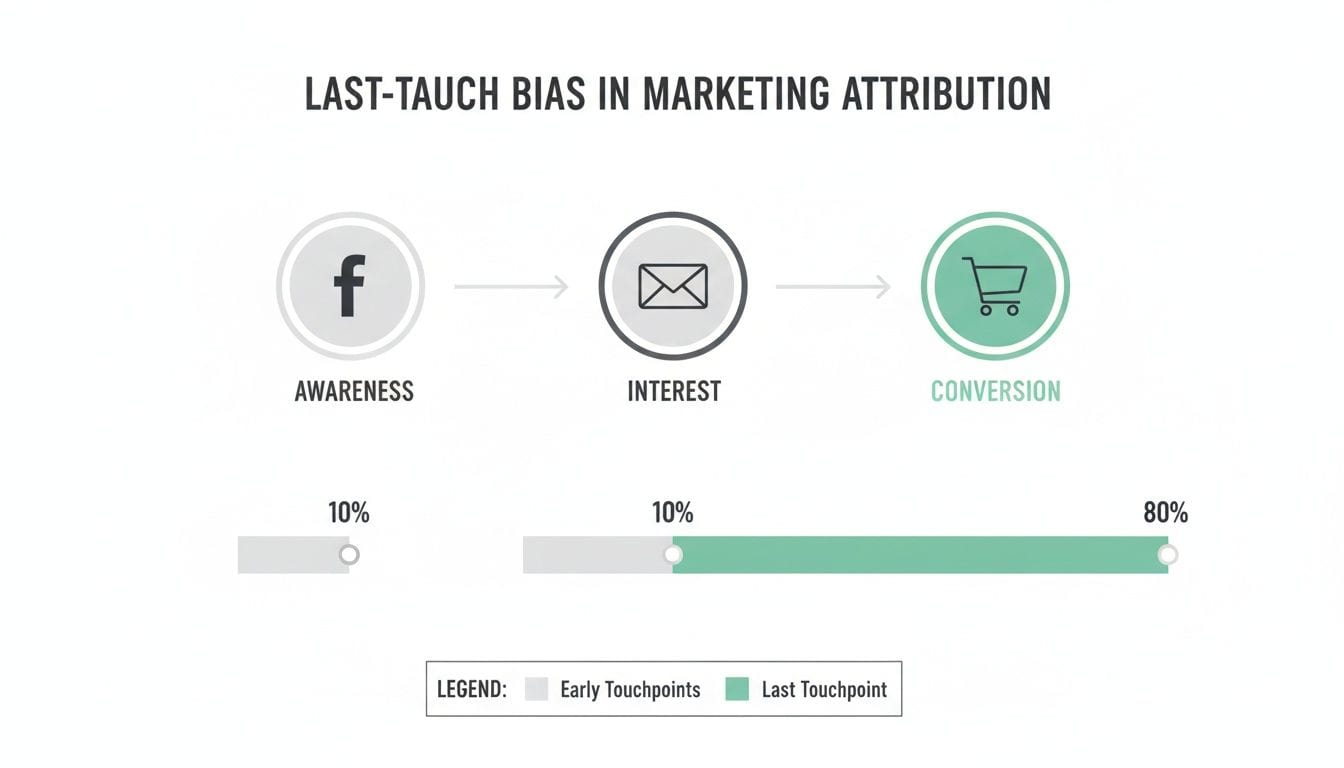
This picture makes it crystal clear—the earlier touchpoints that built awareness and nurtured interest get zero credit, creating a dangerously skewed view of what’s actually driving your growth.
To make this tangible, let’s follow a single customer journey for a $100 purchase. This customer interacted with the brand four times before buying:
- Paid Social Ad: Discovered the brand scrolling through Instagram.
- Organic Search: Googled a related term and found a blog post.
- Email Newsletter: Clicked a link in a promotional email they’d signed up for.
- Branded Search: Searched the company’s name directly and clicked a PPC ad to buy.
Now, let's see how different models would assign credit for this $100 sale.
First-Touch Attribution: The Origin Story
First-touch attribution is the mirror opposite of last-touch. It gives 100% of the credit to the very first interaction a customer has with your brand. It’s all about pinpointing what first sparked their interest and pulled them into your world.
In our example, the Paid Social Ad on Instagram gets the full $100 credit. This model is great for celebrating top-of-funnel channels and showing you what’s most effective at generating brand new leads. Its massive blind spot? It completely ignores every single thing that happened afterward to nurture that lead and actually close the sale.
Linear Attribution: The Democratic Approach
The linear model is all about fairness. It splits the credit equally across every single touchpoint along the customer’s path to purchase. Think of it as giving every player on the team equal recognition for the win, no matter what position they played.
For our $100 sale, all four touchpoints—Paid Social, Organic Search, Email, and Branded Search—would each get $25 in credit. While this approach rightly acknowledges that every interaction played some role, it makes a big assumption that all touchpoints are created equal, which is rarely the case.
Time-Decay Attribution: The Recency Bias
The time-decay model works on a simple premise: the closer a touchpoint is to the final conversion, the more influential it was. It gives the most credit to the last interaction and progressively less to the ones that came before it.
In our scenario, the Branded Search ad would get the lion's share of the $100 (say, $40), followed by the Email Newsletter ($30), then Organic Search ($20), and finally the initial Paid Social ad ($10). This model is particularly useful for businesses with longer sales cycles, as it rewards the channels that keep the brand top-of-mind right before a customer decides to buy.
U-Shaped (Position-Based) Attribution: The Bookend Method
Finally, we have the U-shaped model, also known as position-based. This one gives the most credit to the very first and very last touchpoints, then splits what’s left among all the interactions in the middle. Typically, it assigns 40% of the credit to the first touch, 40% to the last touch, and distributes the remaining 20% among the middle touches.
Using our example journey:
- Paid Social (First Touch): Gets $40 credit.
- Branded Search (Last Touch): Gets $40 credit.
- Organic Search & Email (Middle Touches): Each gets $10 credit.
This model is a popular compromise because it values the channels that both introduce new customers and close deals, rewarding both lead generation and conversion-focused efforts.
The table below provides a quick side-by-side comparison of how these models work and where they might fall short, helping you see the bigger picture beyond just last-touch.
Attribution Model Comparison
The stark contrast between these models drives home a critical truth: your choice of attribution model directly shapes your entire perception of marketing performance. While last-touch attribution gives you a simple, clean answer, it often leads you to undervalue the very channels that build initial awareness and trust—like that first Paid Social ad in our example, which last-touch completely ignores.
Why Clean Data Is Your Most Critical Asset

We can debate the merits of last-touch, first-touch, or multi-touch attribution all day long. But here’s the uncomfortable truth: none of it matters if your data is a mess. The old saying "garbage in, garbage out" isn't just a clever phrase—it's the unbreakable law of analytics.
Your attribution reports are only as trustworthy as the data that fuels them. Just one inconsistent campaign tag, a single broken tracking pixel, or a gap in your event collection can torpedo your results. You could end up shifting huge portions of your budget based on reports that are, frankly, wrong.
Before you can confidently give credit to any channel, you have to get your data house in order. Otherwise, you’re just measuring noise.
The Silent Killers of Attribution Accuracy
Some of the most destructive data quality issues are also the quietest. They don't set off alarms or crash your dashboard; they just slowly poison your attribution from the inside out, warping your view of what’s actually working.
These silent killers operate in the background, chipping away at your data integrity. If you're not actively looking for them, they can go unnoticed for months, leading you to make one bad decision after another.
Here are a few of the usual suspects:
- Inconsistent UTM Parameters: The marketing team uses
utm_source=Facebookwhile the agency usesfacebook.com. To your analytics platform, these are two completely different channels. This splits your data, makes your social campaigns look weaker than they are, and throws attribution completely off. - Broken or Missing Tracking Pixels: A pixel on your thank-you page fails to fire, or a tag on a third-party ad platform breaks. Suddenly, that interaction is invisible. This leaves a hole in the customer journey, and the credit often gets dumped into the wrong bucket, like "Direct" traffic.
- Cross-Domain Tracking Gaps: A user clicks an ad, lands on your main site, then moves to a separate subdomain to check out. If your cross-domain tracking isn't set up perfectly, the session breaks. Your analytics tool now sees a "new" visitor, and the original source that brought them to you is lost forever.
The accuracy of any attribution model, including last-touch attribution, is entirely dependent on the integrity of the underlying data. Minor inconsistencies in campaign tagging or a single broken tracking pixel can cascade into significant reporting errors, rendering your ROI calculations useless.
The Necessity of an Automated Defense
Let's be realistic: manually checking every single link, pixel, and event is impossible. With hundreds of campaigns and landing pages in play, human error is a given. The sheer scale of modern marketing makes manual audits a frustrating and inefficient exercise.
This is where automated analytics QA becomes non-negotiable.
Tools like Trackingplan are your first line of defense, constantly monitoring your entire analytics setup in real-time. Instead of finding a tagging error weeks after the fact, you get an alert the moment something breaks. This proactive approach is the only way to maintain the kind of pristine data that reliable attribution requires.
By automating the hunt for messed-up UTMs, broken pixels, and other data problems, you build a safety net for your analytics. You can learn more about building that strong foundation by checking out these data quality best practices. It’s how you ensure every marketing dollar is measured correctly, so you can finally trust the numbers your attribution model is showing you.
Automating Your Attribution Data Quality
So, we've covered the theory. Now it’s time to move from the why of data quality to the how. Manually checking every single campaign link, tracking pixel, and analytics event just isn’t feasible for modern marketing teams. The sheer volume of activity means mistakes aren't just possible—they're inevitable.
This is where automated monitoring completely changes the game. Instead of relying on painful, periodic audits that only find problems after they’ve already poisoned your data, an automated system acts like a 24/7 security guard for your entire analytics setup. It’s the difference between reviewing security footage after a break-in and having a real-time alarm that stops intruders at the door.
An automated platform provides that safety net, making sure every marketing dollar is measured accurately and that you're making decisions based on data you can actually trust.
Real-Time Detection for Flawless Attribution
Automated observability platforms like Trackingplan are built to solve the data quality crisis before it even starts. The system keeps a constant watch on your data flow, from the moment a user lands on your site to the second that data hits your analytics tools. It automatically flags the exact issues that wreck last-touch attribution reports.
This proactive approach means you catch and fix problems as they happen, preserving the integrity of your data and the reliability of your marketing insights.
Here are a few key issues an automated platform can spot instantly:
- Malformed UTM Parameters: If a campaign goes live with a typo in
utm_source(likefacebokinstead offacebook), the platform sends an immediate alert. This prevents a chunk of your traffic from being miscategorized. - Tagging Inconsistencies: It flags any deviations from your established naming conventions, ensuring
Paid_Socialisn't split into a dozen different variations that water down its reported impact. - Broken or Missing Analytics Events: When a critical conversion event like
purchase_completedsuddenly stops firing because of a code change, you’ll know right away—not at the end of the month when your revenue numbers look completely wrong.
By automatically validating every event and parameter against your predefined tracking plan, an automated QA system ensures that the data fueling your attribution models is consistently clean, complete, and correct.
From Alert to Resolution: A Practical Example
Let's walk through a real-world scenario. Imagine your marketing team launches a massive holiday campaign with a $50,000 budget. The campaign directs all traffic to a specific landing page using a unique UTM tag: utm_campaign=holiday_promo_2024.
A few hours after launch, a developer pushes a small update to the site’s header. Unknowingly, this update breaks the JavaScript that pushes the utm_campaign parameter into your dataLayer for certain browsers. All of a sudden, a huge portion of your expensive campaign traffic is being logged as "Direct" or "(not set)" in your analytics.
Without automation, this kind of error could fly under the radar for days. By the time someone on the marketing team finally notices the weird data in their reports, thousands of dollars in ad spend have been misattributed. The campaign's true ROI is now a total mystery.
With a tool like Trackingplan in place, the story is completely different.
- Instant Alert: Within minutes of the bad code going live, Trackingplan detects that the
utm_campaignproperty is missing from user sessions. An alert immediately fires off to your team’s Slack channel. - Root-Cause Analysis: The alert gives developers the exact context they need to pinpoint the problematic code change, saving them hours of frustrating guesswork.
- Rapid Fix: The team quickly rolls back the change or deploys a hotfix.
In this scenario, a single automated alert saves the entire campaign. The data stays accurate, the $50,000 budget is correctly attributed, and the team can confidently measure the campaign's true success. This is the practical power of shifting from reactive data cleanup to proactive data quality assurance.
How to Move Beyond Last-Touch Attribution
Now that we’ve pulled back the curtain on last-touch attribution’s limitations and the absolute necessity of clean data, it’s time to plot a new course. Ditching last-touch attribution isn’t like flipping a switch. It’s an evolution, a phased approach to building your marketing decisions on a foundation of rock-solid data.
To be fair, last-touch isn't always the villain. For businesses with lightning-fast sales cycles, like impulse e-commerce buys, it can work. When a customer sees an ad and clicks "buy" within minutes, the last click often does tell most of the story. But for everyone else, clinging to this model is a huge strategic blind spot.
The tide is turning. While single-source attribution is expected to hold a 48.70% market share by 2025, the real story is in the growth. Algorithmic and data-driven models are expanding at a blistering 14.3% CAGR, completely blowing past the simpler methods. This isn’t just a trend; it's a competitive imperative to get a complete picture of the customer journey. You can dig into more of this data in research from Future Market Insights.
Charting Your Path Forward
The best way to move to a more sophisticated attribution strategy is with a "crawl, walk, run" mindset. This progressive approach avoids chaos and builds confidence at every step, making sure your team is ready for what’s next.
The real goal isn't just to adopt a new model, but to build a culture of data integrity. A sophisticated attribution model running on junk data is more dangerous than a simple one on clean data—it gives you a false sense of confidence.
Your roadmap should be all about building capabilities one step at a time. Master the basics before you even think about jumping into complex, data-driven systems.
A Three-Step Evolution
Here’s a practical, step-by-step plan to guide your transition from last-touch to a more insightful model:
-
Crawl: Solidify Your Data Foundation. This is non-negotiable. Before you do anything else, get your data pristine. Enforce strict UTM tagging rules across every single campaign and team. Bring in an automated analytics QA tool like Trackingplan to constantly watch for tracking errors, broken pixels, and messy data. Get this right, or nothing else matters.
-
Walk: Experiment with Simple Multi-Touch Models. Once you can trust your data, it’s time to play around. Dip your toes into the other models available in your analytics platform. Start with simple ones like Linear or Time-Decay to see how credit shifts when it's not all piled onto the last click. This helps your team get comfortable with a multi-touch world without making a drastic, permanent change.
-
Run: Embrace Data-Driven Attribution. With a clean data pipeline and some experience reading multi-touch reports, you're finally ready for the big leagues. Data-driven models use machine learning to assign credit based on your specific business data, giving you the most accurate view of your marketing ROI possible. This is where you unlock true insight.
A Few Lingering Questions
Still have some questions floating around about last-touch attribution? Let's clear up a few of the most common ones that marketers run into.
Is Last-Touch Attribution Ever Actually a Good Choice?
Yes, but its use case is incredibly narrow. Think of businesses with super short sales cycles, like low-cost e-commerce products where someone sees an ad and buys almost on the spot. In those scenarios, it can be a simple starting point.
But for most businesses, where the journey from "hello" to "here's my credit card" is more complex, it offers a dangerously incomplete picture. Its simplicity is tempting, but it often hides more than it reveals.
How Does Google Analytics Handle Attribution?
Good question. By default, Google Analytics 4 uses a data-driven attribution model, assuming your account has enough data to power it. This is a smart model that divvies up credit based on how your property has performed historically.
That said, you can still switch to other models. This includes the old "last non-direct click" model from Universal Analytics, which is just a slightly tweaked version of last-touch attribution that simply ignores direct traffic as the final interaction.
What's the First Step to Adopting a Better Model?
The absolute, non-negotiable first step is getting your data clean and trustworthy. Before you can even think about relying on a multi-touch model, you have to know the data feeding into it is pristine.
This means enforcing strict UTM tagging rules across every single campaign and, ideally, using an automated QA platform to constantly monitor for tracking errors. Building a solid data foundation isn't just a suggestion—it's the only way forward.
Ready to build that solid data foundation? Trackingplan automatically keeps an eye on your analytics and marketing tags, catching errors before they have a chance to corrupt your reports. Ensure your attribution data is always accurate and reliable.