Discover the key features for analytics platforms that ensure reliable insights and powerful data integration in this 2026 guide. Explore now!
TL;DR:
- Analytics platforms must unify data, enforce consistent metrics, and deliver trustworthy insights at scale. Choosing the right platform prevents fragmented reports, broken attribution, and unreliable decisions. Key features include deep data integration, governed semantic layers, native AI, real-time processing, and enterprise security.
Analytics platforms are defined by their ability to unify data, enforce consistent metrics, and deliver trustworthy insights at scale. For data analysts and marketing professionals, choosing the wrong platform means fragmented reports, broken attribution, and decisions built on bad numbers. The key features for analytics platforms covered in this guide include data integration depth, governed semantic layers, native AI capabilities, real-time processing, and enterprise security. Tools like Snowflake, Salesforce, and Amplitude each illustrate what best-in-class looks like across these dimensions.
1. What are the core data integration capabilities for analytics platforms?
Modern analytics platforms live or die by their connectivity. Enterprise integrations typically span Snowflake, BigQuery, Redshift, Salesforce, and HubSpot, with automated ETL and ELT pipelines handling schema normalization behind the scenes. Platforms that force manual data prep at this stage cost analysts hours they cannot recover.

The practical standard for enterprise tools is support for 100 or more distinct data sources. That number matters because marketing teams rarely operate from a single system. Your ad data lives in Google Ads, your CRM data in Salesforce, your product data in a cloud warehouse, and your web behavior data in a separate pipeline.
Key integration capabilities to evaluate:
- Automated ETL/ELT pipelines that normalize schemas without manual intervention
- Cloud warehouse connectors for Snowflake, BigQuery, and Redshift
- SaaS app integrations covering Salesforce, HubSpot, and similar tools
- Role-based access controls and multi-tenant architecture for team-level data security
- API flexibility for custom sources not covered by native connectors
Pro Tip: Prioritize platforms that integrate deeply with your primary data ecosystem rather than broadly with marginal tools. Ten deep integrations beat 200 shallow ones every time.
2. Why governed semantic layers are a must-have for consistent analytics
A governed semantic layer is the single source of truth for how your organization defines its metrics. Without one, you get what analysts call metric drift: the sales team’s definition of “revenue” differs from finance’s, which differs from marketing’s, and every report tells a different story.
Centralized semantic layers prevent metric drift by centralizing definitions and enforcing them across every report, dashboard, and AI query. Teams that deploy this layer early avoid costly downstream reporting inconsistencies. The alternative is discovering the problem after six months of conflicting board reports.
The business case is direct. Platforms with strong semantic layers allow teams to locate information faster and generate up to 4 times more revenue by enforcing consistent metric definitions. That multiplier comes from trust. When every team uses the same numbers, decisions move faster.
What a governed semantic layer should include:
- Centralized metric definitions for revenue, churn, conversion rate, and similar KPIs
- Version control for metric logic so changes are tracked and reversible
- Access controls that prevent unauthorized metric edits
- Audit trails showing who changed a definition and when
Pro Tip: Test for a governed semantic layer during your platform evaluation, not after purchase. Ask vendors to show you how a metric definition change propagates across existing dashboards.
3. How native AI and automated insights transform analytics platforms
The phrase “AI-powered” is the most abused marketing term in analytics software today. True AI-native platforms actively investigate data, surface anomalies, and provide explainable results. Bolt-on AI features typically amount to autocomplete for queries or automated chart generation, neither of which changes how fast you make decisions.
Native AI built on a governed semantic layer is the standard worth demanding. When AI queries are grounded in centralized metric definitions, hallucinations are prevented and insight consistency is maintained. Without that grounding, conversational querying tools will confidently return wrong answers.
Platforms like Amplitude demonstrate what genuine AI-native analytics looks like in practice. Decision time drops from days to seconds through automated anomaly detection and conversational querying. That speed advantage compounds over a campaign cycle. A marketing team that catches a tracking failure on day one loses one day of data. A team that catches it on day seven loses a week.
“AI should be native to the platform and grounded in the semantic layer to avoid hallucinations and maintain insight consistency.” — GoodData
Capabilities that separate real AI from hype:
- Automated anomaly detection that flags statistical outliers without manual threshold-setting
- Conversational querying grounded in governed metric definitions
- Explainable AI outputs that show the logic behind every insight
- Preventive guardrails that block queries likely to return misleading results
For marketing teams specifically, anomaly detection in campaigns is where AI delivers the clearest return. Catching a broken pixel or a budget spike before it corrupts your attribution data is worth more than any visualization feature.
4. The importance of real-time data processing in analytics platforms
Real-time data access is not a luxury feature for marketing teams. It is the difference between catching a campaign failure in the first hour and discovering it in the weekly report. Analytics platforms built for 2026 need to support streaming data, not just batch processing.
The technical foundation for real-time analytics includes:
- Streaming data connectors for Apache Kafka and Amazon Kinesis
- Change data capture (CDC) to reflect database updates without full reloads
- DirectQuery capabilities for live analysis against source systems
- Near-real-time alerting tied to statistical thresholds
- Incremental data refresh to reduce latency without full pipeline reruns
Streaming data support from Kafka and Kinesis, combined with DirectQuery for live analysis, gives platforms the ability to deliver timely alerts and fresh insights for agile marketing. A campaign manager who can see conversion data within minutes of a creative change makes better optimization decisions than one waiting for overnight batch jobs.
The alerting layer matters as much as the processing layer. Real-time data without real-time alerts is still a reactive system. Platforms that combine streaming ingestion with threshold-based notifications close the loop between data arrival and analyst action.
5. Security, governance, and compliance features that safeguard analytics platforms
Security is not a differentiator in enterprise analytics. It is a baseline requirement. Platforms that cannot demonstrate compliance with SOC 2, GDPR, and HIPAA do not belong in a serious evaluation for organizations handling customer data.
Enterprise-grade security includes AES-256 encryption at rest and in transit, single sign-on via SAML or OAuth, detailed audit logs, and automated data lineage. Each of these controls serves a specific purpose in a compliance audit or a security incident.
Many buyers overlook automated data lineage until a compliance audit exposes the gap. Data lineage traces every metric back to its raw source. Without it, you cannot prove to an auditor, or to yourself, that an AI-generated insight is based on clean, properly governed data.
| Security feature | Why it matters |
|---|---|
| AES-256 encryption | Protects data at rest and in transit from unauthorized access |
| SSO via SAML/OAuth | Centralizes identity management and reduces credential risk |
| Row-level access controls | Limits data exposure to only what each role needs |
| Automated audit logs | Creates a traceable record for compliance and incident response |
| Data lineage tracking | Links every metric to its raw source for full traceability |
Role-based and row-level access controls deserve particular attention in marketing analytics contexts. A junior analyst should not have access to raw customer PII when building a campaign report. Platforms that enforce granular permissions at the row level reduce both compliance risk and the blast radius of a compromised account.
Key takeaways
The most effective analytics platforms combine deep data integration, governed semantic layers, native AI, real-time processing, and enterprise security to deliver reliable insights at scale.
| Point | Details |
|---|---|
| Data integration depth | Prioritize platforms with 100+ connectors and automated ETL pipelines for your core stack. |
| Governed semantic layers | Deploy centralized metric definitions early to prevent costly reporting inconsistencies later. |
| Native AI over bolt-on AI | Demand AI grounded in the semantic layer to avoid hallucinations and misleading outputs. |
| Real-time processing | Streaming support and DirectQuery capabilities are required for agile marketing decisions. |
| Security and compliance | AES-256 encryption, audit logs, and data lineage are non-negotiable for enterprise adoption. |
What I’ve learned about picking analytics platforms that actually work
Most platform evaluations I have seen focus on dashboards. Teams spend hours comparing chart types and color themes, then discover six months later that the semantic layer is weak or the AI outputs cannot be explained. The visual layer is the easiest part to build. The governance layer is the hardest, and it is the one that determines whether your analytics actually scales.
The insight from Scoop Analytics that investigation capabilities outperform flashy visualizations matches what I have observed in practice. The teams that get the most value from analytics platforms are the ones asking “why did this metric move?” not “how do I make this chart look better?” Clean trend lines and raw data drill-down beat exotic visualizations every time.
I am also skeptical of AI claims that cannot be demonstrated live during a vendor evaluation. Ask the vendor to run a conversational query on a metric you know is complex, then ask them to explain the output. If they cannot show you the logic, the AI is not grounded in your data. It is pattern-matching on training data, which is a different thing entirely.
The ROI case for analytics in marketing is real, but only when the underlying data is trustworthy. Accessibility matters more than sophistication. A platform used by your entire team at 70% of its capability delivers more value than a sophisticated tool used by two analysts at full capacity.
— David
How Trackingplan strengthens your analytics platform stack
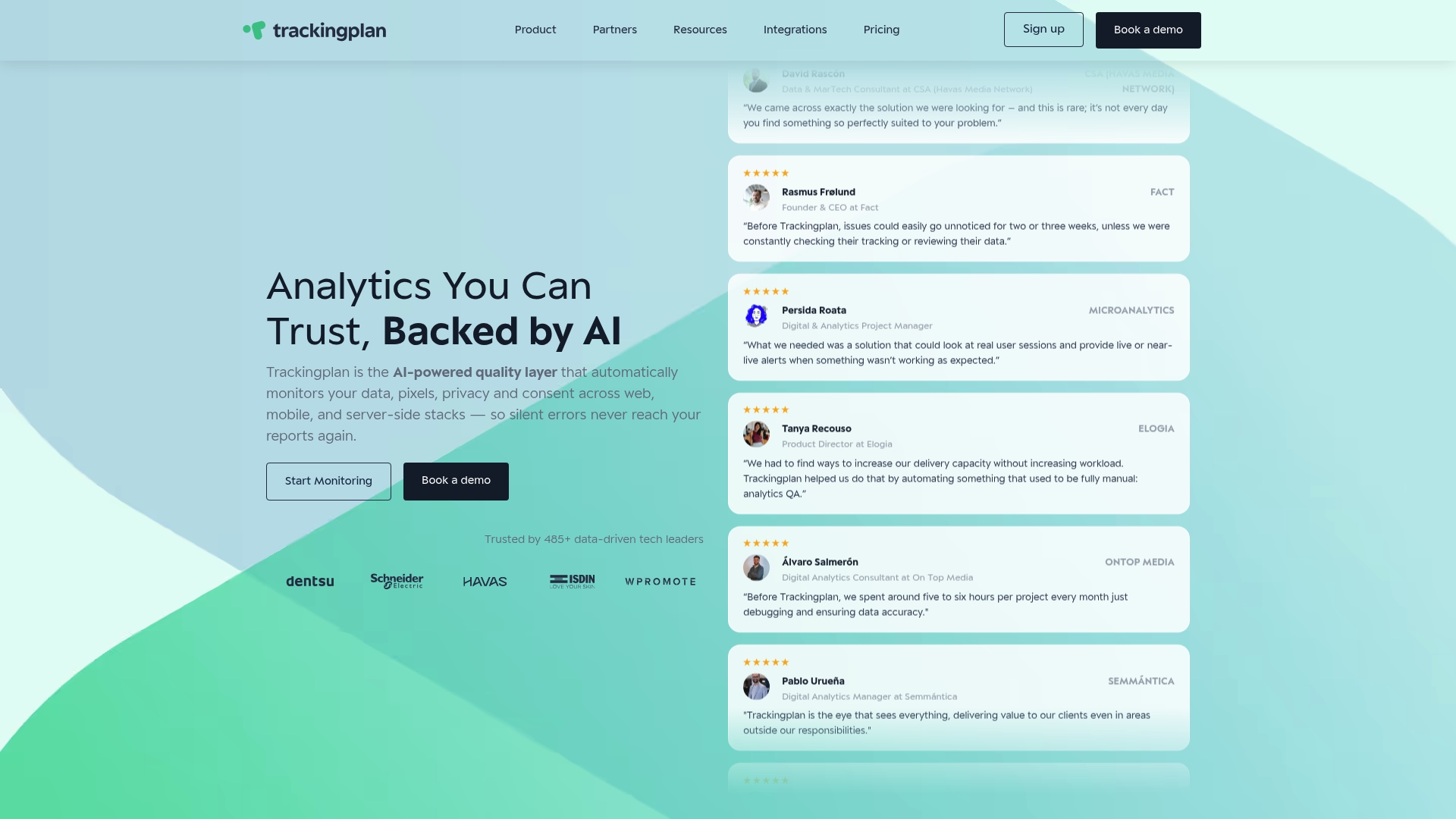
The features covered in this guide only deliver value when the underlying tracking data is accurate. Trackingplan monitors your analytics implementations in real time, detecting broken pixels, schema mismatches, and campaign misconfigurations before they corrupt your reports. It sends alerts via Slack, email, or Teams the moment an anomaly appears, so your team fixes issues in minutes rather than discovering them in next week’s data review.
For data analysts and marketing professionals who rely on platforms like those described above, Trackingplan acts as the quality layer underneath your entire Martech stack. Explore digital analytics data quality tools from Trackingplan to see how automated monitoring protects the accuracy of every metric your platform reports. You can also review Trackingplan’s web tracking monitoring solution for a closer look at how real-time tracking validation works in practice.
FAQ
What are the most critical features for analytics platforms?
The most critical analytics platform capabilities are deep data integration, governed semantic layers, native AI with explainable outputs, real-time data processing, and enterprise-grade security. These five capabilities collectively determine whether a platform can deliver reliable, scalable insights.
How does a semantic layer improve analytics accuracy?
A governed semantic layer centralizes metric definitions so every team uses the same numbers. Platforms with this feature can generate up to 4 times more revenue by eliminating conflicting reports and building cross-team trust in the data.
What separates native AI from bolt-on AI in analytics tools?
Native AI is built into the platform and grounded in the semantic layer, which prevents hallucinations and keeps outputs consistent with your actual business logic. Bolt-on AI typically adds conversational interfaces or chart automation without access to governed metric definitions.
Why does real-time data processing matter for marketing analytics?
Real-time processing lets marketing teams catch campaign failures, tracking errors, and budget anomalies within minutes rather than days. Streaming support from tools like Kafka and Kinesis, combined with threshold-based alerting, closes the gap between data arrival and analyst response.
What compliance standards should an enterprise analytics platform support?
Enterprise analytics platforms should support SOC 2, GDPR, and HIPAA at minimum, backed by AES-256 encryption, SSO via SAML or OAuth, row-level access controls, and automated audit logs. Data lineage tracking is equally critical for tracing metrics back to raw sources during compliance reviews.