
TL;DR:
- Root cause analysis is a structured process used to identify the fundamental causes of problems to prevent their recurrence. It involves analyzing cause-and-effect chains with methods like the 5 Whys, fishbone diagrams, and diagnostic trees. Effective RCA relies on cross-functional teams, continuous monitoring, and proper method selection based on problem complexity.
Root cause analysis (RCA) is defined as a structured process for identifying the fundamental cause of a problem so that corrective action prevents recurrence rather than just masking symptoms. Where general problem-solving addresses what went wrong, RCA asks why it happened at the deepest level. Professionals use methods like the 5 Whys, fishbone (Ishikawa) diagrams, and diagnostic trees to trace cause-and-effect chains back to their source. Organizations from the VA National Center for Patient Safety to manufacturing quality teams rely on RCA to reduce risk, improve reliability, and make decisions grounded in evidence rather than assumption. The American Society for Quality (ASQ) recognizes RCA as a core discipline in quality management, and platforms like Coursera now offer structured training in its methods.
What is root cause analysis and why does it matter?
Root cause analysis is the systematic method professionals use to separate visible symptoms from the deeper conditions that create them. A server crash is a symptom. The misconfigured deployment script that caused it is a root cause. Treating only the crash means the script fires again next week.

The distinction matters because organizations that fix symptoms spend resources on the same problems repeatedly. RCA breaks that cycle by producing solutions tied to actual causes. This is why the discipline appears in quality management frameworks, incident response protocols, and regulatory compliance programs across sectors.
RCA also improves decision-making at the managerial level. When a team can show the exact sequence of events that led to a failure, leadership can allocate resources to the right fix rather than the most visible one. That specificity is what separates RCA from general brainstorming or reactive troubleshooting.
What are the key benefits of root cause analysis?
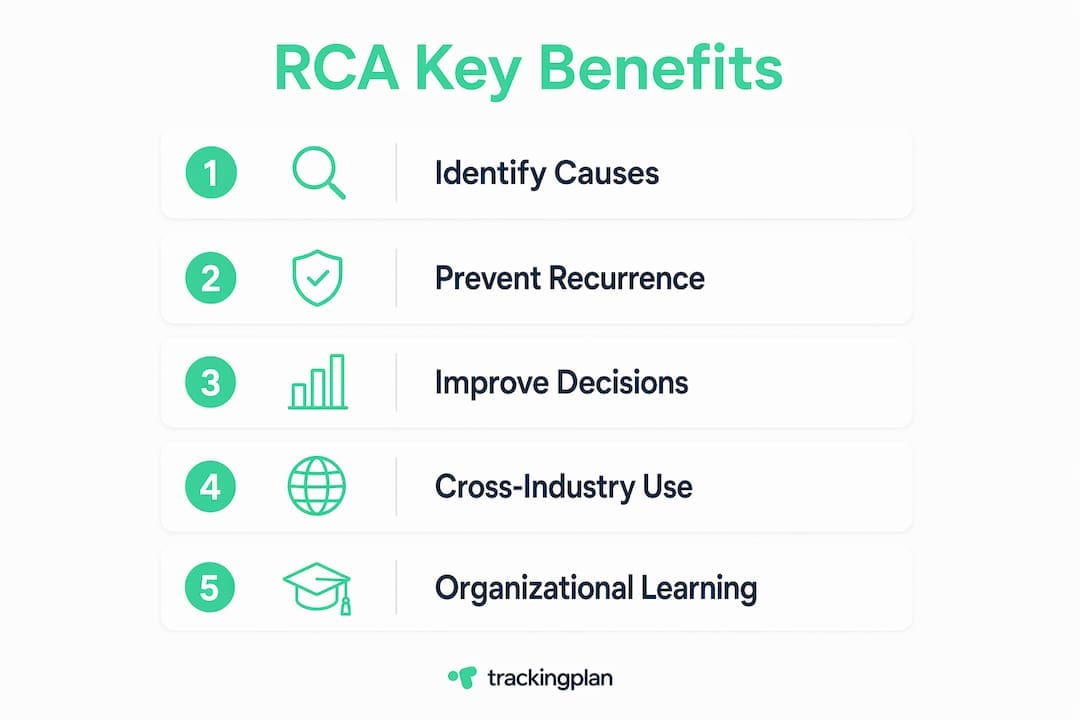
The goals of RCA are to identify what happened, understand the sequence of primary causes, address the incident, and prevent recurrence by removing the root cause. Each goal builds on the last, making RCA a complete problem-resolution cycle rather than a one-step fix.
The practical benefits professionals report most often include:
- Reduced organizational risk. Fixing root causes eliminates the conditions that generate failures, lowering the probability of repeat incidents.
- Improved system reliability. In IT and manufacturing, RCA applied to downtime or defects produces measurable gains in uptime and output quality.
- Better resource allocation. Teams stop spending budget on workarounds and redirect effort toward structural improvements.
- Regulatory compliance. In healthcare, RCA of sentinel events is required by accrediting agencies, making it a compliance tool as much as a quality tool.
- Organizational learning. Documented RCA findings build institutional knowledge that new team members can reference when similar problems arise.
The cross-sector applicability is one of RCA’s strongest characteristics. Healthcare, IT operations, manufacturing, and financial services all apply the same core logic with sector-specific adaptations.
Pro Tip: Document every RCA finding in a shared knowledge base, not just a closed incident ticket. The second time a similar failure occurs, your team will have a head start on the investigation.
What methods and tools does root cause analysis use?
RCA is not a single tool but an overall approach that uses multiple methods depending on problem complexity, team size, and available data. Coursera’s training materials emphasize that teams choose among fishbone diagrams, 5 Whys, and diagnostic trees based on the situation. No single method fits every problem.
The three most widely used methods are:
5 Whys. Ask “why” repeatedly until you reach a cause that cannot be traced further. Toyota popularized this technique in its production system. It works best for straightforward, linear problems where one cause leads to one effect.
Fishbone (Ishikawa) Diagram. Map potential causes across categories such as people, process, equipment, and environment. This visual method suits complex problems with multiple contributing factors. It is common in manufacturing quality reviews and healthcare incident analysis.
Diagnostic Trees (Fault Tree Analysis). Use a top-down logic diagram to map all possible causes of a failure. This method is standard in aerospace and nuclear industries where failure consequences are severe and exhaustive analysis is required.
| Method | Best For | Key Strength | Limitation |
|---|---|---|---|
| 5 Whys | Simple, linear problems | Fast, low-resource | Misses multiple cause branches |
| Fishbone Diagram | Complex, multi-factor problems | Visual, team-friendly | Can become cluttered |
| Fault Tree Analysis | High-stakes, systemic failures | Exhaustive and rigorous | Time-intensive |
| Pareto Analysis | Prioritizing among many causes | Focuses effort on high-impact causes | Requires good historical data |
Method selection depends on the complexity of the problem, the team’s familiarity with the technique, and the context in which the investigation occurs. A five-person IT team diagnosing a broken analytics pipeline needs a different approach than a hospital safety committee reviewing a medication error.
Pro Tip: Before selecting a method, write a one-sentence problem statement that all stakeholders agree on. Teams that skip this step often investigate different problems simultaneously without realizing it.
How does RCA differ across healthcare, IT, and manufacturing?
RCA shares core principles across industries, but the application varies significantly based on regulatory requirements, data availability, and organizational culture.
Healthcare: systems over individuals
The VA National Center for Patient Safety describes healthcare RCA as a multidisciplinary approach that focuses on system causes rather than individual blame. The goal is to understand how and why an incident occurred, not who made a mistake. This framing is deliberate. Blame-focused investigations cause staff to withhold information, which corrupts the data the investigation depends on.
Healthcare RCA is mandated for sentinel events by accrediting agencies including The Joint Commission. This regulatory requirement means hospitals must conduct formal RCA investigations with documented findings and corrective action plans. The Agency for Healthcare Research and Quality (AHRQ) publishes guidance through PSNet to support this work.
IT operations: data-driven diagnosis
IT teams use application monitoring and cloud management tools as part of their RCA investigations. When a system fails, logs, dashboards, and alert histories provide the event timeline that RCA requires. Platforms that surface anomalies automatically give IT teams a faster starting point for their analysis.
In digital analytics specifically, RCA identifies why tracking data breaks, why conversion metrics drop unexpectedly, or why attribution models produce inconsistent results. You can see this applied directly in analytics discrepancy investigations where systematic cause tracing replaces guesswork.
Manufacturing: quality and uptime
Manufacturing applies RCA to defects, equipment failures, and production downtime. The fishbone diagram originated in this sector, developed by Kaoru Ishikawa at Kawasaki in the 1960s. Six Sigma and ISO 9001 both incorporate RCA as a standard quality tool. The focus is on identifying whether failures stem from material variation, process design, equipment wear, or human factors.
How to conduct root cause analysis effectively
Effective RCA follows a defined sequence. Skipping steps is the most common reason investigations produce weak findings.
- Define the problem precisely. Write a factual statement describing what happened, when, and where. Avoid assumptions at this stage.
- Collect data and sequence events. Well-documented event timelines are required before any causality tool is selected. Gather logs, reports, witness accounts, and system records.
- Identify contributing causes. Use your chosen method (5 Whys, fishbone, fault tree) to map the cause-and-effect chain. Push each branch until you reach a cause supported by evidence.
- Verify causal links with data. Credible RCA extends cause-and-effect chains multiple levels deep until each link is justified by data, not assumption. If you cannot support a causal claim with evidence, it is a hypothesis, not a finding.
- Develop and implement corrective actions. Assign ownership, set deadlines, and document the expected outcome for each action.
- Monitor outcomes continuously. Ongoing measurement after RCA confirms whether solutions prevent recurrence and allows teams to adapt if they do not.
The most common pitfall is stopping at the first plausible cause. A server that crashes because of a memory leak is not fully explained by “memory leak.” The real question is why the memory leak was not caught in code review or testing. Stopping at superficial causes without defining preventive measures risks recurrence within weeks.
A second pitfall is conducting RCA as a solo exercise. The VA’s multidisciplinary team model exists because different team members see different parts of a system. A developer, a product manager, and a data analyst investigating the same analytics failure will surface different contributing causes. All three perspectives are needed for a complete picture.
Pro Tip: Set a calendar reminder 30 and 90 days after implementing RCA corrective actions. Most recurrences happen within this window, and early detection lets you adjust before the problem scales.
Key takeaways
Root cause analysis delivers lasting problem resolution only when investigations trace cause-and-effect chains to their source, involve cross-functional teams, and include continuous outcome monitoring after corrective actions are implemented.
| Point | Details |
|---|---|
| RCA targets root causes, not symptoms | Fixing only visible symptoms allows the same failure to recur; RCA eliminates the underlying condition. |
| Method selection matters | Choose 5 Whys for simple problems, fishbone diagrams for complex ones, and fault tree analysis for high-stakes failures. |
| Cross-sector application | Healthcare, IT, and manufacturing all use RCA but adapt it to their regulatory environment and data sources. |
| Blame-free investigation produces better data | Teams that focus on system factors rather than individuals collect more accurate information and reach stronger findings. |
| Monitoring closes the loop | Implementing a fix without measuring its outcome leaves recurrence risk unresolved. |
Why RCA is the discipline most organizations underinvest in
I have watched teams conduct what they call root cause analysis and produce a finding like “human error” or “system failure.” Those are not root causes. They are categories. The real work starts after you write those words down.
The mindset shift that makes RCA genuinely useful is moving from blame to systems thinking. When a process fails, the question is not who made the mistake but what conditions made the mistake possible. That reframe changes everything about how you collect information, who participates in the investigation, and what solutions you actually implement.
The organizations that do this well treat RCA as an organizational learning mechanism, not a compliance checkbox. They build knowledge bases from past investigations. They train managers to recognize when a problem warrants formal RCA versus a quick fix. They measure recurrence rates as a performance indicator.
The emerging trend worth watching is automated root cause analysis in digital analytics. Platforms that monitor tracking implementations in real time can flag anomalies the moment they appear, giving teams a pre-built event timeline before the formal investigation even starts. That capability compresses the data collection phase from days to minutes. For analytics and marketing teams, this is where the role of root cause analysis is evolving fastest.
My advice: match your method to your problem complexity, keep your team cross-functional, and never close an RCA without a monitoring plan. The investigation is not the end of the process. It is the beginning.
— David
How Trackingplan supports root cause analysis for analytics teams
Analytics failures are among the hardest problems to diagnose manually. Broken pixels, schema mismatches, and misconfigured campaign tags produce data errors that look like business problems until you trace them back to their source.
Trackingplan automates the detection layer that RCA depends on. The platform monitors your web tracking implementations in real time, surfaces anomalies via Slack, email, or Teams alerts, and provides the event timeline your investigation needs before you even open a spreadsheet. Its data quality monitoring integrates directly with your analytics stack, so the gap between “something is wrong” and “here is what happened” shrinks from days to minutes. For teams managing multiple client sites or complex Martech stacks, that speed is the difference between a contained incident and a corrupted data set.
Explore web tracking monitoring to see how Trackingplan fits into your RCA workflow.
FAQ
What is root cause analysis in simple terms?
Root cause analysis is a structured method for finding the fundamental reason a problem occurred so that corrective action prevents it from happening again. It focuses on underlying causes rather than visible symptoms.
What are the most common root cause analysis methods?
The most widely used methods are the 5 Whys, the fishbone (Ishikawa) diagram, and fault tree analysis. Method selection depends on problem complexity, team size, and the data available for the investigation.
What is automated root cause analysis?
Automated root cause analysis uses software platforms to detect anomalies, generate event timelines, and surface probable causes without manual data collection. In digital analytics, tools like Trackingplan apply this approach to tracking issues in real time.
How does root cause analysis differ in healthcare vs. IT?
Healthcare RCA focuses on system factors and patient safety, often under regulatory mandates from accrediting agencies. IT RCA relies on logs, monitoring tools, and alert data to reconstruct failure timelines. Both use the same core logic but adapt their data sources and team structures to their environment.
What is the biggest mistake teams make in root cause analysis?
The most common mistake is stopping at the first plausible cause without verifying it with data or defining preventive measures. Without continuous outcome monitoring after implementation, recurrence risk remains high.