
TL;DR:
- Data privacy protects individual autonomy and prevents severe legal and reputational consequences for organizations.
- Regulations like GDPR and CCPA enforce compliance, but many businesses overlook technical and data retention failures that pose hidden risks.
Data privacy is defined as the right of individuals and organizations to control how their personal and sensitive information is collected, stored, shared, and used. Why data privacy matters becomes clear when you consider that over 1.35 billion people were affected by data breaches globally in 2024. That figure represents roughly one in eight people on earth. Regulations like GDPR, CCPA, and the EU AI Act have raised the legal stakes for businesses, while AI-driven data processing has introduced new exposure risks that most organizations have not yet addressed. Whether you are an individual protecting your identity or a business managing customer data, the consequences of getting privacy wrong are measurable, immediate, and growing.
What are the real risks of poor data privacy practices?
Poor data privacy practices carry consequences that go far beyond an embarrassing headline. At the individual level, a breach translates directly into identity theft, financial fraud, and loss of control over personal information that can take years to recover. At the business level, the damage compounds: regulatory fines, litigation, and the erosion of customer trust that took years to build.

The scale of the problem is not abstract. One in eight people worldwide experienced a data breach in 2024 alone. That concentration of harm means breaches are no longer rare events. They are a predictable outcome of inadequate data protection.
One of the least visible risks sits inside vendor relationships. 63.6% of AI vendors do not disclose the third-party AI subprocessors they use. This means personal data your business collects may be flowing into AI models you never reviewed or approved. Outdated vendor contracts often fail to address modern AI subprocessors entirely, creating unseen privacy risks that standard compliance audits miss.
The business consequences of data privacy failures include:
- Regulatory fines under GDPR, CCPA, and the EU AI Act, which can reach tens of millions of dollars
- Reputational damage that reduces customer acquisition and increases churn
- Legal liability from class-action suits and regulatory investigations
- Operational disruption from breach response, forensic audits, and mandatory notifications
- Loss of data utility when compromised datasets can no longer be trusted for decision-making
“The consequences of poor data privacy are not limited to the moment of breach. The downstream effects on trust, compliance standing, and data integrity persist for years.”
Understanding these data privacy impacts is the first step toward treating privacy as a genuine operational priority rather than a checkbox exercise.
Why data privacy is a fundamental human right
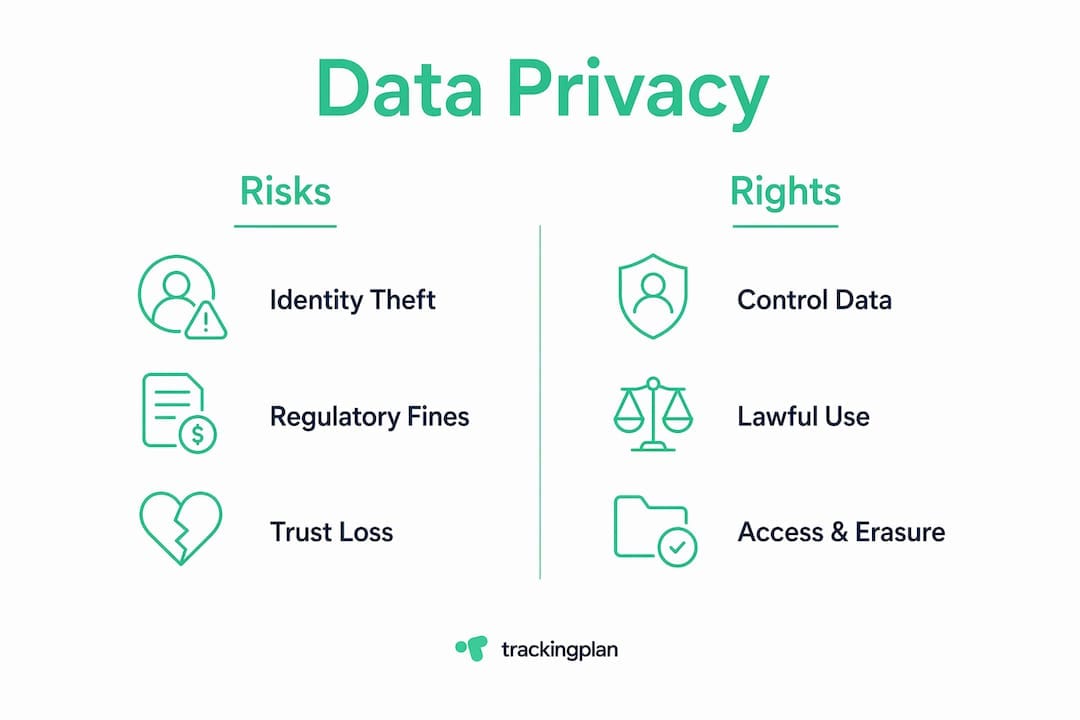
Data privacy is not only a legal obligation. It is a precondition for human autonomy and dignity. Harvard Kennedy School scholars argue that privacy underpins freedom of speech, self-development, and democratic participation. When people cannot control their personal information, they lose the ability to shape their own narratives, make free choices, and engage in public life without fear of surveillance or manipulation.
The “nothing to hide” argument is the most persistent myth in privacy discourse. Privacy is not about concealing wrongdoing. It is about maintaining the space to think, communicate, and develop as a person without every action being recorded, analyzed, and potentially used against you. Shoshana Zuboff’s research on surveillance capitalism documents how behavioral data extracted without meaningful consent becomes a tool for predicting and influencing human behavior at scale. That is not a hypothetical risk. It describes the current operating model of many digital platforms.
“Privacy is not a luxury or a preference. It is the foundation on which individual freedom and democratic society are built.” — Harvard Kennedy School
Pro Tip: When evaluating any digital service, ask one question before signing up: what does this company do with my data if I stop using it? The answer reveals more about their privacy values than any policy document.
The importance of data privacy as a human right also has practical implications for businesses. Organizations that treat user data as a resource to extract rather than a trust to protect will face increasing regulatory pressure, user backlash, and reputational consequences as privacy literacy among consumers continues to grow.
How regulations shape data privacy responsibilities
The regulatory environment for data privacy has shifted from a patchwork of national rules to an increasingly coordinated global framework. GDPR, enforced since 2018, set the baseline for data subject rights, lawful processing, and breach notification. CCPA extended similar protections to California residents and introduced opt-out rights for data sales. The EU AI Act, effective August 2026, adds a new layer of obligations specifically targeting AI systems that process personal data.
Enforcement is no longer theoretical. California reached a record $12.75 million CCPA settlement with General Motors over driver data practices. The case established that retaining data longer than necessary is an independent compliance violation, separate from any breach. This distinction matters because many businesses focus their compliance programs on breach prevention while ignoring data retention schedules entirely.
The most common GDPR compliance failures in AI systems are:
- Absence of documented lawful basis for processing, affecting 47% of audited AI implementations
- Missing erasure mechanisms that fail to honor deletion requests, found in 39% of cases
- Inadequate human review queues for automated decisions, present in 31% of systems
These are not policy gaps. They are technical implementation failures that require engineering work to fix. GDPR Articles 5, 13 through 14, 17, 22, 25, and 35 each impose specific technical and governance obligations on AI systems handling personal data. A privacy policy document does not satisfy them.
| Regulation | Scope | Key obligation | Penalty range |
|---|---|---|---|
| GDPR | EU residents globally | Lawful basis, erasure, DPIAs | Up to 4% of global annual revenue |
| CCPA | California residents | Opt-out rights, data retention limits | Up to $7,500 per intentional violation |
| EU AI Act | AI systems in EU market | Transparency, human oversight, risk classification | Up to 3% of global annual revenue |
The regulatory landscape for analytics compliance will only grow more complex as AI becomes embedded in more business processes. Waiting for enforcement to arrive is not a strategy.
Personal vs. business approaches to data privacy management
Individuals and businesses face the same underlying problem from very different positions. For individuals, the core challenge is the privacy paradox: 81% of Americans are concerned about how companies use their personal data, yet 73% feel they have little control over it. High concern combined with low agency produces a kind of resignation that technology design actively exploits by making data sharing the default and opting out difficult.
For businesses, the challenge is technical and organizational. Less than 12% of AI governance programs are considered mature, even as AI adoption accelerates. Many privacy programs expanded in 2025 in response to AI, but expansion without maturity creates compliance theater rather than genuine protection.
| Dimension | Individual perspective | Business perspective |
|---|---|---|
| Primary concern | Identity theft, loss of autonomy | Regulatory fines, reputational damage |
| Main challenge | Low control despite high awareness | Technical gaps in AI governance |
| Key tool | Privacy-focused apps, consent management | Privacy-by-design, vendor audits |
| Strategic opportunity | Informed consent, data minimization | Consumer trust as competitive advantage |
The benefits of data protection extend beyond avoiding penalties. Harvard Business Review research confirms that companies treating data privacy as a strategic asset build stronger consumer trust and measurable competitive advantage. Privacy is shifting from a defensive compliance function to a growth driver. Businesses that recognize this early gain an edge over competitors still treating it as overhead.
Practical steps to protect data privacy for individuals and businesses
Protecting data privacy requires concrete actions, not just policy statements. For individuals, the starting point is using privacy-focused communication tools like Signal for messaging and conducting regular privacy check-ups on accounts held with Google, Apple, and Meta. Reviewing app permissions quarterly and enabling two-factor authentication on all accounts reduces exposure significantly.
For businesses, the steps are more structured:
- Audit your vendor contracts to identify which third-party tools process personal data and whether AI subprocessors are disclosed. Given that most AI vendors omit subprocessor disclosure, this audit will almost certainly surface gaps.
- Implement data minimization by collecting only what you need and deleting what you no longer use. Retaining data beyond its purpose is a standalone compliance violation under CCPA and GDPR.
- Document your lawful basis for every data processing activity, particularly for AI systems. The 47% failure rate on this requirement makes it the single highest-priority fix for most organizations.
- Build erasure mechanisms into your data architecture so deletion requests can be honored technically, not just acknowledged administratively.
- Train your team on data privacy tips for digital marketers and other functional roles, since most privacy failures originate in operational decisions made by non-legal staff.
Pro Tip: Run a data subject access request test on your own organization. Submit a DSAR as if you were a customer and measure how long it takes to receive a complete, accurate response. The result will tell you more about your real compliance posture than any internal audit.
Privacy-by-design means building data protection into systems from the start rather than retrofitting controls after deployment. For teams using analytics platforms, this means configuring data collection schemas to exclude personally identifiable information by default, not as an afterthought. Understanding how to handle a data subject access request correctly is a practical skill every marketing and analytics team needs in 2026.
Key takeaways
Data privacy matters because it protects individual autonomy, prevents regulatory penalties, and builds the consumer trust that drives long-term business growth.
| Point | Details |
|---|---|
| Breach scale is massive | Over 1.35 billion people were affected by data breaches in 2024, making protection urgent. |
| AI vendors create hidden risk | 63.6% of AI vendors do not disclose subprocessors, exposing data without your knowledge. |
| Regulations carry real penalties | The $12.75M GM CCPA settlement shows that data retention failures alone trigger enforcement. |
| Privacy paradox is real | 81% of Americans are concerned about data use, but 73% feel powerless to control it. |
| Privacy drives business growth | Companies treating privacy as a strategic asset build stronger trust and competitive advantage. |
The uncomfortable truth about where privacy programs actually fail
I have spent years watching organizations invest in privacy policies, legal reviews, and compliance frameworks, and then lose data through a vendor they onboarded three years ago and never re-evaluated. The uncomfortable truth is that most privacy failures are not dramatic hacks. They are quiet, administrative failures: a contract that predates AI subprocessors, a data retention schedule nobody enforces, a deletion mechanism that exists in documentation but not in code.
The regulatory shift happening in 2026 with the EU AI Act is not just another compliance deadline. It is a signal that regulators have caught up to the reality that AI systems process personal data in ways that traditional privacy frameworks were never designed to govern. Organizations that treat this as a documentation exercise will fail audits. Organizations that treat it as an engineering problem will build something durable.
The privacy paradox frustrates me most at the individual level. People are not apathetic about privacy. They are exhausted by systems designed to make privacy protection difficult. The solution is not more awareness campaigns. It is better defaults, clearer consent mechanisms, and building trust online through transparency rather than fine print. Businesses that get this right in 2026 will not just avoid fines. They will earn loyalty that competitors cannot buy.
— David
How Trackingplan helps businesses stay compliant and data-accurate
Trackingplan gives analytics and marketing teams the tools to catch privacy and data quality issues before they become compliance violations. Its automated audit capabilities scan your entire analytics implementation for tracking errors, schema mismatches, and missing consent signals across web, app, and server-side environments. The Privacy Hub centralizes compliance monitoring so your team can identify gaps in real time rather than during a regulatory review. For businesses managing digital analytics data quality, Trackingplan’s AI-assisted alerts flag anomalies the moment they appear, giving you the response time that modern privacy regulations demand. If you have not audited your analytics implementation for privacy compliance in 2026, that is the right place to start.
FAQ
What is data privacy and why does it matter?
Data privacy is the right to control how personal information is collected, used, and shared. It matters because breaches affect billions of people annually and carry serious legal, financial, and reputational consequences for businesses.
What are the consequences of poor data privacy?
Poor data privacy leads to identity theft, regulatory fines, loss of consumer trust, and legal liability. The 2024 General Motors CCPA settlement of $12.75 million illustrates that even data retention failures, not just breaches, trigger major penalties.
How does GDPR affect businesses using AI?
GDPR requires businesses using AI to document lawful processing bases, provide erasure mechanisms, and conduct data protection impact assessments. The most common failures are missing lawful basis documentation (47%), absent erasure mechanisms (39%), and inadequate human review for automated decisions (31%).
How can individuals protect their data privacy?
Individuals can use privacy-focused tools like Signal, conduct regular account permission reviews, enable two-factor authentication, and submit data subject access requests to understand what companies hold about them.
Why is data privacy considered a human right?
Privacy protects the autonomy and dignity required for free speech, self-development, and democratic participation. Harvard Kennedy School research frames privacy not as a preference but as the foundation of individual freedom in a digital society.