
Let's be honest: "marketing data governance" sounds a bit intimidating. But at its core, it's just a formal framework of rules, processes, and responsibilities designed to do one thing: make sure your marketing data is accurate, consistent, and used the right way. It’s the system that turns a messy flood of raw data into an asset you can actually trust for making big decisions.
Why Marketing Data Governance Matters Now

Think of your marketing data like a city's traffic system. Without rules, stoplights, and road signs, you’d have pure chaos. Cars would crash, deliveries would get lost, and getting anywhere would be a nightmare. Data governance is the traffic control system for your information, preventing that gridlock before it starts.
It sets the rulebook for how data is collected, stored, defined, and used across every single one of your marketing channels. This structure guarantees that every team—from analytics to paid media—is on the same page, working with the same reliable information. Without it, you’re just guessing, and that leads to wasted budgets, bad insights, and missed opportunities.
The Core Goals of Governance
At its heart, marketing data governance is about moving your organization from a state of data confusion to one of data clarity. It’s about building confidence. The main goals are pretty straightforward:
- Improving Data Quality: Making sure your data is accurate, complete, and consistent. This is non-negotiable if you want to trust the insights you pull from it.
- Ensuring Regulatory Compliance: Staying on the right side of regulations like GDPR and CCPA is crucial for managing data privacy and avoiding hefty fines.
- Empowering Teams with Reliable Insights: Giving your marketers and analysts access to data they can depend on, so they can make smarter, faster decisions.
These goals aren't just "nice-to-haves" anymore. The data governance market is exploding, projected to grow from $4.44 billion in 2024 to an incredible $18.07 billion by 2032. This boom is fueled by new regulations and the hard-learned lesson that governance failures cost real money.
By putting a solid governance framework in place, you’re building a foundation of trust. That trust runs from your internal dashboards all the way to your customer relationships, ensuring every marketing move is backed by solid data.
Automation and Modern Solutions
Trying to enforce these rules manually across dozens of tools and platforms is a losing battle. A huge piece of modern governance is understanding how technologies, like cookies and tracking pixels, fit into the puzzle. For a deeper look, check out our guide on the relationship between cookies and marketing.
This is where automated observability tools like Trackingplan come in. They act as a constant watchdog, making sure your data "traffic" is flowing smoothly and playing by the rules you’ve set. It's the key to making a truly data-driven marketing strategy a reality, not just a buzzword.
The High Cost of Poor Data Governance

Ignoring marketing data governance isn't just a technical slip-up; it's a direct hit to your bottom line. When data has no structure or rules, the fallout spreads across the entire company, breeding inefficiency, killing trust, and quietly bleeding your budget. Think of it as a silent tax on every single marketing activity you run.
Picture a marketing team trying to launch a campaign across multiple channels. Without a strict governance framework for UTM tagging, the data descends into chaos. Different teams use conflicting campaign names and sources, which makes building a reliable attribution model completely impossible. This isn't just a small headache—it means you have no real idea which channels are making you money. The result? Ad spend gets allocated based on guesswork, not performance, leading to significant budget waste.
This cycle of bad data pushes teams into a constant state of firefighting. Instead of focusing on strategic growth, your analysts are stuck cleaning spreadsheets and trying to make sense of conflicting reports. All that manual auditing doesn’t just drain resources; it crushes morale and slows decision-making to a crawl.
The Financial and Reputational Risks
The problems get much bigger, much faster when broken data starts to infect product and business intelligence. Let’s say a critical analytics event—like 'AddToCart' or 'SubscriptionStarted'—stops firing correctly after a new app release. If no one catches it, product managers will see a sudden, terrifying drop in those key metrics.
They might jump to the wrong conclusion, thinking a new feature is a total flop or that a pricing change is scaring customers away. This can trigger a rollback of a perfectly good update or other poor strategic decisions based on completely false information. The opportunity cost of acting on flawed data is massive.
But beyond operational headaches, the most serious consequences of poor marketing data governance are compliance and privacy failures. An accidental PII (Personally Identifiable Information) leak from a misconfigured marketing pixel or a rogue event can be catastrophic.
- Severe Regulatory Fines: Violating rules like GDPR and CCPA can trigger fines in the millions of dollars, a direct financial blow.
- Erosion of Customer Trust: A data breach is one of the fastest ways to demolish your brand's reputation. Once that trust is gone, it's incredibly hard—if not impossible—to win back.
- Legal and Remediation Costs: The expenses tied to managing a breach, from legal fees to customer notifications, can be enormous.
Poor data governance creates a domino effect. It starts with small inconsistencies but quickly cascades into wasted ad spend, flawed business strategies, and severe compliance risks that threaten the stability of the entire business.
From Technical Debt to Business Threat
Without a solid governance framework, your data goes from being an asset to a liability. Every dashboard becomes suspect, every report needs to be manually checked, and every strategic decision carries an unnecessary layer of risk. What started as a technical problem quickly becomes a direct threat to your revenue and operational efficiency.
Investing in a robust framework and automated monitoring isn't just about getting "clean data." It's about protecting your company's financial health, safeguarding your brand, and empowering your teams to drive real growth. The cost of doing nothing is just too high to ignore.
Building Your Marketing Data Governance Framework

So, you understand the risks of bad data. Now it's time to build the solution, and that requires a blueprint. A marketing data governance framework is exactly that—a structured plan that lays out the people, processes, and standards needed to manage your data the right way. This isn’t about creating endless red tape; it’s about establishing clarity and shared responsibility so your data finally becomes a reliable asset.
Think of it like building a house. You wouldn’t just show up with a hammer and some wood. You’d start with architectural plans, a clear roster of who the electrician and plumber are, and a list of approved materials. Your data framework does the same thing, defining the structure, assigning roles, and setting the standards to ensure everything just works.
A classic mistake is trying to boil the ocean with a massive, all-encompassing plan from day one. The most successful governance programs I've seen start small, focusing on a few high-impact areas, and then scale over time. To get started on the right foot, it helps to understand the ten essential data management best practices.
Establishing Clear Data Ownership and Roles
The first pillar of any solid framework is people. Without clear ownership, data becomes an orphan that nobody feels accountable for. Defining roles makes sure every piece of critical data has a dedicated guardian responsible for its quality, security, and use.
This simple step creates a system of accountability that puts an end to the "it's not my job" problem whenever data quality issues pop up. For a deeper dive into this foundational step, check out our comprehensive guide on data governance best practices.
A well-defined role structure transforms data governance from an abstract concept into a set of tangible, human-led responsibilities. It’s the difference between hoping data stays clean and ensuring it does.
Assigning ownership is the first step in building a culture of data responsibility. Here are the most common roles you'll find in a marketing data governance framework.
With these roles clearly defined, everyone knows who to go to for what, turning chaos into a well-oiled machine.
Creating a Data Taxonomy and Tracking Plan
Once you know who is responsible, the next step is to create a common language for your data. A data taxonomy is basically a classification system that organizes and defines your marketing data, from event names to property formats. Think of it as your organization's official data dictionary.
For instance, a taxonomy would ensure an event like user_signup is standardized across every platform. It would also guarantee that associated properties (email, signup_source, plan_level) are always named and formatted the exact same way. This consistency is the absolute backbone of reliable analytics.
This taxonomy lives inside your tracking plan, which acts as the single source of truth for your entire analytics setup. It’s a living document that details every event, property, and user trait you track—what it means, where it should fire, and who owns it. A solid tracking plan is the bridge connecting marketing, analytics, and development, making sure everyone is on the same page.
But let's be honest, static tracking plans in spreadsheets quickly become outdated and ignored. This is where modern tooling makes all the difference. A platform like Trackingplan automates the discovery and maintenance of your tracking plan, turning it from a static document into a dynamic, observable asset. It continuously scans your implementation to see what’s actually being tracked, compares it against your plan, and alerts you to any deviations in real-time. This transforms governance from a manual chore into an automated, proactive process.
Automating Governance with Modern Tooling
Let's be honest: the days of wrangling marketing data governance with spreadsheets and painful manual audits are long gone. It's a broken system. If you're still trying to police every tag, pixel, and API call by hand, you're fighting a losing battle against today's complex martech stacks and high-speed data flows. It’s like trying to direct rush-hour traffic with a notepad and a whistle—totally inefficient, always reactive, and ultimately doomed to fail.
This manual approach traps teams in a never-ending cycle of firefighting. Analysts spend more time validating data than actually analyzing it. Developers get pulled from building cool new features to fix tracking bugs. And marketers are left making critical decisions with data they can't fully trust. The whole process is slow, expensive, and a bureaucratic mess that kills agility.
To keep up, you have to flip the script from a reactive, "clean-up-the-mess" posture to a proactive, automated one. This is about embracing modern tools that turn governance from a dreaded quarterly audit into a continuous, automated observability practice.
The Power of Proactive Observability
Proactive observability means spotting and solving data problems the moment they happen—not weeks later when a broken dashboard finally tips you off. Automated governance tools act like a vigilant security guard for your entire marketing data ecosystem. They don't just check for errors after the damage is done; they monitor your data pipelines in real-time and enforce your rules automatically.
This is exactly where a platform like Trackingplan slots into the workflow. Instead of a static spreadsheet gathering dust, these tools continuously scan your website, apps, and server-side setups. They discover the data you're actually collecting and instantly compare it against your governance framework, creating a living source of truth that's always up to date.
By automating anomaly detection, you empower your teams to fix issues before they poison your analytics or derail business decisions. Governance stops being about punishment and starts being about prevention.
This real-time monitoring turns your governance policies from a static document into active agents working for you 24/7. Here are a few key capabilities that make this happen:
- Automated Schema Validation: Instantly flags events that don't match your tracking plan's structure, catching things like mismatched property names or wrong data types.
- Detection of Rogue or Missing Events: Alerts you the second a new, undocumented event appears (a "rogue" event) or when a critical event suddenly vanishes.
- PII Leak Prevention: Constantly scans data payloads for patterns that look like personally identifiable information, helping you sidestep costly compliance breaches.
- UTM Compliance Checks: Automatically verifies that campaign tagging follows your naming conventions, ensuring your attribution data stays clean and reliable.
To get a better sense of what's out there, you can explore a curated list of top-tier data quality monitoring tools that are leading this charge toward automation.
Why Automation Is No Longer Optional
The sheer scale and speed of modern data make manual governance impossible. Think about this: by 2026, an estimated 90% of current analytics content consumers will become content creators thanks to AI. On top of that, predictions suggest that by 2027, half of all business decisions will be augmented or automated by AI agents. As you can read in these insights on data management trends, this explosion of data usage creates a level of complexity that manual checks simply can't handle.
The image below shows how a modern platform visualizes the intricate web of data flows, making it far easier to spot problems at a glance.
This kind of visual map lets teams immediately understand dependencies and pinpoint exactly where a breakdown is happening—something a spreadsheet could never do.
Ultimately, automating your marketing data governance isn't just about being more efficient. It’s about building a real competitive advantage. It frees up your most important resource—your people—to focus on strategy, innovation, and growth, all while being confident that the data they rely on is rock-solid and secure.
Practical Steps for Implementation and Success
Knowing why you need marketing data governance is one thing, but knowing how to do it is where the real work begins. A successful rollout isn't a massive, one-and-done project. It’s a journey you take in phases, building momentum with practical steps and quick wins. This approach transforms what feels like a monumental task into a manageable process that starts delivering value right away.
The first step has nothing to do with technology. It’s all about understanding. Kick things off with a thorough data audit to find your organization's biggest pain points. Are inconsistent UTMs wrecking your attribution models? Are broken analytics events making your reports unreliable? Identifying these high-impact issues gives you a clear target for your first efforts.
This initial audit also becomes your best tool for getting executive buy-in. When you can draw a straight line from specific data problems to real business consequences—like wasted ad spend or flawed strategic decisions—the need for governance becomes undeniable. That top-level support is absolutely essential for securing the resources and authority needed to make a real change.
Forming Your Governance Team and Defining Policies
With leadership on board, your next move is to assemble a cross-functional governance committee. This isn’t just a marketing or data team job. You need people from marketing, analytics, product, and engineering at the table. This mix of perspectives ensures the policies you create are practical, well-rounded, and actually get adopted across the company.
The committee's first job is to define a small set of foundational policies. Don’t try to boil the ocean. Instead, focus on the quick wins you found in your audit. That might mean standardizing your UTM naming conventions or defining the exact schema for your top five conversion events.
The goal here is iterative improvement, not immediate perfection. By demonstrating value early with targeted policies, you build the credibility and momentum needed to tackle more complex governance challenges down the road.
Creating a foundational tracking plan is key to this stage. This document becomes your single source of truth, spelling out every event and property you track. It gets all teams on the same page about what data is being collected and why, acting as the blueprint for your entire analytics setup.
Deploying Automation and Measuring Success
Once your initial policies and tracking plan are locked in, the final step is to automate enforcement. This is where modern monitoring tools are a game-changer. Trying to audit your implementation manually is not only unsustainable but also means you're always playing catch-up, reacting to problems long after they’ve already corrupted your data.
This flowchart shows the crucial shift from slow, manual checks to proactive, automated governance.
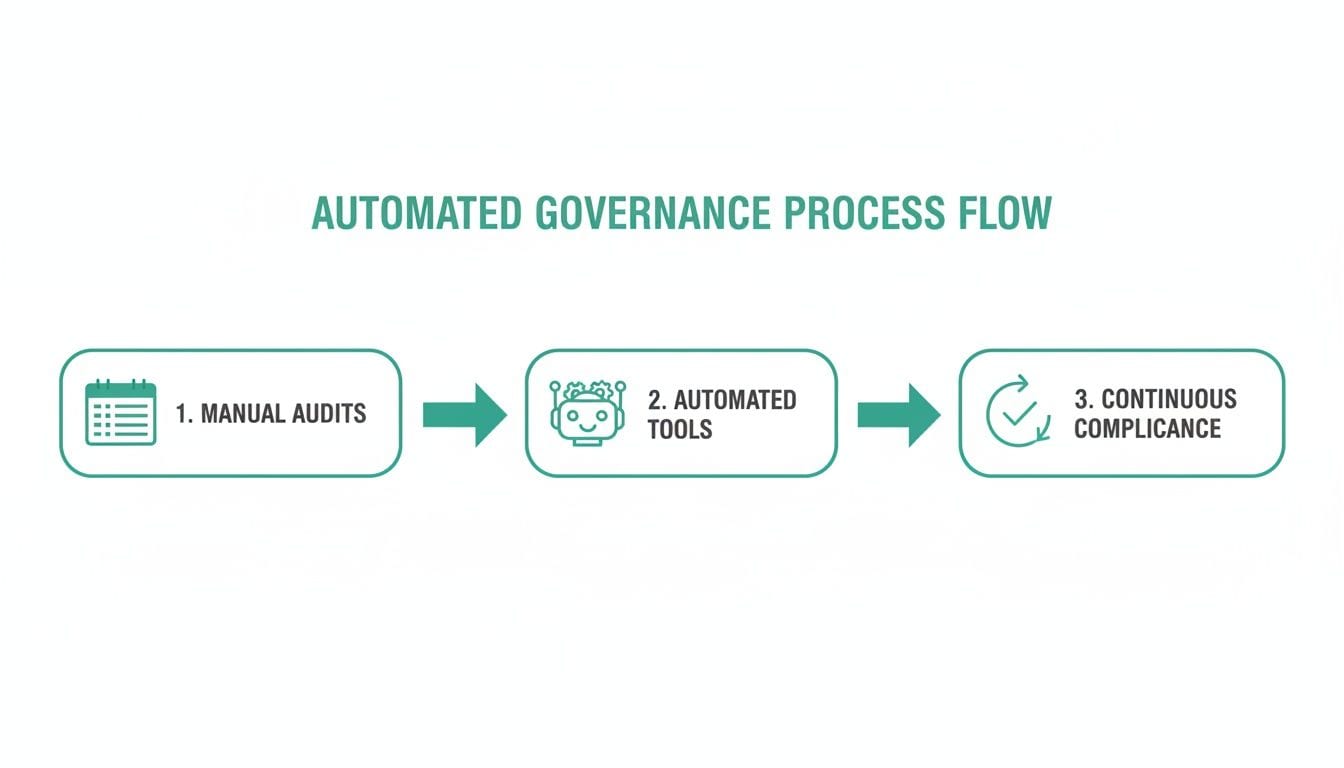
This evolution is what makes governance scalable and truly effective. It turns a periodic chore into a continuous, real-time safety net. Deploying an automated observability platform like Trackingplan puts your tracking plan to work, constantly scanning your implementation to make sure it matches the rules you've defined.
To prove your program is working and justify more investment, you have to measure its impact. Tracking the right key performance indicators (KPIs) makes the value of your governance efforts crystal clear.
- Time to Detect Data Errors: How fast can your team spot a problem, like a broken event? With automation, this should drop from weeks to just minutes.
- Percentage of Compliant Events: This tracks how many of your events stick to the schemas in your tracking plan, giving you a hard number on data quality improvement.
- Reduction in Manual Audit Hours: Quantify the time your team gets back now that they aren't stuck doing manual data validation.
By taking these practical steps—auditing your weak spots, getting leadership buy-in, defining focused policies, and automating enforcement—you can build a marketing data governance program that actually works. This pragmatic, phased approach ensures you deliver real value quickly and build a solid foundation for a lasting data-driven culture.
FAQ
Even with a clear roadmap, you're bound to run into some specific questions when you start putting marketing data governance into practice. Let's tackle some of the most common ones to help you navigate your governance journey with confidence.
What Is the Difference Between Data Governance and Data Management?
It’s easy to get these two terms tangled up, but the distinction is actually pretty simple. Think of data management as the whole city—it's the entire technical operation of collecting, storing, moving, and using information. It’s the pipes, reservoirs, and treatment plants of your data world.
Data governance, on the other hand, is a specific part of that system. It’s not the infrastructure itself, but the rules that ensure the water is clean, safe, and flows to the right places. Governance is about the policies, standards, and processes that make sure your data is accurate, consistent, and used responsibly. In short, data management is the "what" and "where," while governance is the "how" and "why."
You can learn more about how the two disciplines work together from these in-depth data management insights.
How Can We Measure the ROI of Data Governance?
Proving the return on investment (ROI) for marketing data governance is how you get—and keep—long-term buy-in from leadership. The trick is to stop talking about abstract benefits and start connecting your efforts to real business outcomes. When you put concrete numbers to it, the value becomes undeniable.
Quantitatively, you can track metrics that hit the bottom line directly:
- Cost Reductions: Tally up the money saved by cutting down on data errors. This could be wasted ad spend from bad targeting or the cost of dealing with duplicate customer records.
- Efficiency Gains: How much time are your teams spending on manual data cleanup? Calculate those hours saved and translate them into productivity gains.
- Improved Campaign Performance: Draw a straight line from cleaner, more reliable data to higher conversion rates, better personalization, and sharper marketing attribution.
Qualitatively, the impact is just as important. Think about measuring the increase in your team's confidence in the data, which leads to faster, more decisive action. Don't forget to track improved regulatory compliance—avoiding a single hefty fine can pay for the entire program.
The ROI of data governance can be measured through both quantitative and qualitative metrics. Quantitatively, track reductions in costs associated with data errors, decreased time spent on manual data cleaning, and improved marketing campaign performance due to better targeting and personalization. Qualitatively, measure improvements in team confidence in data, faster decision-making, and enhanced regulatory compliance, which mitigates the risk of fines.
Ultimately, measuring ROI isn't just about looking backward. It’s about building a business case from day one that frames governance as a strategic driver of growth, not just another cost center.
Measuring ROI isn't just about tracking numbers after the fact. It's about building a business case from day one that frames governance as a strategic enabler of growth, not just a cost center.
Who Should Be Involved in a Marketing Data Governance Initiative?
One of the biggest mistakes you can make is treating marketing data governance like an IT-only project. For this to actually work, you need a cross-functional team—a "governance council" with people from every team that touches marketing data. This isn't about creating bureaucracy; it's about making sure the rules are practical and get adopted by everyone.
Your core team needs to bring together stakeholders from a few key areas:
- Marketing Leadership (CMO/VP of Marketing): You need an executive sponsor. They're the ones who will champion the initiative, secure the budget, and tie governance goals back to what the business actually cares about.
- Data Analysts and Scientists: These are your primary data consumers. Their input is gold for defining what "good data" looks like and making sure it's actually useful for analysis.
- Marketing Operations and Campaign Managers: These folks are in the trenches every day, setting up UTMs, managing lead lists, and using the data. They know what works and what doesn't in the real world.
- Developers and Engineers: They're the ones implementing the tracking code and managing the tech stack. You can't execute a tracking plan without them at the table.
- Legal and Compliance Officers: In a world of GDPR and CCPA, their guidance isn't optional—it's essential. They ensure your data practices are fully compliant and secure.
When you bring these groups together, you build a shared sense of ownership. Governance stops feeling like a mandate from on high and becomes a collective responsibility. And that’s the only way you’ll build a data culture that truly sticks.
Stop chasing data errors and start trusting your insights. With Trackingplan, you can automate your marketing data governance, detecting issues in real time before they impact your business. See how our observability platform can provide a single source of truth for your entire team. Schedule your personalized demo today.