
So, what exactly is marketing data analysis? It’s the process of digging into raw marketing data to find trends and insights that shape your next move. Forget picturing dense spreadsheets. Think of yourself as a detective for your campaigns, piecing together clues like clicks, conversions, and user behavior to figure out what’s actually working.
Unlocking Growth with Marketing Data Analysis
Think of marketing data analysis as the bridge connecting your marketing activities to your business goals. It’s all about turning abstract numbers into a clear, compelling story about your customers and campaigns. Without it, you’re basically marketing in the dark—relying on gut feelings instead of solid proof.
This process is so much more than just glancing at a dashboard. It's about asking the right questions. Why did one campaign crush it while another fell flat? Which channels are bringing in your most valuable customers? Where are people dropping off in the funnel? Answering these questions lets you make smarter, faster decisions that directly grow your bottom line.
The Shift from Guesswork to Strategy
Not long ago, marketing success was often measured with fuzzy, feel-good metrics. Today, every dollar you spend needs to pull its weight. This is where a data-driven mindset becomes non-negotiable for any modern business.
By analyzing performance data, teams can:
- Allocate Budgets Effectively: Pinpoint your high-performing channels and double down on them, while cutting back on what’s not delivering a solid return on investment (ROI).
- Personalize Customer Experiences: Get a real feel for user behavior to create targeted messages and offers that actually connect with specific audience segments.
- Measure True Business Impact: Move past vanity metrics and draw a straight line from your marketing activities to revenue and customer lifetime value.
A data-driven culture isn't a "nice-to-have" anymore—it's a core requirement to stay competitive. It empowers teams to stop guessing what customers want and start knowing, building strategies on a foundation of hard evidence instead of assumptions.
The Foundation of Trustworthy Decisions
Ultimately, the goal is to create a reliable feedback loop where your campaign results continuously inform and improve your future strategies. For a deeper look into what marketing data analysis involves and how it's applied in retail, you can explore how brands are leveraging data analytics for digital shelf performance.
This reliance on solid information is everything. In fact, a staggering 98% of sales leaders say that trustworthy data is more critical than ever, especially when the economy gets shaky. You can find more insights on this from Salesforce. This drives home a critical truth: the quality of your decisions will never be better than the quality of your data.
The Complete Marketing Data Analysis Workflow
Turning raw data into a clear strategic directive isn't a single event—it's a structured journey. A solid marketing data analysis workflow is a repeatable roadmap that transforms scattered information into real business intelligence. It’s a multi-stage process where each step logically builds on the last, making sure the final insights are both accurate and relevant.
When you have a systematic approach like this, it creates a shared language for everyone involved—analysts, marketers, and developers alike. It helps teams shift away from constantly putting out fires and toward building a proactive, data-informed culture.
This process can be simplified into three core stages, as this flowchart shows.
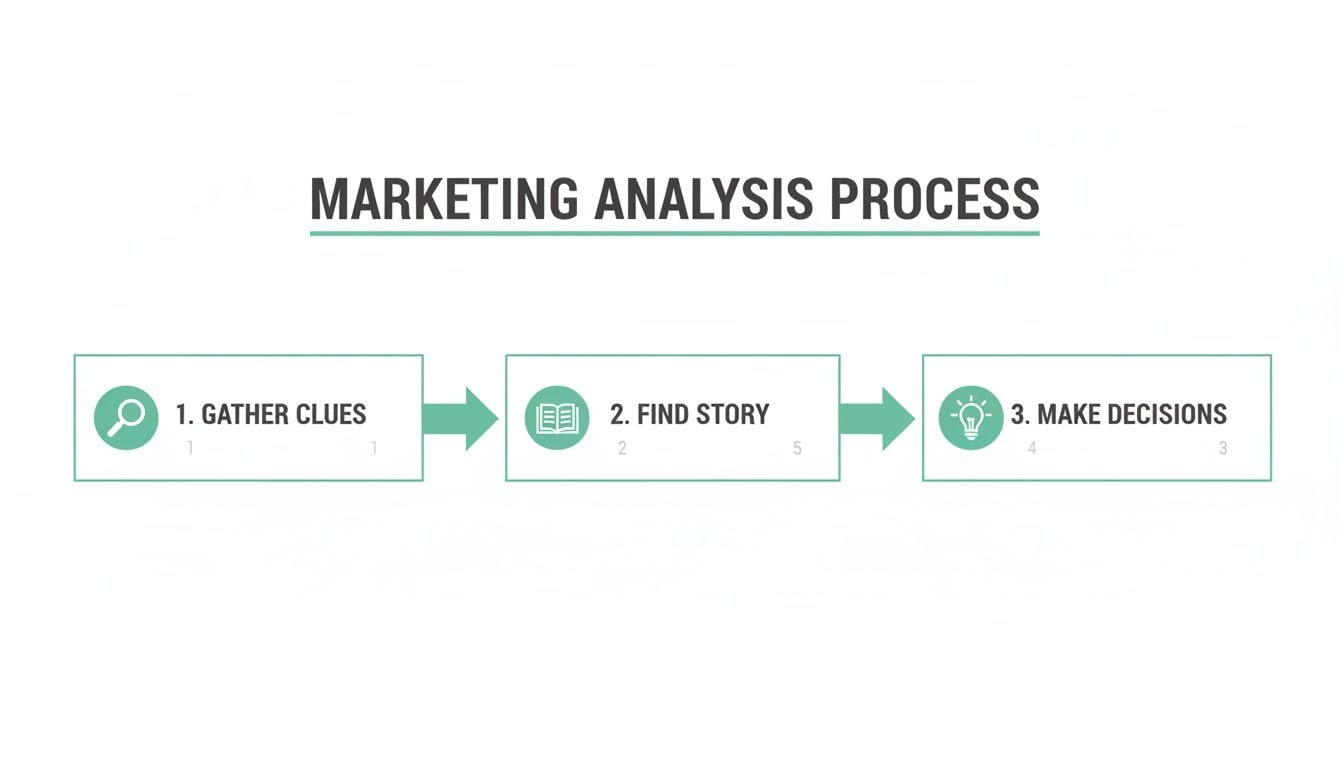
You start by gathering the raw clues from your data, then find the narrative story hidden within them, and finally, use that story to make smarter, more confident decisions.
From Collection to Connection: The Data Foundation
The entire workflow kicks off with data collection. Think of this as sourcing the raw ingredients for your analysis—the better the ingredients, the better the final dish. Marketing data generally falls into three buckets:
- First-Party Data: This is the goldmine—information you collect directly from your audience. It includes everything from your website analytics (page views, session duration), CRM systems (purchase history), and mobile app usage. It's the most valuable and reliable data you own.
- Second-Party Data: This is simply someone else's first-party data that you get straight from the source. A classic example is a hotel chain partnering with an airline to share audience data for co-branded promotions.
- Third-Party Data: This data is gathered by large aggregators who don’t have a direct relationship with the users. It's often purchased to supplement your own data for broad audience targeting, but its accuracy can be a bit of a gamble.
Just collecting this data isn't enough; you need a plan. Without proper tagging and instrumentation, your data collection will be a chaotic mess. A tracking plan is your blueprint—it defines exactly what user actions (events) and details (properties) you need to capture to answer your most important business questions.
Ensuring Data Integrity Through Cleaning and QA
Once data starts flowing in, the next crucial phase is making sure it's actually trustworthy. Raw data is rarely perfect. More often than not, it's messy, incomplete, or inconsistent. This is where data cleaning and Quality Assurance (QA) come in.
Imagine trying to navigate with a broken compass. That's exactly what you're doing when you base decisions on flawed data. A tiny error, like a broken tracking pixel on a "Thank You" page, could underreport your conversions and trick you into shutting down a winning ad campaign.
Data cleaning isn't just a technical chore; it's a fundamental step in building trust in your data. It's the process of finding and fixing errors, removing duplicates, and handling missing values to create a dataset you can truly rely on.
This stage is all about validating that your tracking plan was implemented correctly and that the data coming in accurately reflects what users are actually doing. Seemingly small issues can completely torpedo an entire analysis, making this step absolutely non-negotiable.
Assigning Credit with Attribution Modeling
With clean, reliable data in hand, you can now tackle one of marketing's oldest and biggest challenges: attribution. When a customer converts, which marketing touchpoints get the credit? Attribution modeling is the framework you use to answer that question.
Think of it like a soccer team. The striker might score the goal, but what about the midfielder who made the perfect pass or the defender who started the whole play? Giving 100% of the credit to the final touch just doesn't tell the full story.
There are several models to help you distribute that credit more intelligently:
- Last-Touch Attribution: Gives all the credit to the final touchpoint before a conversion. It’s simple, but it completely ignores the channels that built initial awareness.
- First-Touch Attribution: Assigns all credit to the very first interaction a customer had with your brand. This model is great for highlighting your top-of-funnel channels.
- Multi-Touch Attribution (e.g., Linear, Time-Decay): Distributes credit across multiple touchpoints in the customer journey, painting a much more balanced and realistic picture of which channels are contributing to the final sale.
Choosing the right model helps you understand the true performance of each channel, leading to smarter budget allocation and a far more accurate picture of your marketing ROI.
Transforming Data Into Decisions
The final step in the workflow is where the magic happens: turning your cleaned, attributed data into something people can actually understand and act on. This involves analysis, visualization, and reporting.
Here, analysts use various techniques to spot the trends, patterns, and correlations hiding in the numbers.
These findings are then translated into visual formats like dashboards, charts, and graphs. A well-designed visualization can communicate complex insights much more effectively than a giant spreadsheet ever could. These reports empower everyone—from marketing managers to the C-suite—to make informed, strategic decisions backed by solid evidence, completing the cycle from raw data to real business value.
The journey from raw numbers to actionable strategy is complex, but breaking it down into these key stages makes it manageable and repeatable. Below is a table that summarizes the entire workflow.
Key Stages of the Data Analysis Workflow
Each stage presents its own hurdles, but a structured process ensures that by the time you reach the analysis and reporting phase, you're working with data you can trust to guide your decisions.
Core Methods for Uncovering Actionable Insights
Once your data is clean and organized, the real fun begins. It's time to unlock the stories hidden inside. This is where we move from process to practice, applying specific analytical methods to turn raw numbers into a real strategic advantage. These are the go-to tools that analysts use every day to answer critical business questions and figure out what to do next.
Think of these methods less like complex formulas and more like different lenses for viewing your data. Each one gives you a unique perspective, helping you spot patterns and connections that are practically invisible on the surface. By getting a handle on these core techniques, you can start asking much smarter questions and getting much clearer answers.
A/B Testing for Clearer Choices
One of the most direct and powerful methods in a marketer's toolkit is A/B testing, sometimes called split testing. At its core, it’s a simple experiment to see which version of a marketing asset works better. You create two variations (Version A and Version B), show them to different segments of your audience, and see which one gets more people to take the action you want.
Let's say a marketing team is trying to get more people to open their emails.
- Version A (The Control): The original subject line, "Save Big with Our Weekly Deals."
- Version B (The Variant): A new idea, "Your Exclusive 25% Off Coupon Inside."
The team sends Version A to one half of their list and Version B to the other. After a day or two, they check the results and find that Version B had a 15% higher open rate. This simple test gives them a clear, data-backed reason to switch to the new subject line, immediately boosting their campaign performance.
Predicting the Future with Regression Analysis
While A/B testing is great for comparing two options, regression analysis is all about looking ahead. It helps you forecast future outcomes by digging into the relationship between different variables. Essentially, it helps you understand how a "dependent" variable (like sales) is influenced by one or more "independent" variables (like ad spend or website traffic).
Imagine you need to predict next quarter's sales. A regression model could comb through your historical data and find a strong link between your monthly ad spend and your total revenue. The analysis might show that for every $1,000 you pump into ads, your sales tend to climb by an average of $5,000. That kind of predictive insight is gold for planning your budget and setting revenue targets that are ambitious but achievable.
Regression analysis is what helps you shift from reactive to proactive decision-making. Instead of just looking back at what happened, you can build a model that shows how today's investments will likely pay off tomorrow.
Understanding Customer Behavior Over Time with Cohort Analysis
Not all customers are created equal, and their behavior definitely changes over time. Cohort analysis is a technique that groups users based on a shared characteristic—usually when they signed up or made their first purchase—and then tracks how that group behaves over the following weeks and months.
It’s perfect for answering questions like, "Do the customers we got during our Black Friday sale stick around longer than the ones from our summer campaign?" By tracking the retention rate of each cohort, you might find that the Black Friday group has a massive churn rate after the first month. That insight could make you rethink your deep-discounting strategy and push you to create better onboarding flows to improve long-term loyalty. Tracking these groups is a big part of what you can learn in our guide to customer journey analytics.
Segmenting Your Audience with Cluster Analysis
Cohort analysis groups users by something you already know about them, but cluster analysis is more of an exploratory technique. It sifts through your data to find natural groupings you might not have even known existed. The algorithm segments customers into distinct clusters based on similarities in their behavior, like how often they buy, what products they look at, or how long they spend on your site.
An e-commerce company might run a cluster analysis and find it has three main customer types:
- Bargain Hunters: They don't buy often, but when they do, they make huge purchases during sales.
- Loyal Regulars: They make smaller, consistent purchases every single month.
- Window Shoppers: They browse all the time but almost never pull the trigger on a purchase.
Once you’ve identified these distinct segments, you can stop blasting everyone with the same message. Instead, you can send targeted promotions to the Bargain Hunters, loyalty rewards to the Regulars, and engaging content to the Window Shoppers to nudge them toward a purchase. It makes your marketing feel much more personal and, ultimately, way more effective.
Building Your Modern Marketing Data Stack
Powerful marketing data analysis is only as good as the tools you use to collect, process, and make sense of it all. Just like a chef needs sharp knives and quality pans, an analyst needs a solid set of technologies to turn raw numbers into strategic gold. Building a "modern marketing data stack" is all about picking and integrating tools that work together seamlessly, creating a reliable flow of information.
Think of your data stack as an assembly line. Each tool has a very specific job. When they're all connected correctly, the final product—actionable insight—gets produced efficiently and accurately. Without this organized system, you're just left with a mess of disconnected data silos, which only leads to confusion and decisions based on a fractured picture of reality.
Core Components of a High-Performing Stack
A modern marketing data stack usually revolves around a few key categories of tools. Each one plays a unique role in the data's journey, from the moment a user first interacts with your brand to the final strategic report that lands on your desk.
- Analytics Platforms: These are the bedrock, capturing user behavior on your websites and apps. Tools like Google Analytics and Amplitude are built to track events, monitor user flows, and give you a baseline understanding of how people engage with your digital properties.
- Data Visualization Tools: Let's be honest, raw data is tough to interpret. Tools like Tableau and Looker are designed to transform complex datasets into intuitive dashboards, charts, and graphs. They become the storytellers of your stack, making it easy for anyone to spot trends and patterns at a glance.
- Customer Data Platforms (CDPs): A CDP acts as the central nervous system for all your customer data. It pulls information from all your sources—analytics, CRM, support tickets—and stitches it together into unified, 360-degree customer profiles. This unified view is absolutely critical for any deep personalization and segmentation efforts.
These platforms form the core of most stacks, but there’s a crucial fourth layer that makes sure the entire system is actually trustworthy.
The most sophisticated analytics tools in the world are useless if they're fed bad data. The integrity of your entire marketing data analysis hinges on the quality of the information flowing into these systems from the very beginning.
The Missing Layer: Automated Observability and QA
Traditionally, making sure your data was high-quality was a painfully slow, manual process filled with audits and spot-checks. This reactive approach meant that by the time you found an error—like a broken tracking pixel or a mistagged campaign—it had already corrupted your dashboards and led to flawed decisions.
This is where automated observability and analytics QA platforms come in. These tools act as a proactive quality control system for your entire data pipeline. They continuously monitor your analytics implementation in real-time, catching issues before they can cause any damage. You can get a deeper look at how this works in our automated marketing observability guide.
These platforms automatically alert you to problems such as:
- Missing or broken tracking on key conversion events.
- Inconsistent campaign tagging that completely messes up your attribution.
- Schema changes that could break downstream reports.
By adding this layer, you ensure the data flowing into your analytics, visualization, and CDP tools is accurate and complete. To ensure your marketing data stack is robust and reliable, it's crucial to implement essential database management best practices from the ground up. This combination of powerful tools and automated quality assurance creates a truly modern stack, empowering your team to work efficiently with data they can actually trust.
Why Poor Data Quality Is Costing You and How to Fix It
Bad data isn't just a minor annoyance for your analytics team. It’s a silent profit killer, quietly undermining your entire marketing operation from the inside out. Every decision you make—from budget allocation to strategic pivots—is built on the assumption that your data is telling the truth. But what happens when it’s not?
When data is flawed, the consequences ripple across the business. A simple tagging error can misattribute revenue, making a winning campaign look like a total flop. Likewise, a broken tracking pixel on a key conversion page might trick you into thinking an ad campaign isn't working, causing you to pull the plug—and your budget—based on completely false information.

The Hidden Costs of Unreliable Data
The true cost of poor data quality goes far beyond a few skewed numbers on a dashboard. It erodes trust, grinds decision-making to a halt, and fosters a culture of uncertainty. When teams can't rely on the numbers, they fall back on guesswork, undoing all the hard work you’ve put into building a data-driven strategy.
Think of it like trying to build a house on a shaky foundation. No matter how brilliant the architecture, the whole thing is destined to crumble. In marketing, that "crumbling" looks a lot like this:
- Wasted Ad Spend: Pouring money into channels that seem to be underperforming simply because conversion events aren't being tracked correctly.
- Flawed Strategic Planning: Making long-term business decisions based on historical trends that are inaccurate or just plain incomplete.
- Lost Revenue Opportunities: Failing to spot genuine customer behavior patterns because the data is too messy to make any sense of.
The bottom line is simple: if you can't trust your data, you can't trust your decisions. This disconnect between data and reality is one of the biggest hidden expenses in any modern marketing department.
Moving from Reactive Audits to Proactive Observability
For years, the standard approach to data quality was the manual audit—a slow, painful process of combing through data to find errors after they had already done their damage. This reactive method is like waiting for the fire alarm to go off before you start looking for smoke. By then, it’s often too late.
The modern solution is a shift from this reactive stance to a proactive one: automated observability. Instead of running periodic spot-checks, automated systems continuously monitor your data pipelines in real time.
This approach is like having a 24/7 security guard for your data. The moment an anomaly occurs—like a sudden drop in tracked events or a broken campaign tag—the system sends an immediate alert. This lets your team pinpoint the root cause and fix the issue before it has a chance to corrupt your dashboards or hurt your bottom line.
Adopting a Modern Framework for Data Integrity
Embracing automated observability means you stop chasing past mistakes and start preventing future ones. It ensures that the insights driving your marketing data analysis are built on a foundation of truth. To get there, it helps to understand the core principles involved, which you can explore in our detailed guide covering essential data quality best practices.
This proactive monitoring is also becoming easier to manage with modern tools. A game-changing insight from Altitude Marketing’s report on 2026 CDMO Marketing Trends reveals that 70% of CDMO marketers now use AI tools daily. This automation saves them an estimated 5-10 hours per week on tasks like data analysis, freeing up valuable time for more strategic work.
By implementing a continuous monitoring system, you empower your team to act with confidence. This critical shift ensures your marketing engine runs on clean, reliable fuel, transforming data from a potential liability into your most valuable strategic asset.
Your Actionable Plan for Better Data Analysis
Theory is great, but turning that knowledge into action is what actually moves the needle. Getting better at marketing data analysis isn't a one-and-done project; it's a journey. This final section lays out a clear roadmap to help you build a more powerful and trustworthy data practice, no matter where your team is starting from.
The path forward looks different for everyone. A team just dipping its toes into the data world needs something completely different from a seasoned, data-fluent organization. Your next steps should be tailored to your real-world challenges and what you’re trying to achieve.
For Teams Just Getting Started
If your company is new to structured data analysis, the first job is to build a solid foundation. You can’t build a house on shaky ground, after all. Your main goal here is simple: understand exactly what data you’re collecting and why you’re collecting it.
Start with a foundational audit of your current tracking plan. Ask yourself some tough questions:
- What are our most important business goals? Nail down the key outcomes you absolutely have to measure.
- What user actions actually lead to those goals? Pinpoint the specific events—like a
sign_uporpurchase_complete—that truly matter. - Are we even capturing this stuff consistently? Double-check your setup across your website and apps to make sure the data is reliable.
This initial audit gives you a baseline and brings much-needed clarity to what your data should be telling you.
For Maturing Data Teams
For teams already on their way, the biggest hurdle is usually shifting from reactive fire-fighting to proactive quality control. Manual audits are slow, painful, and just can’t keep up. The next logical step is to build trust and efficiency by bringing in automation.
The goal is to move from a culture of hoping the data is right to a culture of knowing it is. This happens when you catch errors before they poison your dashboards and lead to bad decisions.
It's time to implement automated analytics QA. This gets rid of the soul-crushing manual work of validating your tracking. This kind of system continuously monitors your data flow for screw-ups like broken pixels or messy campaign tagging, freeing up your team to focus on actual analysis instead of endless debugging.
For Advanced Organizations
If you're on an advanced team with a mature data practice, your focus should shift to deeper integration and optimization. At this stage, you’re looking to connect all your disparate data sources to create one unified, panoramic view of the customer journey.
Start exploring ways to integrate your analytics and BI tools more deeply. This means finally breaking down any remaining data silos between your product analytics platform, your CRM, and your data warehouse. The end game is to unlock more sophisticated analyses—like multi-touch attribution and predictive modeling—all powered by a complete and trusted dataset you can actually rely on.
Got Questions About Marketing Data Analysis?
Even with a clear plan, it's natural for questions to pop up around marketing data analysis. Let's tackle some of the most common ones I hear, so you and your team can move forward with confidence.
What’s the Difference Between Marketing Analytics and Data Analysis?
It's a great question, and they really are two sides of the same coin. Think of marketing analytics as the what. It’s all about tracking and reporting on your key performance indicators (KPIs)—things like website traffic, conversion rates, and campaign ROI. It's the dashboard that gives you a real-time pulse on how you're doing.
Marketing data analysis, on the other hand, gets into the why. This is where the real investigation happens. An analyst rolls up their sleeves and dives deep into the data from those analytics platforms to spot trends, predict what might happen next, and answer tough business questions.
In short, analytics tells you the news; data analysis explains the story behind the headlines.
Where Should a Small Business Start?
If you're a small business, the sheer amount of data available can feel like a tidal wave. My advice? Don't try to measure everything. The best place to start is with a single, crucial business question.
Pick one goal you want to nail, like "increase online sales by 10%," and focus all your energy there. From there, make sure you have a basic tool like Google Analytics set up correctly to track the actions tied to that goal—website visits, add-to-cart clicks, and completed purchases.
The most effective starting point isn't a complex tool but a clear question. By focusing on a single, high-impact goal, you can build a simple and manageable data analysis practice that delivers real value without overwhelming your team.
This focused approach lets you learn the ropes on a smaller scale. You'll build momentum and prove the value of data analysis before you even think about expanding to more complex projects.
How Does Automated QA Improve Analysis?
Automated Quality Assurance (QA) is a game-changer for the reliability of your insights. Traditionally, checking data quality was a painful, manual slog. You’d often find errors long after they’d already thrown your reports off course, leaving you in a constant state of uncertainty.
Think of automated QA systems as a 24/7 watchdog for your entire data pipeline. They constantly monitor your tracking implementation in real time, instantly flagging issues like broken tracking pixels, mismatched campaign tags, or missing conversion data.
This proactive approach means the data flowing into your analytics platforms is clean and complete from the very beginning. As a result, your analysis is built on a foundation of trust, empowering your team to make strategic decisions with much, much greater confidence.
At Trackingplan, we give you a fully automated observability and QA platform to guarantee the quality of your analytics from end to end. By catching data issues in real time, we help you build trust in your numbers and empower your team to deliver insights that drive real growth.