
TL;DR:
- Proper data tracking and alignment with clear profitability metrics are essential for effective ad spend optimization. Regular audits, appropriate bidding strategies, and gradual scaling help prevent budget waste and improve ROAS over time. Using automated monitoring tools ensures data integrity, enabling informed decisions and sustainable campaign growth.
Every dollar you put into paid advertising either works or it doesn’t. Yet 20-40% of digital ad budgets are wasted not because of bad creative, but because of structural errors and data problems that marketers often don’t see coming. This optimize ad spend tutorial is built for digital marketing professionals who are past the basics and ready for a disciplined, data-driven approach that actually moves ROAS in the right direction. You’ll get the preparation, execution, and verification framework in one place, with no generic advice.
Table of Contents
- Key Takeaways
- Optimize ad spend tutorial: building the right foundation
- Step-by-step execution strategies
- Verification: monitoring and adjusting performance
- Troubleshooting common pitfalls
- My honest take on optimizing ad spend
- How Trackingplan helps you protect your ad spend
- FAQ
Key Takeaways
| Point | Details |
|---|---|
| Data quality comes first | Fix tracking and attribution before touching bids or budgets, or your optimizations will mislead you. |
| Match bids to your data | “Maximize Conversion Value” outperforms “Maximize Conversions” by 3.3x when revenue data is available. |
| Zero-based auditing recovers spend | Regularly cutting non-performing campaigns can reclaim 10-20% of budget for reinvestment. |
| Scaling requires patience | Facebook’s algorithm needs 50 conversions per week per ad set to exit the learning phase. |
| Integrated changes beat isolated tweaks | ROAS volatility usually results from fragmented decisions, not a single weak lever. |
Optimize ad spend tutorial: building the right foundation
Before you touch a single bid or reshuffle your budget, you need to know that your data is telling you the truth. This is where most teams fail. They jump straight to optimizing campaigns while their tracking is broken, their conversions are undercounted, or their attribution model is crediting the wrong channels.
The single most important upgrade you can make is moving to server-side tracking. Browser-based tracking loses signal constantly due to ad blockers, iOS restrictions, and cookie limitations. Server-side setups bypass these problems entirely, giving ad platforms the complete conversion data they need to train their algorithms properly. When the algorithm is training on a distorted picture, every automated bid decision it makes is compromised from the start.
Once your tracking is solid, define what you actually want from your campaigns. That sounds obvious, but many teams run ads optimized for clicks or impressions, which are metrics that tell you nothing useful about profit. The metrics that matter for optimized ad spend are:
- ROAS (Return on Ad Spend): Revenue generated per dollar spent. Ecommerce averages 2.87:1, fashion reaches 4.3:1, and health supplements sit around 2.3:1.
- POAS (Profit on Ad Spend): Strips out cost of goods and margins, showing actual profitability instead of gross revenue.
- CAC (Customer Acquisition Cost): What you pay to acquire a single new customer, which you should track against LTV.
- LTV (Lifetime Value): Tells you how much you can afford to spend on acquisition without losing money long-term.
Vanity metrics like clicks mislead budget decisions and, worse, they train your algorithms on a distorted version of reality. Stop reporting on impressions as a primary KPI.
Set realistic ROAS targets based on where your campaign actually is. New campaigns in their first few weeks should aim for 2-4x ROAS. Well-optimized campaigns with six or more months of data can target 4-6x. Google Ads optimization typically matures over 6-12 weeks, so be careful not to judge campaign performance before the data stabilizes.
Pro Tip: Audit your tracking implementation before any budget decisions. Use a tool like Trackingplan to automatically detect broken pixels, missing events, or schema mismatches that would otherwise silently corrupt your optimization signals.
Step-by-step execution strategies
With a clean data foundation and clear goals in place, you can move to the tactical layer. This is where ad spend management tips become genuinely practical.
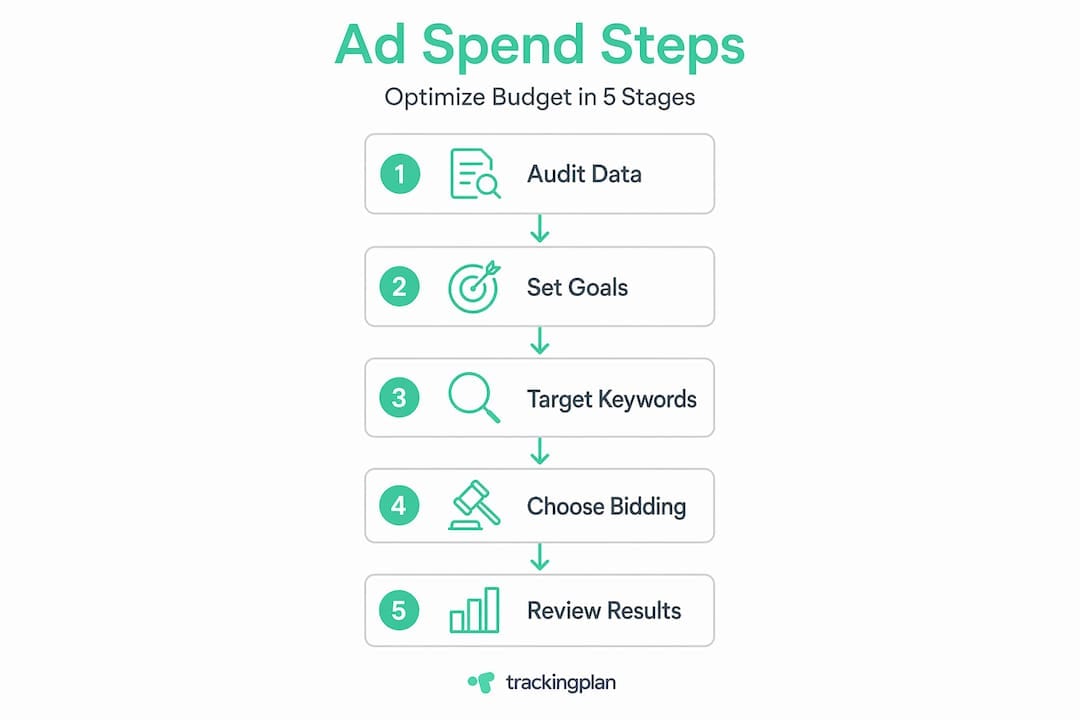
1. Build your negative keyword strategy
Negative keywords are the fastest way to stop paying for irrelevant traffic in Google Ads. Pull your Search Terms report weekly and look for queries that are generating clicks but no conversions. Add these as negatives at the campaign or ad group level. For most accounts, the first audit surfaces dozens of irrelevant queries that have been quietly draining budget for months.
2. Choose the right bidding strategy
Here is a concrete comparison of the two most common Google Ads bidding strategies:
| Bidding Strategy | Best When | Expected Outcome |
|---|---|---|
| Maximize Conversion Value | Revenue data available and fed back to platform | Higher ROAS; outperforms Maximize Conversions by 3.3x |
| Maximize Conversions | Conversion volume is the goal, revenue data unavailable | Higher volume, but revenue efficiency often lower |
| Target ROAS | Mature campaigns with consistent conversion history | Stable ROAS within a defined range |
| Target CPA | Lead generation focus; fixed cost-per-lead goals | Consistent lead cost, but not revenue-focused |
The takeaway is simple. If you have clean revenue data flowing into your platform, use Maximize Conversion Value. Platforms favor revenue-centric signals even if it means overriding default recommendations, and this is one area where you should do exactly that.
3. Manage Meta Ads budget allocation
On Facebook and Instagram, you have two structural choices for budget control. ABO (Ad Set Budget Optimization) gives you direct control over spend at the ad set level. CBO (Campaign Budget Optimization), now rebranded as Advantage Campaign Budget, lets the algorithm distribute budget across ad sets based on performance signals.
ABO works well when you’re testing new audiences or creatives and want equal exposure. CBO works better at scale when you trust the algorithm to find the best-performing ad sets and concentrate spend there. Most mature accounts run a hybrid: ABO for testing, CBO for scaling proven winners.
4. Scale without disrupting the algorithm
Scaling spend too fast causes learning phase traps. Facebook’s algorithm requires 50 conversions per week per ad set to exit the learning phase and perform predictably. If you increase your budget faster than the conversion signal can keep up, you push the ad set back into learning and degrade performance temporarily.

The practical rule: increase budgets by no more than 20% every 5-7 days for stable campaigns. For horizontal scaling, duplicate proven ad sets rather than inflating existing budgets. For vertical scaling, increase spend gradually while monitoring cost-per-result daily.
5. Review and reallocate on a cadence
Weekly reviews should focus on performance anomalies. Monthly reviews should tackle budget reallocation decisions across campaigns and channels. Without a fixed cadence, you’ll find yourself making reactive decisions based on short-term noise instead of meaningful trends.
Pro Tip: When exploring newer channels like AI-driven ad placements, start with a minimum $50 daily budget to give the algorithm enough signal to work with before judging performance.
Creative and landing page alignment also matters more than most teams account for. If your ad promises a specific product benefit and your landing page leads with brand story, you’re losing conversions to message mismatch. Run this audit for every active campaign.
Verification: monitoring and adjusting performance
Getting your campaigns set up well is only half the work. Sustaining performance over time requires a monitoring and auditing system. Here is what effective verification looks like in practice.
Build a monitoring dashboard
Your dashboard should surface the metrics that actually indicate health: ROAS trend by campaign, cost per conversion by ad set, impression share (for search), and frequency (for social). Avoid cluttering it with vanity metrics that feel reassuring but don’t drive decisions.
| Metric | What it tells you | Review frequency |
|---|---|---|
| ROAS by campaign | Revenue efficiency of each campaign | Weekly |
| Cost per conversion | Whether acquisition costs are rising | Weekly |
| Frequency (social) | Risk of ad fatigue in your audience | Weekly |
| Impression share lost (search) | Budget or quality constraints limiting reach | Monthly |
| LTV by cohort | Whether acquired customers are actually profitable | Monthly |
Apply zero-based budgeting regularly
Zero-based budgeting means you justify every campaign’s budget from scratch at each review cycle, rather than just rolling forward last month’s numbers. This approach routinely surfaces campaigns that are running on inertia rather than performance. Recovered spend from non-performing campaigns can be reinvested into what’s working, and research shows this can drive 5-10% incremental growth.
Avoid two specific mistakes that kill verification efforts. First, scaling too fast based on a single good week. Second, pausing campaigns during the learning phase and then wondering why performance tanks when you restart them. Restarting campaigns requires 7-14 days for stable data to re-accumulate.
Pro Tip: Pair your platform dashboards with third-party monitoring to catch tracking failures before they corrupt your data. A broken pixel can send you chasing a “performance drop” that is actually just a data gap.
Automation rules within Google and Meta can help maintain stability, but treat them as guardrails, not a replacement for human analysis. Set rules to pause ad sets that exceed your max CPA, but review those pauses manually before acting on them.
Troubleshooting common pitfalls
Even well-structured campaigns hit problems. Recognizing these patterns early saves both budget and time.
The most common structural errors that cause wasted spend:
- Underfunded ad sets: An ad set running $5 per day cannot generate enough conversions for the algorithm to learn. It burns budget without ever producing useful data.
- Incomplete conversion tracking: If you’re only tracking purchase events and missing add-to-cart or initiate-checkout events, your algorithm lacks the signals to find users who are close to converting.
- Broad targeting without qualification: Platforms default to reach-maximizing behavior. Default platform settings often encourage engagement-optimized bidding rather than revenue-centric approaches, which wastes spend on users who engage but never convert.
- Audience saturation: When frequency on Meta exceeds 3-4 for a given audience segment within a week, performance typically degrades. Cap frequency or refresh creative before the decline compounds.
On the algorithmic side, noisy or incomplete data is more damaging than most marketers realize. When you feed an ad platform partial conversion data, it builds targeting models based on that partial picture and then confidently finds you more of those partial-signal users.
Scaling spend magnifies existing problems. If your campaign structure is broken or your tracking is incomplete, increasing budget accelerates the damage, it doesn’t override it.
When a campaign is genuinely underperforming, pausing it is often the right move despite the anxiety around learning phase resets. A campaign spending budget badly is worse than one temporarily paused and rebuilt correctly. Duplicate the ad set, preserve the creative, and restart with cleaner parameters. You’ll recover the learning phase faster than you’d recover from continued wasted spend.
For planning campaigns that compound results over time rather than burning budget on disconnected pushes, read this guide on digital campaigns for sustainable growth.
My honest take on optimizing ad spend
I’ve worked through enough ad accounts to say this with confidence: the majority of “optimization” work is actually just cleaning up the mess that platforms and hasty execution create. The real problem isn’t that marketers don’t know the right levers to pull. It’s that they pull them in isolation, then get confused when results don’t match expectations.
I’ve seen accounts where ROAS looked excellent on paper but the business was losing money because POAS was never tracked. I’ve seen campaigns scaled aggressively on a two-week high that turned out to be seasonal noise, and the extra budget just deepened the trough that followed. The integrated management approach isn’t just a best practice recommendation. It’s the only approach that actually produces stable, improving results over time.
What I’ve found genuinely undervalued is data hygiene. Most teams audit their creative regularly but check their tracking implementation once at setup and then forget about it. A broken pixel that goes unnoticed for three weeks can corrupt weeks of algorithmic learning, and you won’t see the impact until performance has already declined. By then, you’re chasing a ghost.
My advice: build the monitoring infrastructure before you scale. Know what your ROAS should be given your campaign’s maturity, your margins, and your channel mix. Treat every platform recommendation as a hypothesis worth testing, not a directive worth following. And give yourself the patience to let data accumulate before making structural changes. Most optimization failures I’ve seen weren’t from bad strategy. They were from good strategy executed too impatiently.
— David
How Trackingplan helps you protect your ad spend
The most expensive mistake in paid advertising isn’t a bad ad. It’s making budget decisions based on data you don’t know is broken. Trackingplan’s automated monitoring catches broken pixels, missing events, and tracking mismatches before they corrupt your campaign data and send your algorithms in the wrong direction. With real-time alerts via Slack, email, or Teams, your team knows about data issues within minutes instead of weeks.
If you’re serious about maximizing your ad budget, start with the layer that makes every other optimization possible: data quality. Trackingplan integrates with your digital analytics tools to audit and monitor your entire tracking stack continuously, so your attribution stays accurate and your budget decisions stay grounded in reality.
Explore how web tracking monitoring from Trackingplan can protect the accuracy your campaigns depend on.
FAQ
Why does ad spend optimization matter so much?
20-40% of digital ad budgets are wasted on structural and data issues, not poor creative. Optimizing your spend means recovering that budget and reinvesting it in what actually drives growth.
What metrics should I use to track ad spend performance?
Prioritize ROAS, POAS, CAC, and LTV over vanity metrics like clicks and impressions. These metrics directly reflect profitability and tell your ad platforms to find users who actually generate revenue.
How fast can I increase my ad budget without hurting performance?
Increase budgets by no more than 20% every 5-7 days for active campaigns. Facebook’s algorithm needs 50 conversions per week per ad set to maintain stable learning, and faster increases disrupt that process.
When should I pause a poor-performing campaign?
Pause it when it’s spending budget without generating meaningful conversion data. Pausing and rebuilding with corrected parameters is faster than waiting for a structurally broken campaign to self-correct.
What is the difference between ABO and CBO on Meta Ads?
ABO (Ad Set Budget Optimization) gives you manual control over spend per ad set, while CBO (Campaign Budget Optimization) lets the algorithm allocate budget across ad sets automatically. Use ABO for testing and CBO for scaling proven performers.