
The Ad Spend Black Hole Why Your Reports Disagree
A familiar scenario plays out every week in growth teams.
Paid media reports strong conversion volume. Analytics reports fewer conversions. The sales system confirms even fewer completed outcomes. No one knows whether the campaign underperformed, whether attribution shifted, or whether the tracking broke after a release. The result is the same either way. Teams hesitate, budgets get moved based on shaky evidence, and confidence in reporting keeps dropping.
This is the ad spend black hole. Money goes in, traffic arrives, but the path from click to revenue gets distorted by broken pixels, missing events, inconsistent naming, consent issues, and destination-specific reporting logic.
The scale of the problem is easy to underestimate. The global ad tracking software market reached an estimated value of 845.33 billion USD in 2023, which shows how much money now depends on reliable measurement and validation across digital channels (Zappi's guide to brand and ad tracking software).
Where disagreement usually starts
In practice, report conflicts usually come from a few recurring patterns:
- Platform self-attribution: Ad platforms naturally optimize around their own view of performance.
- Implementation drift: A checkout change, app release, or tag manager update changes tracking behavior without anyone noticing.
- Partial event delivery: An event may fire in the browser but fail to reach one or more destinations.
- Schema inconsistency: One tool receives
product_id, another getsproductID, and a third gets nothing useful at all.
The most dangerous tracking failure isn't the one that breaks everything. It's the one that quietly breaks one destination and leaves the rest looking normal.
A basic ad pixel monitoring tool helps, but teams usually need something broader than pixel uptime alone. They need validation across the full chain, from dataLayer to tag firing to payload structure to destination delivery.
Why this becomes a trust crisis
When reports disagree long enough, people stop trusting analytics altogether. Marketers export numbers into spreadsheets. Analysts build exceptions into dashboards. Developers get pulled into emergency debugging sessions after every launch.
At that point, ad tracking validation software stops being a niche tool. It becomes the control layer that checks whether your measurement system is producing evidence you can reliably use.
What Is Ad Tracking Validation Software Really
Ad tracking validation software checks whether your measurement setup is producing data you can trust before bad inputs spread into attribution, bidding, and reporting. It exists because broken tracking rarely fails in one obvious place. It fails across browsers, apps, tag managers, server-side endpoints, consent tools, and ad platforms that each keep their own version of the truth.
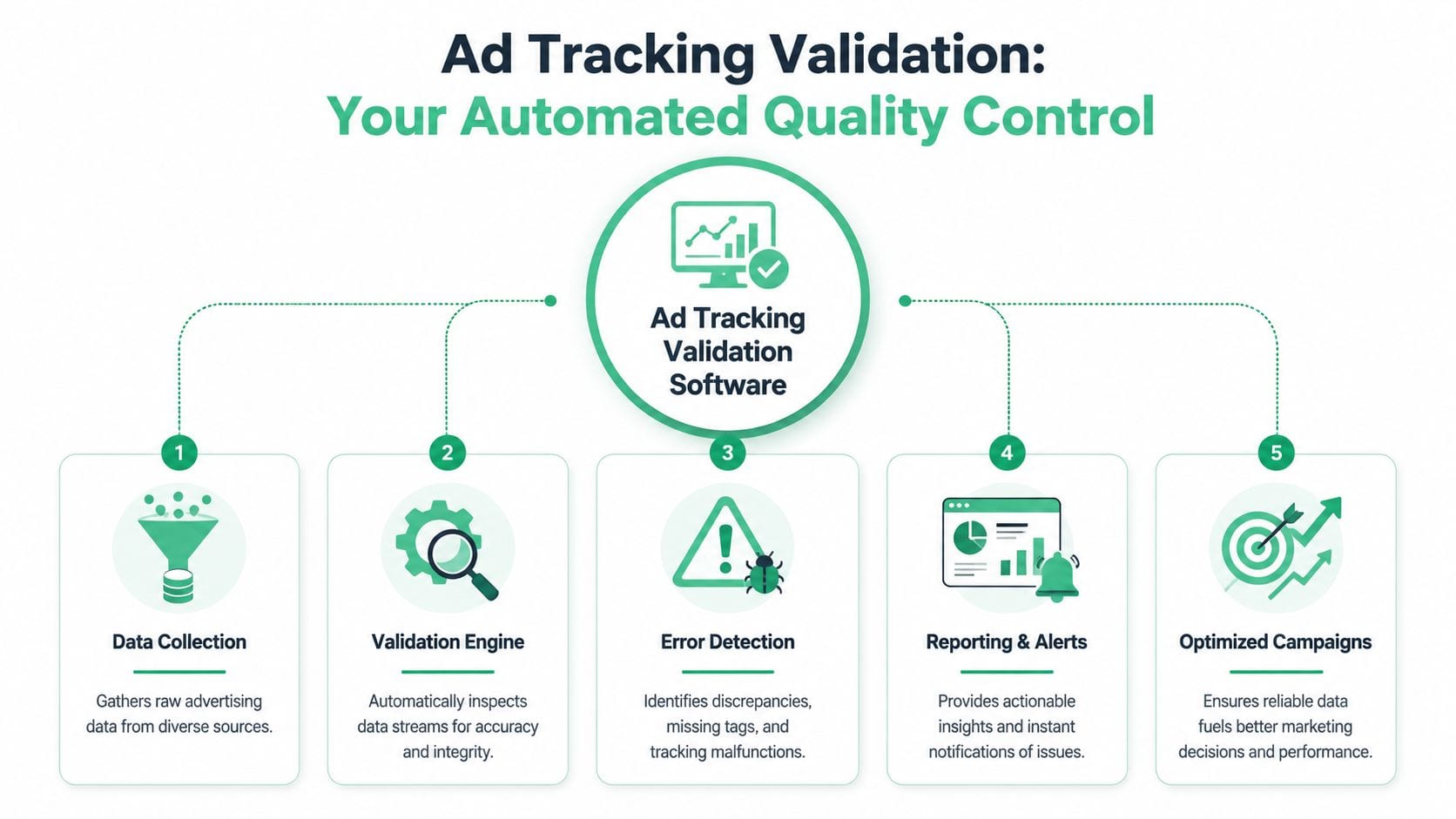
Teams usually notice a problem only after dashboard numbers drift apart. By then, the root cause is older than the report. A release changed the event schema. A consent update blocked one destination but not another. Safari traffic dropped from browser-side collection while server-side events kept flowing. Ad blockers filtered part of the funnel, which created bias rather than a clean outage.
That is why validation software has become part of data observability for analytics implementations. The job is broader than checking whether a pixel exists. The job is to verify that the whole measurement system behaves consistently enough to support ROI decisions.
It monitors the full path, not just the report
Reliable validation happens upstream, close to where data is created and transformed.
A useful platform inspects several layers of the flow:
- Collection layer
It captures what the site or app generates, including dataLayer events, browser requests, SDK output, and server-side payloads. - Transmission layer
It checks whether tags, pixels, webhooks, and API calls fire when expected, with the expected parameters. - Schema layer
It validates event names, property formats, required fields, and naming conventions so one release does not rewrite your tracking plan. - Reconciliation layer
It compares what different systems received. This matters when GA4, Meta, TikTok, and the warehouse each show a slightly different version of the same conversion path. - Alerting layer
It flags missing events, rogue properties, UTM mistakes, PII leaks, consent failures, and unusual changes in volume before analysts have to reverse-engineer the damage.
The reconciliation layer is where a lot of articles stop too early. In practice, one of the hardest problems is not simple breakage. It is partial disagreement. A purchase may appear in one tool, arrive late in another, and be dropped entirely in a third because of payload rules, identity gaps, or browser restrictions. Validation software helps isolate where that divergence starts.
What modern platforms do
Good platforms automate checks that analysts and engineers used to do by hand, badly and too late.
Useful capabilities usually include:
- Automated discovery of the live implementation: The system maps events, parameters, tags, and destinations from what is happening in production, not from stale documentation.
- Detection of missing and unexpected events: If a checkout step disappears or a new property starts appearing without approval, the system flags it.
- Schema validation against a tracking plan: It checks whether the event structure still matches what reporting, attribution, and downstream models expect.
- Campaign tagging checks: It catches malformed or inconsistent UTM values before they fragment acquisition reporting.
- Consent and privacy validation: It surfaces blocked tags, premature firing, and sensitive fields that should never be sent to vendors.
- Cross-platform comparison: It helps teams see whether collection differences come from implementation drift, ad blocker bias, server-side routing issues, or destination-specific processing.
This changes the operating model. Instead of waiting for analysts to find bad numbers in a dashboard review, the system produces evidence at the point of failure. Developers get a concrete diff. Marketing gets a clearer explanation for why one platform is over-reporting. Analysts get a cleaner base layer for attribution and ROI reporting.
Practical rule: If your team discovers tracking problems by comparing conflicting reports after the fact, validation is still happening manually.
What it changes day to day
The biggest change is not convenience. It is trust.
With validation in place, dashboards stop being a negotiation between tools. The warehouse, analytics platform, and ad platforms still will not match perfectly, and they should not be expected to. They use different attribution windows, identity rules, and modeled conversions. But the underlying event pipeline becomes auditable, which means disagreements become explainable instead of political.
That is the true benefit of ad tracking validation software. It gives the team one defensible source of truth about whether the measurement layer is healthy enough to use for budget decisions.
The High Cost of Silent Tracking Failures
Most tracking failures don't announce themselves. They don't crash the site. They don't throw a visible error in the dashboard. They just distort the data enough to make your decisions worse.
That's why teams can spend weeks optimizing campaigns against bad attribution without realizing the measurement layer changed underneath them.

The failures that hurt most
A broken purchase pixel after a checkout deployment is obvious once someone notices revenue has “dropped” in one tool but not another. More often, the damage is subtler.
Here are the failures I see most often in messy implementations:
- Missing events after releases: A front-end update removes a selector, changes a route, or alters dataLayer timing. The event still exists in the spec but never fires.
- Schema drift: The event fires, but required properties change format or naming. Dashboards don't always break visibly. They just become less useful.
- UTM inconsistency: Teams use different naming conventions, incorrect mediums, or partial tagging. Attribution becomes fragmented before the data even reaches reporting.
- Destination mismatch: GA4 receives one payload, Meta receives another, and the warehouse gets a third variant through middleware.
- PII leakage or consent errors: Data gets sent when it shouldn't, or doesn't get sent when it should.
Why these issues cost more than they look
The business impact isn't only reporting confusion.
A silent event failure can cause a paid social team to pause a campaign that is still generating real revenue. A malformed purchase property can break product-level reporting and ruin remarketing audience quality. A consent misconfiguration can create selective underreporting that looks like channel deterioration. And every manual audit pulled into the loop takes time from analysts, engineers, and marketers who should be working on improvement, not forensics.
If your data quality process depends on someone noticing a weird chart, the problem is already old.
One useful explanation of how teams monitor this kind of issue in practice is in the video below.
The overlooked problem of biased missing data
There's another issue that often isn't modeled properly. Some data isn't missing randomly. It's missing systematically.
In 2025, over 1 billion people worldwide actively block ads, and 70-80% of developers use ad-blocking tools, which creates attribution data that underrepresents technical audiences and similar high-intent cohorts (DBTA on the analytics blind spot created by ad blockers).
That matters because it changes what your reports mean. If a large share of privacy-conscious or technically adept users are invisible to browser-based tracking, your attribution model doesn't just undercount. It becomes biased. The missing users may have different buying behavior, higher average value, or different channel preferences than the visible users.
Why ad blocker bias changes strategy
This is especially painful for SaaS, developer tools, infrastructure products, and any company selling to engineers. The people most likely to adopt the product are often the same people most likely to block tracking.
That creates a false sense of certainty. A channel can appear weak because the audience it reaches is less observable, not because the channel is ineffective. A remarketing audience can look smaller than reality. A campaign can seem to underperform against branded search because one is measured more completely than the other.
A strong validation layer won't magically recover every blocked interaction. But it can help teams understand where data is absent by design, where implementation is broken, and where confidence should be lower.
Essential Features of Modern Validation Platforms
The phrase “validation platform” gets used loosely. Some tools are really just tag debuggers. Others are closer to a monitoring layer for the entire analytics implementation. The difference matters.
If the goal is trustworthy dashboards, there are a few capabilities that aren't optional.
Server-side validation is no longer optional
The biggest dividing line is whether the platform can validate server-side tracking, not just browser pixels.
Traditional pixel-based tracking can lose 20-30% of conversion data in cookieless environments, while server-side implementations can maintain over 95% data fidelity (WiFiTalents on ad tracking software and server-side accuracy). That gap directly affects whether your dashboard reflects real performance or a filtered version of it.
Server-side tracking improves resilience, but it also creates a new failure surface. Events can fail at the endpoint, arrive late, use the wrong auth, or send the wrong schema. Validation software should monitor those risks continuously.
The feature set that actually matters
When I evaluate ad tracking validation software, I want to see these capabilities first:
- Automated discovery
The platform should map current implementations across web, app, and server-side flows without requiring a giant manual inventory. - Real-time anomaly detection
If conversion volume suddenly drops, a property disappears, or a tag stops firing, the team should know fast. - Schema validation against expected contracts
This is what catches issues likeproduct_IDappearing whereproduct_idwas expected. - Destination-level comparison
Validation has to compare what each endpoint receives, not just what the page emitted. - Campaign tagging checks
UTM mistakes still break attribution every day, and they're often easier to catch automatically than manually. - Privacy and consent monitoring
Validation should surface potential PII leaks and consent-state issues, because those affect both compliance and data integrity.
Root cause matters more than alert volume
Anyone can build a noisy alerting system. That's not useful. Analysts don't need fifty warnings with no context. They need a path to diagnosis.
Tools with guided debugging stand out in these scenarios. An AI-assisted debugger for analytics issues is valuable when it shortens the time between “the metric moved” and “this exact property broke in this exact flow.”
Operational advice: Don't buy a tool that only tells you something is wrong. Buy one that helps the right person fix it without reconstructing the failure from scratch.
What separates a checker from an observability platform
A basic checker tells you whether a tag exists on a page. A real validation platform monitors implementation health over time.
The distinction usually shows up in how the tool handles change:
If your environment includes Google Ads, Meta, TikTok, Segment, Snowplow, GA4, mobile SDKs, and backend event forwarding, basic inspection won't hold up. You need validation that understands the whole system.
How to Evaluate and Select the Right Software
Buying ad tracking validation software is rarely just a tooling decision. It's a decision about operating model. The wrong product gives you another dashboard to ignore. The right one changes how marketing, analytics, and engineering work together.
I'd evaluate vendors with the same discipline used for any critical data system. Not by demo polish. By how well the tool fits the stack you already have, the way your team works, and the kinds of failures you keep seeing.
The questions worth asking in a demo
Start with coverage. Most vendors look strong when they show one clean website and one ad platform. Real environments are not clean.
Ask questions like these:
- Can it validate web, app, and server-side implementations in the same workspace?
- Does it support the analytics and routing tools you already use, such as GA4, Adobe Analytics, Segment, Snowplow, Mixpanel, or Amplitude?
- Can it compare what was emitted versus what each destination received?
- How does it handle alerts for schema changes, missing events, rogue parameters, UTM errors, and consent problems?
- Can alerts route into Slack, Teams, or incident workflows your team already uses?
- What does onboarding look like for agencies or multi-brand organizations?
If mobile matters to you, it also helps to understand adjacent implementation choices. For teams working on apps, this guide to choosing the right Flutter analytics stack is useful context because mobile analytics architecture often determines how much validation effort you'll need later.
Use a checklist, not gut feel
Here's a practical shortlist to use when comparing tools, including platforms such as ObservePoint, DataTrue, Tag Inspector, and solutions built around continuous analytics QA.
Look for operational fit
A lot of teams overbuy. They purchase a broad “data quality” category product when what they really need is something focused on analytics QA and marketing instrumentation.
Other teams underbuy. They use browser extensions and spreadsheets long after the environment has grown too complex for manual auditing.
If you need a reference point for the broader sector, this roundup of data quality tools for modern data teams is helpful because it shows where analytics validation fits relative to general data quality tooling.
Red flags during evaluation
The easiest way to spot weak fit is to listen for vague answers.
“We need to know whether your tool catches the failures we actually have, not the failures in a perfect demo account.”
Be cautious if a vendor can't clearly explain:
- how they validate server-side events,
- how they compare cross-platform discrepancies,
- how they prevent alert fatigue,
- or how they help teams keep tracking plans current over time.
If those answers are fuzzy, the product will probably become another reporting layer instead of a control layer.
From Implementation to ROI Real-World Validation
Monday morning. Paid search looks strong in Google Ads, GA4 shows a softer trend, Meta reports another number entirely, and the warehouse model is missing part of the weekend. Nobody trusts the dashboard, but budget decisions still have to be made.
That is the fundamental starting point for validation. Implementation matters, but the outcome that matters more is operational trust.
Implementation usually begins with observation, not a massive rebuild. A tag, SDK, or network-level integration starts collecting live event traffic so the team can compare what was supposed to fire against what fired across browsers, apps, server-side endpoints, and ad platforms.

What happens right after setup
The first useful output is usually uncomfortable.
Teams find old pixels still firing after a migration, duplicate purchase events introduced by a tag manager change, mismatched naming between web and app, and destinations receiving different versions of the same conversion. They also find quieter problems that standard QA misses, such as consent settings suppressing one destination but not another, or browser-side data dropping off in high-ad-blocker segments while server-side events keep flowing.
Those discoveries explain why reports disagree. The issue is often not one broken tag. It is a stack of small inconsistencies across platforms that each count, attribute, or drop events differently.
A platform such as Trackingplan is built for that job. It discovers martech implementations from dataLayer to downstream destinations, monitors analytics and attribution pixels across web, app, and server-side setups, and flags anomalies, broken events, schema mismatches, UTM errors, PII leaks, and consent issues in one place.
The alerts that actually change decisions
Useful alerts connect a tracking defect to a business risk. If they do not help a team decide what to fix first, they become another stream of noise.
Common examples include:
- Conversion flow changed after a release
Purchase or lead events drop while sessions and click volume stay stable. - A core event schema drifted
Anadd_to_cartorgenerate_leadevent starts sending a field that downstream reports do not map correctly. - Cross-platform counts split too far apart
Meta, GA4, and the warehouse each report a different version of the same conversion trend, beyond the normal tolerance the team has accepted. - An unapproved destination starts receiving data
A rogue pixel appears after a container publish or plugin update. - Campaign naming breaks mid-flight
Inconsistent UTMs start fragmenting paid media reporting before anyone notices in the dashboard.
The benefit is speed, but speed is only part of it. Good validation shortens the time between failure and explanation. That matters because broken tracking rarely fails cleanly. It degrades unevenly across channels, devices, regions, and privacy contexts, which is why teams often misread a measurement problem as a media performance problem.
How validation turns into ROI
The business case gets clearer once you tie validation to bad decisions that it prevents.
If paid search conversions are inflated by duplicate events, budget shifts toward the wrong campaigns. If browser-side tracking undercounts users with aggressive privacy settings, channels with heavier ad blocker exposure look weaker than they are. If a checkout update changes the event payload for one destination but not another, attribution models start drifting apart and nobody can explain why CAC suddenly moved.
Those are not reporting annoyances. They are allocation errors.
I have seen teams spend days arguing over which dashboard is right when the actual answer was that none of them were using the same underlying event definition anymore. Validation software fixes that by giving marketing, analytics, and engineering one reference point for what was collected, where it was sent, and how it changed over time.
That single source of truth is where ROI shows up. Analyst time goes back into analysis instead of forensic cleanup. Engineers stop chasing vague “numbers look off” tickets. Marketers can trust enough of the reporting layer to scale, pause, or reallocate budget with less guesswork.
A practical way to model the payoff
Do not start with a perfect finance model. Start with one credible failure scenario and assign real cost to it.
A lead-gen team running regional campaigns is a good example. A broken conversion action in Google Ads does not just create a reporting gap. It changes bidding behavior, muddies channel comparisons, and makes local performance look weaker or stronger than it really is. That is why examples like this guide on optimizing Northern Arizona lead tracking are useful. They show how small setup errors can distort actual spend decisions.
Then add the hidden costs that rarely make it into ROI spreadsheets. Reconciliation meetings. Delayed reporting. Lost confidence in experiments. Quarter-end restatements. Manual checks across ad platforms, analytics tools, and warehouse tables. Validation reduces those costs because it catches changes near the source instead of after the numbers have already spread through the stack.
What trustworthy dashboards feel like
The visible dashboard may not change much. The working relationship around it does.
Marketers stop treating every spike like a tracking bug. Analysts stop writing defensive caveats into routine reporting. Developers get fewer speculative requests and clearer tickets when something breaks. Teams still know attribution has blind spots, especially across platforms with different identity rules and privacy constraints, but they are no longer arguing over basic event integrity every week.
That is the practical outcome of real-world validation. Better dashboards, yes. Even better, a data environment where ROI conversations start from shared evidence instead of conflicting screenshots.
The Future Is Proactive A New Standard for Data Governance
The old way of handling tracking was reactive. Someone noticed a discrepancy. An analyst dug through reports. A marketer checked the ad platform. A developer opened the tag manager. By the time the team found the cause, the bad data had already spread into dashboards, campaign decisions, and executive reporting.
That model doesn't hold up anymore.
Modern marketing stacks are too fragmented. Google, Meta, TikTok, GA4, server-side pipelines, CDPs, and warehouses all process data differently. One of the hardest problems in that environment is Google-centric measurement bias, where attribution accuracy is strongest for Google's own ecosystem and drops for Meta, TikTok, and other channels (SegmentStream on attribution tool limitations). Without reconciliation, teams mistake platform bias for business truth.
Validation as governance, not just debugging
This is why ad tracking validation software should be treated as part of data governance.
It gives teams a consistent way to answer basic but critical questions:
- Is the implementation still behaving as documented?
- Are all major destinations receiving the same business event correctly?
- Did a product release change the meaning of a core KPI?
- Are privacy and consent settings affecting observability in known ways?
- Can marketing, product, engineering, and analytics work from the same evidence?
When the answer is yes, the dashboard becomes more than a chart. It becomes shared operational infrastructure.
What changes inside the organization
The most important outcome is trust.
A single source of truth doesn't appear because one platform claims it. It appears because the organization can verify how the data was collected, transformed, and delivered.
That's the shift. Teams stop debating whose numbers are “right” and start maintaining a system where errors are detectable, explainable, and fixable. The more channels and destinations you add, the more valuable that shift becomes.
Reliable reporting isn't a vanity project for analysts. It's what lets paid media teams allocate budget, lets lifecycle teams judge incrementality, lets product teams trust funnel analysis, and lets leadership make growth decisions without second-guessing the instrumentation underneath them.
Ad tracking validation software is how many teams finally get there.
If your team is tired of reconciling broken reports by hand, Trackingplan is worth a look. It provides automated observability and analytics QA across web, app, and server-side implementations, so marketers, analysts, and developers can catch tracking issues before they corrupt decision-making.