
A solid paid media strategy is more than just a plan for spending money on ads. It's an operational blueprint designed to hit specific business goals using paid channels. This isn't about simply bidding on keywords or boosting a few posts; it’s a framework that ties your objectives, audience, budget, and measurement together into a single, cohesive system that actually drives profit.
Beyond Bids and Clicks: A Modern Blueprint
Let's get one thing straight: the old view of paid media as a simple transaction—clicks for cash—is dead. Today, a winning strategy is a full-funnel operational plan, and its success hinges entirely on a rock-solid, data-driven foundation. You can have the most brilliant creative and perfectly crafted ad copy, but if the analytics holding it all together are broken, you're just throwing money away.
This guide zeroes in on the pillars that truly move the needle:
- Setting clear business goals that actually mean something, not just vanity metrics.
- Digging deep to understand your audience segments and where they are in their journey.
- Spreading your budget intelligently across a smart mix of channels.
- Making absolutely sure your analytics are flawless, from data collection all the way to the final report.
A modern paid media strategy is all about building an engine that’s not just profitable but also resilient to whatever the market throws at it. To really nail this, you have to get comfortable with data-driven marketing strategies at your core.
The Core Pillars of Paid Media Success
This flowchart breaks down the foundational process of a modern paid media strategy. It all starts with your goals, then moves to defining the audience, with analytics underpinning the entire operation.
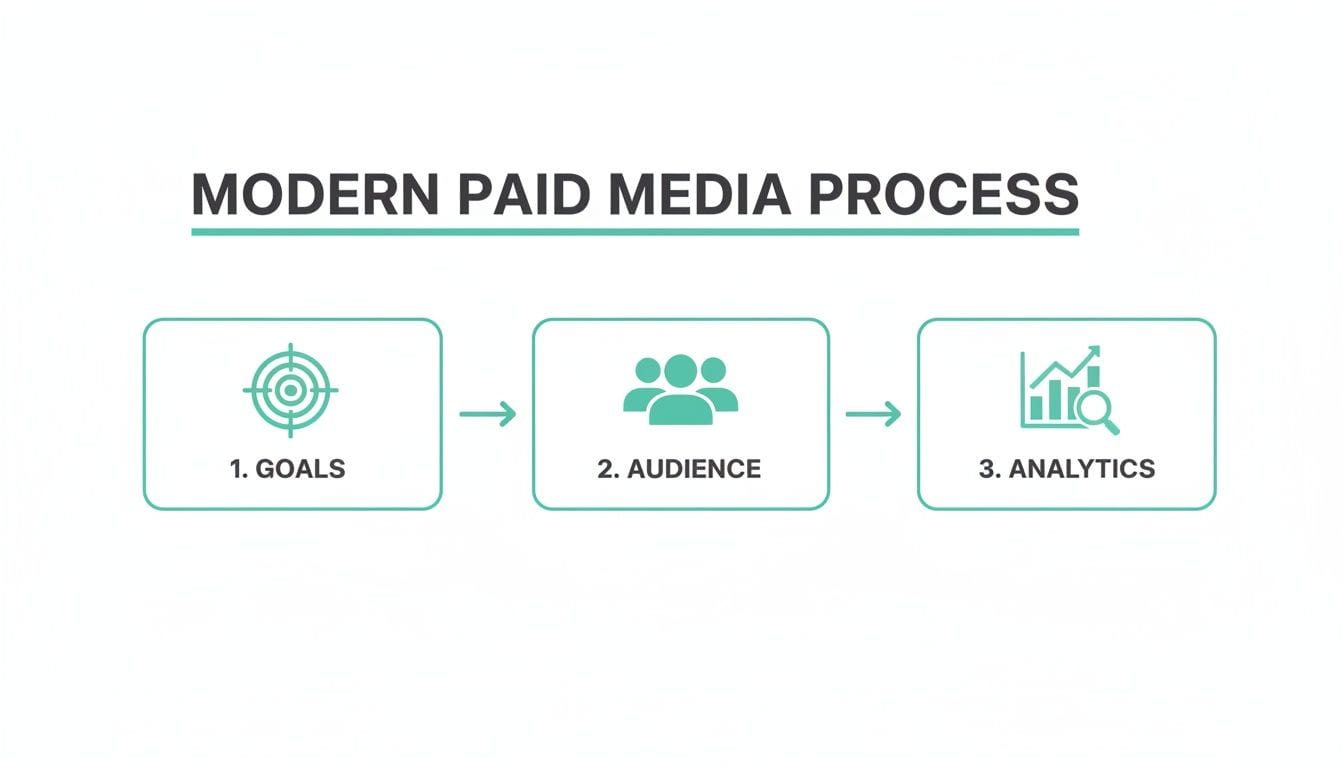
As the visual shows, without clear objectives and a well-defined target, even the most sophisticated analytics tools are useless.
The whole thing falls apart the second the data flowing between these stages becomes unreliable. Just imagine setting a goal to boost ROAS by 20%, but your conversion tracking is busted and underreporting sales. You might end up cutting spend on a top-performing channel because you think it's failing, directly sabotaging your own objective.
This is where data observability becomes non-negotiable. It's not enough to just collect data anymore; you have to continuously validate its accuracy in real time.
This is why automated observability platforms have become essential for protecting multi-million dollar ad spends from these silent but deadly data errors. Think of them as a security layer for your analytics, catching things like broken UTMs, missing conversion events, or even PII leaks before they can quietly tank your ROI.
This guide will give you a practical, no-fluff approach to building a paid media machine that runs on a foundation of data you can actually trust.
Setting Goals and Defining Your Audience
Before you even think about spending a single dollar, you have to build a strong foundation for your paid media strategy. This foundation isn't about bids or flashy ad copy; it's about setting crystal-clear goals and knowing exactly who you're talking to. Honestly, skipping this step is the fastest way I've ever seen to burn through an entire budget with nothing to show for it.
Goals like "increase brand awareness" or "drive more traffic" might sound good in a meeting, but they're useless for actually managing a campaign. They're too vague. You need goals that tie directly to tangible business outcomes, otherwise, you're just flying blind.
From Business Objectives to Measurable KPIs
A powerful paid media strategy starts by translating big-picture business needs into specific Key Performance Indicators (KPIs). This is what connects your day-to-day campaign tweaks to the company's bottom line.
Let's look at a couple of real-world examples:
- A B2B SaaS Company: Their core business objective is to generate 200 new Marketing Qualified Leads (MQLs) every month. This immediately translates into KPIs like Cost Per Lead (CPL) and, more critically, Cost Per Acquisition (CPA) when that lead becomes a paying customer.
- A D2C Apparel Brand: Their goal is simple: drive e-commerce sales. Success here is all about metrics like Return on Ad Spend (ROAS) and Customer Lifetime Value (LTV). They might set a benchmark of a 3:1 ROAS to ensure profitability from the get-go.
See how specific that is? The SaaS company isn't just chasing "leads"; they need MQLs at a sustainable cost. The D2C brand isn't just looking for "sales"; they need a profitable return on every dollar spent. That level of clarity is what makes every decision you make—from keyword bids to ad creative—actually mean something.
The best paid media strategies are built on a hierarchy of metrics. Start with the main business objective (e.g., increase revenue by 15%), translate that into a marketing goal (e.g., hit a 4:1 ROAS), and then break it down into channel-specific KPIs (e.g., keep CPA under $50 on Google Ads).
This structured approach is your guarantee that every click and conversion is pushing the business in the right direction.
Moving Beyond Basic Demographics
Once you've locked in your goals, it's time to figure out who you're targeting. And I mean really figure it out. Basic demographics like age and location are a starting point, but they barely scratch the surface of what makes your ideal customer tick.
To build a paid media strategy that actually works, you need to segment your audience using much richer data.
- Psychographics: What do they actually care about? Their values, interests, and lifestyle choices dictate how they respond to advertising. Someone who prioritizes sustainability needs a very different message than someone who just wants convenience.
- Behavioral Data: How do they behave on your site or app? Look at the signals. Are they abandoning carts, reading your blog for 20 minutes, or watching every product video? These actions reveal their intent and where they are in their buying journey.
- Intent Signals: What are they looking for right now? Targeting someone searching for "buy running shoes size 10" is worlds more effective than broadly targeting a massive "running enthusiasts" audience.
When you combine these elements, you can craft detailed customer personas. Think of these not as fluffy marketing exercises, but as actionable profiles that directly inform your messaging, creative, and channel choices.
Mapping Personas to the Marketing Funnel
Creating personas is half the job. The real magic happens when you map these personas to the different stages of the marketing funnel. Someone who's never heard of your brand needs a completely different ad than someone who left a full shopping cart an hour ago.
For instance, your "Budget-Conscious Buyer" persona might first see your brand through an educational YouTube video at the top of the funnel (Awareness). A few days later, they might get a targeted Facebook ad showing off a special discount (Consideration). Finally, a Google Shopping ad with a sharp price point could be the final nudge they need to make the purchase (Conversion).
Mapping this out ensures every ad feels relevant and timely, gently guiding the right people to the next logical step. Putting in this strategic work upfront is your single best defense against wasted ad spend. It's how you build a paid media engine that delivers predictable, scalable results.
Choosing Your Channels and Allocating Your Budget

Now that you have your goals locked in and know exactly who you're talking to, it's time to get into the nuts and bolts of your paid media strategy. This is where you decide where your money goes—connecting your high-level strategy to the tactical execution of channel selection and budget allocation.
Get this part wrong, and you're just throwing money at platforms where your audience isn't even listening. This isn't about just picking the most popular channels; it's a calculated decision. A B2B company chasing MQLs will almost certainly get more mileage out of LinkedIn, whereas a D2C brand obsessed with ROAS is better off on Instagram Shopping or Google Performance Max.
Navigating the Current Channel Landscape
The paid media ecosystem is a sprawling, ever-changing beast. The old guards like paid search and social are still heavyweights, but new contenders are constantly stepping into the ring. A smart media mix is a diversified and resilient one.
Digital advertising is on track to completely dominate marketing spend, projected to hit $740 billion globally in 2025. That's about 69% of total ad spend, and it's growing by 10% every year. By 2026, experts predict it will balloon to over $850 billion, with mobile ads claiming 75% of that pie. You can dig into the specifics in reports on global advertising spending.
Search still wears the crown with a 40% market share, but social is right behind it. For data teams, this massive scale and fragmentation make it impossible to manually catch every campaign tagging error. This is where having robust observability becomes non-negotiable.
Let's quickly size up the key players:
- Paid Search (e.g., Google Ads, Bing Ads): Your go-to for grabbing high-intent users who are actively looking for what you sell.
- Paid Social (e.g., Meta, TikTok, LinkedIn): Unbeatable for laser-focused audience targeting, building brand buzz, and driving consideration with eye-catching content.
- Retail Media (e.g., Amazon Ads, Walmart Connect): A booming channel that puts your ads right at the digital point of purchase. It's a must for CPG and e-commerce brands.
- Connected TV (CTV): Think television's massive reach but with the precision targeting and measurement of digital—something traditional TV could only dream of.
Making Strategic Channel Selections
Choosing your channels is all about a clear-eyed comparison against your goals and audience. The table below is a practical way to frame your thinking and see where your budget will pack the biggest punch.
Choosing where to play isn't a simple choice; it's a strategic one. Each platform has its own strengths, audience demographics, and cost structures. This table breaks down the major players to help you align your spend with your objectives.
Paid Media Channel Comparison for Strategic Selection
After reviewing your options, remember one of the most common rookie mistakes: spreading a small budget too thin across too many channels. It’s far more effective to dominate one or two key platforms than to make a tiny, forgettable splash on five.
Intelligent Budget Allocation and Bidding
With your channels picked out, it's time to talk money. Don't just pull a number out of thin air. Use an objective-based model. For example, if your goal is to land 100 new customers and your historical CPA is $50, your starting budget is $5,000. Simple. This approach ties every single dollar to a tangible business outcome.
Once your budget is set, bidding is your next focus. Modern ad platforms are packed with AI-powered bidding strategies that handle the heavy lifting. Strategies like "Target CPA" or "Maximize Conversions" let the platform's algorithm adjust bids in real-time to hit your targets.
A pro tip I always follow: set both daily and lifetime budgets for your campaigns. A daily budget acts as a safety net to prevent overspending on any given day. A lifetime budget gives the platform the freedom to spend more on high-traffic days, all while guaranteeing you never blow past your total planned investment.
This blend of smart channel selection, objective-based budgeting, and automated bidding forms the backbone of a powerful spending plan. You end up with a diversified media mix that's directly wired to your goals and powered by performance data you can actually trust.
How to Ensure Your Campaign Data Is Accurate
Your paid media strategy is only as good as the data it’s built on. You can have brilliant creative, perfect audience targeting, and a killer bidding strategy, but it all means nothing if your analytics are a mess. Getting measurement right is the operational backbone of every successful campaign, and that means meticulous tracking, clear attribution, and strict data governance.
Think of it this way: would you fly a plane without a working dashboard? Of course not. Running paid campaigns with untrustworthy data is just as reckless. You’ll end up making budget decisions based on guesswork, which is a fast track to wasting a lot of money.
Standardizing Your UTM Naming Convention
It all starts with something deceptively simple: a standardized UTM naming convention. Urchin Tracking Modules (UTMs) are the little snippets of text you add to a URL that tell your analytics tools exactly where a visitor came from. Without them, your paid traffic gets dumped into a generic "direct" or "referral" bucket, making it impossible to attribute ROI correctly.
A lack of standardization is a recipe for chaos. One person on your team might use utm_source=facebook while another uses utm_source=FB. Suddenly, your data is split into two separate, incomplete sources. A solid, universally adopted convention is non-negotiable.
Here’s a clean, practical structure you can start using today:
- utm_source: The platform sending the traffic (e.g.,
google,linkedin,tiktok). Always keep it consistent. - utm_medium: The marketing channel (e.g.,
cpc,display,social). - utm_campaign: The specific campaign name you're running (e.g.,
q4-black-friday-sale). - utm_term: The paid keyword, which is crucial for search campaigns (e.g.,
womens-running-shoes). - utm_content: Used to differentiate ads pointing to the same URL, letting you test creative (e.g.,
video-ad-avs.image-ad-b).
By enforcing a consistent, lowercase structure, you make sure every dollar you spend can be tracked back to its precise origin. No more guessing.
Understanding Attribution Models
With clean tracking in place, the next piece of the puzzle is attribution. An attribution model is simply the rule that decides how credit for conversions gets assigned to the different touchpoints a customer interacts with. The model you choose can completely change how you perceive channel performance.
For instance, a last-click attribution model gives 100% of the credit to the final touchpoint before a conversion. This model almost always overvalues bottom-of-funnel channels like branded search. On the flip side, a first-click model gives all the credit to the very first touchpoint, which can over-inflate the value of top-of-funnel awareness channels.
More sophisticated models like linear, time-decay, or data-driven attribution offer a much more balanced view by distributing credit across multiple touchpoints. When teams shift from a simple last-click view to a multi-touch model, they often uncover the hidden value of channels that assist conversions but don't always get the final click.
This shift in perspective is critical. It helps you optimize your entire paid media ecosystem, not just the last-click heroes. If you want to dive deeper into the mechanics, you can learn more about the fundamentals of conversion tracking.
The Critical Role of Tracking QA
Even with perfect UTMs and a smart attribution model, your data is still vulnerable. The real-world challenge is maintaining that data integrity over time. This is where tracking QA and automated observability become non-negotiable.
Manual audits are slow, expensive, and basically outdated the moment you finish them. Today's marketing stacks are far too complex for occasional spot-checks. Tiny but costly errors can easily slip through the cracks and silently poison your data for weeks or even months.
Common culprits include:
- Broken Pixels: A sloppy implementation or a routine site update can break your Meta or Google pixel, leading to catastrophic data loss.
- Missing Events: If your "purchase" event stops firing, your dashboards will show ROAS plummeting—even if sales are perfectly fine.
- PII Leaks: Accidentally capturing Personally Identifiable Information in URLs or events can land you in hot water with privacy regulations.
In an era where algorithms drive everything, real-time monitoring is indispensable. Projections show that 79% of ad spend will be algorithmically enabled by 2027. Without automated QA, teams risk burning huge portions of their budgets on campaigns guided by faulty data—a massive risk when 30.6% of marketing budgets are allocated to paid media. Tools that send automated alerts for anomalies to Slack or Teams stop these issues from spiraling out of control.
Automating Data Governance and Integrity
This is exactly where a platform like Trackingplan acts as a safety net. Instead of hoping manual checks catch everything, it provides continuous, automated monitoring for your entire analytics setup.
For example, you can set up a validation rule to monitor your UTM parameters. If a campaign launches with a non-compliant utm_source like "Facebook" (with a capital F) instead of the required "facebook," the system flags it instantly. An alert shoots straight to your marketing team’s Slack channel, so they can fix the error before it pollutes your reports.
It works for other issues, too. If a new, unexpected "rogue" event suddenly appears, or if traffic from a major campaign inexplicably drops to zero, the system detects the anomaly and notifies the right people. This completely shifts your process from reactive damage control to proactive governance, ensuring you always have a single source of truth for your paid media strategy.
Optimizing Performance and Avoiding Common Pitfalls

Launching a campaign and watching the first results roll in is just the starting pistol. The real race—the part that separates a decent paid media strategy from a great one—is all about continuous optimization. This is where you get into a rhythm of analyzing, adjusting, and consistently improving performance over time.
It’s about building a disciplined cycle of measurement, reporting, and refinement. Without this ongoing effort, even the most well-crafted campaigns will eventually plateau and fade. The secret is to build this entire process on a foundation of data you can actually trust, making every decision informed and impactful.
Establishing a Practical Optimization Cadence
To keep from getting lost in a sea of metrics or making knee-jerk changes based on one bad day, you need a structured optimization schedule. This cadence breaks down your analysis into manageable, focused chunks. A good rhythm ensures you’re looking at the right data at the right time.
- Daily Check-ins (5-10 minutes): Think of this as a quick pulse check. You're only looking at critical health metrics: budget pacing, any catastrophic performance drops, and ad disapprovals. The goal is simple: spot fires before they turn into infernos.
- Weekly Analysis (1-2 hours): Time to go a bit deeper. This is where you get into the weeds of ad creative performance, keyword bids, and audience segment results. You should be asking questions like, "Which audience delivered the highest ROAS?" or "Is our new video ad actually outperforming the old static image?"
- Monthly Reviews (2-4 hours): Now, zoom out for the strategic overview. How is each channel performing against its KPIs? Is your media mix still making sense, or should you shift budget from an underperformer to a rising star? This is also the time to spot broader trends and plan for the month ahead.
This structured approach helps you avoid "analysis paralysis" and ensures your optimizations are driven by real trends, not just daily noise. You're building a repeatable process that drives consistent growth.
A Simple Framework for Effective Reporting
Reporting should never be a data dump. Its entire purpose is to communicate insights that lead to action. A classic mistake is building a one-size-fits-all dashboard that just overwhelms stakeholders with metrics they don't care about. The best reports are always tailored to the audience.
Your executive team, for instance, doesn't need to see the click-through rates on 50 different ad variations. They care about business outcomes.
Here’s a straightforward template for structuring your reports:
- Executive Summary: Start with the bottom line. "This month, our paid media strategy generated a 4.2 ROAS, beating our 4.0 target. This was driven primarily by strong performance in our Google Shopping campaigns."
- Key Performance vs. Goals: Use a clean table or chart to show your main KPIs (like Spend, Conversions, CPA, ROAS) against their targets for the period.
- Wins and Insights: Highlight what worked and why. "Our new Facebook creative targeting the 'eco-conscious' audience segment achieved a 30% lower CPA than the control group."
- Challenges and Learnings: Be transparent about what fell short. "The LinkedIn campaign for our new feature failed to hit its MQL goal, which tells us the messaging likely didn't resonate with that professional audience."
- Next Steps: Clearly outline your action plan. "Based on these results, we're doubling the budget for the 'eco-conscious' audience and pausing the LinkedIn campaign to rework the creative approach."
This framework transforms your report from a dry collection of numbers into a strategic story that guides what you do next. To go even deeper on performance measurement, check out our guide on mastering analytics in advertising.
Pitfalls to Sidestep in Your Paid Media Strategy
Even the most buttoned-up strategy can be derailed by a few common mistakes. Just knowing what these traps are is the first step toward avoiding them.
The most dangerous pitfall isn't a bad ad or a poorly chosen keyword; it’s trusting your data without verifying it. Flawed data leads to flawed decisions, creating a negative feedback loop of wasted spend and missed opportunities.
Let’s look at a few of the usual suspects and how to handle them:
- The Fix: Anchor every single campaign to a specific, measurable business outcome. Instead of "awareness," your goal should be something like, "Increase branded search volume by 15% in Q3."
- The Fix: Make it a habit to regularly mine your search term reports to find and exclude queries that have nothing to do with your business. This is one of the fastest and easiest ways to boost campaign efficiency.
- The Fix: Implement automated data observability. A platform like Trackingplan acts like an immune system for your analytics, catching broken pixels, UTM errors, and other tracking anomalies in real time—before they corrupt your dashboards and send you down the wrong path.
This last point is becoming non-negotiable, especially with the explosion of new channels. Take retail media, for example. It's revolutionizing the space, with growth projected at 21.9% year-over-year in 2025 and an expected market size of $140 billion by 2026. This massive growth brings immense complexity and a minefield of tagging issues like UTM inconsistencies and missing events. Automated QA is the only scalable way to turn that growth into dependable performance.
Paid Media Strategy Questions Answered

Even the most buttoned-up blueprint can leave you with questions once you're actually in the trenches, running campaigns and trying to make sense of the results. This section tackles some of the most common queries that come up. Let's get you some clear, straightforward answers.
How Do I Determine the Right Budget for My First Paid Media Strategy
This is a classic "how long is a piece of string?" question, but there's a practical way to approach it. Start with a tangible goal, like acquiring 50 new customers. From there, do a little digging to find the average Cost Per Acquisition (CPA) in your industry for the channels you plan to use.
A simple formula gets you in the ballpark: Goal x CPA. So, if you're aiming for 50 customers at an average $100 CPA, your starting budget is $5,000. But don't just throw that whole amount into the fire. I always recommend carving out a small test budget—say, 10-20% of that total—to first validate your assumptions. Once you have your own performance data, you can scale with confidence based on your actual ROAS, not just industry averages.
What Is the Most Common Point of Failure in a Paid Media Strategy
Hands down, the single biggest point of failure I see is unreliable data tracking. Teams will spend weeks obsessing over ad creative and bidding strategies but completely overlook the data plumbing that everything else depends on. It’s often the simple things that trip people up, like a broken conversion pixel or a mess of inconsistent UTM tags.
When that happens, your performance data is garbage. You end up optimizing campaigns based on flawed information, pouring money into what looks like it's working but really isn't.
This is the silent killer of so many paid media strategies. The only real defense is implementing an automated QA tool. In this day and age, continuous monitoring of your data integrity isn't a luxury; it’s a non-negotiable part of the foundation.
Should I Focus on One Paid Media Channel or Diversify
The sweet spot is usually what I call "focused diversification." Start by mastering one or two core channels where you know your audience is hanging out. Think Google Search for high-intent users or LinkedIn if you're in the B2B space.
Get those channels running profitably and consistently first. Once you have a solid, ROI-positive foundation, you can start methodically testing new channels with a small slice of your budget. The biggest mistake is spreading your budget too thin across five or six platforms right out of the gate. You'll never gather enough data on any single one to optimize it effectively. Build your profitable base, then expand.
How Often Should I Optimize My Paid Media Campaigns
Your optimization rhythm really depends on the scale of your campaigns. If you're running high-spend campaigns with a ton of daily traffic, you need to be doing daily check-ins. You’re not making huge changes, just monitoring pacing and top-level KPIs to catch any fires before they spread.
For most accounts, a weekly deep dive is perfect. This is where you’ll analyze ad creative, tweak audience segments, and adjust keywords. Reserve your monthly reviews for the big picture stuff—making strategic shifts in budget allocation and evaluating overall channel performance. The key is to avoid knee-jerk reactions to a single day's data. Always make your moves based on statistically significant data and trends that develop over time.
A successful paid media strategy relies on data you can trust. Trackingplan provides automated observability to ensure your analytics are always accurate, alerting you to tracking errors, UTM issues, and broken pixels before they can harm your ROI. Stop making decisions with bad data. Get your free Trackingplan account today.