
First-party data is the information you collect directly from your audience—with their full consent, of course.
Think of it as having a one-on-one conversation with your customers. They’re willingly sharing details about themselves with you, not some stranger they’ve never met. This makes it the most accurate and reliable data you can possibly own because it’s coming straight from the source.
Defining First-Party Data in a Cookieless World

As the digital world pivots away from third-party cookies and embraces stricter privacy laws, understanding first-party data isn't just a good idea—it's essential for survival. For years, marketers leaned heavily on third-party cookies to track users across the web, but that era is coming to a close. Browsers are phasing them out, and regulations like GDPR and CCPA are putting power back into the hands of consumers.
This shift presents a huge challenge, but it’s also a massive opportunity. Businesses that get their first-party data strategy right can build more authentic, personalized experiences that foster real, lasting trust with customers. The payoff is huge—companies that truly master this can see a 2.9x revenue lift and a 1.5x increase in cost savings.
The Value of Direct Information
The real magic of first-party data is in its quality and relevance. Since you’re the one collecting it, you know exactly where it came from, how it was gathered, and you can be confident it’s accurate. This direct line to your customers gives you unfiltered insights into their behaviors, preferences, and what they actually need from you.
So, where does this valuable data come from? Common sources include:
- Website and App Interactions: Details from user actions like pages visited, products viewed, or what’s been added to a cart.
- CRM Systems: Goldmines of information from customer service chats, purchase histories, and direct feedback.
- Email and SMS Lists: Contact info and engagement metrics from subscribers who’ve explicitly opted in.
- Surveys and Forms: Direct feedback and preferences shared by your audience through on-site forms or even fun quizzes.
This direct relationship is what modern marketing is all about. When you collect data transparently and with consent, you’re not just staying compliant—you’re building a foundation of trust that third-party data could never replicate.
In this guide, we'll walk you through everything you need to know, from collecting and managing your data to putting it into action to drive growth. A big piece of that puzzle is data quality. After all, the best strategy in the world won't work if the data it's built on is flawed. This is where modern observability platforms become critical, helping teams spot and fix issues to maintain a reliable source of truth.
The move away from third-party tracking isn't something to fear. It’s a chance to build stronger, more meaningful relationships with your customers. You can learn more about this by exploring the reasons why you should care about first-party data in a cookieless world.
Navigating the Data Landscape
To really get why first-party data is such a big deal, you have to understand where it sits in the broader world of information. Not all data is created equal. The source of your information has a massive impact on its accuracy, relevance, and whether it plays by the rules of privacy.
Let's break down the three main types of data to see why collecting it yourself is quickly becoming the only game in town.
Understanding First-Party Data
As we've touched on, first-party data is the information you collect straight from your audience. It’s generated on your own websites, apps, and systems, giving you a clean, direct line to your customers. Think of it as information people have willingly shared with you through their actions.
This direct relationship is what makes it so valuable. The sources are your assets, which means you have total control and transparency over how the data is gathered.
Common sources include:
- Website and App Analytics: This is the classic stuff—tracking user behavior like pages visited, time spent on an article, items added to a cart, or features used in your app.
- CRM Systems: A goldmine of information, holding everything from purchase history and customer service chats to loyalty program status.
- Email and SMS Lists: Data from newsletter sign-ups and marketing messages, including engagement metrics like who’s opening your emails and clicking your links.
- Surveys and Feedback Forms: Simply asking your users directly about their preferences, satisfaction, and interests.
Because this information comes straight from the source, it’s incredibly accurate and directly relevant to your business. No guesswork needed.
Second-Party Data: The Trusted Partnership
Next up is second-party data. This is basically another company's first-party data that they share or sell directly to you. Think of it as a strategic partnership. You aren't buying from some massive, faceless aggregator; you're getting data from a trusted source who has a direct relationship with their own audience—an audience that could be valuable to you.
For example, a luxury hotel chain might partner with a premium airline. The hotel's data on booking preferences (their first-party data) becomes second-party data for the airline, letting it offer perfectly timed, relevant flight deals. It’s generally reliable data, but it's still one step removed from your audience.
Third-Party Data: The Distant Relative
Finally, we have third-party data. This is data you buy from large aggregators who have no direct relationship with the people they’ve collected information on. These companies scrape and pull data from countless sources, bundle it up, and sell it to anyone who will pay.
While third-party data offers enormous scale, it comes with serious drawbacks, especially today. Its accuracy is often questionable, the information can be stale, and it’s a free-for-all—your competitors are buying the exact same datasets. Most importantly, its shady collection methods are on a collision course with modern privacy laws and the death of the third-party cookie.
To succeed in a cookieless world, you'll need to master more advanced techniques like cross-platform identifier matching to build a unified customer view from your own data.
In an environment where consumers expect transparency and control over their information, relying on data collected without direct consent is a risky and outdated strategy.
To make these differences crystal clear, let's put them side-by-side.
First-Party vs Second-Party vs Third-Party Data Comparison
Each data type has its place, but they come with very different pros and cons. The table below breaks down the key differences across the attributes that matter most to your business.
As you can see, while second- and third-party data can help with scale, first-party data is where the real, sustainable value lies. It's the only type that gives you a true competitive advantage built on trust and accuracy.
The Strategic Benefits of First-Party Data
Knowing the different types of data is one thing, but turning that knowledge into real-world business impact is where things get interesting. A solid first-party data strategy isn't just about ticking compliance boxes; it's a powerful engine for growth that builds deeper customer relationships and delivers a serious return on investment. The direct insights you gather unlock a level of personalization that genuinely connects with people.
This connection goes way beyond generic marketing blasts. It’s about showing a returning customer products related to their last purchase or sending a follow-up email that actually addresses a specific pain point they mentioned to your support team. When you use data that customers have willingly shared, your marketing stops feeling like an interruption and starts feeling like a helpful conversation.
The diagram below breaks down the core differences between the data types we've discussed, really highlighting the direct line you have with first-party collection.
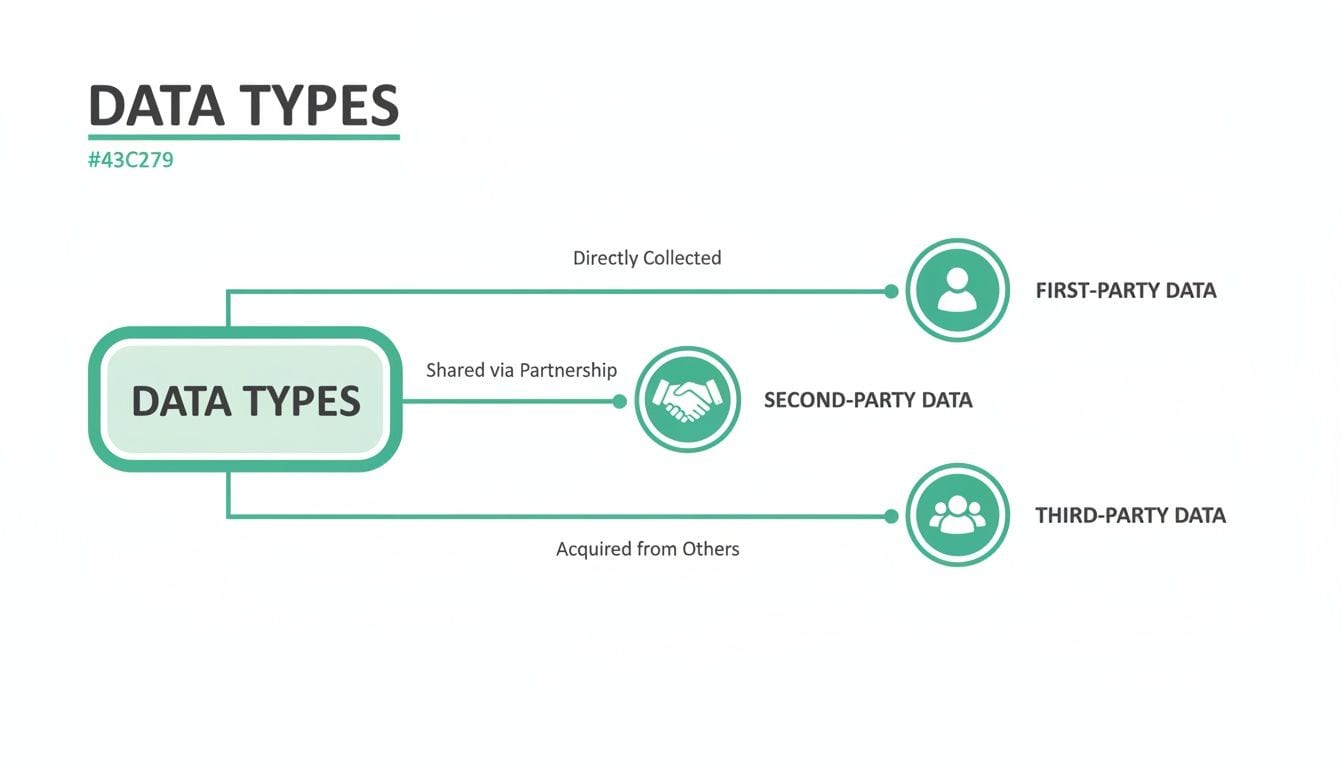
This visual drives home the point: first-party data is a direct line to your customer. Second- and third-party data, on the other hand, bring in middlemen, which adds distance and makes the information less reliable.
Driving Personalization and Boosting ROI
The biggest advantage of first-party data is its unmatched accuracy. Because it comes straight from your audience, it paints a crystal-clear picture of their behaviors and preferences. That clarity is what lets you craft highly personalized experiences that get results.
Instead of casting a wide, expensive net with third-party segments, you can focus your resources on people you already know are interested. This kind of precise targeting has a direct impact on your bottom line in a few key ways:
- Higher Engagement: Personalization based on what users actually do leads to higher click-through rates and more time spent on your site.
- Increased Conversion Rates: When you show the right offer to the right person at the right time, the odds of a purchase go way up.
- Lower Acquisition Costs: By focusing ad spend on high-intent audiences, you cut down on wasted budget and bring in new customers more efficiently.
The ownership and consent built into first-party data collection give businesses unparalleled control and trust advantages, which is absolutely vital in a post-cookie era.
This foundation of trust isn't just a "nice-to-have" metric; it delivers a massive competitive edge. Research shows that companies that get first-party data right see compounding targeting improvements of 10% annually, which translates to exponentially larger customer bases over time. Projections for 2027 suggest these firms could hit 30-40% lower acquisition costs in major markets like North America and the EU. You can learn more about these trends and discover why first-party data is the gold standard for future ad campaigns.
Building Trust and Future-Proofing Your Business
With privacy regulations getting stricter and consumers growing more skeptical, how you collect and use data matters more than ever. The era of third-party cookies is coming to a close, and businesses that don't adapt are going to be left in the dust. A first-party data strategy is your best defense against this sea change.
By collecting data transparently and with explicit consent, you’re doing more than just complying with laws like GDPR and CCPA—you’re building a resilient business model. This approach shows you respect your customers' privacy, which is a powerful way to stand out. In fact, 77% of consumers say that transparency around data use impacts their purchasing decisions.
That trust translates directly into loyalty and a higher customer lifetime value, creating a sustainable competitive advantage that will last long after third-party cookies are a distant memory.
How To Collect High-Quality First-Party Data
Moving to a first-party data strategy is all about building a solid, sustainable collection engine. The idea isn't just to hoard information. It’s about creating a genuine value exchange—customers give you insights because they get something useful back. This simple shift turns data collection from a one-off transaction into a real relationship.
The best place to start is with the digital properties you already own. Your website, app, and social media channels are your front lines. Often, the simplest and clearest interactions are the most powerful ways to start gathering quality information directly from your audience.
Capitalizing on Digital Touchpoints
Some of the most straightforward methods for collecting first-party data are already part of the natural customer journey. If you make these moments valuable and transparent, users will be more than willing to share information that helps you serve them better.
Here are a few key on-site and in-app collection points:
- Account Registrations: When someone creates an account, they're already giving you foundational data like their name and email. This is the perfect time to ask about their preferences so you can start personalizing their experience right away.
- Newsletter Sign-ups: This classic is still one of the best ways to build a direct line to your most engaged users. Don't just stop at the email address—ask what kind of content they'd like to see so your messages always hit the mark.
- Preference Centers: Giving users control over how and when you communicate with them (frequency, topics, channels) is a win-win. It respects their choices and gives you rich, self-reported data about their interests.
These methods work because the value exchange is crystal clear. A user gets a smoother checkout, exclusive deals, or more relevant content, and you get the data to make it happen.
Engaging Users With Interactive Content
Forms are functional, but interactive content can make data collection feel less like a chore and more like an engaging experience. Think quizzes, polls, and surveys—these are fantastic tools for gathering unique insights that behavioral data alone can't provide.
For instance, a skincare brand could run a quiz like, "Find Your Perfect Skincare Routine." The user answers questions about their skin type and lifestyle and gets a personalized recommendation in return. Meanwhile, the brand collects incredibly valuable first-party data to tailor future marketing and product suggestions.
By turning data collection into a helpful or entertaining interaction, you not only gather better information but also strengthen the customer's positive association with your brand.
This approach feels more like a helpful consultation than an interrogation, which makes people far more likely to participate. For more proven tactics, check out these B2B lead generation best practices.
Tapping Into Loyalty and Support Channels
Your most loyal customers—and those reaching out for help—are goldmines of high-quality first-party data. These interactions offer deep insights into customer satisfaction, pain points, and how your products are actually used in the real world.
- Loyalty Programs: Members willingly share their purchase history and preferences in exchange for rewards and perks. This creates an incredibly rich dataset about what your best customers want and how they behave.
- Customer Support Interactions: Every chat, email, or phone call is a data collection opportunity. These conversations are filled with unfiltered feedback on product issues, feature requests, and customer sentiment that can inform everything from marketing to R&D.
These channels are so valuable because the interactions are built on an existing relationship, whether you're rewarding loyalty or solving a problem. For businesses wanting to get more sophisticated with their data collection, learning about advanced techniques like server-side tracking can unlock new ways to capture accurate data directly.
Maintaining Data Quality and Governance
Collecting first-party data is just the starting line. Its real value disappears fast if you don't have a solid plan for quality and governance. Think of your data as the engine that drives all your marketing and analytics. If you're pumping it full of contaminated fuel—like inaccurate, incomplete, or just plain broken data—that entire machine is going to sputter and fail. Data integrity isn’t just some tech-speak; it's what makes your insights reliable.
Unfortunately, keeping data clean is a constant fight. Every digital team knows the pain of silent issues corrupting their analytics, leading to bad reports and wasted money. These problems usually fly under the radar until a big campaign flops or a critical dashboard breaks.
Common Data Quality Pitfalls
Without a way to proactively monitor your data, a few common culprits can quietly sabotage your entire first-party data strategy. Each one creates a blind spot that leads to poor decisions and kills any trust you have in your analytics.
Here are some of the usual suspects:
- Missing Events: A developer pushes a site update, and suddenly your "purchase" or "sign-up" event stops firing. Just like that, you can't measure conversions accurately.
- Broken Tracking: Someone accidentally removes or messes with a tracking snippet. The next thing you know, your traffic data tanks, and everyone thinks there's a real business problem.
- Schema Errors: Data gets sent in the wrong format. For instance, a price comes through as a text string instead of a number, which completely breaks your revenue reports.
- Accidental PII Leaks: Sensitive personally identifiable information (PII) gets captured in an event property by mistake, creating a massive privacy and compliance risk.
These silent errors chip away at the very foundation of what makes first-party data so valuable. If you can't trust the information you collect yourself, its accuracy advantage over third-party data is completely lost.
First-party data is prized for being more accurate than anything you can buy, an edge that's become non-negotiable with third-party cookies on their way out. This shift is forcing businesses to adapt, and the results speak for themselves. Marketers who use structured first-party data see up to 2.5 times higher engagement rates and a 20% drop in customer acquisition costs compared to those still relying on outside sources. You can learn more about the impact of first-party data on engagement.
The Role of Automated Data Observability
Trying to manually audit your analytics for these kinds of problems is a losing battle. It's like trying to find one faulty wire in a city's power grid by checking every connection by hand. This is where automated data observability platforms step in, acting as a smart monitoring system for your entire data pipeline.
Instead of constantly reacting to fires, these tools give you proactive oversight. They scan all the data flowing from your website and apps to your analytics tools, automatically mapping your implementation to create a single source of truth.
This kind of automation is a game-changer for data quality management. With real-time detection and alerts, your team is freed from the tedious grind of manual checks. When an issue like a missing event or a schema error pops up, the right people get an instant notification on Slack or email, complete with all the context needed to fix it fast. Your team can finally trust the data they use to make critical business decisions. To learn more, check out our guide on data governance best practices.
Putting Your First-Party Data to Work

Once you've managed to collect a clean, reliable stream of first-party data, the real fun begins. It's time to put that data to work and turn raw information into tangible business growth. Think of high-quality data as the fuel for smarter marketing, better products, and genuine customer relationships.
This is where you move beyond generic, one-size-fits-all campaigns. Instead, you can start creating experiences that feel personal, relevant, and genuinely helpful because they're based on what you actually know about your customers. It’s not just about collecting information; it’s about activating it to drive specific, measurable results.
Creating Advanced Audience Segments
One of the most immediate and powerful ways to use first-party data is by building sophisticated audience segments. Forget about broad, often inaccurate third-party categories. You can now group users based on their actual behaviors and stated preferences, which offers a level of precision that generic data just can't touch.
Here are a few practical examples of how this works:
- Behavioral Segmentation: Imagine you group together all the users who have viewed a specific product category three or more times but still haven't made a purchase. This is a high-intent segment, perfect for a targeted ad campaign with a special offer to nudge them over the finish line.
- Purchase History Segmentation: You could create a segment of customers who repeatedly buy a consumable product. From there, it's easy to enroll them in an automated email flow that reminds them to reorder right before they're likely to run out.
- Engagement Segmentation: What about users who consistently open your emails but rarely click through? This group might respond better to a different content format, or maybe it's time to send them a quick survey asking what they'd actually like to see from you.
These segments are so much more effective because they're based on direct actions, not assumptions. You’re talking to people based on what you know they do, not what some data broker thinks they might do.
Fueling Personalization and Product Development
Beyond just marketing, first-party data is an absolute goldmine for improving your products and services. By analyzing how people interact with your website or app, you can pinpoint which features are a hit and, just as importantly, where people are getting stuck. This direct feedback loop is invaluable for making smart, informed decisions about your product roadmap.
An e-commerce store, for instance, might analyze cart abandonment data to send personalized recovery emails with a small discount, turning a potential lost sale into a conversion. In the same vein, a publisher can tailor content recommendations based on an individual's reading history, keeping them engaged and on the site much longer.
The role of first-party data in personalization has become a powerhouse for ROI, enabling precise segmentation that transforms digital strategies. Businesses using it for customer personas report up to 20% higher campaign effectiveness because it reveals true preferences over stated ones.
As third-party cookies continue to fade, mastering your own data is projected to deliver 30-40% reductions in customer acquisition costs by 2026, simply by enabling more efficient targeting. You can learn more about how first-party data drives smarter business strategies and see just how far it can take you. With a clean data foundation, the growth possibilities are practically endless.
Common Questions About First-Party Data
As you start leaning into a first-party data strategy, a few practical questions always come up. Getting these sorted out clarifies the road ahead and helps set the right expectations for your team.
How Long Does It Take to Build a Strategy?
This is probably the most common question I hear. The short answer? A first-party data strategy isn't a project you finish. It’s an ongoing process that grows with your business and your customers.
You can definitely score some quick wins in a matter of weeks. Think about simple things like optimizing your newsletter sign-up forms or adding a preference center where customers can tell you what they like. That's the low-hanging fruit.
But building a truly mature, integrated strategy is a long-term commitment. You'll be constantly refining how you collect data, working to keep it clean, and finding new ways to put your insights to work. It’s less like building a house and more like tending a garden—it needs continuous care to really thrive.
What Are the Biggest Challenges in Management?
While the payoff is huge, managing first-party data isn't without its headaches. Success really comes down to navigating a few common hurdles that pop up when you're dealing with complexity and scale.
Here are the big ones:
- Ensuring Data Quality: This is non-negotiable. Inaccurate or incomplete data can torpedo your whole strategy. Problems like missing events, schema errors, and broken tracking can quietly poison your analytics, leading to bad insights and wasted ad spend.
- Integrating Disparate Systems: Customer data is usually scattered everywhere—your CRM, analytics tools, email platform, and e-commerce backend. Stitching all that together into a single, coherent customer view is a serious technical and organizational lift.
- Maintaining Governance and Compliance: When you collect data directly, you're responsible for it. You need solid governance to prevent accidental PII leaks and manage user consent properly, all while keeping up with ever-changing privacy laws.
These challenges are exactly why having the right tools is so important. Automated data observability platforms are essential for keeping your data clean without getting bogged down in manual audits.
First-party data is valuable because it's accurate, but that advantage disappears if the data itself can't be trusted. Bad data leads to bad decisions, period.
Can It Completely Replace Third-Party Data?
Finally, people often wonder if first-party data is the be-all and end-all. The answer is a little nuanced. For your core marketing—things like personalization, customer retention, and sharp segmentation—first-party data is hands-down the best. It's your ground truth.
However, third-party data might still have a few, very specific uses, mainly for broad, top-of-funnel prospecting where you have zero relationship with the audience. But even there, its power is fading fast. The future of marketing is built on the trust and transparency you can only get from a solid first-party data strategy.
Ready to stop worrying about data quality and start trusting your analytics? Trackingplan offers a fully automated observability platform that detects and helps you fix data issues in real time, ensuring your first-party data is always accurate and reliable. Discover how you can build a trustworthy data foundation at https://trackingplan.com.