
The marketing management product life cycle is a simple but powerful model that follows a product's journey from launch to retirement. It’s broken down into four distinct stages: Introduction, Growth, Maturity, and Decline. Think of it as a predictable story for every product, one that tells you exactly how your marketing, sales, and analytics need to adapt to keep it profitable.
The Product Life Cycle Framework Explained
Just like people, products go through a life cycle—from a hyped-up launch to a quiet retirement. The product life cycle framework is what helps marketers, developers, and analysts pinpoint which stage a product is in so they can make the right moves.
Get it wrong, and you'll end up wasting ad spend on the wrong goals, missing key growth opportunities, or creating friction between your teams. This model isn’t just theory; it's a practical roadmap for making critical decisions. It tells you when to pour money into brand awareness, when to pivot to customer retention, and when it's finally time to say goodbye to a product.
For a closer look at aligning your go-to-market strategy with each stage, this guide on product life cycle and marketing is a great resource.
The Four Stages of the Product Life Cycle
The product life cycle consists of four key phases, and each one brings its own set of challenges and requires a different game plan from your marketing and analytics teams.
- Introduction: The product is brand new. Your main job is to build awareness and get those first few customers. Sales are usually slow to start, and marketing costs are high.
- Growth: The word is out, and sales are starting to take off. The focus now shifts from just educating people to grabbing a bigger piece of the market and standing out from competitors.
- Maturity: Sales growth is leveling off as the market gets crowded. Now, it's all about defending your market share, squeezing out as much profit as possible, and keeping your existing customers happy.
- Decline: Sales and market share are on a steady slide. It's decision time: you can either "harvest" the product by cutting costs to the bone or get rid of it completely.
The timeline below gives a great visual of how a product moves through these stages, from its big debut to its final bow.
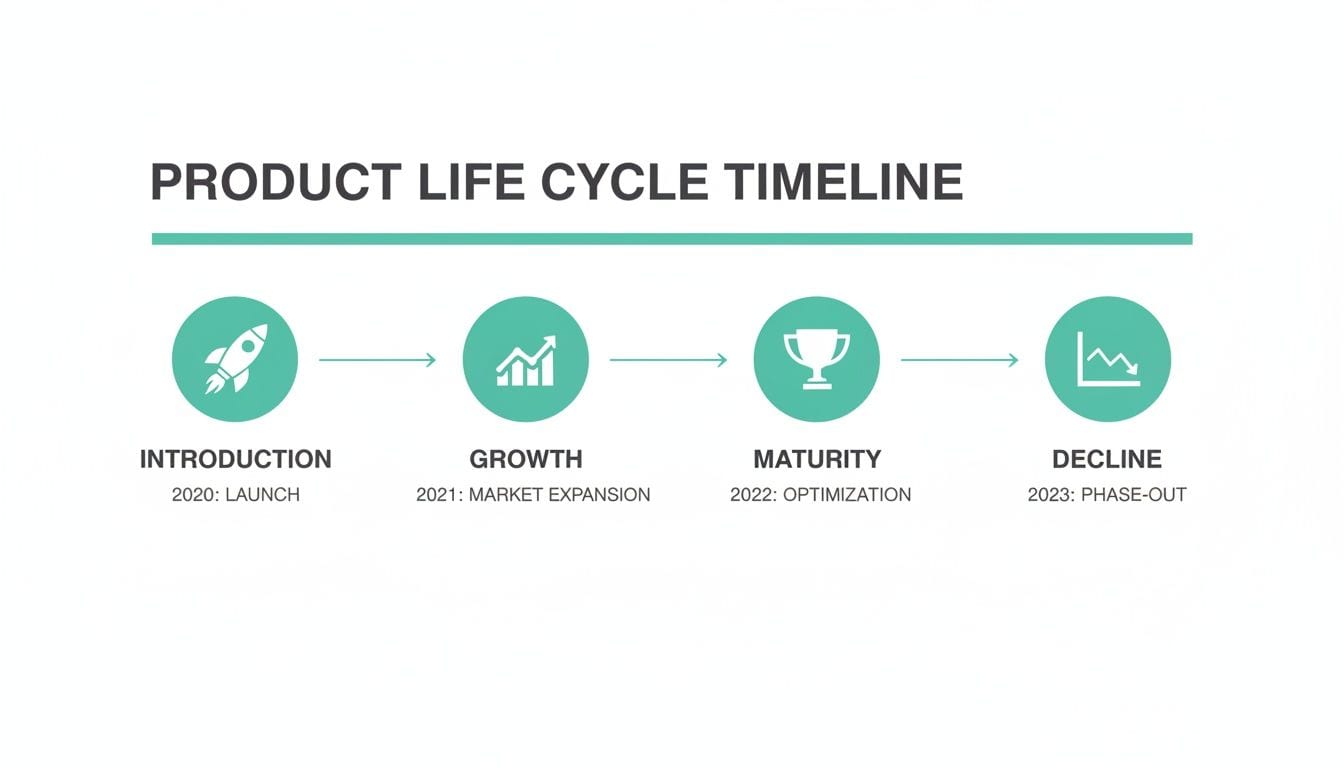
As you can see, your marketing objectives have to change. You start by aggressively building a new market and end by defending your position with a well-established product. Each phase demands a unique approach to win.
To make this even clearer, here's a quick summary of what to expect at each stage.
The Four Stages of the Product Life Cycle at a Glance
This table provides a high-level overview, but remember that the length and intensity of each stage can vary dramatically depending on the product, industry, and market conditions.
Here is the rewritten section, crafted to sound completely human-written and align with the provided style guide and examples.
The Introduction Stage: Building Market Awareness
This is where every product story begins—the high-stakes launch. The introduction stage is defined by one core mission: to build awareness and educate a new market about a product they likely don't know they need yet. It's a period of heavy investment and often negative profits as budgets are poured into customer acquisition.
Think of it like opening a new, unique restaurant in a town that has never heard of your cuisine. At first, you have to offer free samples (demos), explain your ingredients (features), and create a buzz just to get people through the door. Sales are slow, costs are high, and your primary goal isn't profit, but establishing a foothold.
The Primary Goal: Building Product and Market Awareness
During the introduction stage, the focus is singular: create a market and generate product awareness. You're not just selling a product; you're often selling a new way of doing things. This requires a significant marketing push aimed at a carefully selected target audience of early adopters—those visionary customers willing to take a chance on something new.
When the first Xerox photocopier launched in 1959, for example, the concept of instant copies was completely alien. The company had to invest heavily in live demonstrations just to convince businesses of its value. This educational approach is fundamental to the introduction phase.
Key strategies during this stage often include:
- Educational Content: Creating blog posts, webinars, and guides that solve the customer's problem, with the product positioned as the solution.
- Securing Early Adopters: Offering special pricing or exclusive access to innovative users who can provide valuable feedback and become brand evangelists.
- Building Foundational Distribution: Establishing initial sales channels and partnerships to make the product accessible to its first wave of customers.
The challenge of this stage is clear: you're operating on faith, backed by research, that a market for your product exists. Success is not guaranteed, and many products falter here before they ever have a chance to grow.
Why Data Integrity Is Non-Negotiable from Day One
For digital analysts and marketers, the introduction stage is the most critical time to establish a rock-solid analytics foundation. In this phase, marketing faces its toughest challenge: building awareness with minimal revenue. It's not uncommon to burn through 70-80% of initial marketing budgets while profits remain negative.
This is a high-risk period, as many products fail due to a poor product-market fit. To counter this, marketing managers run A/B tests on landing pages or use targeted ads—strategies that proved vital to the iPhone's early success. You can explore more about these foundational strategies in Harvard Business Review's classic analysis of the product life cycle.
However, none of these strategies work if your data is flawed from the start. For data teams, this stage demands vigilant tracking plans to validate implementations from day one. Shockingly, 60% of new Martech stacks suffer from a 15-20% data loss due to misconfigurations, a fatal blow when every dollar counts. This is where a robust tracking plan becomes essential.
Validating every interaction, from the first ad click to the final sign-up, is non-negotiable. Simple failures in data collection can completely distort your understanding of product-market fit, leading you to make disastrous decisions based on bad information.
Automated analytics QA and observability tools like Trackingplan are designed to prevent these early disasters. By continuously monitoring your tracking implementation, they can instantly alert you to issues like:
- Broken sign-up events that prevent you from measuring conversions.
- Mismatched campaign parameters that corrupt your attribution data.
- Missing properties on key events, leaving you blind to user behavior.
Catching these errors in real time ensures the data you collect during this crucial learning phase is accurate. This allows you to confidently measure the ROI of your initial marketing spend and make data-driven pivots, setting the stage for a successful transition into the growth phase.
The Growth Stage Capturing Market Share
Welcome to the acceleration phase. After all the hard work building awareness in the introduction stage, your product is finally gaining real traction. The growth stage is all about a rapid surge in sales, broader market recognition, and, almost inevitably, the arrival of new competitors looking for a piece of the action.
Your marketing playbook needs a major rewrite here. The goal is no longer just to educate people; it’s about differentiation and deep market penetration. You’ve proven there’s a market for your product—now the race is on to capture as much of it as possible before things get crowded.

From Awareness to Preference
As competitors start showing up, your marketing message has to evolve. Instead of just explaining what your product does, you need to hammer home why it’s the best choice out there. This means shining a spotlight on unique features, building a memorable brand, and turning early customers into loyal fans.
During this stage, it’s not uncommon for sales to skyrocket by 200-500% annually as you lock in product-market fit. This explosive expansion forces the marketing focus toward what makes you different. For example, Slack’s growth phase was turbocharged by its integrations with tools like Google Analytics, which helped set it apart from the competition.
Key marketing strategies for this stage include:
- Feature Enhancements: Consistently adding new capabilities and improvements to stay one step ahead of rivals and meet your customers' evolving needs.
- Market Expansion: Pushing into new customer segments or geographical areas to widen your user base.
- Building Stronger Distribution Channels: Optimizing and growing the channels where customers can find and buy your product.
The New Analytics Challenge Scaling with Confidence
The growth stage brings its own set of complex challenges for marketers and analysts. As you scale up campaigns and add new channels, the complexity of your analytics stack explodes. You might add a product analytics tool like Amplitude on top of Google Analytics, which means more data streams to juggle.
This expansion creates more chances for your data to break. A single misconfigured pixel or a broken UTM parameter on a high-spend campaign can fly under the radar, auietly torpedoing your ROI. The cost of bad data gets much higher in this phase because your decisions have a much bigger impact. This is a critical time to understand how to measure marketing effectiveness with total precision.
In the growth stage, you're no longer just testing the waters; you're trying to navigate a fast-moving river. Without a reliable map—your data—you risk running aground while your competitors sail past.
Your focus shifts from basic event validation to ensuring data is consistent and accurate across a multi-tool environment. Attribution models get more complicated, and maintaining a single source of truth is absolutely essential for making smart calls on where to invest your growing budget.
Evolving KPIs from Introduction to Growth
As your strategic goals shift, so do your key performance indicators (KPIs). The metrics that spelled success in the introduction stage just aren't enough anymore. The emphasis moves from awareness and initial adoption to efficiency, profitability, and market dominance.
The table below shows how your core marketing metrics need to transform as you move from the introduction phase into the high-stakes growth phase.
Marketing Metric Shifts from Introduction to Growth
This evolution in metrics demands a much more sophisticated approach to data tracking. Automated monitoring becomes a critical safety net, giving you real-time alerts on broken tracking pixels, campaign tagging errors, or schema mismatches between your analytics tools.
Ultimately, this ensures that as you scale, your data stays reliable. It allows you to optimize performance and maximize your market share with confidence, knowing your decisions are built on a solid foundation.
The Maturity Stage: Maximizing Profit and Defending Your Position
After the rocket-fueled ride of the growth stage, every product eventually settles into maturity. This is where things level off. Sales growth slows, the market is pretty much saturated, and—here's the good part—profitability hits its peak. The game changes from a mad dash for new customers to a strategic defense of the market share you’ve already won.
Think of it like a blockbuster movie that's been out for a month. All the die-hard fans saw it on opening weekend. Now, ticket sales are steady but they aren't breaking records anymore. The studio isn't throwing lavish premiere parties; instead, they're running cost-effective TV spots to keep the movie on people's minds and fill seats, squeezing every last dollar of profit out of its theatrical run.

Shifting Marketing From Acquisition to Retention
During the maturity stage, your marketing playbook needs a major rewrite. Since you’ve already reached most of your potential customers, dumping huge budgets into acquisition starts to bring back less and less. The smartest play? Focus on keeping the customers you’ve already got.
This means your tactics will pivot toward:
- Minor Product Differentiations: Rolling out small improvements, new features, or updated packaging. This gives existing customers a reason to stick around and might even tempt a few users away from your competitors.
- Loyalty and Reward Programs: Building programs that give people a real incentive to make repeat purchases and foster a stronger connection with your brand.
- Superior Customer Service: Doubling down on a fantastic support experience. This not only reduces churn but can turn happy customers into your most powerful advocates.
Microsoft Office is the classic example here. It’s dominated the market for decades, not by reinventing the wheel, but through steady, incremental updates, smart enterprise bundling, and deep integration that makes it almost impossible to leave.
The Analytics Focus: Optimization and Risk Mitigation
On the analytics front, maturity is all about fine-tuning your machine and protecting what you've built. Your dashboards stop being simple growth charts and become sophisticated tools for monitoring the health of your customer base and the efficiency of every marketing dollar spent. The metrics that matter most are different now.
The maturity stage is when you reap the rewards. Sales have stabilized, and with initial R&D costs paid off, your margins are at their highest. For leading companies, it's all about managing key accounts and extending the product’s profitable life with smart feature additions. For example, adding new privacy controls can fend off commoditization—a common threat where margins can easily shrink by 10-15% if you don't innovate. You can find a great breakdown of how to use these stages on Adobe's business blog.
During maturity, your analytics stack is as valuable as the product itself. It's the nervous system that tells you where you're strong, where you're vulnerable, and where silent threats are emerging.
Key analytics priorities now include:
- Customer Lifetime Value (LTV): Getting a deep understanding of your customer base, then segmenting it by LTV to see who your most valuable customers really are.
- Churn Rate: Tracking churn with an eagle eye. More importantly, you need to diagnose the why—what's causing customers to leave?
- Retention Campaign Effectiveness: Measuring the precise ROI of your loyalty programs and other retention-focused efforts.
Guarding Against Hidden Data Problems
This is also the stage where silent data issues can start to eat away at your profits. By now, your analytics stack is probably pretty complex, carrying years of technical debt. What looks like a small data glitch can have a massive ripple effect on high-level strategic decisions.
Think about what could go wrong:
- A schema drift in a key event throws off your LTV calculations by 5%, causing you to put your retention budget in all the wrong places.
- Rogue events from old, forgotten code are creating so much noise in your data that you can't tell if a new feature is actually working.
- A misconfigured pixel for a retention campaign isn't firing, making a successful initiative look like a total flop—and leading you to kill its budget.
These aren't just technical hiccups; they're direct threats to your bottom line. When your entire strategy depends on the data flowing into your dashboards, that data has to be perfect. This is where automated monitoring becomes a must-have. By providing real-time alerts on data anomalies, Trackingplan ensures the numbers guiding your strategy are always trustworthy, letting you defend your market position and maximize profit with confidence.
The Decline Stage: Navigating The Product Sunset
Sooner or later, every product reaches the end of the line. The decline stage kicks in when sales and profits begin a steady, irreversible slide. It’s a natural part of the cycle, often triggered by shifting market tastes, new technology, or a competitor who simply solves the customer's problem better.
Too many companies treat this final chapter like a failure to be swept under the rug. But that's a mistake. The decline stage is a crucial strategic phase. Instead of letting a product quietly fade away with messy, inconclusive data, smart teams proactively manage the sunset to squeeze out the last bits of value and learn from the entire journey. A perfect example is the decline of physical bank branches, which saw a 38% drop in locations across 12 major nations as mobile banking took over.
The Two Strategic Paths: Harvest or Divest
Once a product enters its decline, you’re at a fork in the road. The decision comes down to two clear strategies, and your choice should be guided by hard data on the product’s remaining profitability and its loyal user base.
-
Harvesting: This is all about cutting costs to the bone to maximize what’s left of the profit. You’ll slash marketing spend, stop all new feature development, and focus purely on servicing the core group of loyal customers who are still paying. The goal here is to milk every last drop of revenue before the product is officially retired.
-
Divesting: This means pulling the plug and discontinuing the product entirely. Divesting is the right call when the product is bleeding money, draining resources that could be used elsewhere, or even starting to tarnish your brand's reputation. A graceful exit is key, involving clear communication to customers and a plan to migrate them to newer products if it makes sense.
The choice between harvesting and divesting isn't an emotional one; it's a financial calculation. The right path is determined by analyzing sales velocity, customer concentration, and the operational costs of keeping the product alive.
The Critical Role of Clean Historical Data
For data and analytics teams, the decline stage is where clean, historical data becomes your most valuable asset. All those years of tracking information from the introduction, growth, and maturity stages are no longer just for reporting—they’re a playbook for navigating the product’s end.
This historical data helps you do three critical things:
- Forecast the Decline Rate: By analyzing sales trends over time, you can project how quickly the product will become unprofitable. This is essential for timing your exit strategy just right.
- Identify Loyal Customer Segments: Your data will help you pinpoint the small but dedicated group of users who still love the product. Understanding who they are is fundamental for a successful harvesting strategy or a targeted migration campaign.
- Analyze What Went Wrong: A post-mortem of the product’s entire life cycle can reveal priceless insights. Was the decline caused by a competitor’s innovation, a shift in consumer behavior, or an internal misstep?
Managing this stage effectively depends on having a single source of truth for your analytics. Without it, you're flying blind. You can't separate loyal customers from casual users or accurately forecast the product’s financial trajectory. An automated observability platform like Trackingplan ensures your historical data is reliable, allowing you to manage the product sunset with strategic precision instead of guesswork.
How A Single Source of Truth Unifies Your Teams
Successfully managing a product through its life cycle isn’t just about tweaking strategies. It’s about getting your entire organization rowing in the same direction. Too often, teams end up in silos with competing goals, turning what should be a coordinated push into a frustrating tug-of-war.
Think about it: at every stage, different teams are looking at the same product through wildly different lenses. Their Key Performance Indicators (KPIs) don't just differ—they actively create tension.
The Problem of Misaligned Team Goals
This misalignment is a huge roadblock. When everyone is measured on something different, they naturally pull in different directions.
- Marketing Teams are laser-focused on conversions and return on ad spend (ROAS). Their entire world revolves around driving leads and sales, and they need clean attribution data to prove their value.
- Development Teams are on the hook for shipping new features and keeping the product running smoothly. They prioritize technical stability and performance, not the marketing events tied to each new release.
- Analytics Teams are stuck in the middle, trying to make sense of the chaos. They’re tasked with building reports and finding insights but are often working with messy, inconsistent data from every corner of the business.
This disconnect creates very real problems. A developer might unknowingly tweak a data layer, completely breaking the marketing team’s conversion tracking. The result? Marketing panics, thinking a campaign is tanking. Analysts scramble to find the data black hole. And the developers have no idea they caused the fire drill.
Unifying Teams with a Central Data Hub
This is where having a single source of truth for your analytics becomes the glue that holds everyone together. An automated data governance tool acts as a neutral referee for your data, getting every team to agree on the same version of reality. For more on this, you can explore our guide on marketing data governance.
Instead of teams pointing fingers when a dashboard breaks, everyone gets a shared, objective view of what happened and why.
A single source of truth transforms the conversation from "Whose fault is it?" to "How do we fix it together?" It creates a culture of shared ownership over data quality, which is essential for agile product life cycle management.
By giving everyone an always-current, unified view of your analytics implementation, tools like Trackingplan make sure everyone is working from the same facts. This builds a proactive, collaborative culture where every team can confidently navigate the marketing management product life cycle together. When everyone trusts the data, strategic alignment is the natural outcome.
Frequently Asked Questions

As you start applying the product life cycle model, a lot of practical questions pop up. Let's tackle some of the most common ones you'll encounter in marketing management.
How Long Does Each Stage Of The Product Life Cycle Last?
There’s no magic number. The timeline is completely unique to the product and its market.
A trendy smartphone might blow through its entire life cycle in just 2-3 years, while a timeless classic like Coca-Cola has comfortably stayed in the maturity stage for decades. The key is to forget the calendar and watch your data—sales velocity, market share, and profitability are your true indicators. These metrics will tell you when it's time to shift your strategy.
Can A Product Move Backwards To A Previous Stage?
It's unusual, but it can happen. A mature product can sometimes be catapulted back into a growth phase, but it almost always requires a major reinvention or finding a completely new market.
Think about Botox. It was a mature medical product before it was re-marketed for cosmetic use, which ignited an entirely new—and massive—growth cycle. However, a product in decline almost never reverses course without a fundamental change. It takes more than a slick ad campaign; you need to transform the product's core value.
What Is The Most Common Mistake In Product Life Cycle Management?
The single biggest mistake is failing to adapt your marketing strategy as your product moves from one stage to the next. Too many companies get stuck in a rut, using the same growth-stage acquisition tactics long into maturity, where the game shifts to retention and efficiency. It’s a surefire way to burn cash and miss huge profit opportunities.
This failure to pivot is often caused by a lack of trusted data signaling the transition. It highlights why automated analytics monitoring is critical for making timely, data-driven decisions.
Without clear signals from your data, you’re basically driving with an outdated map. You can’t navigate the turns ahead if you don’t know where you are.
How Does Data Quality Impact The Product Life Cycle?
Data quality isn’t just important; it’s everything. It’s the bedrock of every single strategic decision you make, from launch to sunset.
- Introduction Stage: Bad data can cause you to misread product-market fit, leading you to kill a potential winner or pour resources into a dud.
- Growth Stage: Inaccurate attribution means you scale the wrong channels, wasting enormous amounts of your budget on what you think works.
- Maturity Stage: Dirty data obscures the real reasons for customer churn, making it impossible to effectively defend your market share.
If you don't have a system guaranteeing your data is complete and accurate, you're making critical decisions blindfolded. Poor data quality guarantees poor outcomes at every stage.
Don't let bad data sabotage your product strategy. Trackingplan provides a single source of truth that unifies your marketing, development, and analytics teams around trusted data. Automatically detect tracking errors, validate your implementation, and ensure your decisions are always based on reality. Take control of your data at every stage of the product life cycle. Get started with Trackingplan today.