
As a digital marketing or analytics professional, you might assume your website data is reliable, yet industry research shows 55% of enterprise websites have broken marketing pixels causing significant revenue leakage. This hidden problem severely harms ROI and insights. Many marketing teams never verify tracking accuracy, leading to misinformed decisions and lost conversions. Auditing your website analytics ensures trusted data for optimized marketing performance, revealing issues that silently drain revenue and distort attribution.
Table of Contents
- The Hidden Cost Of Broken Website Analytics: Why Audits Matter
- Complex Challenges In Website Analytics Auditing
- Proven Impact: Audit-Driven Improvements In Tracking And Revenue
- Best Practices For Auditing Website Analytics In 2026
- Optimize Your Website Analytics With Trackingplan
Key takeaways
| Point | Details |
|---|---|
| Audits reveal tracking errors | Identifying broken pixels and data inaccuracies prevents revenue loss and improves decision-making. |
| Hybrid approaches work best | Combining manual reviews with automated tools addresses complex tracking issues most effectively. |
| Regular audits drive growth | Consistent auditing delivers significant improvements in conversion rates and revenue performance. |
| Nuances matter critically | Understanding consent blocking and cross-device tracking complexities ensures comprehensive data quality. |
| Alignment with goals | Implementing audits connects tracking infrastructure directly to business objectives for trustworthy insights. |
The hidden cost of broken website analytics: why audits matter
With the key takeaway in mind, let’s explore how broken analytics tracking specifically impacts your data’s reliability and your business performance. Many websites operate with broken or missing tracking pixels that create unreliable analytics data, undermining every marketing decision you make. When conversions go untracked, you lose revenue visibility and make misinformed budget allocations based on incomplete information.
Common issues plaguing website analytics include missing tags that fail to fire, duplicate tracking sending conflicting signals, and fragmented user journeys that prevent proper attribution. These problems compound quickly. Research confirms that 55% of enterprise websites suffer from broken marketing pixels leading to 15-20% revenue leakage from untracked conversions, a staggering figure that directly impacts your bottom line.
Data leakage of up to 20% fundamentally distorts ROI calculations and campaign optimizations. When you’re missing a fifth of your conversion data, every performance metric becomes suspect. You might pause winning campaigns or scale losing ones based on faulty signals. Attribution models collapse when tracking gaps prevent connecting user touchpoints across the customer journey.
“Without accurate tracking, marketing teams operate blind, making strategic decisions on incomplete data that can cost millions in misallocated budget and lost opportunities.”
Accurate data forms the foundation for attributing marketing performance and allocating budget effectively. Consider these critical impacts:
- Conversion tracking failures hide your best-performing channels, starving them of deserved budget
- Missing event data prevents funnel optimization, leaving revenue on the table
- Broken pixel implementations create attribution black holes where customer journeys disappear
- Schema inconsistencies corrupt data quality, making trend analysis unreliable
Understanding why tracking is crucial for marketing success helps contextualize these challenges. Every untracked conversion represents both lost revenue visibility and a missed opportunity to optimize your marketing engine. When you can’t see what’s working, you can’t replicate success or eliminate waste.
The business implications extend beyond immediate revenue loss. Faulty analytics erode stakeholder confidence in data-driven decision-making. Teams start second-guessing reports, creating organizational friction and slowing strategic pivots. Marketing leaders struggle to justify budget requests when underlying data integrity remains questionable.
Pro Tip: Check your analytics implementation immediately after any website update, marketing campaign launch, or tag management system change, as these moments frequently introduce tracking breaks that go unnoticed for weeks.
Complex challenges in website analytics auditing
Understanding why audits matter leads us to appreciate the complex technical and privacy challenges auditing teams must overcome for truly trustworthy data. Auditing website analytics involves far more than checking if tags fire correctly. Modern digital ecosystems create intricate scenarios that demand sophisticated verification approaches.
Cross-device and cross-domain user identification creates significant discrepancies in tracking accuracy. A customer might research on mobile, compare options on tablet, and purchase on desktop, yet fragmented tracking treats these as three separate users. This attribution breakdown obscures the true customer journey and undervalues touchpoints that influenced the final conversion.

Server-side tracking verification has become critical for data accuracy in modern environments where client-side limitations and privacy controls restrict traditional tracking methods. Many organizations implement server side tracking without properly validating that events reach analytics platforms correctly. Server-side implementations introduce new failure points including API authentication issues, data transformation errors, and network connectivity problems that traditional browser-based monitoring can’t detect.
Schema mismatches and inconsistent event parameters cause insidious data quality issues that corrupt analysis over time. When product_id appears as productID in some events and product_identifier in others, aggregation breaks down. These inconsistencies multiply across teams, tools, and implementation phases, creating data chaos that undermines reporting accuracy.
PII leaks and consent management directly impact compliance and tag firing behavior. Accidentally capturing personally identifiable information in analytics properties creates regulatory exposure under GDPR, CCPA, and similar frameworks. Meanwhile, consent blocking can silently disable critical tags when users decline tracking permissions, skewing your data toward consent-granting segments and creating sampling bias.
Key auditing complexities include:
- Cross-device identity resolution failures that fragment user journeys
- Server-side event validation requiring specialized monitoring infrastructure
- Schema drift over time as implementations evolve without governance
- Privacy compliance verification across multiple regulatory frameworks
- Consent management impacts on data completeness and representativeness
- Tag sequencing dependencies where one tag’s failure cascades to others
Manual versus automated audits each offer distinct benefits and drawbacks. Manual audits provide contextual understanding, catching business logic errors and strategic misalignments that tools miss. Expert auditors recognize when tracking technically works but fails to capture meaningful business events. However, manual reviews scale poorly, miss intermittent issues, and introduce human error.
Automated tools excel at continuous monitoring, catching transient failures, and validating technical implementation details at scale. They provide real-time alerting when tracking breaks and maintain comprehensive audit trails. Yet automation struggles with context, can’t assess strategic alignment, and may generate false positives requiring expert triage.
Hybrid approaches combining expert review with automated tools yield the best results for comprehensive analytics quality assurance. Use automation for continuous technical monitoring and anomaly detection, then layer in periodic expert reviews to validate business alignment, assess privacy compliance nuances, and interpret complex edge cases.
Pro Tip: Document your tracking specifications in a centralized tracking plan that both humans and automated tools can reference, creating a single source of truth for validating implementation accuracy against intended design.
Proven impact: audit-driven improvements in tracking and revenue
Recognizing the challenges, let’s now review compelling evidence of the powerful business impact audits can enable through improved tracking and attribution. Website analytics audits consistently deliver major improvements in conversion rates and revenue when organizations act on findings to fix broken tracking and optimize user experiences.
Case studies demonstrate conversion lifts ranging from 30% to over 300% following comprehensive site audits. One notable example showed a 30% conversion rate improvement after identifying and resolving tracking gaps and user experience friction points. Another case revealed 559% more purchases and 440% year-over-year revenue growth directly attributable to audit-driven optimizations.
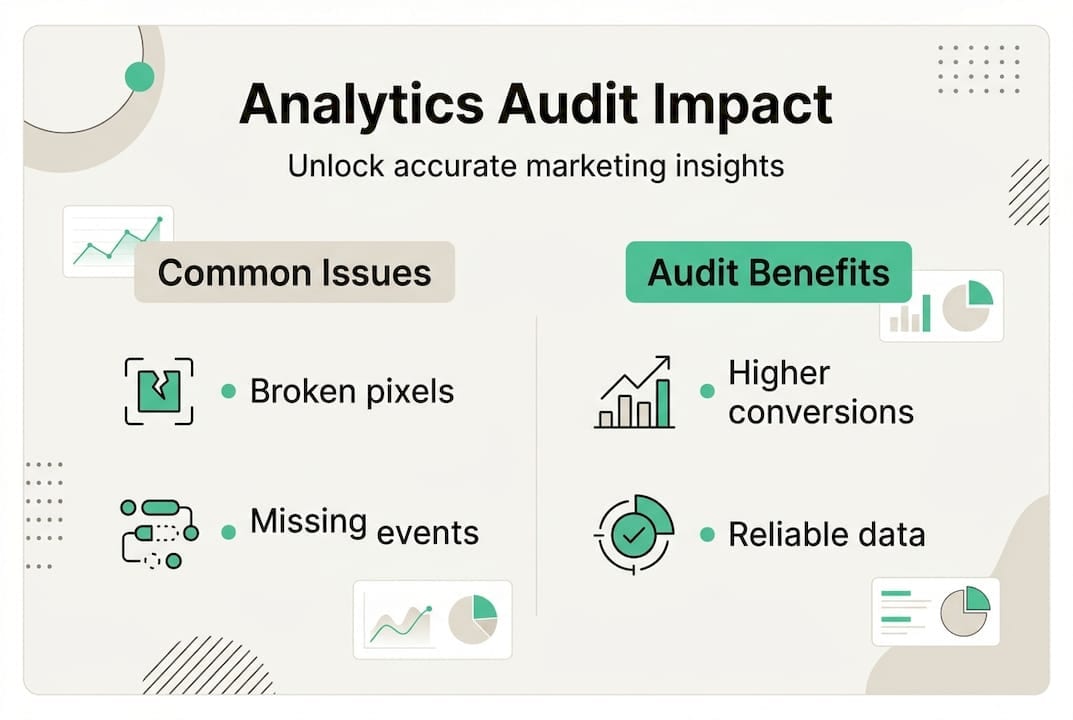
These dramatic improvements stem from audits uncovering critical tracking issues that, once resolved, unlock hidden revenue potential. Missing conversion pixels mean you’re flying blind on campaign performance. Broken checkout tracking prevents funnel optimization. Inconsistent product data corrupts merchandising insights. Fix these issues and performance transforms.
| Metric | Pre-Audit | Post-Audit | Improvement |
|---|---|---|---|
| Conversion Rate | 2.1% | 2.7% | +30% |
| Tracked Purchases | 1,200/month | 7,908/month | +559% |
| Revenue (YoY) | $500K | $2.2M | +440% |
| Data Accuracy | 80% | 97% | +17 points |
Revenue growth from audits can exceed 400% year over year when organizations address systematic tracking failures across their digital properties. This isn’t about driving more traffic or improving products. It’s about finally seeing and optimizing the revenue you’re already generating but failing to measure accurately.
Audits uncover specific tracking issues that directly enable these gains. Common high-impact discoveries include:
- E-commerce tracking firing inconsistently, missing 15-25% of transactions
- Form submission events failing silently, hiding lead generation performance
- Campaign parameters stripping during redirects, breaking attribution
- Mobile app events not syncing with web analytics, fragmenting user journeys
- Server-side conversion events timing out, creating phantom attribution gaps
Continuous auditing supports sustained performance improvement rather than one-time fixes. Organizations implementing quarterly audit cycles maintain data quality gains and catch new issues before they accumulate. Regular validation creates accountability, ensuring new implementations meet quality standards from launch.
The ROI calculation for auditing becomes compelling when you quantify revenue at risk. If you generate $10M annually and experience typical 15-20% tracking leakage, you’re making decisions on $8-8.5M of visible revenue while $1.5-2M goes dark. That invisible revenue distorts every optimization, attribution model, and budget allocation. Investing in comprehensive audits to recover even half that visibility pays for itself many times over.
Pro Tip: Calculate your potential revenue at risk by multiplying annual digital revenue by 15%, then use this figure to justify audit investments and prioritize fixes based on revenue impact rather than technical complexity.
Understanding the web analytics audit process helps you implement these improvements systematically. The key is moving from reactive firefighting to proactive quality assurance that prevents tracking breaks before they impact business decisions.
Best practices for auditing website analytics in 2026
Having seen audit benefits, here’s a practical guide to conducting audits effectively in 2026 to maximize tracking accuracy and marketing performance. Implementing structured audit practices ensures consistent data quality and enables confident decision-making across your marketing organization.
Begin with a comprehensive tracking plan inventory linked to clear business objectives. Document every event, parameter, and conversion you need to track, then map each to specific business questions you’re trying to answer. This foundation ensures your audit validates what actually matters rather than just checking technical implementation.
- Create a centralized tracking specification documenting all events, properties, and expected values
- Map each tracking element to business objectives and key performance indicators
- Identify critical path events where tracking failures have maximum business impact
- Establish data quality thresholds defining acceptable accuracy levels
- Schedule regular audit cycles with defined scope and success criteria
- Document findings in actionable format prioritized by business impact
- Implement fixes systematically with validation testing before deployment
- Monitor continuously to catch regression and new issues promptly
Use a hybrid audit approach leveraging automated tools plus expert contextual review. Automated monitoring catches technical failures and anomalies in real time, while expert analysis validates business alignment and interprets complex edge cases. Research shows that audit tools alone fall short without human expertise to provide context and strategic assessment.
Regularly validate both server-side and client-side tracking setup to ensure comprehensive coverage. Client-side tracking remains essential for user interaction events, while server-side implementations provide privacy-resilient conversion tracking. Verify that both layers work correctly and sync data consistently.
| Audit Approach | Strengths | Limitations | Best Use Case |
|---|---|---|---|
| Manual Expert Review | Business context, strategic alignment | Limited scale, periodic only | Annual comprehensive audits |
| Automated Tools | Continuous monitoring, technical validation | Lacks context, false positives | Ongoing quality assurance |
| Hybrid Method | Comprehensive coverage, scalable | Requires investment in both | Enterprise implementations |
Address privacy compliance and consent management as integral audit components, not afterthoughts. Verify that your tracking respects user consent choices, doesn’t leak PII, and complies with applicable regulations. Privacy violations create legal exposure while consent blocking can silently corrupt your data’s representativeness.
Schedule comprehensive audits annually with interim spot checks for fast-changing environments. Annual deep dives catch accumulated drift and validate strategic alignment, while quarterly spot checks ensure recent changes haven’t introduced breaks. Increase frequency around major launches, migrations, or organizational changes.
Document findings clearly and prioritize fixes based on business impact rather than technical severity. A minor technical issue affecting checkout tracking deserves higher priority than a perfect implementation of a rarely-used feature. Quantify revenue at risk for each issue to guide resource allocation.
Train teams to understand common pitfalls and implementation complexities so they avoid introducing issues. Many tracking breaks result from well-intentioned developers or marketers who don’t understand the downstream implications of their changes. Education prevents problems more effectively than reactive monitoring.
Maintain alignment between marketing goals and audit scope by regularly reviewing your tracking plan against evolving business priorities. As strategy shifts, tracking requirements change. Audits should validate that your analytics infrastructure still serves current needs rather than outdated objectives.
Leverage comprehensive resources like the website audit checklist and web audit checklist to ensure you’re covering all critical validation areas. These structured frameworks prevent oversight and ensure consistent audit quality.
Optimize your website analytics with Trackingplan
To support your auditing efforts, consider using dedicated solutions designed to ensure tracking accuracy and privacy compliance. Trackingplan offers advanced tools for comprehensive digital analytics quality assurance, helping marketing and analytics teams maintain trusted data across complex technology stacks.
Monitor and audit your web tracking to prevent data loss and errors proactively with automated discovery and validation. Rather than waiting for quarterly manual reviews to uncover issues, continuous monitoring catches breaks immediately and alerts your team through email, Slack, or Teams.
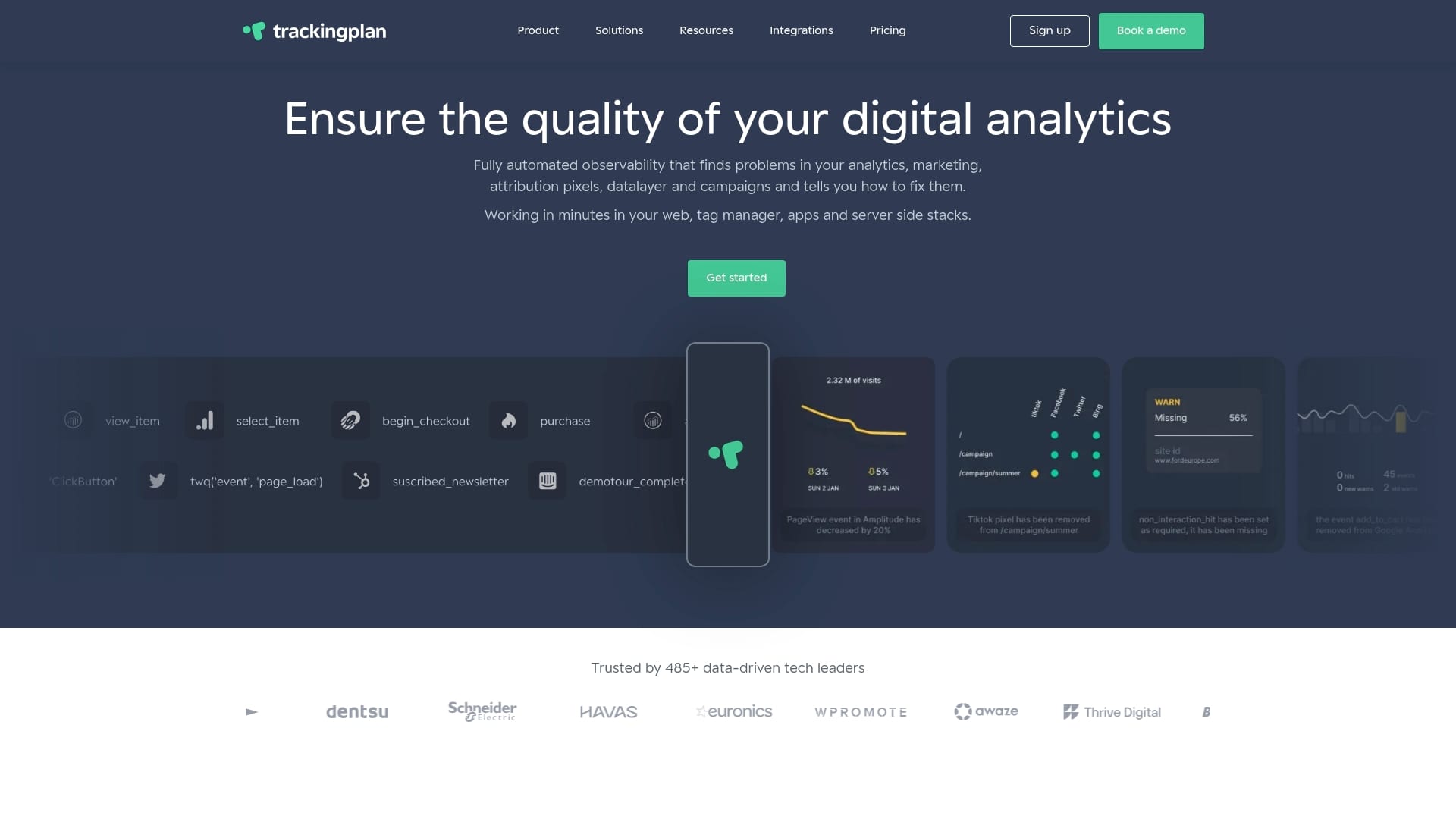
Integrate your analytics stack with digital analytics tools designed for confident marketing decisions based on accurate data. Comprehensive web tracking monitoring ensures every pixel fires correctly, every event reaches its destination, and every conversion gets attributed properly. The privacy hub helps manage compliance with consent management and data privacy standards, protecting your organization while maintaining data quality.
How often should I audit my website analytics?
How often should I audit my website analytics?
Perform a comprehensive audit annually to catch accumulated drift and validate strategic alignment with current business objectives. Supplement annual deep dives with quarterly spot checks focusing on recent changes, new implementations, and high-impact tracking elements. Increase audit frequency immediately following major website updates, marketing platform migrations, tag management changes, or organizational shifts that affect tracking requirements.
What are the biggest risks of not auditing website analytics?
Revenue loss from untracked conversions represents the most immediate financial risk, with typical leakage reaching 15-20% of total digital revenue. Misallocation of marketing budget due to unreliable data compounds this loss as you scale underperforming channels and starve successful ones. Privacy compliance risks emerge when unnoticed PII leaks create regulatory exposure under GDPR, CCPA, and similar frameworks, potentially resulting in significant fines and reputational damage.
Can automated tools fully replace manual audits?
Automated tools excel at catching technical implementation errors, monitoring for anomalies, and providing continuous validation at scale. However, they miss critical business context, privacy compliance nuances, and strategic misalignments that require human judgment. A hybrid approach combining automated monitoring for technical validation with periodic expert review for contextual assessment delivers the most comprehensive audit coverage and highest data quality assurance.
How do audits improve marketing ROI?
By ensuring accurate tracking, audits enable better attribution models and optimized budget allocation based on complete conversion data rather than partial visibility. Improved data quality leads to higher conversion rates and revenue growth as teams can confidently optimize user experiences and campaign performance. Case studies demonstrate conversion lifts of 30% to over 300% and revenue growth exceeding 400% year over year following comprehensive audits that identify and resolve critical tracking gaps.