Discover why tracking marketing data is crucial for ROI in 2026. Learn expert strategies to optimize data accuracy, overcome privacy challenges, and align measurement with revenue goals.
Most marketing teams underestimate the power of integrated data tracking, yet high-performing teams achieve 30-40% better ROI through systematic tracking systems. This gap reveals a critical opportunity: understanding why and how to track marketing data transforms campaign performance and budget efficiency. In 2026, privacy regulations and evolving measurement challenges make data accuracy more valuable than ever. This guide reveals practical methods to optimize your marketing data tracking, overcome common pitfalls, and align measurement with revenue goals through expert insights and actionable frameworks.
Table of Contents
- The Importance Of Tracking Marketing Data For Better ROI
- Challenges And Nuances In Tracking Marketing Data
- Expert Insights: Advanced Analytics And Data Governance Strategies
- Practical Steps To Optimize And Maintain Marketing Data Tracking
- Optimize Your Marketing Data Tracking With Trackingplan
- Frequently Asked Questions
Key takeaways
| Point | Details |
|---|---|
| Integrated tracking boosts ROI | Teams using consolidated data streams achieve 30-40% better campaign returns compared to fragmented tracking approaches. |
| Privacy compliance is manageable | First-party data strategies and consent frameworks enable accurate tracking while meeting GDPR and CCPA requirements. |
| Data governance drives revenue | Structured 90-day implementation plans align tracking systems with business KPIs and shift focus from vanity metrics to revenue impact. |
| Observational methods have limits | Non-experimental tracking can deviate 62-115% from controlled trials, requiring caution and validation. |
| Expert frameworks simplify complexity | Feature engineering and unified dashboards transform raw data into reliable predictive models and actionable insights. |
The importance of tracking marketing data for better ROI
Empirical evidence demonstrates that effective marketing data tracking directly improves campaign performance and resource allocation. Research shows that 72% of top-performing teams use integrated tracking systems, consolidating multiple data streams for more accurate attribution and decision-making. This integration eliminates blind spots that fragment campaign insights and waste budget on underperforming channels.
Consolidated tracking systems reveal which touchpoints genuinely drive conversions rather than simply correlating with them. When you combine data from advertising platforms, web analytics, and customer relationship management tools, patterns emerge that single-source tracking misses entirely. For instance, checkout-related events are the strongest predictors of purchase behavior, yet many teams focus on upper-funnel metrics that provide weaker signals.
The competitive advantage becomes clear when examining resource allocation. Teams with integrated tracking identify which campaigns generate actual revenue versus those that inflate vanity metrics like impressions or clicks. This precision enables smarter budget distribution, cutting waste from low-performing initiatives and doubling down on high-return activities. Marketing teams gain the ability to forecast campaign impact with greater confidence, reducing risk in strategic planning.
Better tracking also shortens feedback loops between campaign launches and performance insights. Instead of waiting weeks for attribution reports, real-time data flows reveal what works within days or even hours. This agility lets you optimize active campaigns rather than learning lessons for next quarter. The cumulative effect transforms marketing from educated guessing into data-informed strategy.
“Integrated tracking systems provide the foundation for attribution accuracy, enabling marketers to understand true customer journeys rather than isolated touchpoint performance.”
Key benefits of comprehensive marketing data tracking include:
- Accurate multi-touch attribution across channels and devices
- Faster identification of underperforming campaigns for immediate optimization
- Reduced customer acquisition costs through precise targeting refinement
- Improved forecast accuracy for budget planning and resource allocation
- Enhanced collaboration between marketing, sales, and product teams through shared data insights
Understanding why tracking is crucial for marketing success positions your team to capitalize on these advantages while competitors struggle with fragmented data and delayed insights.
Challenges and nuances in tracking marketing data
Despite clear benefits, marketing teams face significant obstacles when implementing and maintaining tracking systems. Privacy regulations like GDPR and CCPA have fundamentally changed data collection practices, forcing marketers to rely more heavily on first-party data and explicit consent mechanisms. This shift complicates tracking across devices and sessions, creating gaps in customer journey visibility that third-party cookies previously filled.
Session leakage represents another critical challenge that undermines attribution accuracy. When users browse across multiple devices or clear cookies between visits, tracking systems often treat a single customer as multiple separate users. This fragmentation corrupts machine learning models designed to predict campaign lift, leading to incorrect budget allocations and flawed performance assessments. The problem compounds in mobile environments where app and web sessions rarely connect seamlessly.

Research reveals that observational causal inference methods can deviate 62-115% compared to randomized controlled trials, exposing fundamental limitations in common tracking approaches. Many marketing teams rely on correlation-based attribution without validating whether observed patterns reflect genuine causation. This creates dangerous overconfidence in measurement accuracy, particularly when optimizing for metrics that don’t directly drive business outcomes.
Non-experimental tracking methods should supplement rather than replace controlled testing. While randomized experiments provide gold-standard measurement, they’re resource-intensive and impractical for every campaign decision. The solution involves using observational data cautiously, validating key assumptions through periodic experiments, and maintaining transparency about measurement uncertainty. Teams that acknowledge these limitations make better decisions than those treating flawed data as absolute truth.
Common tracking pitfalls include:
- Relying solely on last-click attribution that ignores upper-funnel contribution
- Failing to account for selection bias in audience targeting and measurement
- Ignoring cross-device behavior that fragments customer journey visibility
- Trusting machine learning models without validating underlying causal assumptions
- Neglecting regular audits that detect tracking implementation errors
| Challenge | Impact | Mitigation Strategy |
|---|---|---|
| Privacy regulations | Reduced third-party data access | Implement first-party data collection with consent frameworks |
| Session leakage | Fragmented user attribution | Use probabilistic matching and unified customer IDs |
| Observational method errors | 62-115% deviation from true lift | Validate with periodic randomized controlled trials |
| Cookie deprecation | Loss of cross-site tracking | Adopt server-side tracking and privacy-safe identifiers |
Addressing these challenges requires robust data governance best practices that balance measurement needs with privacy compliance. Teams must also recognize that prioritizing marketing over analytics creates dangerous blind spots in data quality and interpretation.
Pro Tip: Develop privacy-compliant data strategies that integrate first-party data collection, explicit consent mechanisms, and server-side tracking to future-proof your measurement infrastructure against evolving regulations and browser restrictions.
Expert insights: advanced analytics and data governance strategies
Leading analytics practitioners emphasize that sophisticated technology alone doesn’t guarantee better marketing measurement. Feature engineering, the process of creating meaningful variables from raw data, often outperforms complex machine learning models in predicting customer behavior. Research demonstrates that funnel-weighted scores simplify and improve predictive accuracy compared to black-box algorithms that obscure which factors actually drive conversions.
This insight challenges the common assumption that more advanced models automatically yield better results. A well-designed feature that captures genuine causal relationships, like combining page depth with time on site weighted by funnel position, provides clearer signals than a neural network trained on hundreds of raw variables. The simpler approach also enables marketers to understand why predictions work, facilitating actionable optimizations rather than blind trust in algorithmic outputs.
Complex machine learning models can actually harm decision-making when they lack proper causal features like auction dynamics and competitive context. Models trained purely on observational data often mistake correlation for causation, recommending strategies that worked by coincidence rather than genuine effectiveness. This problem intensifies when teams optimize campaigns based on flawed model recommendations, creating feedback loops that reinforce incorrect assumptions.

Structured implementation plans provide the framework for translating these insights into operational reality. 90-day plans enable KPI alignment by methodically building trusted data governance and connecting tracking systems to business objectives. These phased approaches prevent overwhelming teams while establishing sustainable practices that compound over time.
Unified dashboards represent a critical component of effective data governance, helping organizations shift from vanity metrics to revenue-focused measurement. When stakeholders view the same data through consistent definitions and calculations, cross-functional alignment improves dramatically. Marketing, sales, and product teams stop arguing about whose metrics matter and start collaborating on shared business outcomes.
Establishing reliable marketing data governance follows these essential steps:
- Audit existing tracking implementations to identify gaps, errors, and redundancies across platforms
- Define standardized naming conventions and taxonomies for campaigns, events, and customer attributes
- Implement automated monitoring systems that alert teams to tracking failures and data quality issues
- Create documentation that explains tracking logic, data flows, and calculation methodologies
- Establish regular review cycles where stakeholders validate that metrics align with business priorities
- Build cross-functional governance committees that resolve conflicts and approve tracking changes
These frameworks address the reality that data governance for analytics requires organizational commitment beyond technical implementation. Technology enables governance, but people and processes determine whether systems deliver trustworthy insights. Teams that invest in structured governance reap compounding benefits as data quality improves and stakeholder confidence grows.
Comprehensive marketing data governance also protects against costly errors that undermine campaign performance and waste budget. When tracking breaks silently, teams make decisions on incomplete or incorrect data without realizing the foundation has crumbled. Governance practices catch these failures quickly, minimizing damage and maintaining measurement integrity.
Pro Tip: Start your data governance journey by documenting current tracking implementations and identifying the three highest-impact measurement gaps, then address those systematically before expanding to comprehensive audits.
Practical steps to optimize and maintain marketing data tracking
Translating strategic insights into daily operations requires concrete actions that marketing teams can implement immediately. The following checklist provides essential steps for improving tracking accuracy and compliance while building sustainable data quality practices.
Core actions for tracking optimization:
- Validate that tracking codes fire correctly on all critical pages and conversion events
- Implement server-side tracking to reduce reliance on browser-based pixels vulnerable to blockers
- Establish naming conventions for campaigns, UTM parameters, and custom events across platforms
- Configure automated alerts for tracking failures, data anomalies, and traffic pattern changes
- Document data flows showing how information moves from collection points to reporting dashboards
- Schedule quarterly audits reviewing tracking implementations against current business requirements
- Train team members on proper tagging procedures and data governance protocols
Monitoring the right metrics ensures tracking systems remain healthy and campaigns perform optimally. The following data table identifies key indicators and their significance for marketing measurement.
| Metric | Target Range | Why It Matters |
|---|---|---|
| Event collection rate | >95% | Tracks percentage of intended events successfully captured |
| Attribution match rate | >80% | Measures how often conversions link to marketing touchpoints |
| Data freshness | <24 hours | Ensures reports reflect recent campaign performance |
| Schema compliance | 100% | Validates data structure matches expected format |
| Cross-device match rate | >60% | Indicates ability to track users across devices |
Aligning tracking with revenue-focused KPIs requires connecting measurement systems to actual business outcomes rather than proxy metrics. Start by identifying which customer actions directly generate revenue or reliably predict future purchases. Configure tracking to capture these events with maximum accuracy, even if it means sacrificing visibility into less meaningful activities. This prioritization ensures limited resources focus on measurement that matters.
Privacy compliance demands ongoing attention as regulations evolve and browser restrictions tighten. Implement consent management platforms that respect user preferences while maintaining measurement capability for consenting users. Adopt first-party data collection strategies that reduce dependence on third-party cookies and cross-site tracking. Document data retention policies and ensure tracking practices align with legal requirements in all operating jurisdictions.
Cross-team collaboration amplifies data governance effectiveness by distributing responsibility and leveraging diverse expertise. Marketing teams understand campaign strategy and performance needs. Analytics specialists bring technical measurement knowledge. Legal and compliance teams ensure regulatory adherence. Product teams provide context on user behavior and system capabilities. When these groups coordinate regularly, tracking systems serve organizational needs more comprehensively.
90-day implementation plans provide structured timelines for building governance, deploying unified dashboards, and aligning measurement with strategic KPIs. These phased approaches prevent overwhelming teams while establishing sustainable practices that compound over time. Month one focuses on auditing current state and defining requirements. Month two implements priority fixes and establishes monitoring systems. Month three validates improvements and scales successful practices across the organization.
A reliable campaign tracking checklist ensures consistency across launches and prevents common implementation errors. Maintaining data integrity in marketing analytics protects against the silent failures that undermine decision-making and waste budget on flawed insights.
Pro Tip: Regularly audit tracking tags using automated observability solutions that detect implementation errors, schema mismatches, and data quality issues before they corrupt reporting and campaign optimization decisions.
Optimize your marketing data tracking with Trackingplan
Maintaining accurate marketing data tracking across multiple platforms, campaigns, and team members creates complexity that manual processes struggle to manage. Trackingplan addresses these challenges through automated discovery, monitoring, and auditing of your complete analytics implementation. The platform detects tracking errors, schema mismatches, and campaign misconfigurations before they corrupt your data and mislead optimization decisions.
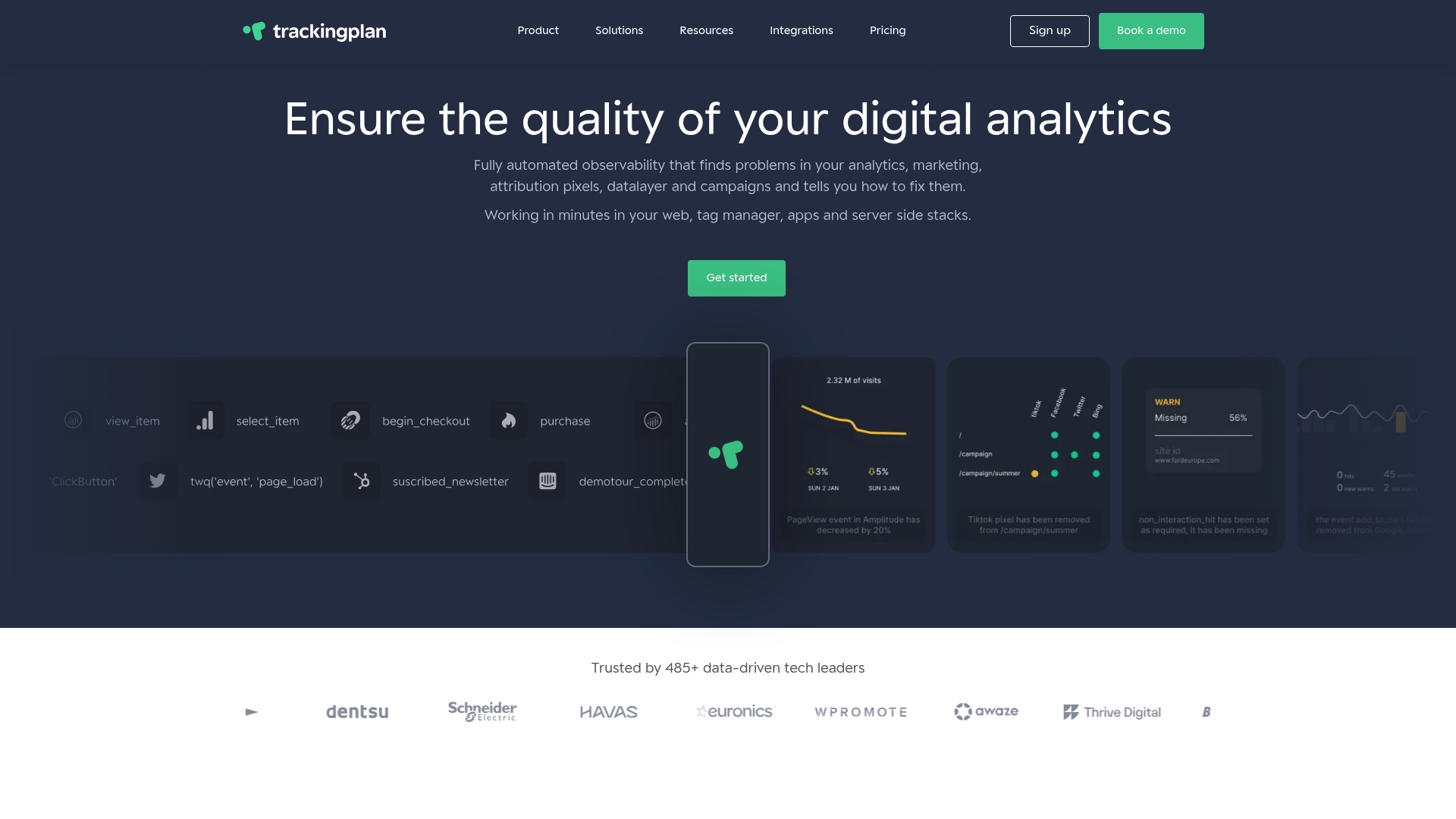
Real-time alerts via email, Slack, or Teams notify your team instantly when tracking breaks, traffic patterns shift unexpectedly, or data quality degrades. This immediate visibility enables rapid diagnosis and correction, minimizing the window where flawed data influences campaign decisions. Comprehensive dashboards provide ongoing insights into your martech stack health, helping you maintain measurement integrity as systems evolve.
Integrating Trackingplan with your digital analytics tools creates a unified observability layer across platforms. Automated web tracking monitoring continuously validates implementations without requiring manual audits. The privacy hub helps ensure compliance while maintaining measurement capability, balancing regulatory requirements with business needs for accurate attribution and optimization.
Frequently asked questions
What is marketing data tracking and why is it important?
Marketing data tracking systematically captures customer interactions across touchpoints to measure campaign effectiveness and optimize resource allocation. It enables attribution of conversions to specific marketing activities, revealing which channels and messages drive business outcomes. Accurate tracking transforms marketing from intuition-based guessing into data-informed strategy that improves ROI and reduces wasted spend. Organizations with comprehensive tracking systems make faster, more confident decisions about budget allocation and campaign optimization.
How do privacy regulations affect marketing data tracking?
Privacy laws like GDPR and CCPA require marketers to obtain explicit consent before collecting personal data and limit cross-site tracking capabilities. These regulations push teams toward first-party data collection strategies that rely on direct customer relationships rather than third-party cookies. Marketers must implement consent management platforms, document data retention policies, and ensure tracking practices comply with regulations in all operating jurisdictions. Adapting to these requirements maintains measurement capability while respecting user privacy and avoiding regulatory penalties.
What are the common errors in observational marketing data methods?
Observational tracking methods can deviate 62-115% from randomized controlled trials because they mistake correlation for causation. These approaches often ignore selection bias, where audiences targeted by campaigns differ systematically from control groups in ways that affect conversion rates. Session leakage and cross-device fragmentation create additional measurement errors by treating single customers as multiple users. Teams should validate observational findings through periodic experiments and maintain transparency about measurement uncertainty rather than treating flawed data as absolute truth.
How can marketing teams improve data quality and governance?
Implementing structured data governance plans aligned with business KPIs establishes sustainable practices for maintaining measurement integrity. Regular audits identify tracking implementation errors, schema mismatches, and data quality issues before they corrupt reporting. Unified dashboards ensure stakeholders view consistent metrics calculated using standardized definitions and methodologies. Cross-functional coordination between marketing, analytics, legal, and product teams distributes governance responsibility and leverages diverse expertise. Automated monitoring systems provide real-time alerts when tracking fails or data patterns shift unexpectedly, enabling rapid response to issues.