
Agentic BI will not fail because the models are weak. It will fail because teams hand autonomous systems data they would never trust in a board meeting.
This is the shift underway. Businesses want analytics that can detect anomalies, explain what changed, recommend the next move, and in some cases trigger action without waiting for an analyst to build another dashboard view. The upside is obvious. The failure mode is obvious too. Once a system can act on its own, broken event tracking, stale metric definitions, schema drift, and missing attribution stop being reporting problems and become operational risks.
I have seen teams chase autonomous analytics before they had reliable instrumentation. The result is fast, polished, wrong answers.
Agentic BI only works when data quality checks, observability, and governance are already part of the stack. Without that safety layer, autonomy is a fantasy. With it, analytics starts to look less like a reporting function and more like an operating system for decisions. Teams trying to close the gap between passive dashboards and active monitoring can see the practical difference in this guide to real-time BI for operators.
The End of Dashboards As You Know Them
Dashboards are no longer the product. They are a user interface for a workflow that now needs interpretation, prioritization, and action.
Traditional BI was built for a reporting problem. The business needed a stable place to check revenue, pipeline, retention, or campaign performance. That still matters. But in live operating environments, a dashboard often becomes a waiting room. The data updates, the charts refresh, and nothing happens until an analyst notices a change, investigates it, confirms the cause, and tells the business what to do.
That lag is the primary limitation.
Static reporting creates a decision bottleneck
A dashboard answers the question someone already knew to ask. It rarely catches the silent failure upstream. It does not inspect broken tracking, challenge a suspicious metric spike, or trace a conversion drop back to a schema change unless a person does that work.
This is why static reporting struggles in growth marketing, product analytics, and ecommerce operations. The top-line KPI can look fine while the underlying instrumentation is drifting out of spec. Campaign parameters disappear. Events fire twice. Revenue arrives late. Attribution logic changes and nobody catches it until performance reviews turn into forensic work. Teams that want a practical frame for this operational problem can compare it with this guide to real-time BI for operators.
Dashboards stop at presentation. The business needs systems that can investigate, validate, and recommend action.
The strongest teams already know this. They are not asking for more charts. They are asking for analytics that can monitor the business with enough context to separate a real trend from a tracking defect.
Agentic BI changes the job description of analytics
Agentic BI shifts analytics from passive visibility to active participation. The system does not just display metrics. It can monitor conditions, run follow-up analysis, explain likely drivers, and route the next step to the right team.
That promise sounds ambitious because it is. It also gets overstated. Autonomy is only useful when the underlying data can survive scrutiny. If the event stream is unreliable or metric definitions are inconsistent, an autonomous system produces wrong conclusions faster. For a more detailed explanation of how this operating model works, see this overview of agentic analytics and autonomous decision workflows.
The trade-off is clear. You get speed, coverage, and continuous analysis. You also inherit a bigger blast radius when the inputs are wrong.
That is why the end of dashboards does not mean the end of BI discipline. It means analytics teams need a stronger foundation under the interface, especially data quality monitoring and observability, before they hand more responsibility to autonomous systems.
What Is Agentic Business Intelligence Really
Agentic business intelligence is easiest to understand if you stop thinking about BI as software and start thinking about it as a lead analyst with a team.
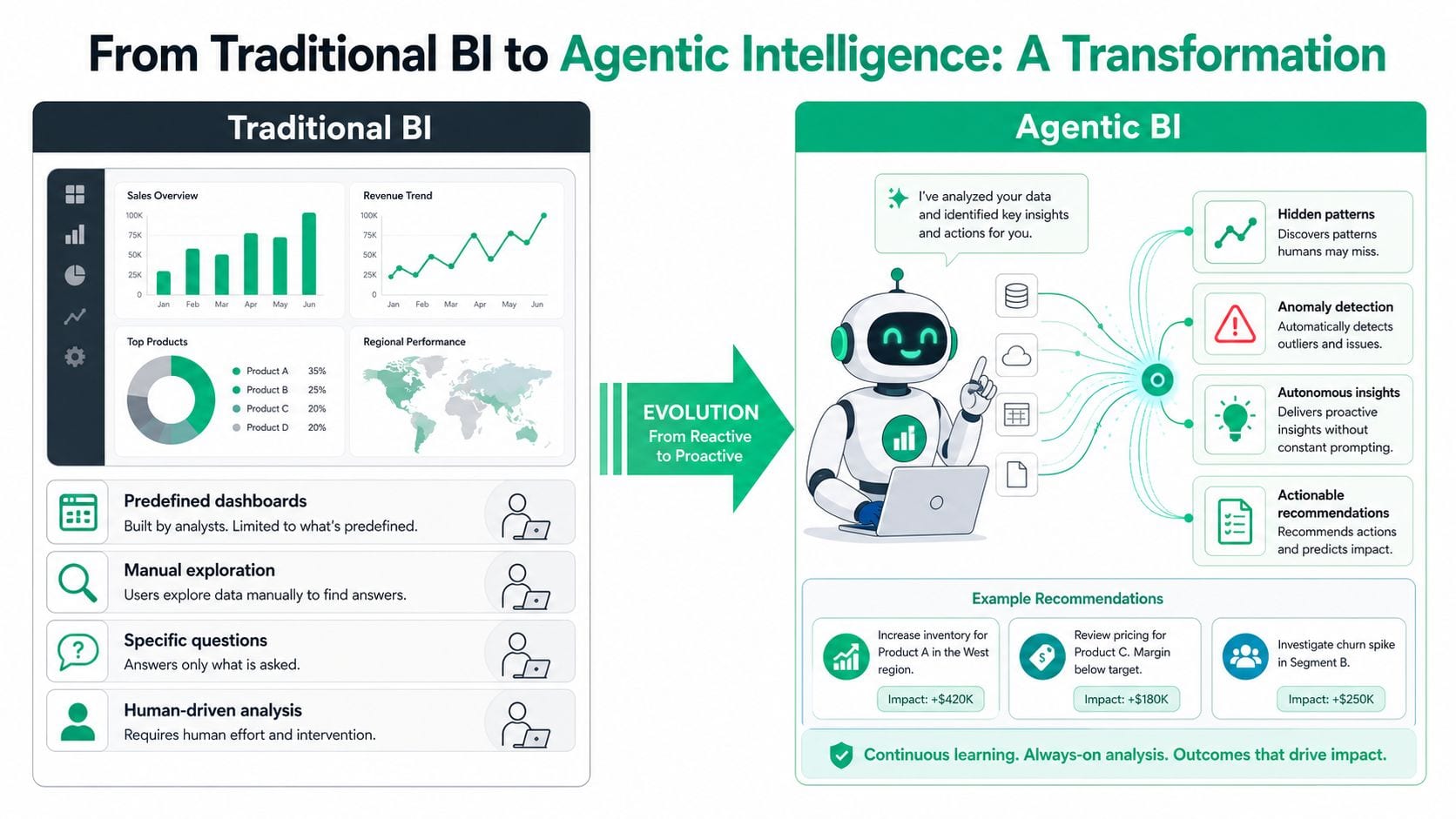
Traditional BI behaves like a calculator. You feed it inputs, choose a report, and interpret the result yourself. Agentic BI behaves more like an autonomous lead analyst that can take a business goal, break it into tasks, pull the relevant data, interpret what changed, and suggest what to do next.
It is goal-oriented, not report-oriented
A standard BI workflow starts with a query or a dashboard. An agentic workflow starts with intent.
Someone asks, "Why did paid conversion quality drop this week?" In a traditional setup, an analyst opens a dashboard, exports data, checks campaign dimensions, inspects landing pages, compares attribution views, and then writes up a conclusion. In agentic BI, the system can orchestrate those steps itself. It doesn't just fetch a chart. It works through a chain of reasoning.
That distinction is why the term matters. The "agentic" part means the system has some combination of memory, planning, tool use, and next-step decision logic. It can pursue an objective through multiple actions instead of responding once and stopping.
It changes how people interact with analytics
The user experience also changes. People don't need to operate the visualization layer as the primary interface. They can direct analysis in natural language and refine the objective as new context appears.
A good explainer on that broader shift is this overview of agentic analytics, especially if you're trying to separate genuine workflow automation from generic AI labeling.
Here's the practical contrast:
| Traditional BI | Agentic BI |
|---|---|
| Human starts with a report | Human starts with a goal |
| Query and dashboard driven | Context and objective driven |
| Retrospective analysis | Proactive investigation |
| User interprets findings | System explains findings |
| Human initiates next step | System recommends or triggers next step |
The mental model that actually helps
The cleanest analogy is an analyst manager coordinating specialists.
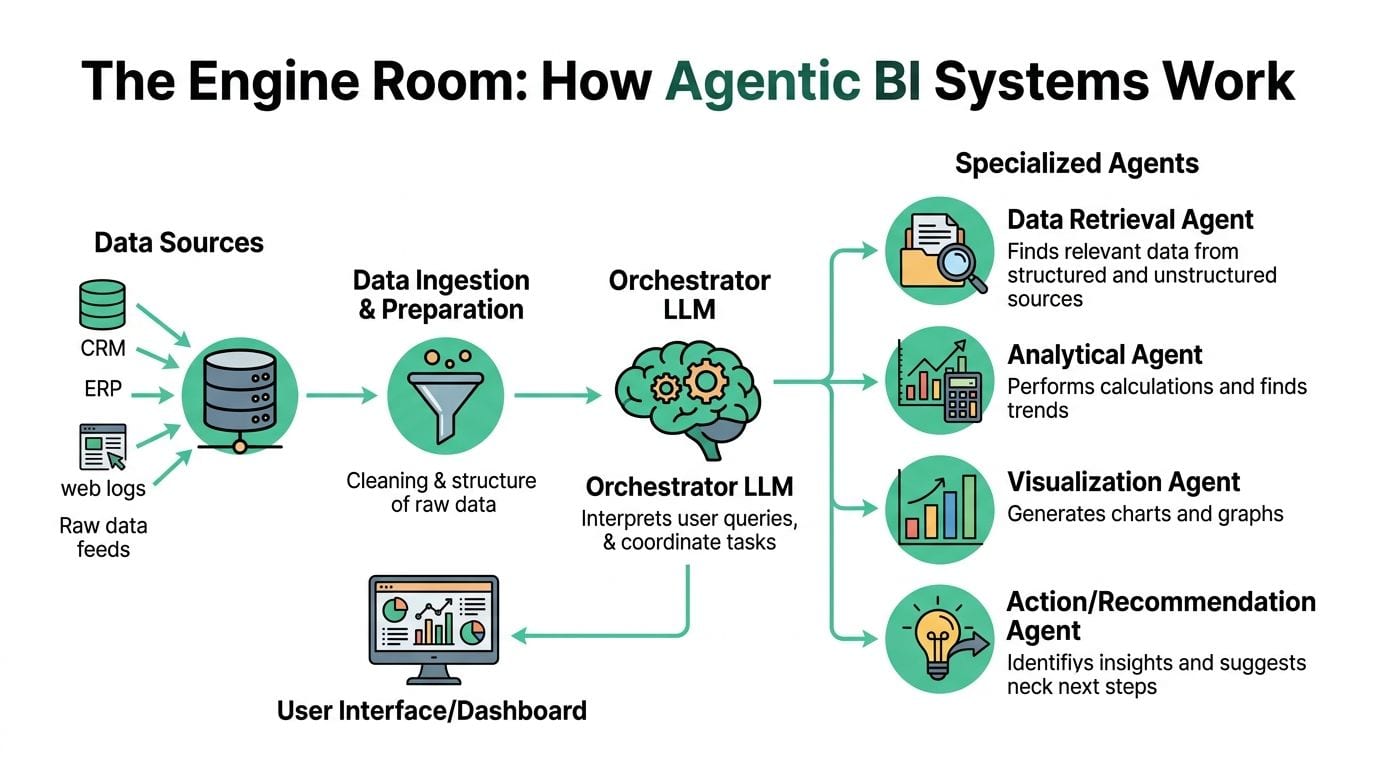
One specialist retrieves data from warehouses, APIs, or event streams. Another checks anomalies. Another drafts a narrative. Another suggests interventions. The orchestrator decides who should act next and in what order.
Practical rule: If the system only summarizes a dashboard in plain English, that's not yet agentic business intelligence. It's a nicer reporting layer.
Real agentic BI isn't about replacing every analyst. It's about moving repetitive analytical labor out of dashboards and into coordinated systems, so human teams can focus on judgment, exceptions, and business trade-offs.
The Architecture Behind Autonomous Insights
Under the hood, agentic BI is less mysterious than it sounds. It's a coordination problem.
The architecture typically uses an orchestrator LLM to manage specialized agents responsible for data access, analysis, reporting, and action. Databricks describes the operational core as a five-step loop: Sense, Analyze, Explain, Recommend, and Act in its guide to what agentic BI is. Capgemini also describes multi-agent orchestration where a core orchestrator coordinates sub-agents for tasks like data unification and report production in its point of view on agentic AI for BI design.
The five-step loop in practice
This is how that loop appears in a realistic operating context.
Sense
The system gathers inputs from event streams, APIs, databases, campaign platforms, product analytics tools, and business systems.Analyze
It checks for anomalies, trend breaks, unexpected correlations, and performance shifts.Explain
It generates a narrative that connects the signal to likely causes. That might include channel mix changes, schema shifts, broken attribution, or inventory constraints.Recommend
It proposes next steps. For example, pause a campaign, recheck a conversion event, or route the issue to engineering.Act
If permissions allow it, the system can trigger workflows, send tickets, notify Slack, or initiate downstream actions.
Orchestration matters more than raw model power
The strongest systems aren't one giant model doing everything. They're coordinated systems with clear roles.
A retrieval agent shouldn't decide budget actions on its own. An anomaly agent shouldn't have authority to change production settings. An action agent shouldn't operate without context from governance rules and data freshness checks. The quality of the orchestration layer determines whether the system behaves like a disciplined operator or an overconfident intern.
That same principle is showing up outside BI. If you're looking at how agentic systems interact with operational tooling, this programmatic mailboxes for AI piece is a good example of why controlled interfaces matter when agents need to perform real tasks.
Infrastructure still decides the ceiling
The architecture only works when agents can access context across systems without introducing new fragmentation. That means unified semantics, memory of prior steps, and tools that let agents execute constrained actions safely.
A useful companion read here is this agentic analytics platform overview, particularly for teams evaluating what a production-oriented stack should look like beyond prompt demos.
The impressive demo is rarely the hard part. Reliable context, guarded actions, and observable execution are the hard parts.
Key Benefits and Real-World Use Cases
The upside becomes tangible when agentic BI is tied to a narrow business problem instead of a broad ambition. That's where the category stops sounding futuristic and starts becoming operational.
The adoption data is encouraging, but selective. According to AI Stratagems' 2026 agentic AI statistics roundup, 23% of organizations have successfully scaled agentic AI, and among that group the average ROI is 171%. The same source reports a 23% increase in sales revenue for organizations using agentic prospecting, an 18% improvement in customer lifetime value through AI-agent-assisted support, and 66% of adopting organizations reporting increased productivity.
Revenue use case in sales and pipeline work
One practical use case is autonomous prospecting support.
An agent can watch CRM activity, email engagement, lead source quality, and product intent signals. When it sees a pattern that suggests a deal is stalling or a segment is heating up, it can prioritize accounts, suggest outreach sequencing, or prepare context for the rep. That's where the reported 23% sales revenue increase becomes believable. Not because the model is magical, but because it reduces lag between signal and action.
Customer value use case in support and retention
Another strong fit is customer support and lifecycle work.
A capable agent can connect support interactions, product usage, billing friction, and marketing history to identify accounts that need intervention. It can summarize likely churn drivers, route a case correctly, and recommend the next best action for retention teams. That's the kind of operating environment behind the reported 18% improvement in customer lifetime value.
For teams trying to think about these workflows through a digital measurement lens, this agentic analytics primer is a useful reference.
Productivity use case in operations and analytics
The least glamorous benefit is often the fastest one to realize. Productivity.
Analysts spend a large share of their time pulling data, validating joins, rewriting business questions into query logic, and turning findings into stakeholder-ready explanations. Agentic BI can absorb a lot of that repetitive work. That's why 66% of adopting organizations reporting increased productivity is one of the more credible signals in the category.
A short way to think about the business value:
- Marketing teams get faster diagnosis when campaigns drift away from expected patterns.
- Sales teams get prioritization support instead of static lead scoring snapshots.
- Operations teams get earlier warnings when process changes start affecting outcomes.
- Analysts gain capability. They spend less time assembling evidence and more time deciding what matters.
The caveat is straightforward. Benefits show up when the system is deployed against a real workflow with clean context and clear authority boundaries. They don't show up because a dashboard got a chatbot attached to it.
Data Quality Your Critical Foundation
Agentic BI has a data quality problem that most category overviews soften too much.
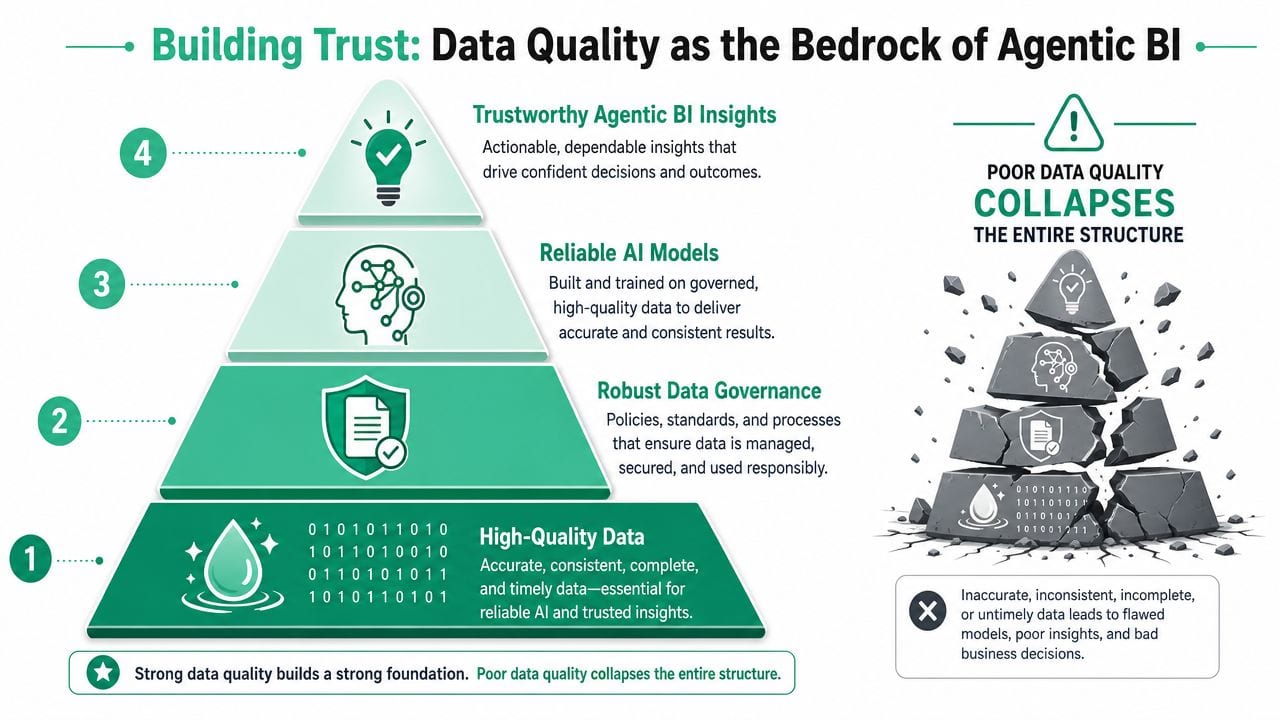
When an autonomous system reasons over broken analytics, it doesn't just produce a wrong chart. It can produce a wrong recommendation, escalate that recommendation with confidence, and distribute it faster than a human would have. That's a dangerous failure mode because the output looks polished.
Bad inputs become authoritative outputs
For agentic BI, the popular "garbage in, garbage out" line isn't strong enough. It's closer to garbage in, gospel out.
The system doesn't just reflect the data. It interprets it, explains it, and may act on it. If a conversion event disappears, a property schema changes, a pixel fires twice, or attribution parameters drift from convention, the agent can build a very coherent story on top of flawed evidence.
Research and vendor material often focus on autonomy. They spend less time on the hidden requirement underneath it, which is continuous validation of the analytics layer itself.
Observability is the safety net
That's why automated observability matters. According to Trackingplan's platform overview, agentic business intelligence requires automated, real-time validation of data pipelines, with continuous monitoring of actual user traffic to detect missing events, schema mismatches, and traffic anomalies within seconds. The same description explicitly contrasts this with manual audits and brittle test suites.
There is also a practical implementation point here that many teams overlook. Observability has to watch real behavior, not only expected behavior. Synthetic checks can tell you whether a predefined test passed. They often won't tell you that a live campaign introduced a rogue UTM pattern, a consent setting changed event volume, or a mobile release altered payload structure in production.
A useful operational companion is this data quality best practices guide, especially for teams that still treat QA as a one-time implementation milestone instead of an ongoing control layer.
What a trustworthy foundation looks like
Teams that are serious about agentic BI usually enforce a few essential practices:
- Real-time validation: Production tracking is monitored continuously, not checked only during launches.
- Schema discipline: Events and properties have expected structure, ownership, and review paths.
- Cross-team visibility: Marketing, analytics, and engineering can see the same implementation reality.
- Drift detection: Changes in traffic shape, tagging, and payloads are surfaced before stakeholders act on them.
A video demonstration helps more than prose here. Trackingplan's YouTube channel includes product walkthroughs that show how automated analytics observability works in practice, especially for teams dealing with silent tracking breakage across web, app, and server-side environments.
If you wouldn't let a finance system post entries without reconciliation, don't let an agentic BI system act on unreconciled analytics.
Navigating Governance and Security Risks
A lot of agentic BI messaging still assumes autonomy is mainly a UX improvement. It isn't. It's a control problem.
Once a system can recommend or trigger action, leadership has to answer a harder set of questions. What data did the agent rely on? Which definition of revenue or conversion did it use? Who was allowed to approve the action? Can the team reconstruct the chain of decisions after something goes wrong?
Governance can't be bolted on later
Embeddable's analysis is blunt on this point. Minimum viable agentic BI systems must include role-aware access, multi-tenancy isolation, and a full audit trail for every agent decision, and 70% of AI failures in BI stem from agents acting on unverified data according to Embeddable's article on agentic BI governance.
That should reset expectations. Governance isn't a compliance appendix. It's part of the product definition.
Non-negotiable control: If an agent can act, every action needs a visible trail of inputs, reasoning steps, permissions, and outcomes.
The common failure pattern
The most common design mistake is giving agents broad access before teams have agreed on semantics, freshness rules, and decision boundaries.
An executive sees "autonomous KPI monitoring" and assumes the system can safely watch the business. In reality, the agent may be reading conflicting metric definitions from multiple tools, using stale dimensions, or acting before data validation completes. That isn't intelligence. It's uncontrolled automation.
What mature teams put in place
The teams that deploy this responsibly usually define controls at several layers:
- Access control by role: Agents only see and do what a role permits.
- Isolation by tenant or business unit: One team's context doesn't leak into another's.
- Auditability: Every recommendation and action is reconstructable.
- Policy enforcement: Agents operate inside explicit rules, not informal expectations.
If your organization already thinks about infrastructure governance through code and reviewable policy, the same mindset applies here. This guide covering IaC, GitOps, and policy-as-code is a useful parallel because agentic BI needs the same discipline: permissions, versioned controls, and repeatable enforcement.
Agentic systems don't remove governance work. They make weak governance impossible to hide.
Your Roadmap to Implementing Agentic BI
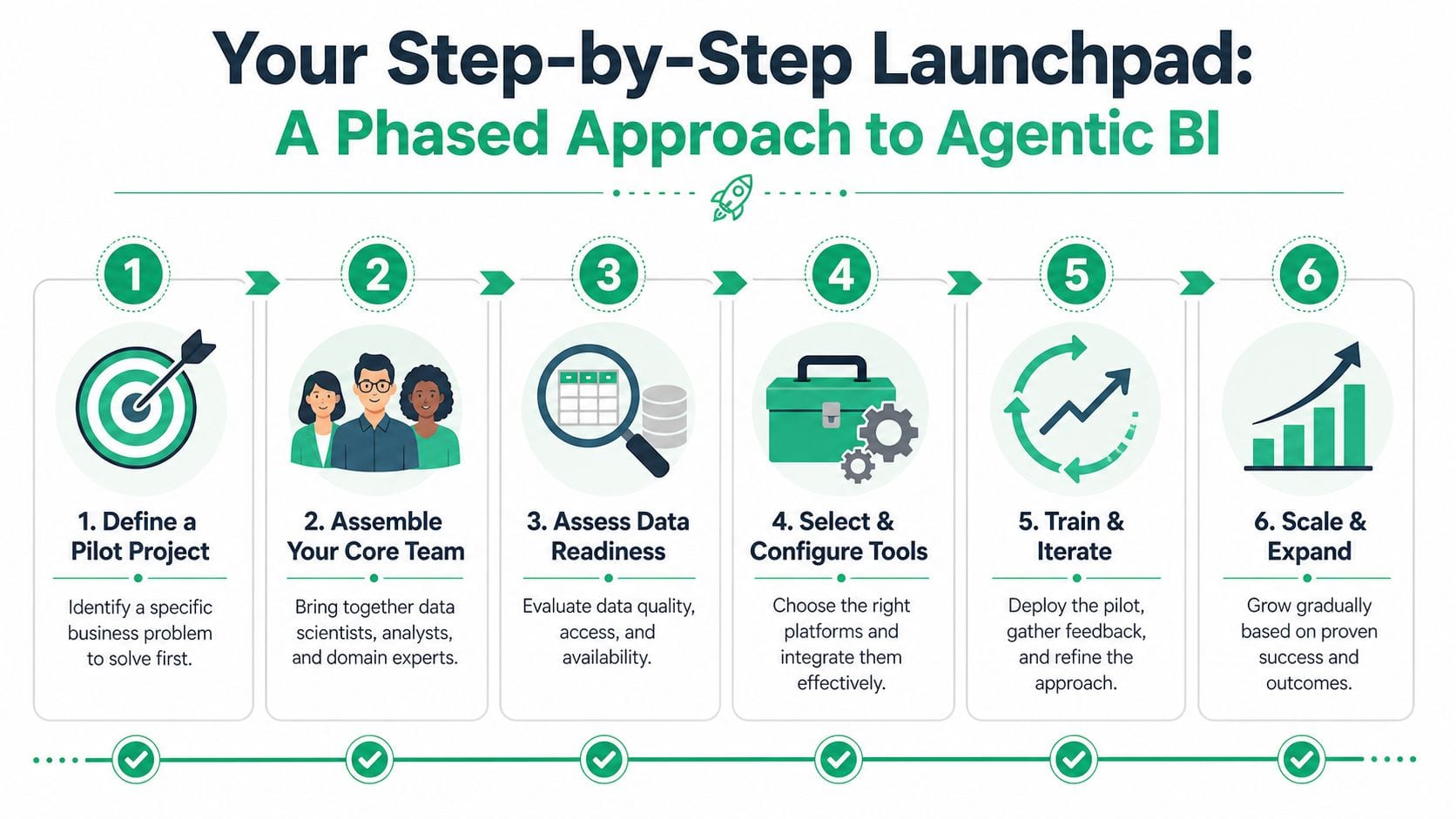
Most companies shouldn't start with a company-wide rollout. They should start with one problem that is valuable, narrow, and safe enough to test under real conditions.
The point of a pilot isn't to prove that AI can answer questions. Everyone already knows it can. The point is to prove that your organization can run agentic workflows with reliable data, clear ownership, and measurable operating value.
A practical pilot checklist
Choose a bounded use case
Pick a workflow with clear pain and limited blast radius. Campaign anomaly detection, funnel break diagnosis, or support triage are better pilot candidates than "fully autonomous analytics."Name the business owner
The data team can't own value on its own. A marketing lead, operations manager, or revenue owner needs to define what good looks like.Treat data readiness as step zero
Before model prompts or orchestration logic, verify that the underlying events, dimensions, and source mappings are dependable.Define allowed actions
Start with recommendation-only mode if needed. Let the system explain and suggest before it is allowed to trigger changes.Instrument review and feedback loops
Capture false positives, bad explanations, and edge cases. Those lessons improve orchestration more than endless prompt tweaking.Expand only after trust is earned
Move from one domain to the next when the team can explain why the pilot worked, not just when the demo looked good.
What not to do
Avoid three patterns:
- Don't start with the broadest possible scope. Cross-functional autonomy sounds exciting and usually creates confusion.
- Don't skip the semantic cleanup. Agents need consistent definitions more than they need clever prompts.
- Don't measure success only by speed. Faster wrong decisions are still wrong decisions.
A strong launch depends on operational discipline more than novelty. Teams that want agentic BI to work need product thinking, analytics rigor, governance design, and continuous validation in the same room.
If you're evaluating the category seriously, treat implementation as a systems project, not a model experiment.
If your team wants autonomous analytics without losing trust in the underlying data, Trackingplan is worth a close look. It gives analytics, marketing, and engineering teams an automated way to observe real user traffic, catch missing events and schema mismatches, monitor pixels and attribution signals, and keep digital measurement reliable before bad data reaches dashboards, models, or agents.