
If your week starts with ten tabs open, a Slack thread about dropping conversions, and three people arguing over which dashboard is right, you're in the exact moment this shift matters. Teams often spend too much time stitching together campaign data, product data, and tracking data by hand. The problem isn't a lack of charts. It's that the charts stop at visibility, while the business needs diagnosis, judgment, and action.
From Overwhelmed by Data to Empowered by Agents
Monday morning usually looks the same. A marketer spots a dip in paid performance. An analyst opens GA4, Mixpanel, the warehouse BI layer, and ad platform reports. A developer gets pulled in because someone suspects tracking broke. Hours pass before anyone can answer the basic question: is this a real business issue, a channel shift, or a data problem?
That's the world agentic analytics is trying to change.
According to Trackingplan's explanation of agentic analytics, the defining shift is from static reporting to an active decision engine, where autonomous AI agents continuously monitor data, detect anomalies, reason about results, and trigger context-aware actions with minimal human intervention. That matters because the core bottleneck in modern analytics isn't collecting data. It's turning scattered signals into reliable decisions fast enough to matter.
What makes something agentic
A dashboard is passive. It waits for you to log in, choose a metric, add a filter, compare date ranges, and decide whether the change matters.
An agent behaves more like a capable analyst with initiative. It can:
- Watch continuously: It doesn't wait for a stakeholder to notice a dip.
- Investigate across sources: It can connect campaign inputs, product behavior, and downstream outcomes.
- Push toward action: It can recommend the next move, not just surface a chart.
That doesn't mean human analysts disappear. It means their role changes. Instead of spending half the day validating basic variance, they can focus on whether the explanation is credible, whether the action fits the business context, and what tradeoffs matter most.
Practical rule: If your current analytics workflow ends at “someone should look into this,” you're still in the passive era.
A good companion read for teams trying to frame this shift is Querio's piece on demystifying agentic analytics for data teams. It helps separate the actual operating model change from the usual AI buzzwords.
How Agentic Analytics Differs from Traditional BI
Traditional BI gave companies a shared view of performance. That's valuable. But it still left the hardest work to humans: deciding what question to ask, which tables to join, how to interpret the result, and what action should follow.
Agentic analytics changes the operating model. As EnterpriseDB explains in its discussion of the rise of agentic analytics, traditional analytics waits for human interpretation of static dashboards, while agentic analytics is proactive and adaptive. It deploys autonomous AI agents that reason through complex data challenges, execute multi-step analyses, and deliver actionable insights by combining large language models, reasoning frameworks, and tool-use capabilities.
The simplest way to think about the difference
Traditional BI answers: What happened?
Agentic analytics tries to answer: Why did it happen, what is likely next, and what should we do now?
That sounds subtle, but in practice it's a major break from the old model.
Why dashboards aren't enough anymore
Dashboards work well when the business knows what to watch and has time to interpret signals manually. That model breaks when:
- Data volume grows: More channels, more events, more edge cases.
- Decision windows shrink: A campaign problem by noon may be expensive by evening.
- Dependencies multiply: Marketing, product, engineering, and analytics all affect the same KPI.
A dashboard can show a conversion drop. It usually can't trace whether the cause sits in a landing page rollout, a broken checkout event, a bad UTM pattern, or a shift in audience quality without human effort.
This is not just a better chatbot
Teams often confuse agentic analytics with conversational analytics. The difference is depth.
A chatbot usually responds to one question at a time. An agent can pursue a goal. It can pull data, test a hypothesis, validate business logic, and return with a conclusion and a suggested next action. That's why the right comparison isn't “dashboard versus chat box.” It's “manual analysis chain versus autonomous analysis workflow.”
Traditional BI gives you visibility. Agentic analytics aims to give you momentum.
The Architecture of an AI Analyst
The easiest way to understand what is agentic analytics is to stop thinking about a single model and start thinking about a coordinated analyst system.
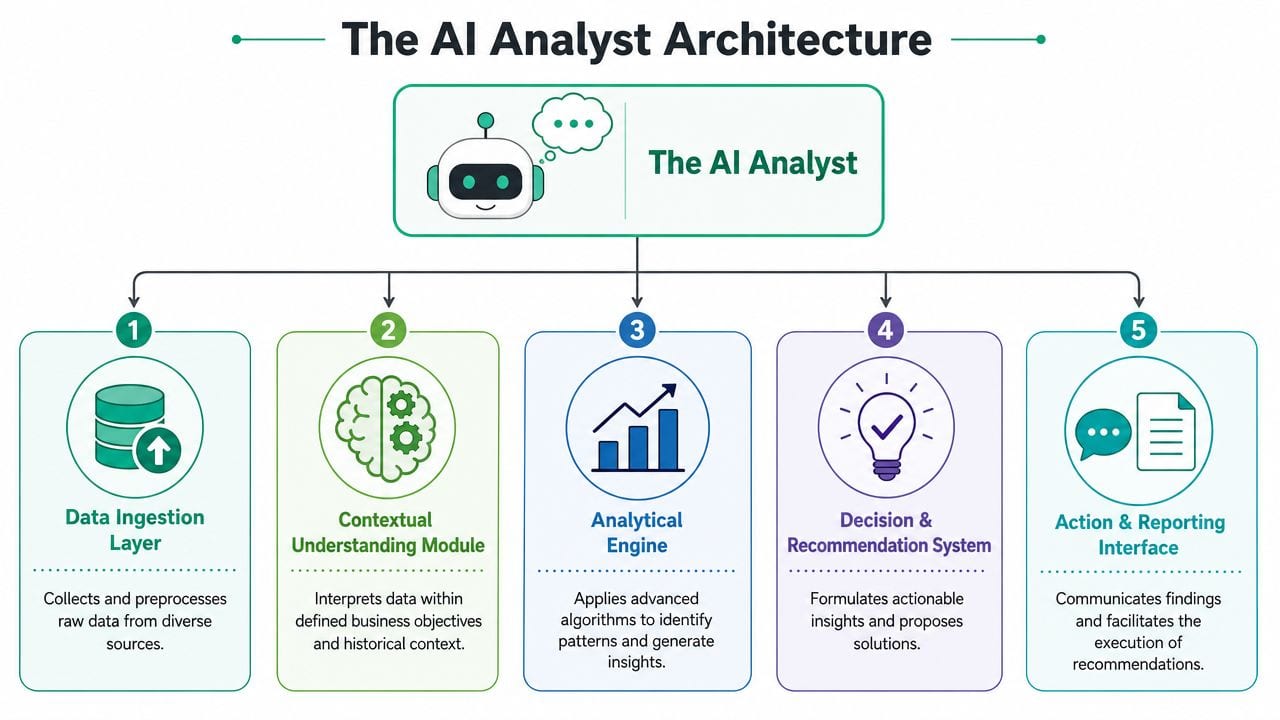
An AI analyst works less like a search box and more like a compact data team. Alteryx describes agentic analytics as the integration of LLMs, reasoning frameworks, and tool-use capabilities to perform multi-step investigations without constant human intervention. In that model, agents can execute complete workflows such as ingesting data, building analytical models, and synthesizing findings, rather than answering one prompt in isolation.
The team analogy that makes this easier
Think of the architecture in five parts.
The reasoning layer
This is the team lead. It decides how to approach the task.
If the question is “why did signups fall last week,” the reasoning layer breaks that into subproblems. Check the exact timing. Compare channels. Look for site changes. Validate whether tracking changed. Then decide which path deserves deeper inspection.
The language layer
This is the shared working language, usually an LLM.
It interprets messy requests from humans, turns findings into plain English, and helps the system move between business language and technical language. “Paid social quality dropped after a creative refresh” has to connect to tables, dimensions, events, and campaign metadata.
The tool layer
This is the specialist bench.
The agent may need SQL access, API calls, Python execution, dashboard generation, experiment logs, or external research inputs. In some stacks, teams also explore patterns like integrating web search APIs for RAG when an agent needs fresh outside context in addition to internal data.
Why orchestration matters more than any single model
A strong model alone doesn't create a strong analyst. The value comes from how the parts coordinate.
An effective agent can:
- Ingest the right data
- Apply business logic
- Check whether the result is plausible
- Summarize findings for a human
- Hand off or trigger an action
That sequence is why many teams are now talking about the rise of the AI data analyst. Trackingplan's article on the rise of the AI data analyst is useful if you're mapping how these systems fit into day-to-day analytics work.
A chatbot answers. An AI analyst investigates.
Where readers usually get confused
The common confusion is assuming the agent “understands” the business automatically. It doesn't. It reasons within the context it's given.
If the system doesn't know how your company defines qualified pipeline, active users, or attributed revenue, it can produce polished nonsense. So the architecture is only half technical. The other half is semantic and operational: definitions, permissions, lineage, and validation.
Agentic Analytics in Action Real-World Use Cases
The practical test of any new analytics model is simple. Does it shorten the loop between signal and decision?

In OvalEdge's overview of enterprise agentic analytics, the work falls into three areas: helping people understand what's happening and why, building and maintaining dashboards, and working alongside other agents to run and optimize tasks like marketing campaigns in real time. Those categories are broad, but they become concrete quickly.
Marketing performance monitoring
A growth team launches new creative across Meta, Google Ads, and email. Midweek, cost efficiency weakens and on-site engagement shifts.
In a traditional setup, an analyst gets pinged, checks dashboards, exports data, compares segments, and writes up findings. In an agentic setup, the system can monitor campaign behavior continuously, notice the pattern, isolate which audience or creative cluster changed, and return a concise explanation with a recommended next step such as reviewing a specific ad set or channel mix.
Teams exploring this path often start with marketing because the feedback loop is fast. Trackingplan's article on agentic AI in marketing is a useful lens on where autonomous analysis and campaign workflows start to overlap.
Product and conversion diagnosis
An ecommerce team sees checkout completion fall sharply. The first fear is always the same: is the site broken, or is the data broken?
An agent can investigate across the funnel. It can compare page views to add-to-cart behavior, identify the exact step where the drop begins, check whether the issue aligns with a recent release window, and package the evidence for the on-call developer or product owner. That compresses triage time and gives the technical team something more useful than “conversion is down.”
Customer retention and lifecycle action
A SaaS company wants to identify users who are drifting toward churn. The old process usually involves a periodic report, manual segmentation, and a delayed retention campaign.
An agent can watch product usage patterns, detect meaningful changes in engagement, connect them to lifecycle data, and suggest a response such as a retention outreach or support intervention. In more mature setups, the analytics agent can also work alongside workflow agents that deliver the message or assign the follow-up task.
The strongest use cases don't start with full autonomy. They start with continuous monitoring and fast diagnosis in a narrow workflow.
A less glamorous but important use case
Dashboard maintenance matters more than people often admit.
Agentic systems can also build and maintain dashboards, especially for recurring business questions. That removes a class of repetitive analyst work that rarely creates strategic advantage but consumes real time. If the system can generate the view, keep it aligned to the business definitions, and flag when the underlying assumptions change, analysts get more room for interpretation and planning.
Navigating the Risks Governance and Accuracy
Agentic analytics sounds powerful because it is. That's also why weak controls become more dangerous.
A human analyst can make a bad judgment and usually contain the damage. An autonomous system can make the same mistake faster, more often, and across more connected workflows. If an agent recommends action based on corrupted campaign tagging, missing events, or misunderstood business definitions, the error doesn't stay inside a dashboard. It can affect budgets, alerts, customer messaging, or executive decisions.
The main risk categories
Data accuracy risk
If the inputs are wrong, the output can be confidently wrong. This gets worse when the agent has permission to act instead of only report.
Governance risk
Enterprise deployments need guardrails. The system has to reason within approved definitions, respect access controls, and stay inside clear boundaries for what it can and can't do.
Privacy and security risk
Analytics data often touches sensitive user behavior, consent states, and fields that may expose personal information if poorly managed. A capable agent with broad access needs tighter controls, not looser ones.
Why observability enters the conversation
Teams generally understand model risk. Fewer teams focus on analytics pipeline risk. But for agentic systems, the analytics layer becomes operational infrastructure.
That means issues like schema drift, broken pixels, event loss, and tracking mismatches stop being “annoying data quality problems” and start becoming decision integrity problems. If you need a grounding framework, Trackingplan's overview of what data observability means helps connect pipeline health to business trust.
If a dashboard is wrong, someone may notice late. If an agent acts on wrong data, the mistake can enter production before anyone notices.
The black box problem is partly a data problem
People often talk about AI transparency as a model explainability issue. In analytics, it's also a lineage issue.
To trust an agent's conclusion, teams need to know what data it used, which definitions it followed, what checks it passed, and why it chose that action path. Without that chain, “AI confidence” is mostly theater. Good governance means the system can be inspected, questioned, and constrained.
The Unspoken Prerequisite Automated Analytics QA
Most articles about what is agentic analytics focus on autonomy. The missing piece is trust.
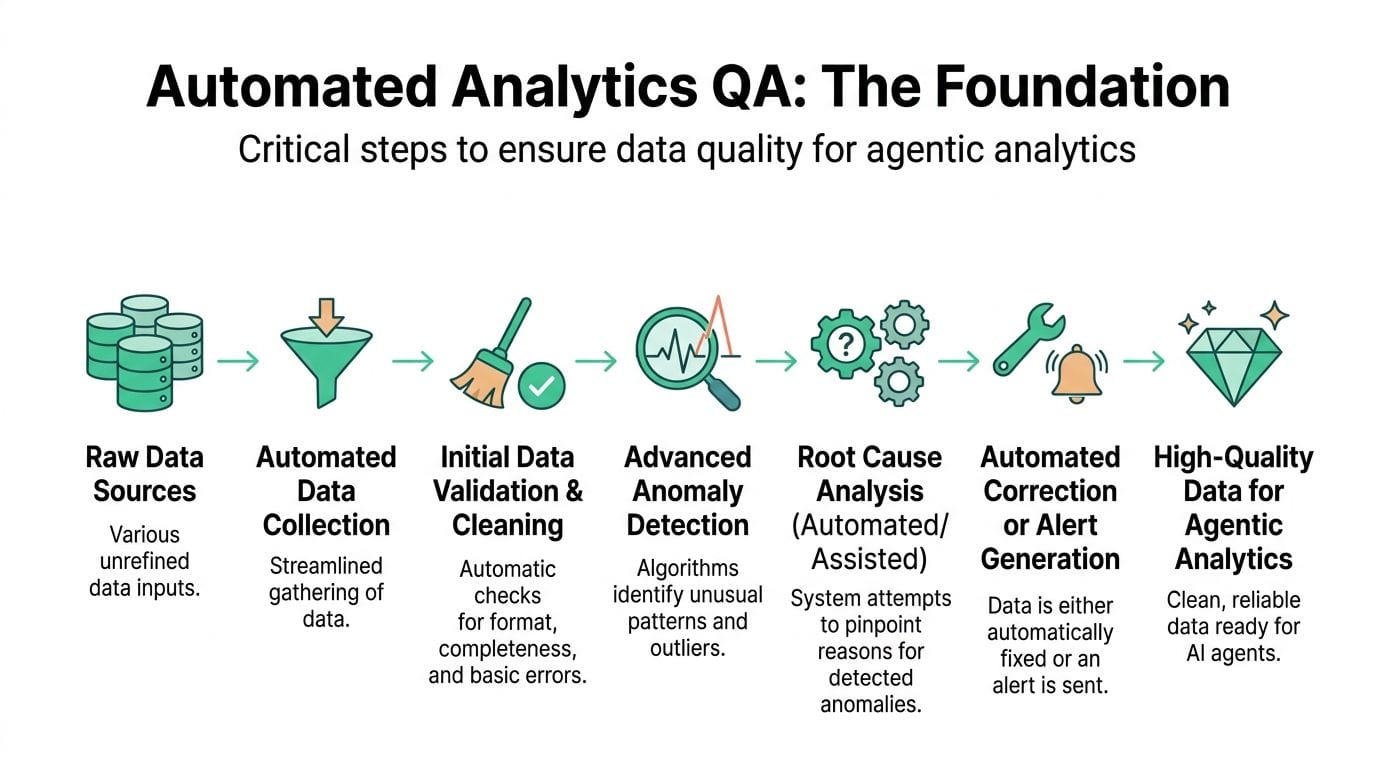
An agent can monitor, diagnose, recommend, and even execute. But if the underlying analytics stream contains missing events, malformed properties, rogue tags, broken attribution pixels, or accidental PII leaks, then the system isn't becoming intelligent. It's becoming dangerous at speed.
Why this gap matters more than most guides admit
Databricks' discussion of agentic analytics highlights a critical blind spot in the broader conversation: existing content often skips analytics observability. It also notes that 73% of enterprises report that poor data quality prevents AI deployment, which is why automated observability to detect problems like missing events or UTM errors matters before an agent acts.
That number should change how teams sequence their work. The first question shouldn't be “Which agent platform should we choose?” It should be “How will we know the agent is acting on trustworthy data?”
What automated analytics QA actually covers
This is broader than warehouse testing.
A serious analytics QA layer watches the instrumentation that feeds decision systems:
- Event completeness: Are expected events firing across web, app, and server-side flows?
- Schema consistency: Did a property name, type, or required field change without warning?
- Tag and pixel integrity: Are attribution and marketing destinations still receiving the right payloads?
- Campaign hygiene: Are UTM rules and naming conventions staying intact?
- Privacy checks: Is any PII leaking into analytics or ad destinations?
These are not edge cases. They are routine failure modes in digital analytics.
For a practical grounding in this discipline, Trackingplan's data quality assurance guide for analysts in 2026 is worth reading because it treats analytics QA as an ongoing operational layer, not a one-time audit.
If you'd like a visual walkthrough, Trackingplan also publishes educational material on its YouTube channel, including videos on analytics QA and observability concepts through the Trackingplan YouTube videos library.
Hard truth: Autonomous action without automated QA is just faster exposure to bad decisions.
The overlooked safety layer
Teams often add monitoring after an AI pilot disappoints them. That's backwards.
Observability belongs upstream. It should catch data collection problems before they enter dashboards, semantic layers, warehouse models, or agent workflows. Once an agent is trusted to recommend or trigger action, the data pipeline needs the equivalent of pre-flight checks. Otherwise, every elegant reasoning step rests on corrupted premises.
This is the part many agentic analytics conversations still gloss over. The breakthrough isn't only that agents can act. It's that they can act safely only when the analytics foundation is continuously validated.
Your Roadmap to Getting Started with Agentic Analytics
You don't need to rebuild your whole stack to get started. You do need the right order of operations.
According to Snowplow's guide to agentic analytics, effective agentic analytics depends on structured, enriched, and semantically defined data. That means capturing event-level behavioral data, defining consistent business metrics, and documenting relationships between datasets. The quality of that semantic layer directly shapes how reliable the agent's output will be.
Start with a low-risk path
The smartest first move is usually not autonomous execution. It's monitored analysis.
- Audit the data foundation
Review event tracking, key metrics, schema consistency, destination coverage, and access controls. If teams don't trust the numbers now, they won't trust an agent later. - Define business meaning clearly
Document how your company defines revenue, qualified leads, active users, retention, attribution, and experiment metrics. Agents need definitions, not tribal knowledge. - Choose a narrow pilot
Start with one workflow such as campaign anomaly detection, conversion monitoring, or dashboard generation. Keep the blast radius small.
Build trust before autonomy
Once the foundation is cleaner, move in stages:
- Monitoring first: Let the agent detect and summarize.
- Diagnosis next: Let it investigate likely causes.
- Recommendations after that: Let it suggest actions for human approval.
- Execution last: Only allow automated actions when the workflow is governed and stable.
That's not slow. It's disciplined.
Treat QA like engineering, not cleanup
Analytics teams can borrow useful habits from software testing. A strong reference point is this guide to QA excellence, especially if your team needs help turning validation into a repeatable operating practice instead of an occasional manual review.
A workable roadmap usually comes down to five habits:
- Keep scope tight: One domain, one workflow, one owner.
- Instrument clearly: Event names, properties, and destinations should be easy to audit.
- Add governance early: Permissions and approval rules shouldn't be bolted on later.
- Measure trust, not just speed: Faster answers only matter if people believe them.
- Review failures closely: Every bad recommendation teaches you whether the issue lives in the model, the context, or the data.
The teams that get value from agentic analytics aren't the ones that rush to full autonomy. They're the ones that make their data legible, testable, and governed enough for autonomy to be worth trusting.
If your team wants to explore agentic analytics without betting decisions on fragile tracking, Trackingplan gives you the safety layer most AI analytics projects are missing. It automatically monitors analytics implementations across web, app, and server-side stacks, catches missing events, schema issues, broken pixels, UTM errors, and potential PII leaks, and helps analysts, marketers, and developers trust the data before any agent acts on it.