
Marketing teams using AI see over 3x the ROI compared to those that don’t, yet most teams still leave that value on the table. The culprit isn’t the technology. It’s poor data, fragmented stacks, and a fuzzy understanding of what AI actually does inside a marketing program. 87% of enterprise marketing teams now use AI and allocate roughly 18% of their budgets to it, but only the ones tracking properly capture the full upside. This guide breaks down the mechanics, the high-value use cases, the real risks, and the practical steps to make AI work for your campaigns.
Key Takeaways
- AI enhances campaign ROI
- Teams using AI with proper data tracking can achieve over triple the ROI
- Personalization is AI’s strength
- AI makes large-scale personalization fast, dynamic, and effective when data is solid.
- Human oversight is crucial
- Hybrid human and AI teams consistently outperform fully automated setups.
- Quality data is a must
- Poor or fragmented data causes AI to amplify errors and missteps in marketing.
- Phased adoption wins
- Pilot projects and gradual scaling help maximize results and minimize risks with marketing AI.
Understanding AI’s core mechanics in digital marketing
Before you can use AI well, you need to know what it’s actually doing under the hood. Three capabilities drive almost everything you see in modern marketing tech stacks.
- Machine learning finds patterns in historical data and uses them to make predictions.
- Natural language processing (NLP) reads, generates, and classifies text, powering chatbots, ad copy tools, and sentiment analysis.
- Predictive analytics takes those patterns and projects future outcomes, like churn probability or expected return on ad spend (ROAS).
Together, these three capabilities form the engine behind most AI-driven marketing tools available today.
What makes them powerful is the feedback loop they create. Data flows in, the model analyzes it, generates a prediction, triggers an action, and then measures the result to improve the next cycle. The loop runs continuously, which means the system gets sharper the more quality data you feed it. This is also why AI’s impact in martech compounds over time when the underlying tracking is solid.
One stat worth anchoring here: teams that implement a closed data loop, where every campaign action feeds back into the model, consistently outperform those running AI as a one-way broadcast tool. The loop is the product.
Where AI creates the most value in marketing
Understanding the core mechanics is one thing, but where does AI generate the most impact for real-world marketing teams?
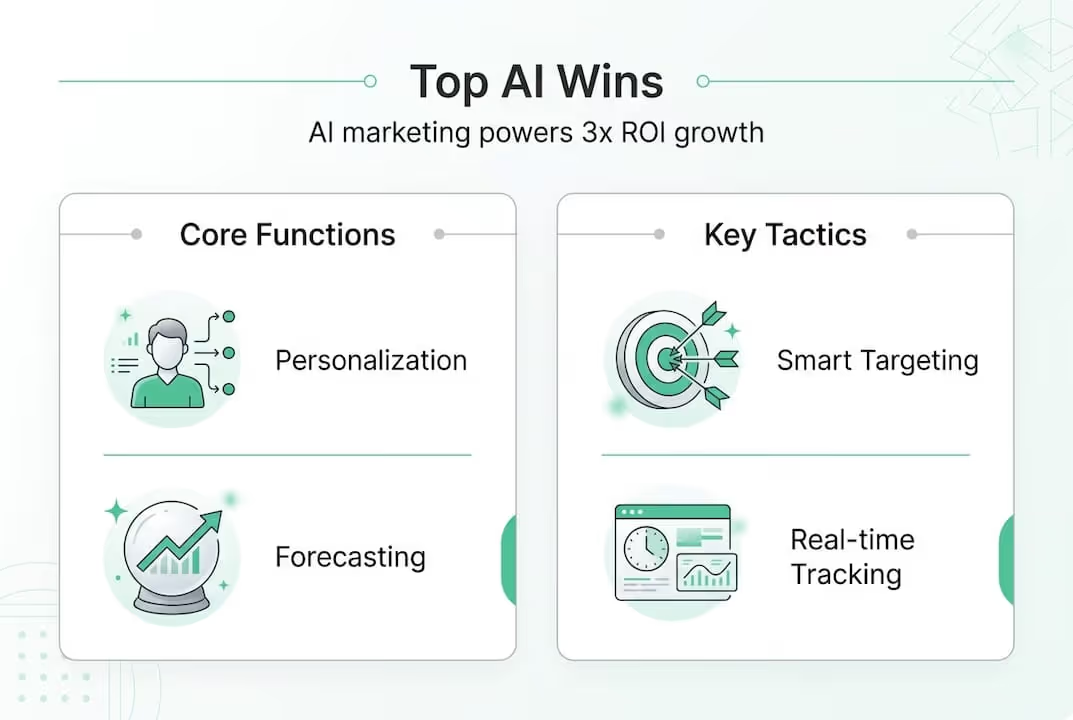
Real-time personalization, predictive targeting, automated bidding, and content optimization are the four areas where AI consistently moves the needle. Each one benefits from continuous learning, meaning performance improves as campaigns run longer and data accumulates.

Content creation is currently the number one AI use case across marketing teams, and ROI-focused teams using AI for content see 3.2x better results than those relying on manual workflows alone. That gap is hard to ignore. For a deeper look at how analytics and ROI maximization connect in practice, it’s worth understanding how measurement underpins every AI-driven decision.
Here’s a concrete example. An eCommerce brand running Google Performance Max campaigns switched from manual CPC bidding to AI-driven predictive bidding anchored to first-party purchase data. Within 90 days, ROAS improved by 41% because the model could adjust bids in real time based on signals no human analyst could process fast enough.
“The brands winning with AI aren’t the ones with the most tools. They’re the ones feeding the best data into fewer, better-integrated systems.”
Pro Tip: The quality of your AI output is a direct reflection of your data quality. Before adding a new AI tool, ask whether your existing tracking is clean enough to support it.
Real-time tracking and outcome forecasting with AI
Having covered where AI shines in value creation, let’s turn to how advanced tracking and forecasting drive actionable results day to day.
Real-time dashboarding lets marketing teams see campaign performance as it happens, not 24 hours later. Event-based triggers allow the system to fire an action the moment a user behavior occurs, like abandoning a cart or hitting a pricing page three times in one session. AI compresses production cycles and surfaces insights without requiring manual analysis at every step, which frees your team to focus on decisions rather than data wrangling.
Predictive outcome reports take this further. Churn forecasts flag at-risk customers before they leave. ROAS predictions let you reallocate budget before a campaign underperforms. These aren’t hypothetical features. They’re live inside most enterprise-grade platforms right now. For teams focused on campaign optimization with analytics, real-time forecasting is quickly becoming a baseline expectation rather than a premium add-on.
Here’s a practical setup for real-time campaign tracking:
For more on how advertising analytics insights translate into campaign decisions, the connection between clean event data and accurate forecasting is direct and measurable.
Pro Tip: Always validate AI-generated insights with a small-scale experiment before acting on them at full budget. Models can be confidently wrong, especially when trained on incomplete historical data.
Pitfalls and edge cases: When AI falls short
AI is powerful, but it isn’t magic. What happens when things go wrong or constraints hit?
The most cited failure mode is data quality. AI scales errors when input data is poor, a dynamic often summarized as “garbage in, garbage out.” At scale, a misconfigured pixel or a broken event schema doesn’t just affect one report. It corrupts every model downstream that relies on that data. The top marketing data issues in 2026 almost always trace back to tracking gaps that went undetected for weeks.
Latency is another constraint. AI bidding systems are probabilistic and operate on slightly delayed signals, which makes them poorly suited for environments where millisecond decisions are critical. Governance is the third major gap. When an AI system makes a bad targeting decision, accountability is murky. Who owns the error, the model, the data team, or the marketer who deployed it?
A useful stat: 71% of consumers expect personalization, but poorly calibrated AI can serve irrelevant or even offensive content at scale, eroding trust faster than any manual campaign ever could. The risks of poor data quality extend well beyond wasted spend.
Here’s a quick guide to error-proofing your AI stack:
Human-AI collaboration: Maximizing marketing performance
While edge cases exist, research shows the most sustainable wins come from teams blending AI with human oversight. Here’s how.
Human-AI collaboration yields 2.4x better performance than full automation across marketing functions. That’s not a marginal improvement. It’s a structural advantage. The reason is straightforward: AI handles volume and speed, humans handle judgment and context. Neither alone covers the full range of what a high-performing campaign requires.
CMOs are also moving cautiously on fully agentic AI systems, citing fragmented data and liability concerns. The smarter path is a phased rollout that builds confidence and capability over time.
“The teams seeing the biggest gains aren’t replacing marketers with AI. They’re restructuring workflows so AI handles the repetitive, high-volume work while humans focus on strategy and creative direction.”
Following 2026 analytics best practices during each phase ensures the data feeding your AI stays accurate as you scale. Workflow improvements consistently outperform tool additions when it comes to sustainable AI performance gains.
Best practices: Successful AI adoption in digital marketing
How do leading marketing teams actually implement and refine AI solutions for sustainable advantage?
AI excels in high-volume tasks like content generation and automated bidding, but requires human oversight for strategy and creative direction. A phased rollout, starting with Q1 pilots and scaling toward agentic workflows by Q4, maximizes ROI while keeping risk manageable. Teams that skip the pilot phase and deploy AI at full scale immediately tend to amplify existing data problems rather than solve them.
Here’s what the most successful implementations have in common:
For teams looking at how AI cuts insight time in practice, the gains are most visible when the underlying analytics infrastructure is already solid. Pairing strong analytics best practices with a phased AI rollout is the combination that consistently separates high-performing teams from the rest.
Pro Tip: Anchor every new AI initiative to one specific KPI before launch. If you can’t define what success looks like in a single metric, the project isn’t ready to run.
How Trackingplan helps you win with AI-powered marketing
Every strategy in this guide depends on one thing: reliable data. If your tracking layer has gaps, broken pixels, or schema mismatches, your AI tools are working with corrupted inputs and every insight they produce is suspect.
Trackingplan monitors, validates, and audits your entire analytics implementation in real time, so you always know your data is accurate before it reaches your AI stack. From digital analytics tools integration monitoring to web tracking monitoring that catches broken events the moment they fail, Trackingplan closes the gap between what you think is being tracked and what’s actually firing. The AI-assisted debugger surfaces root causes instantly, cutting diagnosis time from hours to minutes. When your data foundation is solid, every AI investment you make performs the way it was designed to.
Frequently asked questions
How does AI personalize digital marketing campaigns?
AI personalizes campaigns by analyzing user data in real time to dynamically adjust messages, offers, and channels for each individual consumer based on their behavior and context.
What is the biggest risk when using AI for marketing?
The biggest risk is scaling errors from poor data quality. AI amplifies bad data across every downstream model, leading to mis-targeting and inaccurate performance reporting at speed.
Can AI fully automate digital marketing?
Full automation works for repetitive, high-volume tasks, but human oversight outperforms full automation by 2.4x when applied to strategy, creative, and risk management.
What are common AI use cases in digital marketing?
AI is most commonly used for content creation, campaign optimization, audience targeting, and real-time analytics, with content creation ranking as the top use case in 2026.
How do I start integrating AI into my marketing stack?
Start with a data audit, run small pilot projects tied to specific KPIs, and measure outcomes carefully before scaling AI use across your full campaign portfolio.