
Most marketing teams believe their channel reports tell the full story. They don’t. When Google Ads claims credit for a conversion, Meta claims the same one, and your email platform counts it too, you’re not seeing reality. You’re seeing three platforms fighting over the same customer. Multi-platform tracking solves this by unifying data across every touchpoint into a single, coherent picture. This guide breaks down exactly what multi-platform tracking is, why it matters for attribution accuracy, and how your team can implement it without getting lost in technical complexity or conflicting vendor reports.
Key Takeaways
- Multi-platform tracking eliminates blind spots by connecting user actions across channels.
- Enables better decision-making
- Integrated data helps teams optimize marketing investments with clarity and confidence.
- Future-proofs your analytics
- Server-side and first-party methods help maintain accuracy despite cookie restrictions or ad blockers.
- Requires ongoing effort
- Success depends on continuous monitoring and team alignment, not just better tools.
What is multi-platform tracking?
Multi-platform tracking is the practice of collecting, connecting, and analyzing user behavior data across every channel and environment where your audience interacts with your brand. That means your website, mobile app, email campaigns, paid social, search ads, and even in-store interactions if applicable. The goal is to stitch these touchpoints together into a unified user journey, so you can see what actually drives conversions instead of what each platform claims drives them.
Single-platform tracking, by contrast, only captures what happens within one environment. A Facebook pixel tells you about Facebook-driven behavior. Google Analytics tells you about web sessions. Neither knows what the other is seeing, and neither can tell you how a user who clicked a Meta ad on their phone later converted on a desktop after reading an email. That gap is where attribution falls apart.
The importance of tracking becomes obvious when you list the real-world scenarios multi-platform tracking addresses:
In every one of these cases, single-platform tracking either misses the journey entirely or attributes the conversion to the last touchpoint it happened to see.
The technical backbone of multi-platform tracking increasingly relies on server-side tracking basics and first-party data strategies. Server-side tracking and first-party data enable accurate cross-device and cross-platform user identification, bypassing cookie deprecation and ad blockers. This matters because browser-based tracking is eroding fast. Safari’s Intelligent Tracking Prevention, Firefox’s enhanced privacy defaults, and the gradual death of third-party cookies mean that client-side pixels alone can no longer be trusted to capture complete data.
First-party identifiers, such as logged-in user IDs, hashed emails, and CRM records, give you a stable anchor to connect behavior across sessions, devices, and channels. Combined with server-side event collection, this approach dramatically reduces data loss and gives you a foundation that privacy regulations won’t erode.
Why multi-platform tracking is essential for data accuracy
Here’s a scenario most analytics teams have lived through. You run a campaign across Google, Meta, and email simultaneously. At the end of the month, you add up the conversions each platform reports and the total is 40% higher than your actual revenue. That’s not a rounding error. That’s systemic over-reporting caused by siloed attribution.

Without multi-platform tracking, data quality challenges like these are invisible until you look for them. Each platform uses its own attribution window, its own conversion definition, and its own logic for claiming credit. The result is that the same conversion gets counted multiple times across different reports, and your budget decisions are based on fiction.
The numbers behind poor tracking are significant. Studies consistently show that ad spend misallocation caused by broken or incomplete tracking can account for 20 to 30 percent of total digital marketing budgets being directed to underperforming channels. When your attribution is wrong, your optimization decisions are wrong too.
Server-side accuracy strategies address this by moving data collection off the browser and onto your own server infrastructure. This means ad blockers can’t intercept the signal, browser privacy settings don’t interfere, and you control exactly what data gets sent where.
Pro Tip: To spot hidden attribution gaps, pull a conversion report from each of your active platforms for the same 30-day period and add them up. Then compare that total to your actual CRM or order management data. A gap larger than 15% is a strong signal that your tracking has serious overlap or loss issues that need immediate attention.
Modern methodologies: How teams achieve true multi-platform tracking
Understanding the importance of accurate data, let’s see which methodologies leading teams use to achieve reliable multi-platform tracking.
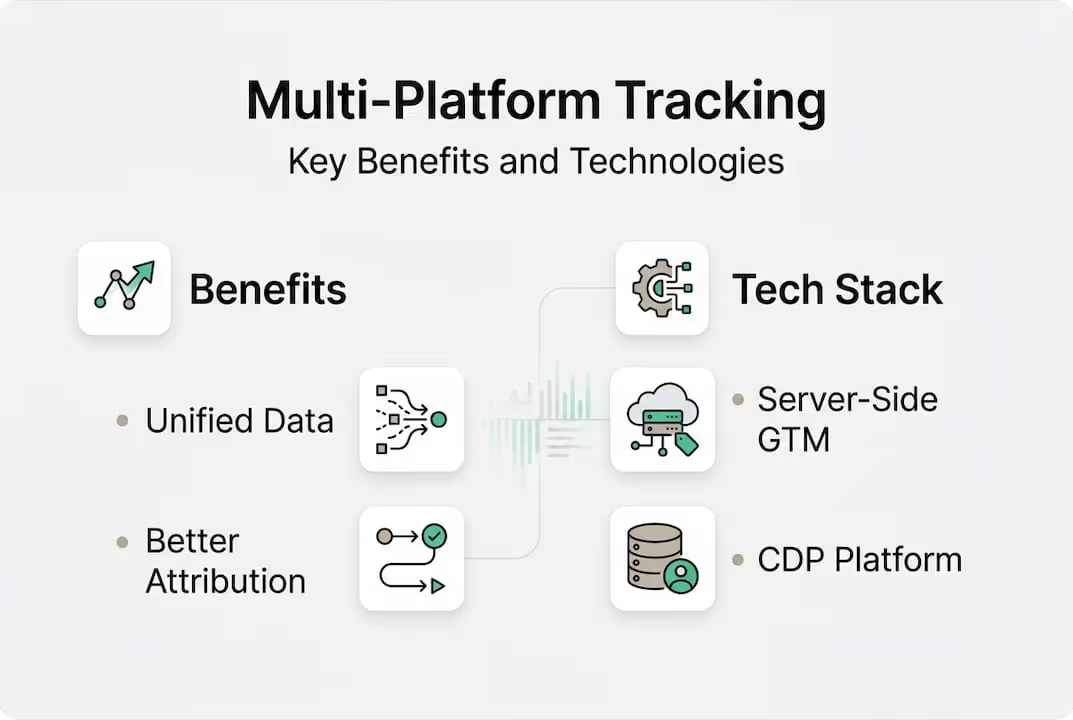
The three core technologies driving modern multi-platform tracking are server-side Google Tag Manager (GTM), Customer Data Platforms (CDPs), and multi-touch attribution (MTA) models. Each plays a distinct role, and the most effective implementations combine all three.
Google Tag Manager server-side moves your tag execution from the visitor’s browser to a server you control. This gives you data quality, speed, and privacy control that client-side tagging simply can’t match. CDPs like Segment, mParticle, or Tealium handle identity resolution, connecting anonymous sessions to known users across devices and channels. MTA models, whether data-driven or time-decay, then distribute conversion credit across all the touchpoints that actually contributed.
“Integrated solutions combining server-side GTM, CDPs, and data-driven attribution models within the
give teams the control and accuracy needed to make confident budget decisions across channels.”
Here’s how a modern team typically implements multi-platform tracking:
For teams optimizing privacy with server-side tracking, the server-side approach also simplifies consent management. You can enforce data minimization and regional privacy rules at the server layer before data ever reaches a third-party vendor.
For a deeper look at how to apply these frameworks, the attribution optimization guide walks through practical configurations for each model type.
Best practices for implementing and optimizing multi-platform tracking
With the methodology frameworks in mind, it’s critical to translate them into actionable steps. Here’s how you can implement and optimize multi-platform tracking for measurable gains.
Pro Tip: Prioritize the platforms where your highest-value customers convert. Run a quick analysis of your last 90 days of revenue by channel. The top two or three channels should get your first and most rigorous tracking investment. Everything else can follow.
For monitoring tracking accuracy over time, set up automated alerts for anomalies. A sudden drop in event volume, a spike in null values, or a mismatch between platform-reported and server-reported conversions are all signals that something has broken.
The biggest mistakes teams make include relying on default platform connectors without validating the data they produce, not testing cross-device journeys before launch, and treating tracking as a one-time setup rather than an ongoing process. Following a solid comprehensive tracking implementation guide helps avoid these pitfalls from the start.
Server-side tagging remains the strongest foundation for privacy-resilient, accurate multi-platform tracking as third-party cookies continue to disappear.
The uncomfortable truth about multi-platform tracking: Why most teams don’t get it right
Most teams treat multi-platform tracking as a technical problem. They buy a CDP, implement server-side GTM, configure an MTA model, and assume the work is done. It isn’t.
The real failure point is cultural. Who owns the data layer when the developer, the analyst, and the marketing manager all have different definitions of a “conversion”? Who audits the tracking when everyone assumes someone else is watching? These process gaps cause more attribution errors than any broken pixel ever will.
We’ve seen teams with sophisticated Google Tag Gateway strategies and enterprise CDPs still making budget decisions based on corrupted data, simply because no one had reviewed the implementation in six months. Privacy regulations change. Platforms update their APIs. Code deploys break tags. Tracking is not a set-and-forget system.
The teams that get multi-platform tracking right treat it as a continuous discipline. They assign clear data ownership, run quarterly audits, and build feedback loops between their analytics, marketing, and engineering teams. They don’t just audit their software stack. They audit their processes. That’s the real competitive advantage.
Ready to master multi-platform tracking? Here’s your next step
If this guide has made one thing clear, it’s that accurate multi-platform tracking requires more than good intentions. It requires the right infrastructure, continuous monitoring, and a team that stays ahead of breakage before it affects your decisions.

Trackingplan is built specifically for this challenge. It automatically audits your entire analytics and marketing tracking stack, detects broken pixels, schema mismatches, and campaign misconfigurations in real time, and alerts your team before bad data reaches your reports. You can integrate digital analytics tools across your full Martech stack and use the Marketing Performance Watchdog to stay on top of every tracking signal. Request a demo and see how much cleaner your attribution data can be.
Frequently asked questions
How does multi-platform tracking improve marketing attribution?
Multi-platform tracking unifies user actions across channels, eliminating duplicate conversion counting and providing a complete view of the customer journey. Server-side tracking and first-party data further improve accuracy by enabling cross-device identification that cookie-based methods can’t match.
What technologies are needed for effective multi-platform tracking?
The core stack typically includes server-side GTM for data control, a CDP for identity resolution, and MTA models for attribution. These tools, when integrated with Google Marketing Platform, give teams both precision and privacy compliance across all channels.
How do privacy rules affect multi-platform tracking?
Server-side and first-party methods help comply with privacy laws by keeping data collection under your control and reducing reliance on third-party cookies. Server-side tagging allows you to enforce consent rules at the server layer before data reaches any vendor.
What’s the biggest challenge in implementing multi-platform tracking?
Aligning team processes and ensuring ongoing data validation is often harder than selecting the right technology. Without clear data ownership and regular audits, even the best technical setup will produce unreliable results over time.