
Multi-armed bandit testing is a smarter, more dynamic way to run experiments. Instead of splitting traffic evenly and waiting for a winner, it automatically shifts users toward the best-performing variations in real time. This is a game-changer because it minimizes the "cost" of showing users a losing option.
This approach uses machine learning to solve a classic dilemma in testing: exploration versus exploitation. It’s not just about finding a winner; it’s about maximizing your results while you find it.
What Is Multi-Armed Bandit Testing
Imagine you walk into a casino with a pocketful of quarters and you’re standing in front of a row of slot machines. Each one is a "one-armed bandit," and your mission is simple: walk away with as much money as possible before you run out of quarters. This is the perfect analogy for multi-armed bandit testing.

In this scenario, each slot machine is a different variation of your homepage, a new headline, or a feature you’re testing. Your quarters are your users. The payout from each machine is its conversion rate—something you don’t know when you start. So, how do you play to win?
The Explore vs Exploit Dilemma
Every single quarter you spend forces you to make a critical choice:
- Explore: Do you try a machine you haven't played much to see what its payout is like? You might waste a quarter on a dud, but you could also stumble upon the jackpot. This is exploration.
- Exploit: Or, do you just keep feeding quarters into the machine that’s been paying out the best so far? This maximizes your immediate winnings, but you might be leaving money on the table by ignoring an even better machine down the row. This is exploitation.
This is the classic explore-exploit tradeoff, a fundamental challenge that multi-armed bandit algorithms are specifically designed to solve. Where a traditional A/B test stays in pure "exploration" mode by locking in an even traffic split, a bandit algorithm intelligently does both.
A multi-armed bandit approach continuously identifies the degree to which one version is outperforming others and routes the majority of traffic dynamically and in real-time to the winning variant. The primary focus shifts from just gathering data to actively maximizing results during the test.
How It Works in Practice
A multi-armed bandit test starts by sending a small, equal amount of traffic to every variation. It’s in full exploration mode, gathering just enough initial data to see what’s working.
But as soon as one variation starts showing a glimmer of promise—getting more sign-ups, clicks, or sales—the algorithm starts to "exploit" that information. It dynamically funnels a larger share of new traffic to the emerging winner, capitalizing on its success immediately. All the while, it keeps sending a tiny trickle of traffic to the other options, just in case one of them makes a comeback or was a late bloomer.
This adaptive process gives you a few major advantages:
- Minimizes Regret: It massively reduces the opportunity cost, or "regret," of sending users to an inferior experience. You lose far fewer potential conversions compared to a rigid 50/50 A/B test.
- Faster Results: You start reaping the rewards of the better-performing variation almost instantly, as more and more users are directed to it.
- Ideal for Short-Term Goals: It’s perfect for time-sensitive campaigns, like a holiday flash sale or a news headline, where you need to maximize performance within a very short window.
At the end of the day, multi-armed bandit testing isn't just about figuring out which variation wins. It's about winning while you figure it out.
How Bandits Differ From Traditional A/B Tests
While both multi-armed bandits and A/B tests aim to find a winning variation, their philosophies and mechanics are worlds apart. A classic A/B test is a rigid, scientific process built for one thing: learning with statistical confidence. It's a pure exploration exercise.
You set your variations, lock in a fixed traffic split—say, 50/50—and then you wait. During this exploration phase, you’re knowingly sending half of your users to what might be a much worse experience, and you just have to absorb that cost. The test runs its course until it has enough data to declare a winner with high certainty.
A multi-armed bandit, on the other hand, is all about performance. It’s an adaptive system that blends exploration with exploitation, meaning it shifts from learning about your variations to capitalizing on the best one in real time.
The Key Difference Is Dynamic Traffic Allocation
The biggest distinction lies in how traffic is managed. An A/B test is static; a multi-armed bandit testing strategy is dynamic.
A bandit algorithm doesn't wait for statistical significance to act. As soon as it gathers enough data to suggest one variation is outperforming the others, it begins to shift more traffic towards that emerging leader, effectively minimizing regret while the test is still running.
This means that instead of losing potential revenue by sending users to a poorly performing page for weeks, the algorithm course-corrects on the fly. It dramatically reduces the opportunity cost of testing, making it a far more efficient way to optimize for immediate gains.
To make this clearer, let's break down the fundamental differences between the two methodologies.
Multi-Armed Bandit vs. A/B Testing at a Glance
This table lays out the core operational and strategic differences, helping you see where each method shines.
The tradeoff becomes obvious here. A/B testing provides deep, statistically robust insights into all your variations, which is invaluable for big strategic decisions. If your main goal is deep learning, you might want to check out this guide on choosing the right A/B test platform. For short-term campaigns or ongoing optimization, however, the bandit's focus on immediate performance is hard to beat.
When Performance Trumps Purity
Think about a flash sale. You’ve got 72 hours to maximize revenue, and you want to test a few different promotional banners. Waiting two weeks for an A/B test to reach statistical significance is a non-starter—the sale would be long over.
A bandit, however, could identify the best-performing banner within hours and start sending the vast majority of traffic there for the rest of the sale.
This dynamic approach is also a cornerstone of modern advertising. The optimization engines behind AI for ads often rely on similar rapid-fire testing to quickly find winning creatives and copy, squeezing every drop of performance out of a campaign budget.
Ultimately, the choice comes down to your primary objective. Are you conducting research to inform a major business decision, or are you trying to squeeze every possible conversion out of your traffic right now? A/B testing is for learning; bandit testing is for earning.
Now that we've covered how multi-armed bandit testing breaks from the traditional A/B test playbook, let's pop the hood and look at the engine. How does a bandit actually decide which variation gets more traffic? The secret is in its algorithm—the specific set of rules it uses to solve that tricky exploration vs. exploitation puzzle.
While the underlying math can get pretty deep, the concepts themselves are quite intuitive. You can think of each algorithm as a different personality or strategy for tackling the problem. We’ll walk through the three most common ones you'll encounter: Epsilon-Greedy, Upper Confidence Bound (UCB), and Thompson Sampling.
This flowchart gives a great visual summary of the core difference between a static A/B test and the adaptive nature of a bandit test.
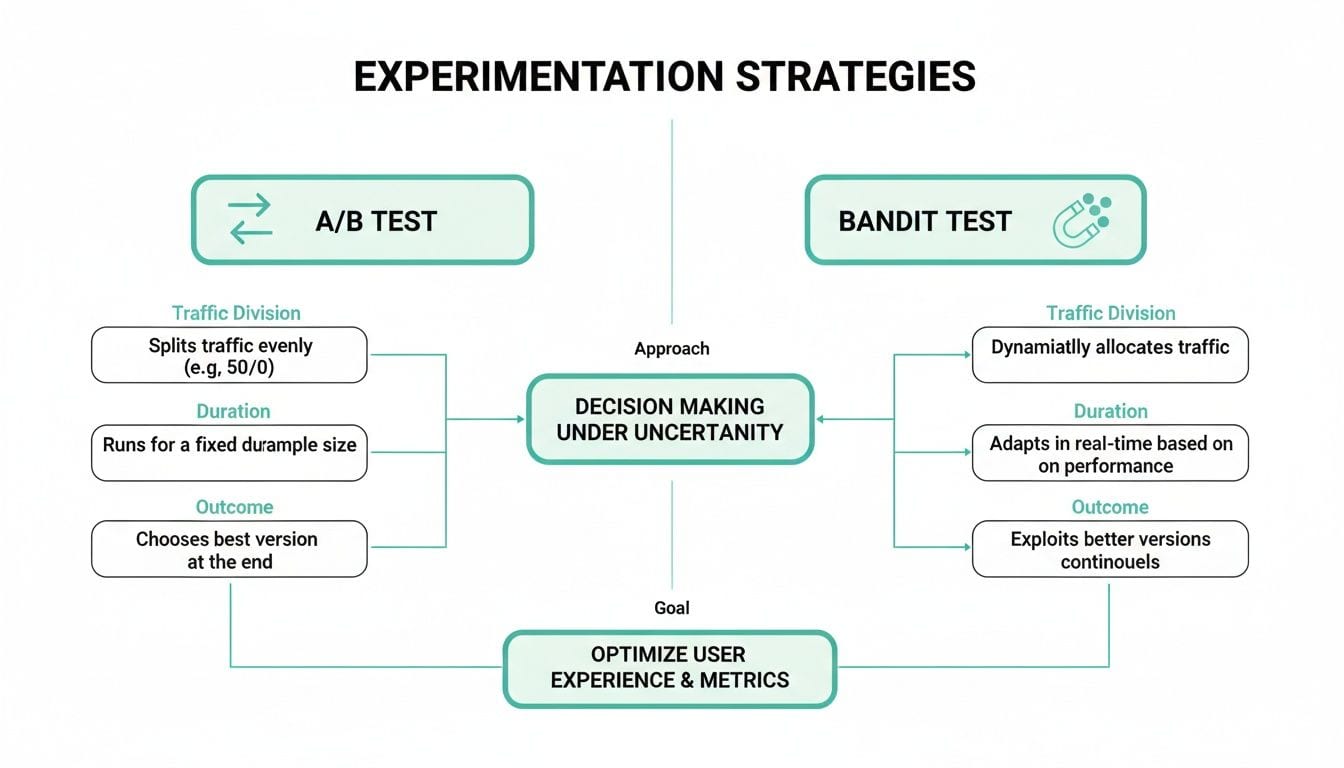
As you can see, an A/B test splits traffic and sticks to it. A bandit, on the other hand, acts more like a magnet, dynamically pulling more and more users toward the options that prove to be the most rewarding over time.
Epsilon-Greedy: The Disciplined Explorer
The Epsilon-Greedy algorithm is probably the most straightforward of the bunch. Think of it as a strategist that is mostly disciplined but has a planned, curious streak.
The "greedy" part of its name describes its default behavior. The vast majority of the time, it exploits what it already knows. It checks the historical performance of every variation and sends the next user to whichever one currently boasts the highest conversion rate. This is the logical move to maximize immediate returns.
But it also knows it can't be greedy all the time. A small fraction of the time, defined by a parameter called epsilon (ε), it deliberately chooses to explore. In these moments, it ignores the current winner and picks one of the other variations completely at random.
- Exploitation (1 - ε of the time): The algorithm chooses the variation with the best-known performance.
- Exploration (ε of the time): The algorithm picks a random variation to gather fresh data.
So, if you set epsilon to 0.1, the algorithm will be greedy 90% of the time, always sending traffic to the current champion. For the other 10% of the time, it will explore the other options, giving them a fair shot to prove they might be better. This simple rule is a powerful way to prevent the algorithm from getting stuck on a variation that looked good early on but isn't the true winner.
Upper Confidence Bound (UCB): The Optimist
The Upper Confidence Bound (UCB) algorithm takes a more sophisticated, "optimistic" approach to the problem. Instead of exploring randomly, it makes calculated bets based on both performance and uncertainty.
UCB gives a chance to variations that are either performing well or that simply haven't been tested enough to be counted out. It calculates a score for each arm by combining two key factors:
- Actual Performance: The measured conversion rate of the variation so far.
- Uncertainty Bonus: An extra "potential" score it adds to variations that have seen fewer users. This bonus gets smaller as an arm gets more traffic and its performance becomes more certain.
UCB essentially acts like an optimist, thinking, "I'll try this variation because it's either already a proven performer, or I don't have enough data yet to be sure it isn't a hidden gem."
This strategy makes exploration much more intelligent. A brand-new variation with just a handful of data points will get a huge uncertainty bonus, encouraging the algorithm to test it. On the other hand, a variation with tons of data and a mediocre conversion rate will have a tiny bonus and a low overall score, so it will be shown less. This makes UCB far more efficient than Epsilon-Greedy's purely random exploration.
Thompson Sampling: The Probabilistic Strategist
Thompson Sampling is often hailed as one of the most effective bandit algorithms in practice. It operates on Bayesian principles, tackling the problem like a "probabilistic strategist." Instead of just looking at a single number like the current conversion rate, it maintains a probability distribution for what the true conversion rate of each variation might be.
Imagine each variation has a whole range of possible conversion rates, with some being more likely than others based on the data collected so far. At each turn, Thompson Sampling does the following:
- It draws one random sample from the probability distribution of each variation.
- It compares these sampled values and sends the next user to the variation that produced the highest number.
- It observes the outcome (a conversion or not) and uses that new data point to update the probability distribution for the variation that was shown.
This elegant process naturally balances exploration and exploitation. A variation with a high but very uncertain conversion rate will have a wide distribution, so it will sometimes produce a very high random sample, giving it a chance to be explored. A consistent winner’s distribution will become narrow and tall, ensuring it gets picked most often.
This is the kind of robust algorithm that companies like DoorDash have successfully used to power their experimentation platforms. It’s known for converging on the best option quickly while effectively minimizing regret along the way, even when dealing with the data delays common in real-world systems.
How to Implement a Successful Bandit Test
Jumping into your first multi-armed bandit test might seem like a lot, but it's a pretty straightforward process when you break it down into manageable steps. Success here isn’t just about picking a clever algorithm. It really comes down to solid planning and—most importantly—data you can actually trust. After all, an experiment is only as good as the information it runs on.
The whole thing starts with getting your foundation right. Before you even start brainstorming different variations or thinking about traffic, you need to be crystal clear on what winning looks like. If you don't have a specific goal, you're just running a test for the sake of it, with no way to know if it's helping your business.
Define Your Goal and Key Metrics
First things first: you need to lock down the single most important goal for your test. Are you trying to get more newsletter sign-ups? Push sales for a particular product? Or maybe just get more clicks on a new CTA button? A bandit algorithm needs one "North Star" metric to optimize for, so being specific is non-negotiable.
Once you have that primary goal, you can pick the key performance indicator (KPI) that measures it. This KPI is what becomes the "reward" that the algorithm works to maximize.
-
Goal: Increase user engagement on a new feature.
-
KPI (Reward): Clicks on the "Learn More" button for that feature.
-
Goal: Maximize revenue from a promotional campaign.
-
KPI (Reward): Total purchase value per session.
-
Goal: Drive more leads from a landing page.
-
KPI (Reward): Form submission success events.
Your chosen KPI has to be a directly measurable action a user takes. This action is what generates the reward signal that tells the bandit which variation is doing better, making it the most critical part of your setup.
Define Your Reward and Variations
With your KPI locked in, you have to define precisely what a "reward" looks like in your analytics. This isn't some abstract idea; it's a specific, trackable event. For example, a reward of "1" might be triggered when a form_submission event fires, and "0" if the user leaves without submitting.
This brings you to the next step: creating your variations, or "arms." These are the different headlines, images, or page layouts you want to put to the test. Just make sure each variation is different enough to actually produce a meaningful change in performance. Testing two shades of blue that are almost identical probably won't give you any useful insights.
A bandit test lives and dies by the quality of its data. The algorithm blindly follows the rewards it receives. If your tracking is broken and fails to report conversions for the winning variation, the algorithm will wrongly punish it and divert traffic to an inferior option.
This is exactly why the integrity of your analytics implementation is so important. Every single reward event must be tracked perfectly.
Ensure Flawless Analytics Instrumentation
The most common reason a multi-armed bandit test fails is simply bad data. If your tracking is unreliable, the algorithm is going to make bad decisions. Your test results won't just be useless—they'll be actively misleading. You could even end up rolling out a losing variation just because a tracking bug made it look like a winner.
Picture this: your best-performing headline is tracked with an event that gets blocked by ad blockers or just fails to fire on certain browsers. The bandit algorithm doesn't know about these technical problems. It only sees a lower conversion rate and starts sending traffic away from your hidden champion.
This is precisely why automated analytics QA is a must-have for successful bandit testing. A platform like Trackingplan acts as an essential safety net by keeping a constant eye on your data flow.
It can automatically catch issues like:
- Missing Events: If a
purchaseevent suddenly stops firing for one of your variations, you’ll get an alert right away. - Schema Errors: Inconsistent properties or mismatched data types can completely confuse the reward logic.
- Anomalies: A sudden, unexplained drop in event volume can be a dead giveaway that your implementation is broken.
By making sure the data feeding your bandit algorithm is complete and accurate, you can be confident that its decisions are based on real user behavior, not tracking errors. This kind of data governance is the bedrock of any reliable and successful experiment.
The Critical Role of Data Quality in Bandit Testing
A multi-armed bandit test is an intelligent system, but it has one glaring vulnerability: it’s only as smart as the data it’s fed. The algorithm blindly trusts the reward signals it gets, which means flawless data quality isn't just a "nice-to-have"—it's the bedrock of the entire experiment.

When data quality is poor, your results don't just get a little skewed; they can become completely corrupted. This can lead you to make some truly disastrous business decisions. Even small tracking errors can trick the algorithm into making the wrong choices, turning a powerful optimization tool into an expensive mistake.
How Tracking Errors Sabotage Bandit Tests
Let's walk through a classic scenario. You're testing two headlines. Headline B is the clear winner, driving 20% more conversions than Headline A. The problem? A subtle bug in your tracking code stops the purchase event from firing for users on certain browsers who see Headline B. The bandit algorithm has no idea a technical glitch is happening.
From its perspective, Headline B looks like a dud. It sees fewer rewards and quickly concludes Headline A is the superior option. As a result, it starts pulling traffic away from your actual winning variation, actively tanking your revenue and rendering the whole experiment useless.
Bad data is worse than no data. While no data leads to inaction, bad data leads to the wrong action. In bandit testing, this means actively promoting a losing variation at the expense of the real winner.
This kind of thing can happen in a few common ways:
- Missing Events: An analytics event doesn't fire because of an ad blocker, a network issue, or a simple coding mistake.
- Inconsistent Properties: The data sent with an event (like
product_idorprice) is formatted differently across variations, which confuses the reward logic. - Broken Pixels: Third-party marketing pixels that are part of your conversion definition fail to load correctly for one of the variations.
Any of these issues can poison your data pool, making your test results dangerously misleading.
Ensuring Data Integrity with Automated QA
Let's be real—manually checking every single event and property for every user flow just isn't feasible at scale. This is where automated observability and QA platforms become absolutely essential for running a reliable multi-armed bandit test.
A tool like Trackingplan acts as a constant guardian over your data pipeline. It automatically discovers your entire analytics setup and monitors it in real-time, giving you a critical safety net for your experiments.
By keeping a continuous watch on your data flow, it can instantly spot anomalies that you would otherwise miss until it’s far too late. For instance, it can alert you if:
- There’s a sudden drop in the volume of a key conversion event for just one variation.
- A new, unexpected "rogue" event shows up, pointing to an implementation error.
- Event properties contain schema errors, like a price being sent as a string instead of a number.
These alerts give you the chance to immediately pause the bandit test, dig into the root cause, and fix the problem before it invalidates your results. This ensures your optimization decisions are based on reality, not on tracking artifacts. For a deeper dive, you can learn more about data quality best practices that are foundational to any successful testing program. Ultimately, trusting your data is the first step to trusting your results.
Common Bandit Testing Pitfalls and How to Avoid Them
Bandit tests are a fantastic way to speed up optimization, but they aren't a magic bullet. Getting them wrong is easier than you might think, and a few common mistakes can completely derail your results, leading you to back the wrong horse.
Knowing what can go wrong is just as important as knowing how to set up the test correctly. The good news is that with a bit of foresight, you can sidestep these traps and ensure your bandit tests deliver reliable, actionable insights.
The Cold Start Problem
One of the most common headaches is the "cold start" problem. This is what happens when you throw a new variation (a new "arm") into a test that’s already been running for a while. The existing arms have a performance history, but your new contender starts from scratch.
Without a dedicated initial push of traffic, the new variation can't gather enough data to prove itself. The algorithm, seeing a few early, unlucky results from a tiny sample, might write it off as a loser before it ever had a real shot.
To prevent this, you have to give new arms a fair fight.
- Implement a Warm-Up Period: Force the algorithm to send a minimum amount of traffic or impressions to any new variation before it starts making performance-based decisions. This ensures the new arm builds a solid baseline.
- Use an Optimistic Algorithm: Some algorithms, like Upper Confidence Bound (UCB), are naturally built to handle this. They give an "uncertainty bonus" to arms with less data, which encourages them to explore shiny new options.
Premature Convergence on a Local Winner
Another major pitfall is premature convergence. This happens when your algorithm gets a little too excited about an early winner and starts funneling almost all the traffic to it way too soon. It stops exploring the other options, locking onto a "local maximum"—a variation that's good, but not necessarily the best one.
This is the classic explore-exploit dilemma gone wrong. The algorithm gets too greedy, too quickly, and misses the chance to find the true champion that might have taken a bit longer to reveal its strength.
Premature convergence is like declaring the winner of a marathon after the first mile. An early front-runner might look impressive, but the real champion could be pacing themselves for a stronger finish. The algorithm needs to keep exploring long enough to see the whole race.
Here's how to stop your algorithm from calling the race too early:
- Tune Your Exploration Rate: If you’re using Epsilon-Greedy, make sure your epsilon (ε) value isn’t set too low. A common starting point is 0.1 (10%), which guarantees that 10% of your traffic is always dedicated to exploration.
- Use a Decay Schedule: Start with a higher exploration rate and slowly lower it over time. This front-loads your test with broad exploration, then shifts to more aggressive exploitation once every variation has had a fair chance to perform.
Ignoring Seasonality and Changing Trends
Bandit tests can run for a long time—sometimes indefinitely. This makes them susceptible to outside forces like seasonality, marketing campaigns, and shifting user behavior. A headline that works wonders during Black Friday might be a total flop a month later.
If your bandit algorithm doesn't adapt to these changes, it might get stuck favoring a variation that’s long past its prime. The model becomes stale, making decisions based on outdated user preferences.
The key is to build a model that can adapt.
- Implement a Sliding Window: Configure your algorithm to only look at data from a recent time frame, like the last 14 or 30 days. This forces the model to "forget" old, irrelevant data and react to what's happening now.
- Monitor for Concept Drift: Use analytics QA tools to keep an eye on major shifts in user behavior. A sudden jump or dip in your baseline conversion rate is a huge red flag. It could signal that the context has changed, and you might need to reset or rethink your entire test.
Frequently Asked Questions About Multi-Armed Bandit Testing
As we wrap up, let's go over a few of the most common questions that come up when teams are thinking about bringing multi-armed bandits into their testing strategy.
When Should I Use a Bandit Instead of an A/B Test?
You'll want to use a bandit when your main goal is to maximize performance while the test is still running. Think of time-sensitive opportunities like flash sales, headline optimization, or short-lived promotional campaigns. In these cases, every conversion counts, and you simply can't afford to keep sending traffic to a losing variation.
On the other hand, stick with a traditional A/B test when your goal is deep learning and statistical certainty. If you need to understand the precise impact of all your variations to inform a major strategic decision, the fixed traffic split of an A/B test gives you the robust data you need on every option, including the ones that don't perform well.
Are Bandits Only for Short-Term Campaigns?
Not at all. While they’re brilliant for short-term pushes, bandits are also incredibly powerful for long-term, continuous optimization.
You can set a bandit to run indefinitely on a crucial landing page or feature. It will perpetually learn and adapt to shifts in user behavior, always favoring whichever variation is currently performing best. This "always-on" optimization means you're consistently deploying the strongest option without needing to constantly launch new experiments.
How Do I Interpret Results Without Statistical Significance?
This requires a slight shift in mindset. With a bandit test, you won't get a final report that declares a "winner with 95% confidence." Instead, you're evaluating performance based on two practical factors:
- Overall Lift: What was the total number of conversions (or rewards) you gained during the test? The goal here is to maximize this number, not to hit a specific p-value.
- Traffic Distribution: Take a look at how the algorithm distributed traffic over the experiment's lifetime. If one variation consistently pulled in over 80-90% of the traffic, that's your clear winner from a performance standpoint.
Instead of asking, "Which variation won with 95% confidence?" you should be asking, "Which variation drove the most conversions, and by how much?" The proof is in the overall performance gain, not a final statistical declaration.
Ready to run experiments with data you can trust? Trackingplan offers a complete analytics observability platform to ensure your multi-armed bandit testing is powered by accurate, reliable data. Stop letting tracking errors sabotage your results and start making decisions with confidence. Learn more at Trackingplan.