
TL;DR:
- Effective marketing stacks depend on strong tool integration rather than sheer number.
- The key is using a hub-and-spoke architecture with reliable connectors and a centralized data layer to ensure ROI.
Must-have martech tools are the integrated software solutions that enable marketing teams to automate campaigns, unify data, and optimize performance across every channel. The marketing technology category now spans thousands of products, yet the teams that win are not the ones with the longest list of martech tools. They are the ones whose tools talk to each other. 75% of businesses have adopted AI-integrated martech, making connectivity the prime selection criterion. This guide covers the essential martech categories, the integration patterns that make them work, and the practices that keep a stack healthy over time.
1. What are the must-have martech tools every stack needs?
Every efficient marketing stack is built on five foundational categories. Each one serves a distinct function, and together they form the operating system for modern digital marketing.
- Marketing automation platform. Orchestrates multi-channel campaigns, scores leads, and triggers personalized follow-ups based on behavior. Without this layer, teams send batch-and-blast emails and miss timing signals entirely.
- Customer relationship management (CRM) system. Stores contact records, tracks pipeline stages, and connects sales activity to marketing campaigns. The CRM is the most common hub in a hub-and-spoke architecture.
- Analytics platform. Measures traffic, conversions, and attribution across web, app, and paid channels. Teams that skip a dedicated analytics layer make budget decisions on gut feel rather than data.
- Content management system (CMS). Publishes and structures content at scale. CMS and Web Experience Management deployments grew 21.4% in 2026, reflecting how central content delivery has become to the full customer journey.
- Integration middleware or iPaaS. Connects the tools above via APIs and automated workflows. This layer is what separates a stack from a collection of disconnected subscriptions.
Pro Tip: Before adding any new tool to your stack, confirm it offers a documented API and at least one native integration with your CRM or analytics platform. If it does not, the cost of maintaining a custom connector will exceed the tool’s value within a year.
2. How integration quality defines martech effectiveness
Integration quality is the single biggest predictor of whether a martech stack delivers ROI. Manual point-to-point integrations cause 40% of stack failures, not tool inadequacies. That statistic means nearly half of all stack breakdowns trace back to how tools are connected, not what the tools themselves do.

The two dominant integration patterns are point-to-point and hub-and-spoke. Point-to-point connects each tool directly to every other tool. It works at small scale but becomes fragile fast. Hub-and-spoke routes all data through a central platform, typically a CRM or customer data platform (CDP), which then distributes clean records to specialist tools. A hub-and-spoke architecture yields 30–40% operational savings compared to fragmented point-to-point setups.
Storing all customer data in a centralized CDP or data warehouse prevents the behavioral data bottlenecks that plague CRM-only stacks. A CDP handles high-volume event data that a CRM was never designed to process. The result is a single source of truth that every tool reads from, rather than five tools each maintaining their own version of a customer record.
Native integrations deliver 99%+ uptime, far above what consumer-grade automation tools provide. Consumer-grade connectors lack error logging and retry logic, which means a failed sync goes undetected until a campaign misfires or a report shows corrupted data.
Pro Tip: Audit every integration in your stack quarterly. Map which connections are native, which run through enterprise middleware, and which are custom scripts. Custom scripts with no owner are the most common source of silent data failures.
3. AI-powered tools that belong in every modern stack
AI is no longer a premium add-on in marketing technology. It is now embedded in the core tools that teams use daily. 75% of businesses have adopted AI-integrated martech, which means teams that have not yet built AI into their stack are operating at a structural disadvantage.
The most impactful AI applications in a marketing stack fall into three areas:
- Anomaly detection and predictive analytics. AI-powered analytics tools flag traffic drops, conversion rate shifts, and attribution anomalies in real time. Teams catch broken tracking before it corrupts a week of campaign data.
- Audience segmentation and campaign orchestration. AI-enhanced automation platforms analyze behavioral signals to build dynamic segments and trigger personalized sequences. Static list-based segmentation cannot match this level of responsiveness.
- Context engineering for on-site experience. Rich structured data accessible via API-first CMS platforms enables AI agents to personalize user interactions and guide visitors toward conversion. This is the practice of context engineering: feeding AI the right data so it can make the right decision at the right moment.
For teams building out their AI-powered analytics tools, the priority is connecting AI layers directly to the central data layer. An AI tool that reads from a stale or incomplete data source produces recommendations that are worse than no recommendation at all.
4. Best practices for building a martech stack that lasts
The teams with the most effective stacks did not buy their way there. They built deliberately, audited regularly, and cut tools that stopped earning their place.
Start with an audit. Map every tool currently in use, its owner, its integrations, and the specific metric it is accountable for. Declaring a clear role for every tool aligned to a revenue-generating motion is the foundation of true stack rationalization. Without that accountability, tools accumulate and nobody notices when they stop working.
Choose an architecture pattern before choosing tools. Suite-based stacks consolidate functionality in one vendor’s ecosystem. Best-of-breed stacks pick the strongest tool in each category and connect them via middleware. Hub-and-spoke sits between the two: one central platform plus specialist tools connected through native integrations. The pattern you choose determines which tools are even eligible for your stack.
Select tools based on integration readiness. Evaluate documented APIs, native connectors, and the vendor’s track record for uptime before evaluating features. A tool with a weaker feature set but a reliable integration layer outperforms a feature-rich tool that breaks your data flow.
Implement continuous monitoring. Continuous monitoring catches data gaps before they affect operations. Platforms like Trackingplan automate this layer, detecting broken pixels, schema mismatches, and tracking errors across web, app, and server-side environments in real time.
Rationalize on a schedule. Most martech stacks waste 40% of features due to poor rationalization. Set a biannual review cadence. Any tool that cannot demonstrate a direct contribution to a GTM metric gets cut or consolidated.
Pro Tip: Assign a named owner to every tool in your stack. Ownership without a metric is just a title. The owner should be able to answer, in one sentence, what revenue or efficiency outcome their tool is responsible for.
5. How company size shapes your essential martech checklist
The right list of martech tools for a 10-person team looks nothing like the right list for a 500-person organization. Size, go-to-market motion, and industry all determine which categories are critical and which are premature.
Small teams (under 50 people) get the most value from three tools done well: a CRM, a marketing automation platform, and an analytics solution. Adding more before these three are fully integrated creates complexity without capability. The priority is clean data flow between the three, not feature expansion.
Mid-market teams (50–500 people) typically add a dedicated CMS, a CDP or data warehouse, and channel-specific tools for paid media, SEO, or social. The hub-and-spoke architecture becomes necessary at this stage. Without it, the team spends more time reconciling data across tools than acting on it.
Enterprise organizations may run 90 or more tools, but integration quality and data flow matter more than tool count. The risk at enterprise scale is not having too few tools. It is having too many tools with overlapping functions, unclear ownership, and fragile connections that nobody monitors.
B2B teams prioritize CRM depth, account-based marketing capabilities, and intent data integrations. Ecommerce teams prioritize behavioral analytics, personalization engines, and real-time inventory connections. The categories are the same. The weighting is different. Align your essential martech checklist to your specific GTM motion, not to a generic industry list.
For a deeper look at how these categories fit together, the martech stack guide from Trackingplan covers modern stack structure with a focus on connectivity and data flow.
Key takeaways
The most effective martech stacks are built on integration quality and data architecture, not tool quantity.
| Point | Details |
|---|---|
| Integration quality drives ROI | Point-to-point integrations cause 40% of stack failures; hub-and-spoke architecture cuts that risk significantly. |
| Centralize your data layer | A CDP or data warehouse as the single source of truth prevents data conflicts across tools. |
| AI requires clean data inputs | AI-powered tools produce accurate recommendations only when connected to a reliable, unified data layer. |
| Rationalize on a schedule | Most stacks waste 40% of features; biannual audits with named tool owners prevent this drift. |
| Match stack depth to team size | Small teams need three tools done well; enterprise teams need governance and monitoring more than new tools. |
The architecture-first lesson I keep relearning
Every time I have seen a marketing team struggle with their stack, the problem was never the tools. It was the connections between them. Teams spend months evaluating features, negotiating contracts, and onboarding new platforms, then discover six months later that the data flowing between those platforms is incomplete, duplicated, or just wrong.
The build-versus-buy debate is a distraction. The real challenge is making tools work together in real time. I have watched enterprise teams with 90-plus tools make worse decisions than a startup with five, because the enterprise data was fragmented and nobody owned the integration layer.
My honest recommendation: draw your data architecture before you open a single vendor demo. Know where your customer record lives, how it gets updated, and which tools are allowed to write to it. That diagram will eliminate half your vendor shortlist immediately, and it will save you from the silent failures that corrupt campaigns and waste ad spend for months before anyone notices.
The composable stack trend is real and worth following. Shifting from CRM-centric to composable stacks with a CDP or warehouse as the central intelligence layer is the architecture pattern that scales without breaking. But composability only works if you monitor it. Tools drift. Schemas change. Pixels break. The teams that stay ahead are the ones that treat monitoring as a permanent function, not a one-time setup task.
— David
How Trackingplan keeps your martech stack honest
A well-designed stack still breaks. Pixels go missing after a site update. Schema changes in one tool corrupt data in another. Campaign tags fire on the wrong pages for weeks before anyone checks.
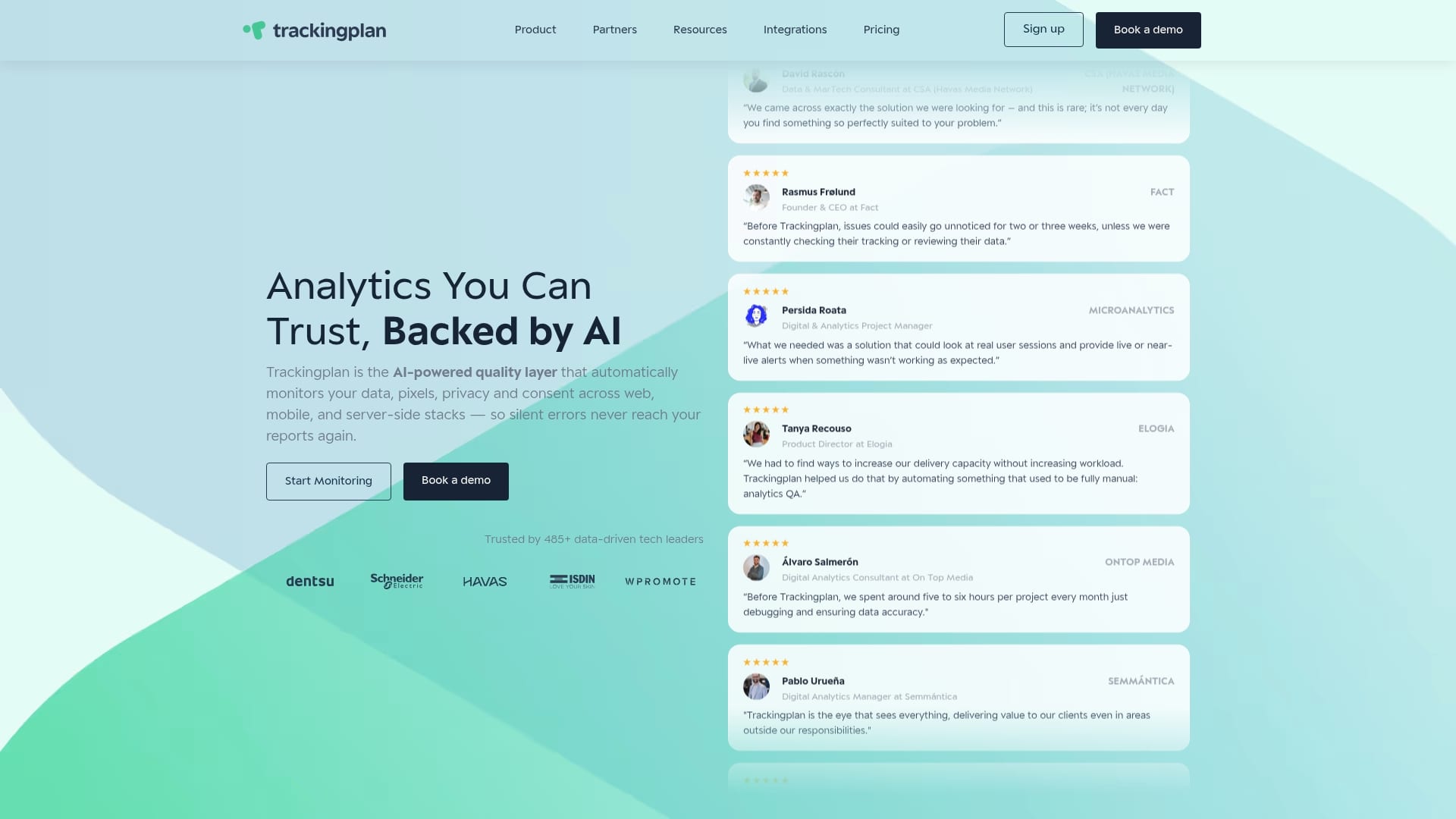
Trackingplan automates the monitoring layer that most teams skip. It detects broken pixels, tracking errors, and schema mismatches across web, app, and server-side environments, then sends real-time alerts via Slack, email, or Teams before bad data reaches your reports. For teams that rely on clean analytics data to make attribution and budget decisions, Trackingplan removes the manual audit work and replaces it with continuous, automated oversight. See how it works and understand why data quality is the foundation every martech stack needs.
FAQ
What are must-have martech tools?
Must-have martech tools are the integrated software solutions that automate campaigns, unify customer data, and measure marketing performance. The core categories are marketing automation, CRM, analytics, CMS, and integration middleware.
How many martech tools does a team actually need?
Small teams need as few as three tools connected cleanly. Enterprise organizations may run 90 or more, but 40% of features go unused in most large stacks due to poor rationalization.
What is the biggest risk in a martech stack?
Fragmented point-to-point integrations are the biggest risk. Over 40% of stack failures trace back to poorly managed integrations rather than the tools themselves.
What is hub-and-spoke architecture in martech?
Hub-and-spoke architecture routes all data through one central platform, typically a CRM or CDP, which connects to specialist tools via native integrations or enterprise middleware. It reduces integration failures and creates a single source of truth.
How does AI fit into a must-have martech stack?
AI belongs in the analytics, automation, and CMS layers of a modern stack. It requires clean, centralized data to function accurately, making data architecture a prerequisite for any AI-powered marketing capability.