
TL;DR:
- Lift testing measures a campaign’s true impact by comparing conversions between randomly assigned exposed and control groups. It confirms causality and helps optimize marketing spend by identifying organic growth versus campaign-driven results. Proper implementation requires sufficient sample size, accurate randomization, and appropriate measurement windows.
Lift testing is the process of measuring a marketing campaign’s true incremental impact by comparing an exposed group against a control group to isolate causality. The industry term for this practice is incrementality testing, and both terms are used interchangeably across digital marketing teams. Unlike click-through rates or last-touch attribution, lift testing answers a harder question: did your campaign actually cause those conversions, or would they have happened anyway? Lift testing measures incremental impact by isolating the difference between what happened with your campaign and what would have happened without it. For analysts managing ad spend across multiple channels, that distinction is the difference between optimizing real growth and chasing noise.
What is lift testing and how does it work?
Lift testing, or incrementality testing, compares conversion rates between an exposed group and a control group to determine how many conversions were truly campaign-induced. The exposed group sees your ad. The control group does not. The difference in conversion rates between the two groups is your lift, expressed as a percentage above the control baseline.
The core formula is straightforward. Lift equals the conversion rate of the exposed group minus the conversion rate of the control group, divided by the conversion rate of the control group. A 5% conversion rate in the exposed group versus a 4% rate in the control group produces a 25% lift. That number tells you your campaign drove one additional conversion for every four that would have occurred organically.
Randomization is the foundation of a valid test. Audiences must be assigned to exposed or control groups randomly, before any campaign exposure occurs. Without true randomization, selection bias corrupts your results before you collect a single data point. Randomization prevents cross-channel leakage and maintains test integrity across the full measurement window.
Statistical significance separates real lift from random variation. A result is not meaningful until it clears a confidence threshold, typically 90% or 95%. Running a test too briefly, or with too few conversions, produces results you cannot trust.
What are the key components of a valid lift test?
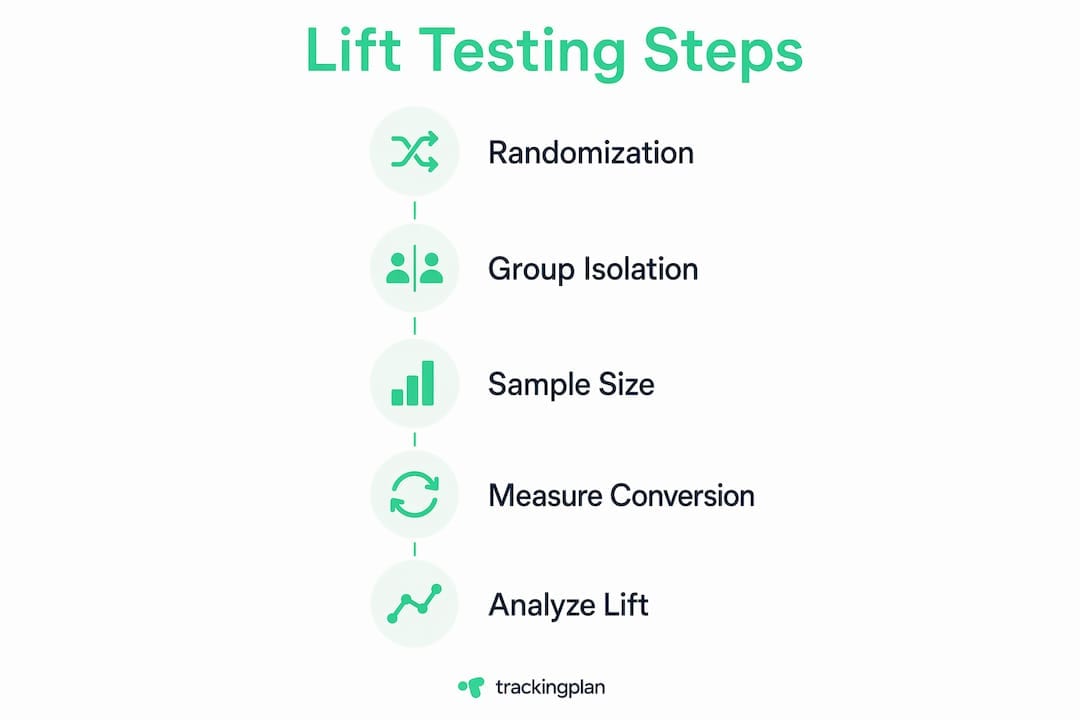
A valid lift test requires five components working together. Miss any one of them and your results become unreliable.
- Randomized cohorts. Audiences split into test and control groups must be assigned randomly, not by behavior, geography, or device type unless you are running a geo-based design intentionally.
- Group isolation. The control group must not see your ads through any channel, including retargeting, organic social, or email. Cross-contamination is the most common reason lift tests produce inflated results.
- A defined measurement window. A clear conversion window captures both immediate and delayed effects. Too short a window misses delayed conversions. Too long a window introduces noise from external factors like competitor promotions or seasonal shifts.
- Sufficient sample size. Statistical power requires at least 200 conversions in the control group to detect a 10–20% lift with 80% confidence. For a 1% baseline conversion rate with a 10% traffic holdout, that means roughly 200,000 total impressions.
- Statistical significance analysis. Use a two-sample z-test or chi-square test to confirm your lift is not a product of random variation.
Common experimental designs include holdout groups (a percentage of your audience withheld from all campaign exposure), geo-based tests (comparing matched geographic regions), and matched cohort designs (pairing users by behavioral similarity before splitting them).
Pro Tip: Before launching, calculate your required sample size using a power calculator. Plug in your baseline conversion rate, expected lift percentage, and desired confidence level. If your campaign cannot reach that threshold in a reasonable time frame, the test will not produce reliable results.
How does lift testing compare with A/B testing and attribution models?
These three methods answer different questions, and confusing them leads to bad decisions.
Lift testing differs from A/B testing because it focuses on incrementality and causation rather than variation performance. A/B testing asks which version of an ad, landing page, or email performs better. Lift testing asks whether running the campaign at all produced more conversions than running nothing. Both use control groups, but their objectives are distinct.
Attribution models assign credit for conversions across touchpoints. Last-touch, first-touch, and data-driven attribution all answer the question “which channel gets credit?” They do not answer “would this conversion have happened without any campaign?” Attribution models may not isolate true incremental impact, which means they can overstate the value of channels that capture existing intent rather than create new demand.
| Method | Core question | Measures causality? | Best use case |
|---|---|---|---|
| Lift testing | Did the campaign cause conversions? | Yes | Proving incremental ROI |
| A/B testing | Which variation performs better? | Partial | Creative and copy optimization |
| Attribution modeling | Which channel gets credit? | No | Budget allocation across channels |
Lift testing adds the most value when you need to justify budget for a channel that looks strong in attribution but may be capturing organic conversions. Brand awareness campaigns, upper-funnel video, and paid social are the most common candidates. For optimizing attribution tracking, lift testing provides the causal anchor that attribution models cannot supply on their own.
What are the common pitfalls in lift testing?
Lift testing’s biggest failure points are operational, not statistical. The math is straightforward. The execution is where most tests break down.
- Contamination between groups. A user assigned to the control group who sees your ad through a retargeting pixel or organic social post is no longer a clean control. This inflates the control group’s conversion rate and deflates your measured lift.
- Poor randomization. Splitting audiences by even or odd user IDs, by device type, or by any non-random method introduces systematic bias. Use platform-level randomization tools or a dedicated experimentation layer.
- Measurement windows that are too short. A 48-hour window for a considered purchase product misses the majority of conversions. Map your typical purchase cycle before setting the window.
- External influences. Competitor promotions, news events, or seasonal spikes affect both groups unevenly. External factors can leak into the control group, decreasing lift accuracy and producing results that reflect market conditions rather than campaign performance.
- Multi-channel leakage. Running a paid search campaign simultaneously with a lift test for paid social means users in the control group may still convert through search. Isolate the channel being tested or account for cross-channel exposure explicitly.
Pro Tip: Run a pre-test validity check by comparing baseline conversion rates between your test and control groups before the campaign launches. If the rates differ by more than 5%, your randomization has a problem. Fix it before spending budget.
How to implement lift testing and analyze the results
Running a lift test follows a clear sequence. Skipping steps produces unreliable data.
- Define your objective. Decide what conversion event you are measuring: purchases, sign-ups, app installs, or another outcome. Vague objectives produce uninterpretable results.
- Segment your audience. Divide your target audience into test and control groups using a randomization method your ad platform supports natively. Most major platforms offer built-in holdout group functionality.
- Set your holdout size. A 10–20% holdout is standard. Smaller holdouts reduce statistical power. Larger holdouts waste potential conversions in the control group.
- Define the measurement window. Match the window to your purchase cycle. A one-week window works for impulse purchases. A four-week window is more appropriate for subscription products or high-consideration purchases.
- Run the campaign without changes. Do not adjust bids, creative, or targeting during the test. Mid-test changes invalidate your results.
- Collect and validate your data. Pull conversion data for both groups at the end of the window. Check for data completeness and flag any anomalies before calculating lift.
- Calculate lift and assess significance. Apply the lift formula and run a significance test. If your result does not clear 90% confidence, extend the test or increase sample size before drawing conclusions.
- Interpret and act. A statistically significant positive lift confirms the campaign drove incremental conversions. Use the lift percentage to calculate true cost per incremental conversion and compare it against your target CPA.
Successful lift test interpretation requires accounting for organic trends and external market changes before drawing conclusions. A lift result that looks strong during a seasonal peak may not replicate in a flat period. For campaign performance monitoring, pairing lift test results with ongoing tracking data gives you a fuller picture of what is driving growth.
Integrating your lift test data with a marketing automation checklist helps teams standardize the process across campaigns and avoid repeating setup errors. Consistent process documentation also makes it easier to compare lift results across different campaigns and time periods.

Key Takeaways
Lift testing produces reliable incrementality measurement only when randomization, group isolation, sample size, and measurement windows are all correctly configured before the campaign launches.
| Point | Details |
|---|---|
| Define incrementality clearly | Lift measures conversions caused by the campaign, not just correlated with it. |
| Randomization is non-negotiable | Poor randomization introduces bias that no statistical method can correct after the fact. |
| Sample size determines reliability | At least 200 control group conversions are needed to detect a 10–20% lift at 80% confidence. |
| Measurement windows must match purchase cycles | Too short a window misses delayed conversions; too long a window adds external noise. |
| Attribution models do not replace lift testing | Attribution assigns credit; lift testing proves causation. Both serve different decisions. |
Why most marketers are still measuring the wrong thing
The shift from correlation to true incrementality is one of the most underappreciated changes in marketing measurement right now. I have watched teams celebrate strong ROAS numbers on paid social for months, only to run their first holdout test and discover that a significant portion of those conversions would have happened organically. The campaign was capturing demand, not creating it. That is a fundamentally different business situation, and attribution models will never surface it.
The uncomfortable reality is that one-off lift tests are not enough. Just as ongoing monitoring matters after any structural verification, a single lift test is a snapshot, not a permanent answer. Markets shift, audience behavior changes, and a channel that showed strong lift in Q1 may perform differently in Q4. The teams that get the most value from incrementality testing treat it as a recurring practice, not a one-time audit.
The other thing I have seen trip up even experienced analysts is premature interpretation. A test that runs for two weeks during a product launch period is not telling you what you think it is. External momentum inflates lift. You need clean periods, adequate windows, and a healthy skepticism about results that look too good.
The good news is that the tooling has improved significantly. Platforms now offer native holdout group functionality that removes much of the manual setup burden. The bottleneck today is not technical. It is organizational. Teams need to commit to holding back a portion of their audience, accept the short-term cost of not serving ads to the control group, and wait long enough for results to be meaningful. That discipline is what separates teams that actually know their campaigns work from teams that assume they do.
— David
How Trackingplan supports accurate lift testing
Reliable lift test results depend entirely on clean, complete tracking data. If your conversion events are misfiring, your pixel is dropping sessions, or your experiment tags are misconfigured, your lift calculation is wrong before you even run the math.

Trackingplan monitors your web tracking implementation in real time, alerting your team the moment a tracking error, schema mismatch, or broken pixel appears. Its AI-assisted debugger identifies the root cause of data anomalies automatically, so you spend less time diagnosing and more time acting on results. For teams running lift tests across multiple channels, Trackingplan’s digital analytics data quality tools give you the confidence that the data feeding your incrementality calculations is accurate and complete.
FAQ
What is lift testing in marketing?
Lift testing measures the incremental impact of a marketing campaign by comparing conversion rates between an exposed group and a control group. The difference between the two groups, expressed as a percentage, is the campaign’s lift.
How is lift testing different from A/B testing?
A/B testing compares two variations of a campaign element to find the better performer. Lift testing determines whether running the campaign at all produced more conversions than running nothing, making it a test of causation rather than variation.
How many conversions do I need for a valid lift test?
A minimum of 200 conversions in the control group is needed to detect a 10–20% lift at 80% confidence. For a 1% baseline conversion rate with a 10% holdout, that requires approximately 200,000 total impressions.
What causes inaccurate lift test results?
The most common causes are contamination between test and control groups, poor randomization, measurement windows that are too short or too long, and external market events that affect both groups unevenly.
When should I use lift testing instead of attribution modeling?
Use lift testing when you need to prove that a channel is generating new demand rather than capturing existing intent. Attribution modeling allocates credit across touchpoints but cannot confirm whether those conversions would have occurred without the campaign.