
Staring at a complex web of data privacy regulations can feel like trying to solve a puzzle with half the pieces missing. But what if those core principles of privacy weren't a hurdle, but your biggest competitive advantage? This guide reframes privacy from a simple compliance checkbox to a strategic tool for building unbreakable customer trust and a more sustainable, high-performing data operation.
Why Privacy Principles Matter Now More Than Ever
Not long ago, the unofficial rule of data collection was simple: grab everything you can, just in case. Today, that approach isn’t just outdated—it’s a liability. Protecting user privacy is no longer just a legal obligation; it's a fundamental part of building a web that works for everyone and a core pillar of a modern business strategy.
This shift is about more than just dodging fines. It's about finally recognizing that customer trust is your most valuable, non-renewable asset. When users feel their data is respected, they’re far more likely to engage, convert, and stick around for the long haul. The principles of privacy are the blueprint for earning that trust.
From Legal Burden to Strategic Advantage
If you're only thinking about privacy as a set of rules to follow, you're missing the bigger picture. It’s better to view these principles as the foundation for building a smarter, more efficient analytics operation. A privacy-first approach forces you to be deliberate about your data strategy, which naturally leads to cleaner data, more accurate insights, and a much stronger relationship with your audience.
Protecting user privacy is fundamental to creating a web that works for everyone. The W3C's Statement on Privacy Principles highlights this, providing foundational concepts to guide development toward a more trustworthy online environment.
The Real-World Impact on Data Teams
For the analysts, marketers, and developers in the trenches, these concepts aren't abstract ideals. They directly impact day-to-day work, from designing a tracking plan to configuring a simple marketing pixel. Ignoring them introduces serious risks that go far beyond a slap on the wrist from regulators.
Here’s why getting a handle on privacy principles is a game-changer:
- Reduces Risk: When you only collect what's necessary and handle it responsibly, you shrink your exposure to costly data breaches and regulatory penalties. It's that simple.
- Improves Data Quality: A focus on privacy forces you to cut through the noise. By eliminating irrelevant data, you're left with more reliable dashboards and clearer business insights.
- Builds Customer Loyalty: Transparency and respect for user choice are powerful brand differentiators. They foster long-term trust and are key drivers of customer retention.
- Future-Proofs Your Strategy: Regulations will keep evolving. A business built on solid privacy foundations can adapt with ease, while others will be left scrambling to retrofit compliance.
Ultimately, these principles aren’t here to limit what you can do; they’re here to help you do it right. Think of them as the building blocks for an analytics stack that is not only compliant but also more effective, reliable, and respected by the very users you’re trying to serve.
The Seven Foundational Principles of Privacy
Drowning in privacy jargon? Let's cut through the noise. At their core, the principles of privacy aren't just complex legal hurdles; they're a set of common-sense rules for handling personal information with respect. Think of them as the constitution for your data practices—a guide that ensures you build trustworthy experiences, not just compliant ones.
Getting a handle on these seven concepts is the first step toward building an analytics stack that’s both effective and ethical. They give you a clear framework for making smart decisions, whether you're designing a new feature or configuring a marketing campaign.
This map shows how these principles all connect to the central goal of building user trust, which is achieved through a mix of smart strategy, effective execution, and solid compliance.
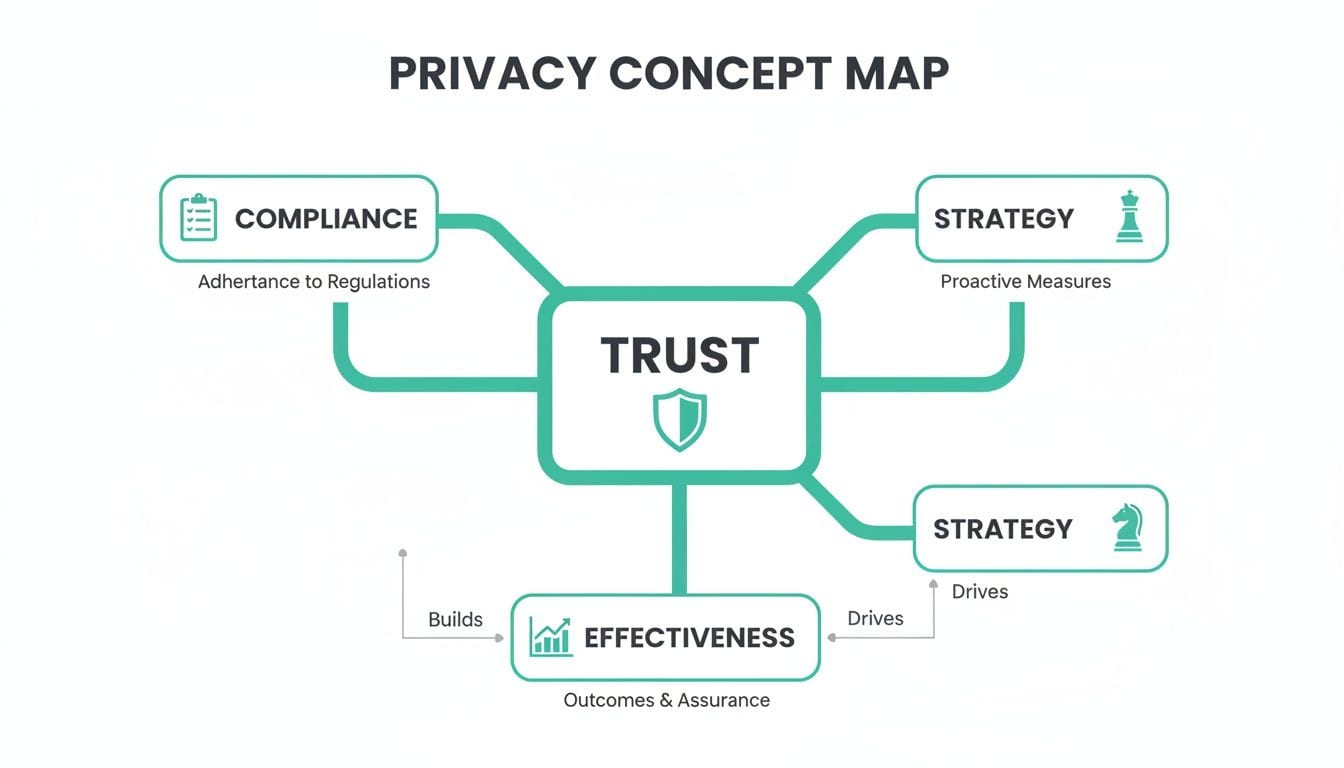
As you can see, a successful privacy program isn't just about checking boxes. It’s about weaving privacy into your core business strategy to deliver more reliable and effective outcomes.
To make these principles tangible, let's break them down. The following table gives you a quick overview of each one and what it looks like in the real world of analytics and marketing.
Core Privacy Principles at a Glance
Now, let's dig a little deeper into what each of these means for your day-to-day work.
1. Lawfulness, Fairness, and Transparency
This first principle is the bedrock of all data handling. It boils down to this: you must have a legitimate, legal reason for collecting and processing data, and you have to be completely open about what you're doing.
Imagine you're a librarian. You wouldn't secretly follow patrons home to see what other books they read. Instead, you'd openly explain how their borrowing history helps you recommend new books and improve the library's collection. That’s transparency, and it’s what builds trust.
2. Purpose Limitation
This one’s pretty straightforward: collect data for a specific, explicit, and legitimate purpose, and don't you dare use it for anything else without fresh consent. You have to define why you need the data before you even touch it.
If a user signs up for your newsletter, you have their permission to email them newsletters. Simple. You do not, however, have their permission to sell their email address to data brokers or use it to track their location. The purpose was clearly defined and must be respected.
3. Data Minimization
Here’s where a lot of data strategies go off the rails. Data Minimization means you should only collect the data that is absolutely necessary to achieve your stated purpose. More data is not always better; often, it's just more of a liability.
Think of it like packing for a weekend trip. You bring what you need—a couple of outfits, toiletries, a phone charger. You don’t bring your entire wardrobe and your lawnmower. Over-collecting data is the digital equivalent of overpacking. It's burdensome, risky, and completely unnecessary.
By the end of 2024, data protection laws covered 79% of the global population. This massive shift highlights the importance of principles like data minimization, as organizations that over-collect information face skyrocketing risks in a privacy-conscious world.
4. Accuracy
The accuracy principle dictates that the personal data you hold must be accurate and, where necessary, kept up to date. This isn't just a compliance issue. Inaccurate data leads to flawed analysis, poor user experiences, and flat-out bad business decisions.
For example, having an old shipping address for a customer means their order goes to the wrong place, creating frustration and costing you money. The same logic applies to analytics; if your user data is wrong, your conclusions will be too.
5. Storage Limitation
Just as you shouldn't collect data you don't need, you also shouldn't keep it forever. Storage Limitation requires that you store personal data only for as long as it's needed to fulfill the original purpose.
It’s like cleaning out your refrigerator. You don't keep food past its expiration date because it becomes useless and potentially harmful. Setting up clear data retention policies ensures you periodically and securely get rid of data that no longer serves a legitimate purpose.
6. Integrity and Confidentiality
This principle is all about security. It’s your responsibility to protect the personal data you hold against unauthorized access, accidental loss, or damage. You have to implement the right technical and organizational measures to keep it safe.
Your data storage should be like a bank vault, not a public bulletin board. This involves:
- Encryption: Protecting data both when it's moving across networks and when it's sitting in storage.
- Access Controls: Making sure only authorized personnel can view or modify sensitive information.
- Regular Audits: Proactively looking for vulnerabilities in your systems before someone else does.
7. Accountability
Finally, the accountability principle ties everything together. It's not enough to just follow the rules; you must be able to demonstrate your compliance. This means keeping records of your data processing activities, conducting impact assessments, and having clear policies in place.
Accountability is the difference between saying you're compliant and proving you are. For data teams, this often means having a single source of truth for your analytics—like an up-to-date tracking plan—that shows exactly what data is collected, where it goes, and why. This is what lets you answer questions from regulators, executives, or users with confidence.
Applying Data Minimization in Your Analytics Stack
In the world of data, the impulse to hoard is strong. More data feels safer, right? But the truth is, collecting everything you can is a fast track to creating a massive liability. The principle of Data Minimization is your defense against this, pushing you to shift your mindset from collecting as much as possible to collecting only what is essential.

This isn't just some abstract compliance theory. It has immediate, practical consequences for your entire analytics and marketing stack. Every unnecessary field you capture—whether it's an extra form input or a redundant event property—adds noise, drives up storage costs, and widens your attack surface for a data breach.
The Hidden Risks of Over-Collection
Hoarding data might seem harmless on the surface, but it silently poisons your analytics implementation. When you over-tag pages or cram too much user information into your events, you end up with a bloated, fragile system that no one can maintain or trust.
Think about a simple user_signup event. Does it really need to capture the user's browser version, screen resolution, and the exact time of day? Or is just the user_id and signup_method enough to answer your core business questions? Every single property you add is a decision that carries weight.
The principle of data minimization—collecting only the personal data necessary for a specific purpose—has become a cornerstone of global privacy frameworks. By the end of 2024, data protection laws covered 79% of the global population. This surge underscores the shift: organizations ignoring minimization face skyrocketing risks, as the global average data breach cost hit USD 4.44 million in 2025, with 44% of breaches exposing personal info like names and emails—data often over-collected in tracking pixels and dataLayers. You can discover more insights about the global state of data privacy on Usercentrics.com.
The trend is undeniable: a "collect-it-all" approach is no longer sustainable. Adopting data minimization isn't just about checking a compliance box; it's a strategic move to de-risk your operations and dramatically improve your data quality.
Building Leaner, Smarter Tracking Plans
Applying data minimization starts at the source: your tracking plan. This document should be your constitution, defining precisely what data is necessary and, just as importantly, why. A lean tracking plan is the bedrock of a privacy-first analytics stack.
Here are a few practical ways to enforce this principle:
- Justify Every Event: Before you add a new event, ask one simple question: "What specific business decision will this data help us make?" If the answer is vague or nonexistent, don't track it.
- Scrutinize Every Property: For each event, go through its properties with a fine-tooth comb. Ditch anything that's a "nice-to-have" instead of a "need-to-have." For instance, instead of capturing full URLs that might accidentally contain PII, just capture the URL path.
- Configure Pixels Carefully: Marketing pixels are notorious for over-collecting. When setting them up, disable automatic "advanced matching" features you don't explicitly need, and make sure they only fire on truly relevant pages.
A key part of data minimization also involves setting up clear record retention guidelines to ensure data isn't kept longer than necessary.
Automating Enforcement with Observability
Manually auditing your entire analytics implementation against your tracking plan is a nightmare. It's slow, tedious, and prone to human error. A developer could accidentally push code that starts leaking email addresses into a UTM parameter, and you might not find out for months—if ever.
This is where modern observability tools completely change the game.
An analytics observability platform like Trackingplan acts as your automated watchdog. It constantly scans your live data traffic and cross-references it with your official tracking plan, effectively putting data minimization enforcement on autopilot.
This approach gives you several critical advantages:
- Real-Time PII Leak Detection: The system can automatically spot patterns that look like personally identifiable information (PII)—like emails, names, or phone numbers—showing up in event properties or URL strings. It fires off an immediate alert, so you can fix the leak before it escalates into a major incident.
- Detection of Unapproved Data: If a developer adds a new event or property that isn't defined in your tracking plan, the platform flags it as a "rogue" element. This ensures no unapproved data collection ever slips through the cracks.
- Schema Validation: It confirms that the data being sent matches the format you expect (e.g., a
priceproperty should be a number, not a string). This upholds data quality and prevents a cascade of errors in your downstream tools.
By automating these checks, you graduate from a reactive, audit-based posture to a proactive, continuous governance model. You're not just enforcing privacy principles; you're building a more reliable and trustworthy data asset for your entire organization.
Mastering Consent and Transparency in Marketing
Consent isn't just a banner click or a legal checkbox; it's the very foundation of a trustworthy relationship with your users. As two of the most critical principles of privacy, consent and transparency demand that you're clear, honest, and respectful about how you handle personal data. Anything less erodes the trust your entire business is built on.

This means moving away from the murky waters of implied consent—where you assume permission unless a user objects—and embracing explicit consent. Modern data practices demand a clear, affirmative "yes" from users before you track their behavior or collect their information for marketing.
From Implied to Explicit Consent
For years, the digital world operated on a model of implied consent. Visiting a website was often seen as tacit approval to be tracked by a dozen different scripts. That era is over. Today, regulations and user expectations demand an active, unambiguous agreement.
Explicit consent requires a specific action from the user, like ticking an unchecked box or clicking an "Accept" button. It must be freely given, specific, informed, and easily retractable.
A great privacy notice isn't a wall of legal text designed to be ignored. It's a clear, concise explanation of what data you collect, why you need it, and how it will be used, written in plain language that anyone can understand.
This shift has a massive impact on marketing and analytics. It means your cookie banners must offer genuine choice, and your privacy notices have to be more than just legal boilerplate. They need to be transparent communication tools. To get a deeper understanding of this topic, you can learn more about the fundamentals of consent management and how to implement it effectively.
The Technical Challenge of Honoring Consent
Getting a user's "yes" is only half the battle. The real technical challenge for data teams is ensuring that consent signal is actually honored across your entire, complex toolset. A user might deny consent for marketing cookies, but what if a misconfigured tag still fires and sends their data to an ad platform?
This is a common and costly mistake. The user’s choice must be enforced consistently, from the moment it's given to every single downstream destination. A failure here isn't just a technical glitch; it's a direct violation of their privacy and your promise to them.
The stakes are incredibly high. Surveys show that 87% of consumers support banning data sales to third parties without their consent, highlighting just how fragile user trust has become. For data teams, consent misconfigurations put this trust at risk, and automated tools are essential for preventing violations under frameworks like GDPR, where fines now total over €6.7 billion.
Using Observability to Enforce Consent
How can you be certain that your analytics stack is respecting every user's choice, every single time? Manual checks are impossible. You can't personally inspect every data packet for every user to ensure compliance. This is where continuous observability becomes essential.
An automated platform like Trackingplan monitors your data flow in real time to act as your consent enforcement engine. It provides the proof you need to ensure your implementation matches your privacy promises.
Here's how it solves the problem:
- Detects Misconfigurations: It can automatically detect when a marketing or analytics pixel fires even though a user has not given the required consent. This allows you to catch and fix violations before they become widespread.
- Validates Consent Signals: The system can verify that the consent signals passed from your Consent Management Platform (CMP) are correctly interpreted and acted upon by all your integrated tools.
- Preserves Data Integrity: By ensuring only consented data enters your analytics systems, you improve the quality and reliability of your insights. Your performance metrics will more accurately reflect the users who have actively opted in.
By automating this verification process, you move from a reactive "hope it's working" stance to a proactive, provably compliant one. You're not just adhering to the principles of privacy; you're building a more robust and trustworthy data operation that respects user choice at every turn.
Upholding Data Subject Rights with Confidence
When a user asks to see or delete their personal data, it kicks off a high-stakes scavenger hunt for most data teams. How sure are you that you can find every last bit of that user's information across all your systems? This isn't just a hypothetical—it's a fundamental part of the modern principles of privacy.
Honoring these data subject rights, like the right to access or the right to be forgotten, is a direct measure of your company's respect for its users. But let’s be honest: in a sprawling ecosystem of analytics tools, CRMs, ad platforms, and data warehouses, finding it all feels like an impossible task of digital archaeology.
The Challenge of a Fragmented Data Footprint
A single user's data isn't sitting in one neat folder. It’s sprinkled across dozens of different systems, often tied to different identifiers like a user_id, anonymous_id, or email. Manually chasing down every piece of this digital footprint is slow, expensive, and dangerously prone to human error.
If you miss just one location, you've failed to comply. That means breaking user trust and putting yourself at risk of regulatory fines. And the scale of this problem is only getting bigger.
The right to access and deletion empowers individuals to control their data. With global data storage expected to exceed 200 zettabytes by 2025, and regulations covering 79% of the world's population, fulfilling these rights is a massive operational challenge. Automated data discovery and observability are crucial for ensuring compliance and accurately managing deletion requests across complex data stacks.
This is exactly why having a complete, automated map of your entire analytics implementation is no longer a luxury; it’s a necessity.
A Practical Workflow for Data Subject Requests
To handle access and erasure requests without the chaos, you need a single source of truth that shows you exactly where user data is flowing. An automated observability platform creates this map, turning a frantic manual process into a structured, repeatable workflow. Giving users control through accessible user privacy settings, like those seen in apps, is key to helping them manage their own data.
Here’s how a modern, automated approach simplifies everything:
- Automated Data Discovery: The process starts with a system that has already mapped your entire analytics ecosystem. It knows every destination—from your CRM to your ad platforms—that receives a specific
user_idor other personal identifiers. - Locate the User: When a request lands, you use this central map to instantly pinpoint every tool and database where that user's data lives. No more guesswork or manually logging into dozens of different platforms.
- Execute the Request: Armed with a clear list of locations, you can systematically go into each system to either export the user's data (for an access request) or trigger its deletion (for an erasure request).
- Verify and Document: Finally, the system gives you an audit trail. You can confirm that the data has been successfully removed or compiled and document the entire action to prove compliance if you’re ever asked.
This automated workflow transforms data subject rights from a source of anxiety into a manageable, routine process. It ensures you can respond to users accurately and confidently, showing that your commitment to their privacy is more than just words in a policy—it’s backed by provable action.
Building Accountability with Automated Governance
The final cornerstone of a solid privacy framework is accountability. It’s a simple but powerful idea: you have to be able to prove you’re compliant. For years, this meant wrestling with cumbersome spreadsheets and periodic manual audits—a slow, error-prone process that just can't keep up with the speed of modern digital operations.

Today, showing you’re accountable demands something more dynamic and reliable. Automated analytics governance has stepped in as the definitive answer, shifting accountability from a reactive chore to a continuous, proactive part of your data strategy. It's about creating a living record of your data practices, not a static, dusty snapshot.
The Shift to Continuous, Automated Proof
Manual audits are obsolete because they only capture a single moment in time. The very next day, a new code deployment could introduce a PII leak or a consent misconfiguration, making your audit worthless. Real accountability requires a system that watches your data flows around the clock.
This is where continuous monitoring and real-time alerts become essential. An automated platform acts as a permanent, impartial observer of your analytics setup. It documents every event, verifies every pixel, and validates every data point against your established rules, creating an unchangeable audit trail.
Accountability is the bridge between saying you respect privacy and proving it. In an environment where a single line of code can create a major compliance breach, automated governance provides the verifiable evidence needed to maintain trust with both users and regulators.
This automated approach doesn't just catch problems; it helps build a culture of shared responsibility. For a deeper look at how documentation supports this, our guide on creating a Privacy Impact Assessment template provides a structured framework.
Creating a Unified View for All Teams
One of the biggest hurdles in maintaining compliance is the silo between teams. Marketers, developers, and analysts often work with different tools and priorities, leading to miscommunications and mistakes that create privacy risks. Automated governance breaks down these walls by giving everyone a single source of truth.
This unified view ensures everyone is on the same page:
- Marketers can launch campaigns with confidence, knowing their tags are configured correctly and honor user consent choices.
- Developers get immediate, actionable alerts if their code accidentally introduces a data quality or privacy issue, letting them fix it fast.
- Analysts can trust the data in their dashboards, confident that it’s accurate, complete, and was collected in a compliant way.
By automating the detection and documentation of your data practices, you build an analytics program that is provably compliant. This allows your teams to work together more effectively, fix issues long before they escalate, and ultimately deliver insights you can stand behind with total confidence.
Common Questions on Privacy Principles
When you start putting privacy principles into practice, a few common questions always seem to pop up. Here are some straightforward answers to the ones we hear most often in data analytics.
What Is the Most Important Principle of Privacy for Digital Analytics?
While all the principles work together, Data Minimization is probably the best place to start for digital analytics. If you only collect the data you absolutely need for a specific, defined purpose, you automatically shrink your risk and make compliance much simpler.
Nailing data minimization creates a positive ripple effect. It makes it far easier to manage other principles like consent and security, helping you build a more efficient and trustworthy data stack from the ground up.
How Can I Check If My Website Is Accidentally Leaking PII?
Trying to find PII leaks manually is like finding a needle in a haystack—it's tough, unreliable, and sensitive data can be hiding anywhere from event properties to UTM parameters or even right in the URL. The only truly effective way to catch them is with an automated analytics QA and observability platform.
An automated tool keeps a constant watch on all your analytics and marketing tags in real time. It can spot patterns that look like PII—like emails or names—and alert you before a small slip becomes a massive compliance headache.
Does Using a Consent Management Platform Guarantee Compliance?
A Consent Management Platform (CMP) is a critical piece of the puzzle, but it’s no silver bullet for compliance. It's surprisingly common for misconfigurations to cause marketing or analytics pixels to fire even when a user has said "no," which is a serious violation.
Real compliance means verifying that user consent choices are actually being respected by every tool in your Martech stack. Continuous monitoring is what closes the loop between what a user chooses and what your tech does, validating that tags only fire when the right consent is in place. It ensures your setup is doing what you promised.
Ready to build an analytics program people can trust? Trackingplan gives you the automated observability needed to catch PII leaks, enforce consent, and validate your data in real time. Discover how Trackingplan helps you uphold privacy principles with confidence.