
Privacy work gets messy fast when Tealium sits at the center of a busy stack. Marketing adds a new pixel. Product changes a signup flow. Engineering updates the data layer. Legal updates consent language for one region but not another. A month later, nobody is fully sure whether the implementation still matches the policy.
That's the core problem the Tealium privacy compliance framework needs to solve. Not just consent capture. Not just a banner. The hard part is turning privacy rules into technical controls that keep working after releases, vendor changes, and campaign deadlines.
In practice, teams struggle less with the initial setup than with keeping consent logic aligned across browser tags, app SDKs, server-side events, and downstream destinations. A policy can look clean in documentation and still fail in production because one connector bypassed a purpose rule or one variable changed names in the data layer.
The workable approach is to treat privacy as an operating model. Tealium can support that model when consent is captured clearly, stored consistently, translated into stable machine-readable signals, and enforced before data leaves the page or continues downstream. The rest is governance and verification.
Navigating the Modern Data Privacy Maze
Organizations don't have a privacy problem in theory. They have an implementation problem.
Consent exists in one system, tags live in another, and the actual data leaving the site depends on whatever was published last. That's why privacy incidents often start with ordinary delivery work. A campaign launch introduces a vendor. A site redesign changes selectors or event names. An app release updates SDK behavior. None of those changes are framed as privacy work, but all of them can affect compliance.
Why manual checks keep failing
Manual reviews can catch obvious issues, but they don't scale well when Tealium manages multiple tags, consent categories, and region-specific behavior. A one-time audit might confirm that the banner appears and a few major vendors respect consent. It won't reliably catch silent regressions across every journey.
The biggest blind spots usually look like this:
- Consent drift: The banner text, consent categories, and enforcement logic no longer match.
- Tag sprawl: Old pixels remain active, or new ones go live without being mapped to a purpose.
- Data layer instability: Consent values or event attributes change format and break rule logic.
- Regional inconsistency: One market gets the intended controls while another inherits the wrong defaults.
Privacy breaks in the gaps between systems, not in the policy document.
What a centralized framework changes
A solid Tealium setup gives teams one place to coordinate capture, interpretation, and enforcement of user choices. That matters because privacy laws don't care whether the failure came from a tag manager, a CMP, or a rushed release. They care whether data was processed in line with the user's rights and your stated policy.
A workable framework gives you three things that matter day to day:
- A clear source of consent truth
- Technical enforcement tied to purpose
- A way to verify that production behavior still matches policy
That's where Tealium becomes more than a deployment tool. It becomes the control layer that can keep analytics, marketing, and governance teams aligned when the implementation changes underneath them.
What Is the Tealium Privacy Compliance Framework
The easiest way to understand the Tealium privacy compliance framework is to think of it as digital passport control for data. Before data goes anywhere, analytics, advertising, personalization, or another destination, the system checks whether that movement is allowed under the user's consent and your configured policy.
That's different from a basic cookie banner. A banner only asks the question. A framework has to capture the answer, store it, translate it into something systems can act on, and enforce it consistently across collection and activation.
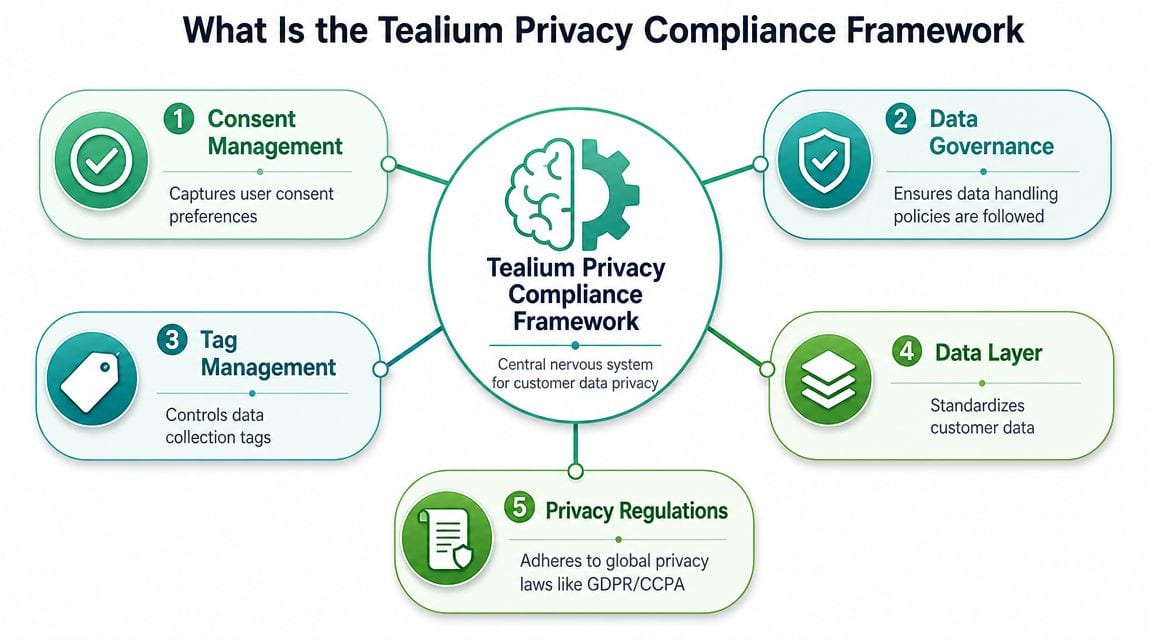
The framework is bigger than consent capture
Tealium's own privacy notice presents privacy as a combination of legal basis, transfer safeguards, security controls, incident response, and retention discipline. Tealium states it relies on explicit consent as a legal basis for processing, Standard Contractual Clauses for international transfers, encryption for data in transit and at rest, access controls limited to authorized personnel, regular audits, and breach response aligned with the GDPR's 72-hour expectation in its privacy notice.
Those controls matter because they show how privacy compliance functions in operations. A modern framework isn't just “show banner, collect click.” It has to answer several distinct questions:
- Lawful basis: Why is this data being processed?
- Transfer controls: What governs cross-border movement?
- Security: Who can access the data, and how is it protected?
- Incident handling: What happens when something goes wrong?
- Retention: How long does the data stay in scope?
If you're still treating Tealium as only a tag manager, it helps to read a broader explanation of what Tealium is in the context of governance and data delivery.
What works in practice
The framework works when teams stop thinking in vendor features and start thinking in control points. The most reliable implementations define purposes clearly, bind each vendor to a purpose, and make consent state available in a stable form that every downstream rule can read.
What usually doesn't work is relying on one layer alone. A banner without enforcement is cosmetic. A load rule without a clean consent signal is brittle. A legal policy without technical validation won't protect production behavior.
Practical rule: If a purpose can't be mapped to a technical enforcement rule, it isn't operational yet.
Core Components and Data Flow Explained
A Tealium privacy setup becomes manageable when you separate it into components. The logic is simple. The implementation usually isn't.
The key is understanding the chain from user choice to actual data transmission. If one link in that chain is weak, the whole framework starts producing false confidence.
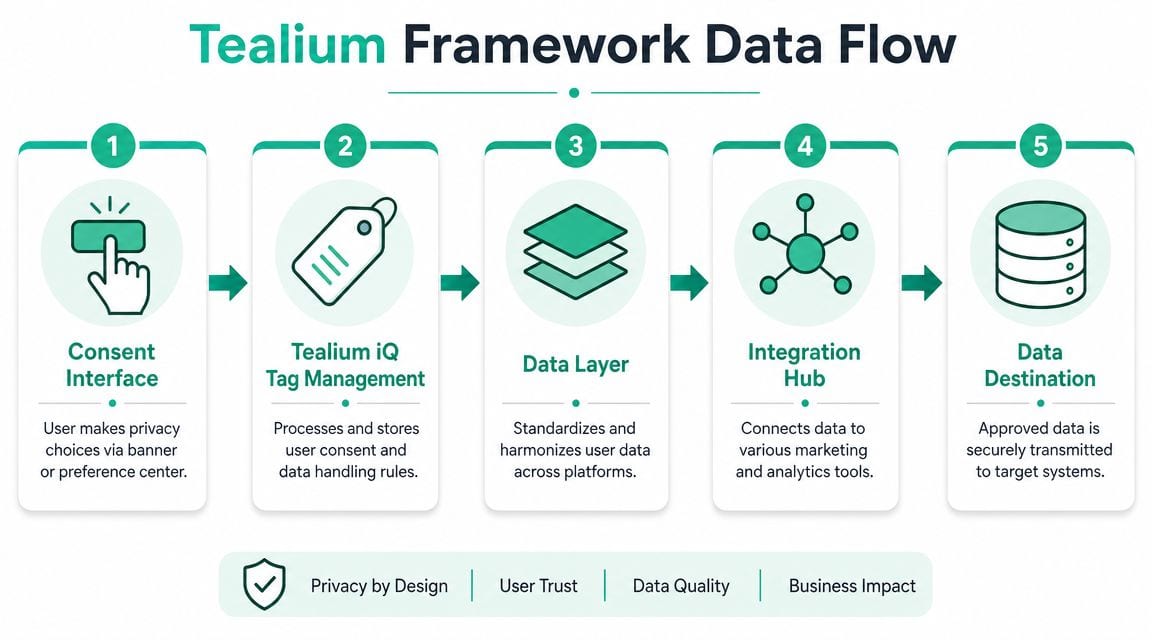
The four control points that matter
The most useful way to model the data flow is this:
- Consent interface
- Consent state
- Data layer mapping
- Tag and connector enforcement
The consent interface is the visible part. It's the banner, modal, or preference center where the user grants, denies, or updates choices. Many projects spend most of their time on this component, even though it's only the first step.
Consent state is where the decision lives after capture. If this layer is unstable, every downstream control becomes unreliable. Teams often run into trouble when consent exists in multiple places at once, such as a CMP object, a cookie, and a custom app variable, with no clear priority.
The data layer mapping stage translates human language into machine logic. “Analytics allowed” has to become a clean signal that Tealium can read repeatedly. If one page writes analytics=true and another writes consent_analytics=granted, enforcement logic starts to fragment.
A deeper look at maintaining that consistency is covered in this guide to ensuring Tealium data layer integrity.
Where compliance usually breaks
Tealium's market positioning has shifted toward operational privacy, not just static documentation. In its G2 award announcement for 2026, Tealium says it helps enterprises operationalize privacy with real-time consent management, purpose-based data controls, and granular governance policies, reflecting the move from policy statements to continuous enforcement in production systems, as described in its G2 Best Software Awards announcement.
That shift matters because the most common failure isn't banner design. It's implementation drift between policy and execution.
The highest-risk breakpoints are usually these:
- Unmapped vendors: A new tag gets added without being assigned to a purpose.
- Inconsistent consent variables: Different templates or apps use different names or values.
- Server-side blind spots: Browser-side collection looks compliant, but downstream event routing isn't aligned.
- Withdrawal failures: Consent can be granted and denied initially, but updates or revocations don't fully propagate.
If you only test first-page banner acceptance, you haven't tested privacy. You've tested a happy path.
What good enforcement looks like
A strong setup blocks or allows collection before the data leaves the page when browser-side collection is involved, and it applies equivalent purpose logic in server-side processing where relevant. The architecture should make exceptions explicit, not accidental.
That means teams should validate more than one user journey. Test grant, deny, update, and withdrawal states. Test them across regions. Test them in web, app, and server-side paths if your stack uses all three.
When the consent interface, consent state, and data layer stay clean, Tealium can enforce policy predictably. When those layers drift, governance teams end up reviewing screenshots while noncompliant events continue to flow.
Mapping Tealium Capabilities to GDPR and CCPA
Legal requirements become easier to operationalize when you translate them into technical controls. That's the main value of the Tealium framework for governance teams. It gives you a way to map abstract obligations to concrete implementation decisions.
The mapping isn't one-to-one in every case. Privacy laws are legal frameworks, not product specs. But Tealium's consent, governance, and enforcement capabilities can support the controls organizations need to demonstrate.
For a more tool-specific breakdown, this overview of Tealium GDPR compliance tools is a useful companion for implementation planning.
Tealium features versus legal obligations
| Tealium Capability | Applicable GDPR Requirement | Applicable CCPA/CPRA Requirement |
|---|---|---|
| Purpose-based consent categories | Supports lawful-basis handling where consent is the chosen basis for specific processing purposes | Supports opt-out handling by separating advertising-related processing from other categories |
| Consent state management | Helps maintain a record of current user choice and apply it consistently | Helps apply consumer privacy choices across data collection and downstream use |
| Tag and connector enforcement | Supports limiting processing to what the user permitted | Supports preventing data flows tied to sale or sharing where opt-out applies |
| Centralized governance rules | Helps align technical controls with documented privacy policy | Helps apply consistent restrictions across vendors and properties |
| Data retention and access controls | Supports governance around data minimization, storage discipline, and controlled access | Supports responsible handling of personal information within broader privacy operations |
GDPR and CCPA don't ask for the same thing
GDPR often pushes teams toward purpose-level clarity and a documented lawful basis. CCPA and CPRA often push harder on opt-out rights and downstream restrictions around sale or sharing. If you configure a single generic consent switch, you'll usually satisfy neither standard very well.
That's why purpose-based design matters. Analytics, personalization, and advertising shouldn't live under one technical flag unless your legal approach treats them the same. Most mature teams separate them because enforcement gets clearer and audits get easier.
Regional nuance matters
Global programs also have to deal with location-specific delivery. Teams operating across restrictive networks or high-control environments often need to think beyond standard banner behavior and vendor routing. If that's part of your footprint, this guide on privacy for secure internet access in China is relevant background for regional governance planning.
The legal requirement is rarely “install a CMP.” The requirement is to make user rights and restrictions real in your systems.
The practical takeaway is simple. Don't ask legal to approve a screenshot of the banner and call the project done. Map each legal requirement to a Tealium control, a destination behavior, and a validation method.
Practical Implementation and Configuration Steps
Implementation works better when you run it like a control design project, not a tagging exercise. The sequence matters. If you skip inventory and jump straight to banner configuration, you'll end up retrofitting logic under pressure.

Start with a purpose inventory
Before touching Tealium iQ, list every tag, pixel, SDK, connector, and event stream that collects or forwards user data. Then group each one by purpose.
A useful inventory usually answers these questions:
- What does the vendor collect
- Why is it being used
- Which region or property uses it
- What consent state should permit it
- What happens if consent is denied or withdrawn
This is the point where many teams discover duplicate vendors, legacy pixels, or “temporary” tags that never got reviewed.
Configure the consent model before the UI
The banner matters, but the taxonomy matters more. Define your consent purposes first. Keep them understandable to users and technically actionable for engineers.
Avoid categories that sound legally polished but can't be enforced. “Improving your experience” is vague. “Analytics” or “Advertising” is clearer, easier to map, and easier to test.
Make the consent state durable
The most stable implementations expose consent through consistent variables that exist across templates and journeys. You want the same logic available on landing pages, account areas, checkout, and post-login states.
Many projects become brittle when the CMP stores one value, a custom script writes another, and Tealium reads a third. Pick one canonical representation and force everything else to translate into it.
Enforce before collection
This is the core control. The consent interface captures the choice, the consent state stores it, the data layer translates it, and tag enforcement blocks or allows collection before data leaves the page, which reduces the risk of policy bypass according to Trackingplan's analysis of the Tealium privacy compliance framework.
In practice, that means configuring rules so vendors don't fire merely because a page loads. They fire only when the corresponding consent signal is present and affirmative.
A practical rollout often looks like this:
- Classify all destinations by purpose
- Create a canonical consent variable set
- Map CMP outputs into those variables
- Apply enforcement rules to each tag and connector
- Test denial and withdrawal before launch
- Document exceptions explicitly
Good privacy configuration is boring by design. Every tag should follow the same rule pattern unless there's a documented reason not to.
Test beyond the default path
Don't stop at “accept all” and one homepage test. You need to verify deny, update, and revoke behavior across the user journeys that matter. That includes forms, checkout, logged-in areas, app flows, and server-routed events where applicable.
What works is repetition and consistency. What fails is custom logic on a handful of high-visibility pages while the rest of the site follows older rule patterns.
Validating Compliance with Automated QA and Monitoring
A Tealium privacy setup can be correct at launch and wrong two weeks later. That's not a criticism of Tealium. This is characteristic of active digital properties.
The main threat is compliance drift. A new vendor appears. A developer renames a data layer field. A region-specific template overrides the default. Consent logic still exists, but it no longer controls everything it should.
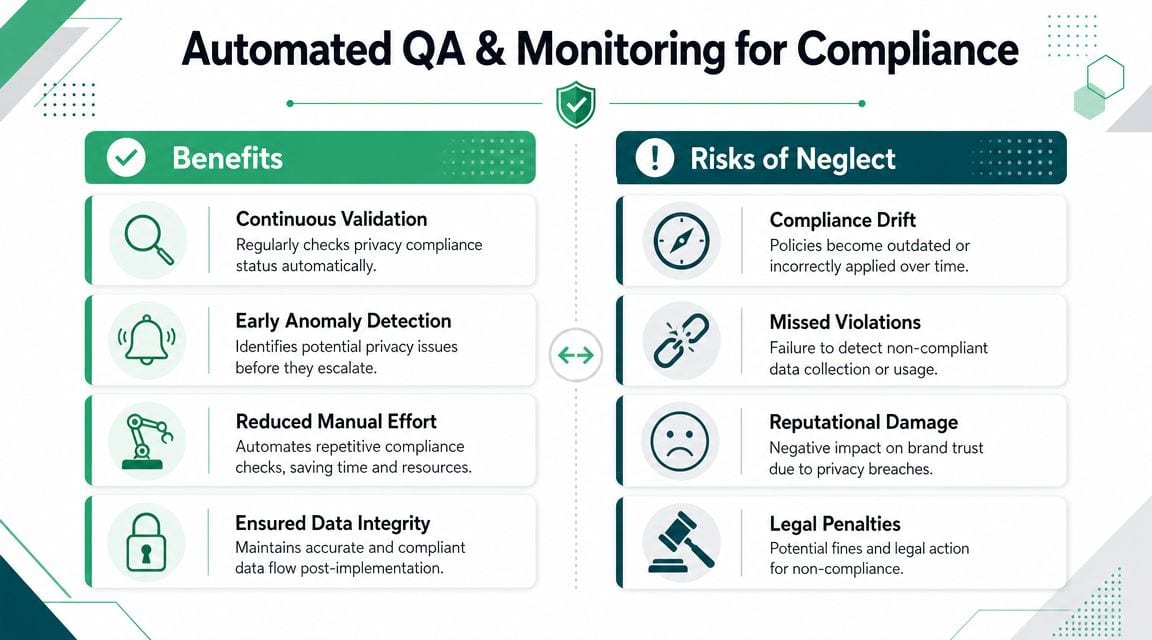
Why scheduled audits aren't enough
Periodic reviews help, but they tend to sample behavior rather than observe it continuously. That leaves long gaps where consent issues can pass unnoticed, especially on low-traffic templates, app releases, or campaign landing pages.
The checks that matter most are ongoing:
- Are any tags firing when consent is denied
- Did a new destination appear without review
- Did the consent variable format change
- Are withdrawal flows suppressing downstream collection
- Is browser behavior aligned with app and server-side handling
What automated monitoring should catch
Automated validation is the missing layer for many privacy programs. It doesn't replace governance or implementation. It verifies that they still hold in production.
One option is Trackingplan's guide to consent enforcement verification, which outlines how teams can monitor whether tags, destinations, and consent logic stay aligned after deployment. In practice, this type of monitoring helps detect rogue tags, data layer regressions, potential PII leakage, and consent mismatches without relying on manual spot checks.
That's especially useful in Tealium environments where multiple teams can affect collection behavior. Marketing can add vendors. Developers can change variables. Agencies can publish updates. Compliance needs a way to see what has changed, not what everyone assumes changed.
Monitoring should answer one question quickly: did production behavior still match the policy after the last release?
What to verify regularly
A practical validation routine should include:
- Denied state validation: No restricted tags or calls should fire.
- Granted state validation: Allowed tags should fire as expected, with correct data.
- Withdrawal validation: Previously allowed destinations should stop receiving data after revocation.
- Schema checks: Consent-related fields should keep the same names and values over time.
If you want additional walkthroughs, the privacy and QA material on the Trackingplan YouTube channel is worth reviewing alongside your own test cases.
Common Pitfalls and Advanced Considerations
The most common mistake is assuming the framework ends at the banner. It doesn't. It ends where every relevant data flow either complies or gets blocked.
A major edge case is Global Privacy Control. Tealium's materials note support for opt-out cookies and GPC, and the broader challenge is getting browser-level signals to coexist with your own preference center, app states, and downstream measurement needs. Tealium also notes that U.S. privacy laws are converging on opt-out rights, and California regulators finalized rules in 2024 requiring businesses to honor browser-based signals like GPC, which raises real implementation questions around conflicting signals and suppression logic in its article on protecting data as a competitive advantage.
Problems basic setups miss
- Signal conflicts: A browser sends an opt-out signal, but the site UI shows an older saved preference.
- Partial suppression: Analytics stops, but an ad connector still receives enriched events.
- Withdrawal gaps: Revocation updates the banner state but not the mobile SDK or server event policy.
- Template assumptions: A prebuilt setup works on one property and breaks on another because the data layer differs.
What mature teams do differently
They test every consent state, not just grant and deny. They test by region. They test after releases. They review vendor inventory continuously. And they don't assume a “temporary exception” will remain temporary unless someone documents and revalidates it.
The harder truth is that compliance is less about initial configuration and more about operational discipline.
If your team runs Tealium across web, app, or server-side flows, Trackingplan can serve as a validation layer that monitors tags, destinations, consent behavior, and data layer changes in production so you can catch drift before it turns into a privacy incident.