
TL;DR:
- Choosing the right user behavior tracking methods is increasingly complex due to ad-blockers, privacy restrictions, and regulations like GDPR and CCPA.
- A hybrid approach using server-side and client-side methods, combined with ongoing governance, provides the most accurate and compliant insights into user behavior.
Choosing the right user behavior tracking methods has never been more complicated. Ad-blockers now affect a significant share of web traffic, browser privacy restrictions tighten every year, and regulations like GDPR and CCPA have fundamentally changed what you can collect and how. Yet the pressure to prove campaign ROI and understand the customer journey has only increased. This article breaks down every major tracking method available today, the criteria you should use to evaluate them, and where each one fits into a real marketing stack in 2026.
Table of Contents
- Key takeaways
- 1. The criteria that should guide your choice of user behavior tracking methods
- 2. Cookie-based tracking and first-party data collection
- 3. Browser event tracking with JavaScript SDKs
- 4. Server-side and hybrid tracking methods
- 5. Heatmaps, session recordings, and qualitative behavior methods
- 6. User engagement tracking metrics that actually predict outcomes
- 7. UEBA and AI-driven behavior analytics techniques
- 8. Comparing methods side by side and choosing the right fit
- My honest take on where user behavior tracking is heading
- How Trackingplan keeps your tracking accurate and compliant
- FAQ
Key takeaways
| Point | Details |
|---|---|
| Client-side tracking has a data ceiling | Ad-blockers and browser restrictions cause 35–40% data loss on conversion events alone. |
| Server-side tracking recovers lost data | Sending events from your backend bypasses browser-level interference and improves attribution accuracy. |
| Privacy compliance is non-negotiable | Consent management, pseudonymization, and first-party data strategies must be built into your tracking architecture from day one. |
| Layering methods beats relying on one | Combining client-side, server-side, and qualitative tools produces the most accurate picture of user behavior. |
| Data quality determines analytics value | Broken schemas and inconsistent event names corrupt your data over time. Governance must be ongoing, not a one-time setup. |
1. The criteria that should guide your choice of user behavior tracking methods
Before comparing specific tools and techniques, you need a framework. Not every tracking method fits every organization, and picking the wrong one wastes budget and distorts your data.
Accuracy and data completeness. Your first question should be: how much data are you actually losing? Self-reported user data routinely diverges from actual behavior, which means observed behavioral data is always more reliable. Add browser-level privacy protections and ad-blockers, and client-side-only setups can become dangerously incomplete.
Privacy compliance. With GDPR, CCPA, and a growing list of regional regulations, every tracking method needs to account for consent management, data minimization, and user rights. Privacy-first tracking requires consent platforms, pseudonymization, and a preference for first-party over third-party data.
Implementation and maintenance burden. Server-side setups offer accuracy advantages but demand engineering resources. JavaScript SDKs deploy fast but require ongoing schema governance.
Here are the other criteria worth evaluating before committing to a method:
- Cross-device and logged-in user tracking capability
- Native integrations with your analytics and marketing platforms
- Infrastructure and licensing costs at scale
- Time to first meaningful data
- Vendor lock-in risk
Pro Tip: Before evaluating tools, audit what percentage of your current conversions are being captured. If you have not done this in the last six months, your optimization decisions are based on incomplete data.
2. Cookie-based tracking and first-party data collection
Cookies remain foundational to web analytics, but the gap between first-party and third-party cookies is now enormous from a practical standpoint.
Third-party cookies, which allowed advertisers to track users across unrelated domains, are effectively dead in most modern browsers. Safari blocked them years ago via Intelligent Tracking Prevention. Firefox followed. Chrome’s deprecation timeline has shifted, but the direction is fixed.
First-party cookies, set by your own domain, remain viable and are the backbone of most session tracking setups. They persist across pages, carry session identifiers, and support login state tracking. The key risk is duration: browser restrictions like ITP cap first-party cookie lifetimes set via JavaScript at seven days or less, which breaks longer conversion windows for many marketing campaigns.
The practical implication is that cookie-based tracking needs to be paired with server-set cookies, where your backend writes the cookie via an HTTP response header rather than a client-side script. Server-set cookies are not subject to the same ITP restrictions and can maintain full attribution windows.
3. Browser event tracking with JavaScript SDKs
JavaScript-based event tracking is what most marketers think of when they hear “user behavior analytics.” Google Analytics 4, Mixpanel, Amplitude, and Segment all operate primarily on this model. A snippet loads on your page, listens for user actions, and fires events to a collection endpoint.

The advantages are real. Deployment is fast. The tooling is mature. Most platforms have pre-built integrations with ad networks, CRMs, and data warehouses. For teams without dedicated engineering resources, JavaScript SDKs let you get tracking live in days rather than weeks.
The ceiling, though, is significant. Sites relying only on client-side tracking typically lose 35 to 40% of conversion events to ad-blockers and browser privacy tools. That means your funnel analysis, ROAS calculations, and attribution models are working from roughly 60 to 65% of actual events. For high-traffic ecommerce sites, that gap translates directly to misallocated ad spend.
Heatmaps, session recordings, and mouse tracking tools like Microsoft Clarity or FullStory also fall into this category. They capture where users click, how far they scroll, and where they rage-click. These are valuable for UX analysis and form optimization, but they capture behavior qualitatively rather than as structured events you can query.
A note on event schema consistency: Strict, versioned event schemas are not optional. Without enforced naming conventions across teams, your event data degrades over time into a patchwork of inconsistent properties that break dashboards and make attribution unreliable.
4. Server-side and hybrid tracking methods
This is where accurate user behavior tracking in 2026 gets serious.
Server-side tracking sends events from your own backend infrastructure directly to analytics APIs, bypassing the browser entirely. No ad-blocker can intercept a request from your server to Google’s Measurement Protocol or Meta’s Conversions API. This alone closes the majority of the data loss gap that afflicts client-side-only setups.
The most widely used implementations today combine GA4’s Measurement Protocol with Meta CAPI. Your server listens for key events, such as purchases or form submissions, and fires them independently of whatever the browser is doing. Even if a user has every tracking blocker active, the event still reaches your analytics platform.
The real complexity in server-side tracking comes from identity resolution. Without the browser context, you need to explicitly pass user identifiers in every event payload. Identity stitching connects anonymous pre-login sessions to known users via hashed stable identifiers and a consistent event taxonomy. Get this wrong and you end up with duplicate user profiles, inflated session counts, or broken funnel analysis.
Pro Tip: When deploying server-side tracking alongside existing client-side tags, implement deduplication logic from day one. Both your browser tag and your server may fire the same event. Use a shared event ID to deduplicate on the receiving end, or you will double-count conversions and corrupt your attribution data.
Hybrid models, where client-side tracking handles UX-level behavioral signals and server-side tracking handles conversion and transaction events, give you the best of both approaches. The client layer captures rich interaction data. The server layer guarantees conversion accuracy. Together, they produce a more complete picture than either method alone. For a deeper look at how this works in practice, Trackingplan’s coverage of server-side tracking for data accuracy in 2026 walks through the architecture decisions in detail.
5. Heatmaps, session recordings, and qualitative behavior methods
Quantitative event tracking tells you what happened. Qualitative behavior tools tell you why.
Session recordings show you exactly how a real user navigated your checkout flow, where they hesitated, and what they did immediately before abandoning. Heatmaps aggregate click and scroll behavior across thousands of sessions into a visual layer that makes problem areas obvious without requiring you to write a single SQL query.
These tools have two meaningful limitations. First, they cannot be queried at scale the way structured event data can. You cannot build a retention model or a predictive lead score from session recordings. Second, privacy regulations require careful implementation. Session recording tools must be configured to mask sensitive form fields and respect consent signals.
The strongest use case for qualitative methods is hypothesis generation. You see that users are clicking on a non-clickable image repeatedly. That insight informs a product change. You then measure the impact with structured event tracking. Combining quantitative metrics with qualitative feedback consistently produces deeper behavioral understanding than relying on either source alone.
6. User engagement tracking metrics that actually predict outcomes
Most marketing teams track the wrong engagement metrics. Page views and bounce rate are easy to report but poor predictors of business outcomes.
The metrics that actually matter are behavioral sequences and retention signals. Day 7 retention is a more reliable predictor of product-market fit than total downloads or new user counts. A DAU/MAU ratio above 0.4 indicates genuine stickiness in productivity tools, while a ratio of 0.2 is typical for social apps. These ratios give you a fast, comparative read on whether users are coming back.
For campaign analytics, the engagement metrics worth tracking include:
- Feature adoption rate within the first session
- Time between key events in a conversion funnel
- Return visit frequency within 30 days of acquisition
- Drop-off points in multi-step flows by traffic source
The pattern here is that retention-based metrics reveal whether your product is actually serving users, not just whether your acquisition channels are working. Acquisition is easy to game. Retention is not.
7. UEBA and AI-driven behavior analytics techniques
User and Entity Behavior Analytics, commonly called UEBA, originated in cybersecurity but has meaningful applications in enterprise marketing analytics and fraud detection.
The core idea is to establish a behavioral baseline for individual users and flag statistically significant deviations. In a security context, that might mean detecting an insider threat. In a marketing context, it can identify fraudulent conversions, bot traffic inflating your campaign metrics, or loyalty program abuse.
The technology has advanced significantly. Hybrid AI models combining Transformer-based sequence modeling and graph neural networks now achieve 97.9% accuracy in behavioral anomaly detection, with false positives reduced to just 11 per 1,000 sessions. That level of precision was not achievable with traditional rule-based anomaly detection.
| Approach | Accuracy | False positive rate | Best use case |
|---|---|---|---|
| Rule-based anomaly detection | ~75% | High | Simple threshold alerts |
| Machine learning (single model) | ~88% | Moderate | Fraud scoring |
| Hybrid Transformer + GNN (UEBA) | 97.9% | 11 per 1,000 sessions | Insider threats, complex fraud |
For most marketing teams, full UEBA deployment is overkill. But the underlying principle, that sequence-aware ML models capture behavioral order effects for predictive insights, applies directly to personalization engines, churn prediction, and next-best-action models.
“The value of AI-driven behavioral analytics is not just anomaly detection. It is building a continuous model of what ‘normal’ looks like for each user segment so that deviations, whether threatening or just an opportunity, surface automatically.”
8. Comparing methods side by side and choosing the right fit
No single user behavior tracking method covers every scenario. The right choice depends on your goals, your team’s technical capacity, and your privacy obligations.
| Method | Data accuracy | Privacy risk | Implementation effort | Best for |
|---|---|---|---|---|
| Client-side JS tracking | Medium (60–65%) | Medium | Low | Fast deployment, UX events |
| First-party cookies (server-set) | High | Low | Medium | Session continuity, attribution |
| Server-side tracking | High | Low | High | Conversion accuracy, ad platforms |
| Heatmaps and session recordings | High (qualitative) | Medium | Low | UX optimization, hypothesis generation |
| UEBA and AI-driven analytics | Very high | Low to medium | Very high | Fraud detection, personalization at scale |
| Hybrid (client + server) | Very high | Low | High | Enterprise marketing, full-funnel analytics |
For startups and smaller teams, a JavaScript SDK with first-party server-set cookies is the right starting point. It deploys fast, integrates with most ad platforms, and gives you enough data to make early product decisions. Add session recording for qualitative depth.
Growing teams with active paid acquisition programs should prioritize server-side tracking for conversion events. The accuracy improvement directly improves ROAS reporting and bid optimization signals sent back to ad platforms.
Enterprise teams running multi-channel campaigns need the full hybrid model, plus a governance layer to keep event schemas consistent across teams and codebases. For understanding user engagement at depth, layering behavioral sequence analysis on top of your event data unlocks the personalization and retention insights that drive real growth.
Regardless of size, every team should treat data quality as infrastructure. One broken pixel or misnamed event property silently corrupts weeks of data before anyone notices. Observed behavioral data is only as reliable as the systems collecting it.
My honest take on where user behavior tracking is heading
I’ve spent years watching marketing teams build elaborate analytics stacks that produce dashboards nobody trusts. The problem is almost never the tool. It’s the data underneath.
What I’ve learned is that most teams add tracking methods before they’ve fixed the accuracy of the ones they already have. They adopt server-side tracking while their existing client-side setup has broken event schemas and missing properties. The new layer just amplifies the existing noise.
My experience with teams that successfully adopted server-side tracking is that the wins came not just from the volume of recovered data, but from the discipline the implementation required. You cannot lazily fire server-side events. You have to define your event schema explicitly, pass identifiers deliberately, and deduplicate carefully. That discipline, applied retroactively to the whole tracking stack, is what actually improved their campaign insights.
The privacy piece is where I see the most avoidance. Teams treat compliance as a legal checkbox rather than a design principle. The teams I’ve seen do it well built consent management and data minimization into their tracking architecture from the start. They collect less, but what they collect is cleaner and more actionable.
My actual recommendation: pick fewer methods, implement them with rigor, and instrument quality monitoring around them. You will get more value from 70% of user actions tracked accurately than from 100% tracked poorly.
— David
How Trackingplan keeps your tracking accurate and compliant
Getting your tracking architecture right is one challenge. Keeping it right as your team ships new features, adds campaigns, and cycles through tools is a different problem entirely.
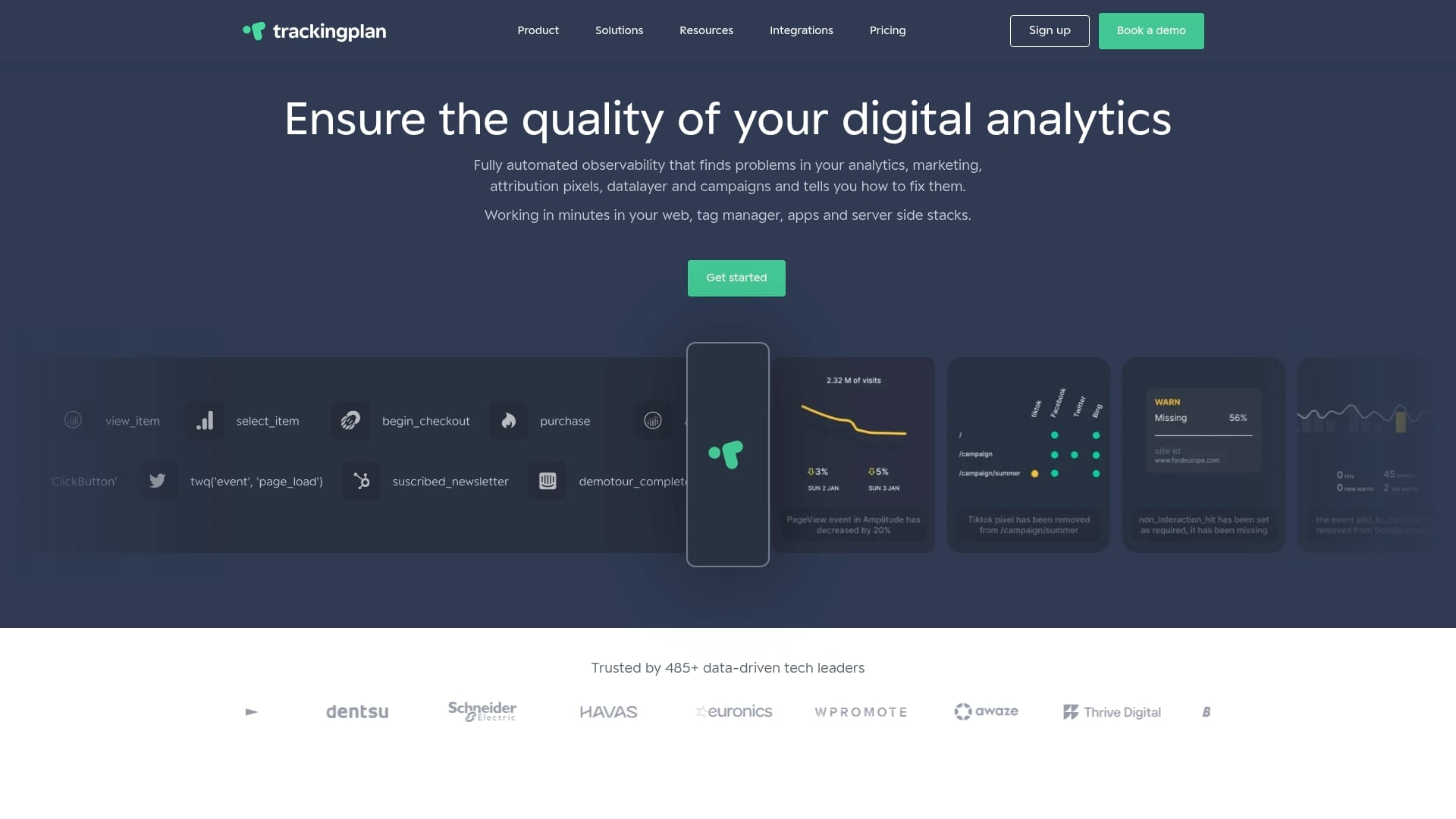
Trackingplan monitors your entire analytics implementation automatically, whether you are running client-side tags, server-side pipelines, or both. It detects broken pixels, schema mismatches, and missing conversion events in real time and alerts your team via Slack, email, or Teams before data loss compounds. Its digital analytics quality tools give marketing and analytics teams a live view of data health across their full Martech stack, without requiring engineers to manually audit tracking on every release. The Trackingplan Privacy Hub adds compliance monitoring for consent signals and data handling, so your privacy-first tracking strategy stays enforced even as your implementation evolves.
FAQ
What are the most accurate user behavior tracking methods?
Server-side tracking combined with first-party cookies offers the highest accuracy, as events are sent directly from your backend and bypass ad-blockers and browser restrictions. A hybrid model pairing server-side conversion tracking with client-side behavioral events covers both accuracy and depth.
How does server-side tracking differ from client-side tracking?
Client-side tracking fires events from the user’s browser, where ad-blockers and privacy tools can intercept them. Server-side tracking fires events from your own backend directly to analytics APIs, so no browser-level interference can block them.
How do I choose between tracking methods for a small team?
Start with a JavaScript SDK and server-set first-party cookies for session continuity. Add a session recording tool for qualitative insight. Prioritize server-side tracking for conversion events once paid acquisition scales up and attribution accuracy becomes critical to ROAS reporting.
What is identity stitching in user behavior tracking?
Identity stitching connects anonymous pre-login sessions to known users by passing a hashed stable identifier through your event data. It creates a continuous behavioral view across devices and sessions without relying on third-party cookies.
Why do marketers lose conversion data with standard tracking setups?
Standard client-side setups miss 35 to 40% of conversion events because ad-blockers and browser privacy protections intercept the tracking requests before they reach analytics platforms. Server-side tracking closes most of that gap by routing events through your own infrastructure.
Recommended
- Tracking Pixels: Boost Marketing Accuracy and ROI in 2026 | Trackingplan
- Why tracking is crucial for marketing success in 2026 | Trackingplan
- User Acquisition & Attribution Report: Uncover the Origins of Your Success | Trackingplan
- 10 Actionable Examples of Channel Marketing That Drive Growth in 2026 | Trackingplan