
TL;DR:
- Monitoring ad spend in real time helps prevent waste, optimize performance, and build trust with finance teams. Automated systems with frequent cycles and cross-channel dashboards significantly reduce overspend and improve margin protection. Without proper oversight, teams risk undetectable overspending, attribution errors, and client churn.
Monitoring ad spend is the practice of tracking advertising budgets in real time to detect inefficiencies, prevent overspending, and maximize return on investment. Without it, the average Google Ads account wastes 12% of total spend on undetected anomalies. On a $10,000 monthly budget, that is $1,200 gone every month and $14,400 every year. For marketing professionals managing campaigns across Google Ads, Meta Ads, and LinkedIn, the importance of tracking ad spend goes beyond financial hygiene. It is the difference between campaigns that scale and campaigns that silently drain budgets while reporting looks clean.
Why monitor ad spend: the core case for budget oversight
Ad spend monitoring is the discipline of comparing planned budgets against actual expenditure in real time, then acting on the gap. The industry term for this practice is budget vs. actual management, and it applies across every paid channel from search to programmatic display.
The benefits of monitoring your marketing budget fall into three categories: waste reduction, performance optimization, and stakeholder alignment.
- Waste reduction: Broken pixels, misconfigured targeting, and duplicate campaigns all consume budget without generating conversions. Catching these errors early stops compounding losses before they become quarterly write-offs.
- Performance optimization: When you know which campaigns are pacing ahead of budget and which are underdelivering, you can reallocate spend toward what is working. This is not a monthly exercise. It is a daily one.
- Stakeholder alignment: 49% of U.S. B2B marketers report strict budget constraints. That means CFOs and finance teams are watching. Marketers who can show real-time spend data against planned budgets earn credibility and budget authority that those who cannot simply do not.
Marketing leaders also face a structural problem: unified cross-channel visibility is rare, which makes it nearly impossible to justify spend convincingly to finance stakeholders. Ad spend monitoring solves this by creating a single source of truth across platforms.
Pro Tip: Set up a shared dashboard that pulls spend data from Google Ads, Meta Ads, and any programmatic platforms into one view. When a CFO asks why you need more budget, you answer in seconds, not days.

How does automated monitoring improve tracking accuracy?
Manual monitoring has a structural flaw. You check dashboards once a day, maybe twice. Campaigns do not pause between your checks.
Manual daily checks fail to catch budget spikes that occur between intervals. Between Friday afternoon and Monday morning, a campaign can overspend by $500 to $2,000 with no one watching. That is not a hypothetical. It is a documented pattern that hits agencies and in-house teams alike every weekend.
Automated monitoring solves this with frequency and precision. Here is how a well-structured automated system operates:
- 15-minute monitoring cycles: Built-in ad platform budget rules run on daily cycles and cannot detect gradual or cross-metric anomalies. Dedicated tools that check every 15 minutes reduce monthly waste from $1,867 to $92 per account. That is a 95% reduction in preventable loss.
- Threshold-based alerts: Alerts fire at 50%, 75%, 90%, and 100% of budget consumed. Each threshold triggers a different response, from a Slack notification at 50% to an automatic campaign pause at 100%.
- Auto-pause functionality: When a campaign hits its budget ceiling, auto-pause stops spend immediately. Without it, Google Ads and Meta Ads continue serving ads for hours after a daily budget is technically exhausted, billing you for the overage.
- Cross-channel aggregation: A single campaign objective often spans Google, Meta, and programmatic networks. Monitoring each platform in isolation misses the total spend picture. Automated tools that aggregate across channels give you the full number.
Agencies that adopt automated budget alerts save an average of $8,000 per client annually by preventing overspend and avoiding costly refunds. Across a 20-client book of business, that is $160,000 in protected margin every year.
Pro Tip: When setting up cross-channel monitoring, treat total campaign budget as the primary constraint, not individual platform budgets. A campaign that is on-pace in Google Ads but overspending in Meta will look fine in platform-level reports and catastrophic in your P&L.
What metrics and practices support effective ad spend tracking?
Tracking ad spend without the right metrics is like monitoring a patient’s temperature while ignoring blood pressure. You need a full panel.
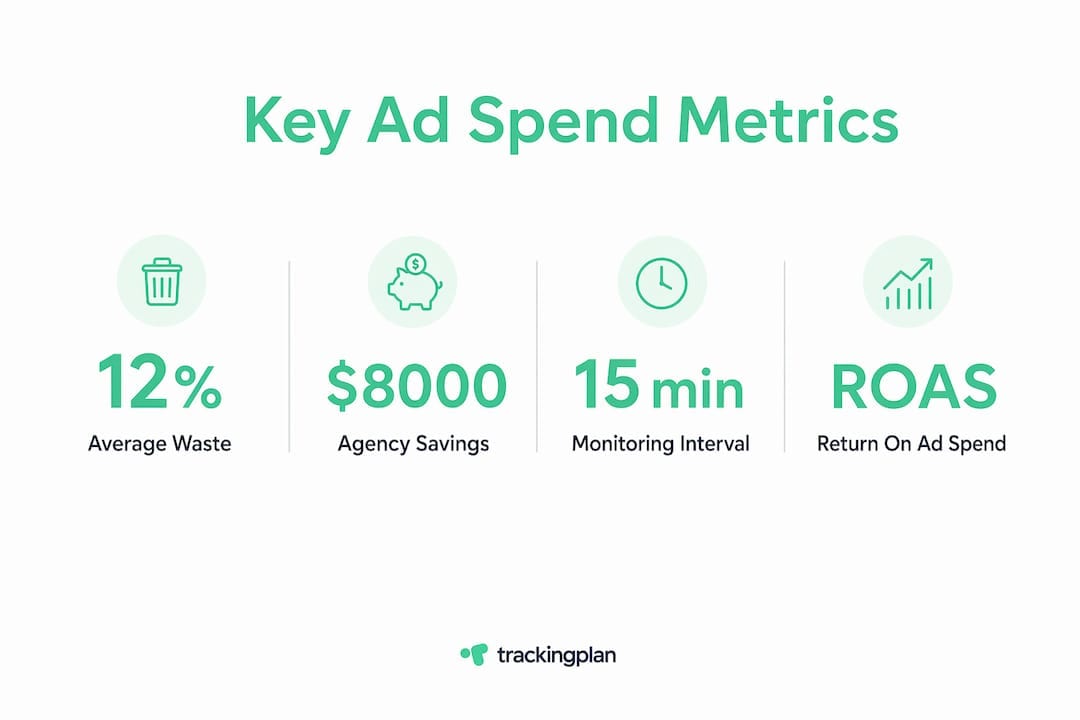
The core KPIs for ad spend management are return on ad spend (ROAS), cost per acquisition (CPA), customer acquisition cost (CAC), and conversion rate by channel. ROAS tells you the revenue generated per dollar spent. CPA tells you what each conversion costs. Together, they tell you whether your budget is working or just moving.
Variance management is the practice of comparing budgeted spend against actual spend on a weekly or monthly cycle. Weekly budget vs. actual reviews enable early identification of poorly performing campaigns before capital becomes locked in. A campaign that is 30% over budget in week two of a four-week flight will blow the monthly allocation unless you intervene. Catching it in week two costs you a conversation. Missing it costs you the budget.
The table below shows where manual and automated monitoring each succeed and where they fall short:
| Monitoring approach | Strengths | Limitations |
|---|---|---|
| Manual daily checks | Low cost, full human context | Misses overnight and weekend spikes, slow response time |
| Platform-native rules | Built into Google Ads and Meta Ads, no setup cost | Daily cycle only, cannot detect cross-metric anomalies |
| Dedicated automated tools | 15-minute cycles, cross-channel alerts, auto-pause | Requires initial configuration and integration |
| Unified dashboard (e.g., Trackingplan) | Real-time cross-platform visibility, AI anomaly detection | Requires data pipeline setup |
Practical steps that support effective ad budget oversight include daily spend caps at the campaign level, pacing budgets that distribute spend evenly across a flight period, and scenario analysis that models what happens to ROAS if spend increases by 20% or drops by 30%. These are not advanced techniques. They are table stakes for any team spending more than $10,000 per month on paid media.
59% of CMOs report lacking the resources to execute their strategy, which makes spend pacing and saturation monitoring even more critical. When budget is tight, every dollar needs a documented reason to exist.
What challenges arise without proper ad spend monitoring?
The risks of skipping spend monitoring are not abstract. They are specific, measurable, and often irreversible within a budget period.
The most common challenges marketing teams face without proper oversight include:
- Overspend without detection: Campaigns running on broad match keywords or wide audience targeting can exhaust monthly budgets in days. Without monitoring, you discover the problem when the invoice arrives.
- Attribution gaps: When tracking pixels break or fire incorrectly, conversion data becomes unreliable. You may be cutting your best-performing campaigns based on bad data while scaling the ones that are actually losing money.
- Data silos: Google Ads, Meta Ads, and programmatic platforms each report in their own interface. Without aggregation, your total spend picture is always incomplete. This is where integrated financial and marketing systems that provide shared dashboards and predictive analytics become operationally necessary.
- Client churn for agencies: Campaign overspend incidents are a leading cause of client churn. A single overspend event can wipe out a month’s margin on a managed account and permanently damage the client relationship.
- Strategic misalignment: When marketing and finance operate on different data, budget conversations become adversarial. Marketing asks for more spend. Finance sees costs rising without clear revenue attribution. Neither side wins.
The solution is not more manual effort. It is the right architecture. Adopt automated monitoring tools, establish alert thresholds before campaigns launch, and connect your spend data to your revenue reporting. Teams that do this move from reactive expense tracking to proactive investment management. That shift is what separates marketing organizations that grow budgets from those that defend them.
Key takeaways
Monitoring ad spend is the single most effective way to protect marketing budgets, improve attribution accuracy, and build the cross-channel visibility that earns finance team trust.
| Point | Details |
|---|---|
| Waste is measurable and preventable | The average Google Ads account loses 12% of spend to undetected anomalies, totaling $14,400 annually on a $10,000 monthly budget. |
| Automation outperforms manual checks | 15-minute monitoring cycles reduce monthly waste from $1,867 to $92 per account, a result daily checks cannot achieve. |
| Agencies save $8,000 per client | Automated budget alerts and auto-pause prevent overspend that erodes margin and damages client relationships. |
| Unified dashboards are non-negotiable | Cross-channel visibility across Google Ads, Meta Ads, and programmatic platforms is required to justify spend to finance stakeholders. |
| Variance management drives discipline | Weekly budget vs. actual reviews catch underperforming campaigns before capital becomes locked in for the full flight period. |
The uncomfortable truth about ad spend monitoring
I have reviewed hundreds of paid media accounts over the years, and the pattern is almost always the same. Teams that think they are monitoring their ad spend are actually monitoring their reporting. Those are not the same thing.
Reporting tells you what happened. Monitoring tells you what is happening right now, and whether it matches what you planned. The gap between those two things is where budget gets lost.
The most common mistake I see is over-reliance on platform-native controls. Google Ads and Meta Ads have budget rules, yes. But those rules run on daily cycles and cannot catch the kind of gradual drift or cross-channel overspend that compounds quietly over a two-week period. By the time the monthly report surfaces the problem, the money is already spent.
What actually works is a layered approach. You need platform-level caps, a dedicated monitoring tool running on short cycles, and a unified view that aggregates spend across every channel. The real-time monitoring benefits are not theoretical. They show up directly in margin protection and in the quality of conversations you can have with finance teams.
The other thing I would push back on is the idea that monitoring is a finance function. It is not. It is a performance function. The teams that treat spend monitoring as a core part of campaign management, not an afterthought, are the ones that consistently hit their ROAS targets and grow their budgets year over year. That is not a coincidence.
— David
How Trackingplan helps you protect every dollar of ad spend
Trackingplan gives marketing teams and agencies the real-time visibility they need to stop budget waste before it compounds. The platform automatically detects broken pixels, missing tracking events, and campaign misconfigurations across Google Ads, Meta Ads, and server-side environments, then fires alerts via Slack, email, or Teams the moment something goes wrong. For teams managing digital analytics data quality, Trackingplan’s AI-assisted debugger identifies the root cause of tracking errors so you fix the right thing fast. The AI-assisted debugger also surfaces attribution gaps that manual audits routinely miss. When your tracking is accurate, your spend decisions are accurate. That is the foundation Trackingplan is built on.
FAQ
Why is monitoring ad spend critical for ROI?
Monitoring ad spend prevents budget waste from broken tracking, misconfigured campaigns, and undetected anomalies that silently consume budget without generating conversions. The average Google Ads account loses 12% of total spend to these issues, which equals $14,400 annually on a $10,000 monthly budget.
How often should ad spend be monitored?
Ad spend should be monitored in 15-minute cycles using dedicated tools, not daily manual checks. Platform-native rules run on daily cycles and miss gradual or cross-metric anomalies that cause the majority of preventable overspend.
What metrics matter most for tracking advertising costs?
ROAS, CPA, and conversion rate by channel are the primary KPIs for evaluating advertising expenses. Variance management, comparing budgeted spend against actual spend weekly, adds the financial discipline needed to catch underperforming campaigns before they exhaust the full budget.
How does automated monitoring benefit agencies specifically?
Agencies using automated budget alerts and auto-pause functionality save an average of $8,000 per client annually by preventing overspend and avoiding refunds. Campaign overspend is also a leading cause of client churn, making proactive monitoring a client retention tool as much as a financial one.
What is the biggest risk of skipping ad spend monitoring?
The biggest risk is attribution failure. When tracking pixels break or fire incorrectly, conversion data becomes unreliable, causing teams to cut high-performing campaigns and scale losing ones based on bad data. Accurate spend monitoring depends entirely on accurate tracking data underneath it.