
A growth lead approves a campaign at 9:00 a.m. By lunch, an agent has built audience segments, generated creative variants, pushed changes into paid social, and shifted budget toward the best early signal. By 3:00 p.m., revenue reporting is off because one event stopped firing after a site release, UTMs were overwritten in a redirect, and the agent kept optimizing against incomplete conversion data.
That scenario is much closer to agentic AI marketing than many teams expect. The jump from AI-assisted work to autonomous execution is already underway across martech, as reflected in the martech changes that defined 2025. The question is no longer whether software can take action across marketing systems. The question is whether your data can support that level of autonomy.
The upside is obvious. Agentic systems can plan, execute, monitor, and adapt without waiting for a human prompt at every step. They can speed up testing, reduce operational drag, and coordinate work across channels that usually live in separate tools.
The constraint is less glamorous and far more important. Autonomous agents inherit the quality of the tracking, schemas, naming conventions, consent signals, and destination logic underneath them. If that foundation is unstable, agents scale confusion faster than any human team could. Teams that succeed with agentic AI will be the ones that know when to trust, constrain, and override their systems, and that starts with observability and governance.
The Dawn of Self-Driving Marketing
At 9:00 a.m., a growth team approves a campaign brief. By lunch, an autonomous system has pulled audiences, generated creative, launched tests, updated bids, and routed leads into the CRM. By late afternoon, performance looks strong on the surface, but one broken event, one bad consent flag, or one naming mismatch can send the whole system in the wrong direction.
That is the core promise and risk of agentic AI marketing. It does not just assist with tasks. It acts across systems. It can coordinate media, lifecycle, analytics, and CRM workflows faster than any human team can manage manually. But speed only helps if the inputs are trustworthy.
Many teams are already feeling the pressure described in the martech changes that defined 2025. Tool sprawl is giving way to orchestration. The operating question is changing from “which platform does this task?” to “which system is allowed to decide and act?”
That shift matters because marketing execution has been constrained by operations for years. Teams lose time to broken tags, unclear attribution, inconsistent audience definitions, delayed reporting, and release-driven tracking regressions. Agentic systems can remove a large share of that manual coordination. They can also amplify every weakness in the measurement layer beneath them.
Self-driving marketing has a narrow, practical meaning. An agent gets a defined objective, access to approved systems, and a clear range of actions. It can optimize spend, launch variants, enrich records, trigger journeys, or escalate anomalies. Some teams already host production-ready AI agents for adjacent operational work. Marketing will follow the same path, but only where controls are explicit.
A useful test is simple. If the team cannot define the goal, the allowed actions, the data sources, and the stop conditions, the workflow is not ready for autonomy.
The first wave of value will come from bounded workflows with measurable outcomes. Budget pacing. Lead routing. Journey branching. Catalog updates. Conversion anomaly detection. Those are good candidates because the objective is clear and the blast radius is easier to contain.
The harder truth is that autonomy raises the cost of bad data. A human specialist might notice that paid social conversions suddenly dropped because a key event stopped firing after a release. An agent may keep reallocating budget against that incomplete signal until wasted spend shows up in finance. That is the data quality gap. It is the main reason some teams will get real gains from agentic AI while others will automate bad decisions at scale.
The winners will not be the teams with the most agents. They will be the teams with reliable tracking, observable data flows, governed schemas, and fast detection when something breaks. That foundation determines whether autonomy improves marketing performance or just accelerates reporting errors.
What Is Agentic AI in a Marketing Context
Marketers often already understand two forms of AI.
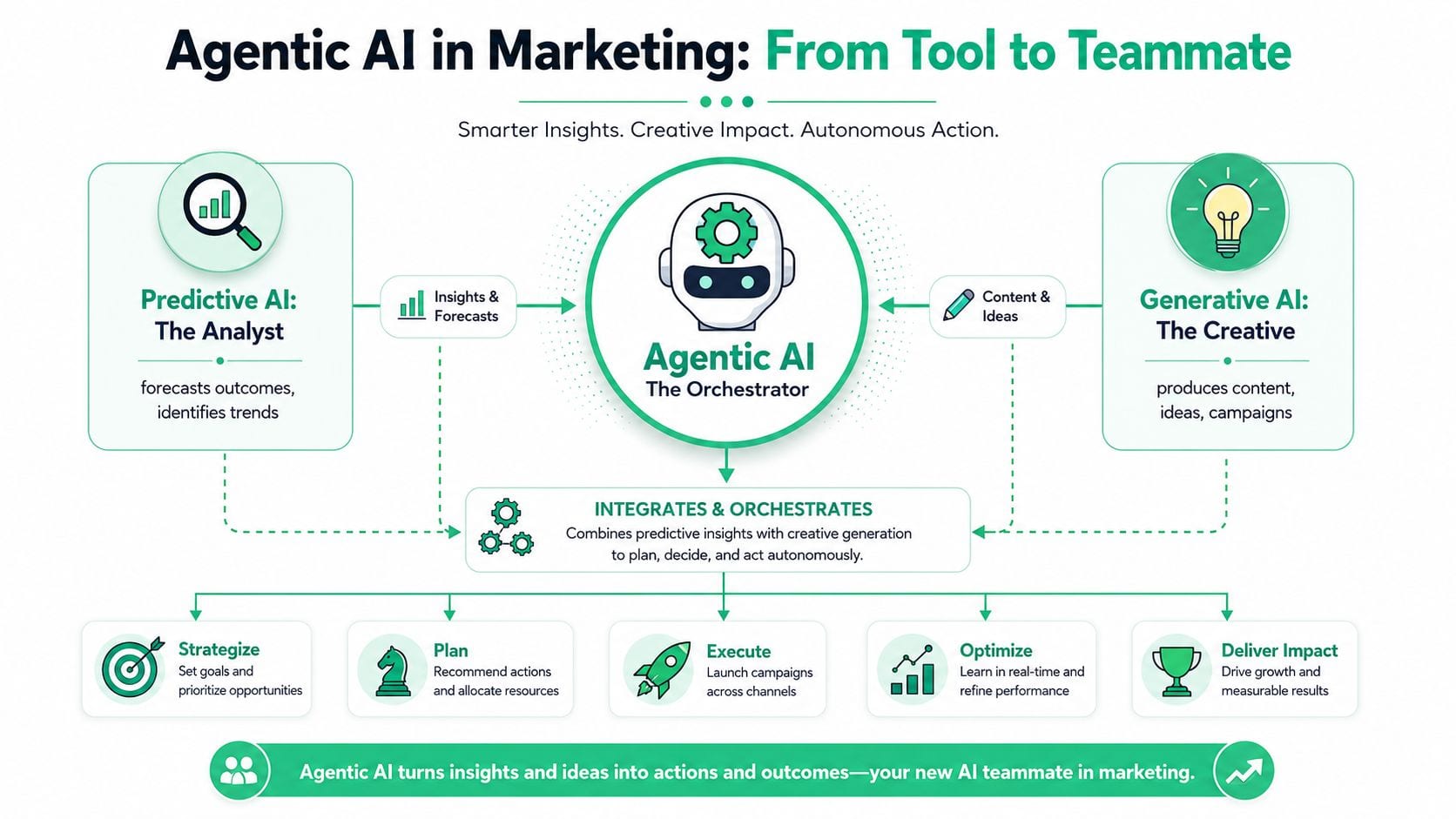
Predictive AI tells you what may happen. It scores leads, forecasts churn, and estimates conversion likelihood. Generative AI creates assets on demand. It drafts subject lines, ad copy, image prompts, landing page sections, and summaries.
Agentic AI is different. It doesn't stop at analysis or content creation. It plans, decides, and executes through a sequence of decisions to pursue a goal, coordinating tools and sometimes other agents along the way, as described in this explanation of agentic AI's operating mode.
From assistant to manager
Here's a simple perspective:
- Predictive AI is the analyst.
- Generative AI is the creative assistant.
- Agentic AI is the project manager.
The analyst says, “This audience is likely to convert.”
The creative assistant says, “Here are five ad variations for that audience.”
The manager says, “Use that audience, launch the top two variants, pause the weak channel, shift budget, and report what changed.”
That's a meaningful operational jump. It turns AI from a task-level helper into a goal-seeking system.
Predictive vs. Generative vs. Agentic AI in Marketing
| Capability | Predictive AI (The Analyst) | Generative AI (The Creative) | Agentic AI (The Manager) |
|---|---|---|---|
| Primary role | Forecasts outcomes | Produces content | Pursues goals through actions |
| Input style | Historical and behavioral data | Human prompts and context | Goals, constraints, live signals, tool access |
| Output | Scores, forecasts, recommendations | Copy, images, summaries, ideas | Decisions, tool calls, workflow execution |
| Human involvement | Human decides what to do | Human asks for each task | Human sets guardrails and reviews exceptions |
| Best fit | Lead scoring, churn prediction, demand forecasting | Content production, ideation, variation generation | Campaign orchestration, cross-tool optimization, autonomous operations |
The operating loop
Agentic AI marketing works because it closes a loop:
- Sense incoming signals from analytics, CRM, ad platforms, web behavior, and product usage.
- Reason over those signals in context of a goal.
- Act through APIs, workflows, and connected tools.
- Learn from what happened and adjust the next decision.
That's why teams looking to host production-ready AI agents should evaluate more than model quality. They need execution controls, integrations, auditability, and real operational boundaries.
Agentic AI doesn't replace the tools marketers already use. It coordinates them toward an outcome.
In marketing, that distinction matters. A standalone model can write copy. A true agentic system can decide whether that copy should be generated at all, where it should run, which audience should see it, and what to do next if performance degrades.
Core Architectures and Capabilities
Most agentic AI marketing systems look complex from the outside and fragile from the inside. The reason is usually architectural. Teams focus on the reasoning layer because it feels like the “AI part,” but the deciding factor is often the data and execution layer around it.
The five modules that matter
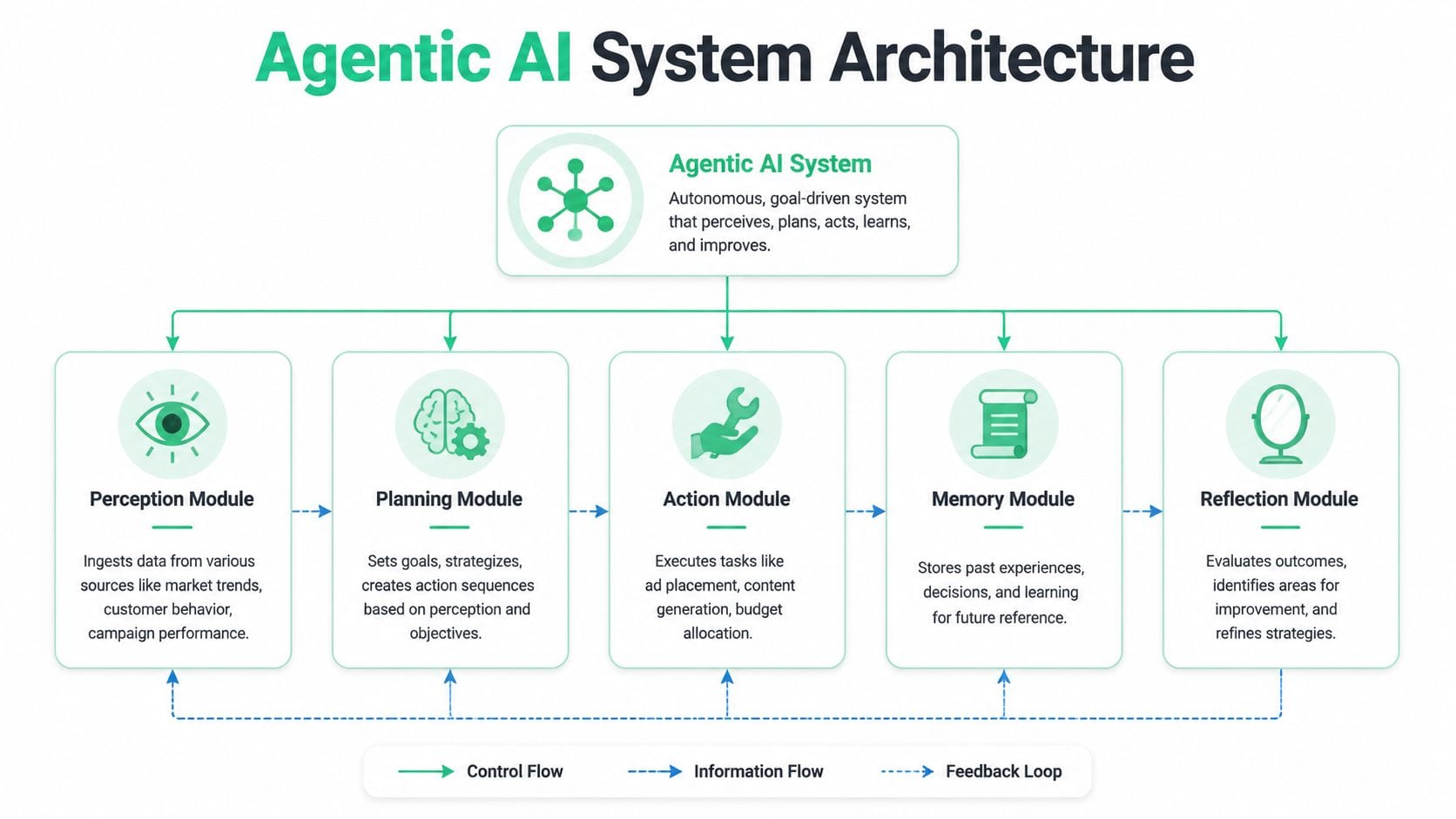
A usable system usually includes five components.
Perception ingests signals from analytics platforms, CDPs, CRMs, ad networks, product telemetry, and support systems. At this stage, source reliability becomes critical. If events are missing or mislabeled, everything downstream starts leaning on a false baseline.
Planning translates a goal into a sequence of steps. For example, “grow qualified demo requests” might become segment selection, message generation, budget allocation, channel sequencing, and monitoring rules.
Action connects the system to execution surfaces. Think Google Ads, Meta, HubSpot, Salesforce, Braze, a CMS, or internal tools. Here, “recommendation” becomes “live spend.”
Memory stores prior outcomes, constraints, learned preferences, and context. Without memory, the agent repeats itself. With memory, it can improve sequencing, suppression logic, and channel choice over time.
Reflection evaluates what happened and whether the system should persist, reverse, or escalate a decision.
Why real-time infrastructure is non-negotiable
Agentic marketing depends on timing. If the system reacts after the moment has passed, it's not orchestrating. It's reporting late.
According to CDP.com's definition of agentic marketing, agentic AI marketing requires a real-time unified customer profile store with sub-second decisioning latency (≤50ms) to support autonomous, multi-step orchestration. The same source notes that batch-synced silos introduce delays of hours or days, which breaks real-time operation. It also states that meeting those latency thresholds can drive a 10 to 15% lift in conversion rates in composable CDP benchmarks.
That has a practical consequence. A reverse-ETL workflow that updates segments later may still support reporting. It won't support real-time autonomous decisioning.
What breaks in the real world
The hard part isn't dreaming up use cases. It's making the stack trustworthy.
Common failure points include:
- Slow data paths: Event data arrives too late for in-session decisions.
- Thin context: Tables are technically available but poorly modeled, so the agent can't reason over metrics confidently.
- Weak action controls: The system can change spend or targeting without clear approval rules.
- No anomaly feedback: The agent keeps optimizing after instrumentation drifts.
For teams trying to compare AI agents to GEO services, the useful distinction is operational depth. Agentic systems don't just surface opportunities. They require a control plane, memory, and action permissions across tools.
For analytics-heavy organizations, agentic analytics is often the better entry point than full campaign autonomy. It forces the team to solve context, modeling, and data trust before giving agents direct control over execution.
The model is rarely the first bottleneck. Data freshness, event integrity, and tool permissions usually are.
Practical Use Cases in Digital Marketing
The easiest way to understand agentic AI marketing is to watch what it does with a concrete goal.
Full-funnel budget orchestration
A performance lead gives the system a target: increase qualified conversions while protecting efficiency. The agent monitors awareness, retargeting, branded search, and lifecycle touchpoints as one connected system instead of separate channel reports.
When upper-funnel traffic quality drops, it doesn't just alert the team. It can reallocate budget, tighten audience criteria, pause weak creative combinations, and keep feed data flowing to the CRM. The marketer reviews exceptions and strategy, not every adjustment.
Autonomous goal decomposition matters. According to Amazon Ads' guide to agentic AI, organizations implementing agentic marketing report 30 to 40% reduction in campaign cycle time, 25 to 35% lower operational costs, and 20 to 30% higher campaign effectiveness.
True one-to-one personalization
A lifecycle marketer wants more than token personalization. Not “Hi Sarah” in the subject line. Actual decisioning based on behavior, channel, and timing.
An agent can interpret a customer's recent activity, determine whether the next best action is email, paid retargeting, on-site content, or no outreach at all, then adapt the sequence. It can change offers, suppress users who already converted, and coordinate messaging so channels stop fighting each other.
The gain isn't just relevance. It's consistency across systems that usually operate in silos.
Creative iteration without the handoff mess
Creative production often stalls between brief, draft, review, launch, and analysis. Agentic workflows compress that cycle.
A system can generate variants, route them into approval rules, deploy them across channels, read early response signals, and retire weak combinations. The human team still protects brand, claims, and legal boundaries. The agent handles the repetitive loop.
If your use case depends on external audience or trend data, it's worth evaluating social media scraping solutions carefully before wiring them into an autonomous workflow. Data collection quality upstream affects every downstream decision.
Lead discovery and enrichment
One of the strongest near-term use cases is structured demand creation. In a real-world example shared in this walkthrough of AI agents for prospecting, four distinct AI agents autonomously built lead lists, enriched prospect data from sources such as LinkedIn profiles, local press mentions, and hospital directories, and ran continuous backend autopopulation, cutting 40 to 60% or more of manual effort.
That's a good example of where agentic systems shine first. The objective is clear. The workflow is multi-step. The outputs are verifiable. Human teams still decide outreach strategy, but the repetitive research work no longer blocks execution.
Your Roadmap to Agentic AI Implementation
A marketing team gives an agent permission to reallocate paid budget across channels. The logic looks sound. The model has access to performance data, conversion trends, and audience signals. Then a tracking change breaks purchase events on a set of landing pages, and the agent starts shifting spend away from campaigns that are working.
That is why implementation needs to start with control, not autonomy.
According to Gartner's top strategic technology trends for 2025, agentic AI will be one of the defining enterprise technology shifts over the next few years. The opportunity is real. So is the failure pattern. Projects stall when teams treat agents like smarter automation instead of operational systems that depend on reliable inputs, explicit permissions, and measurable business outcomes.
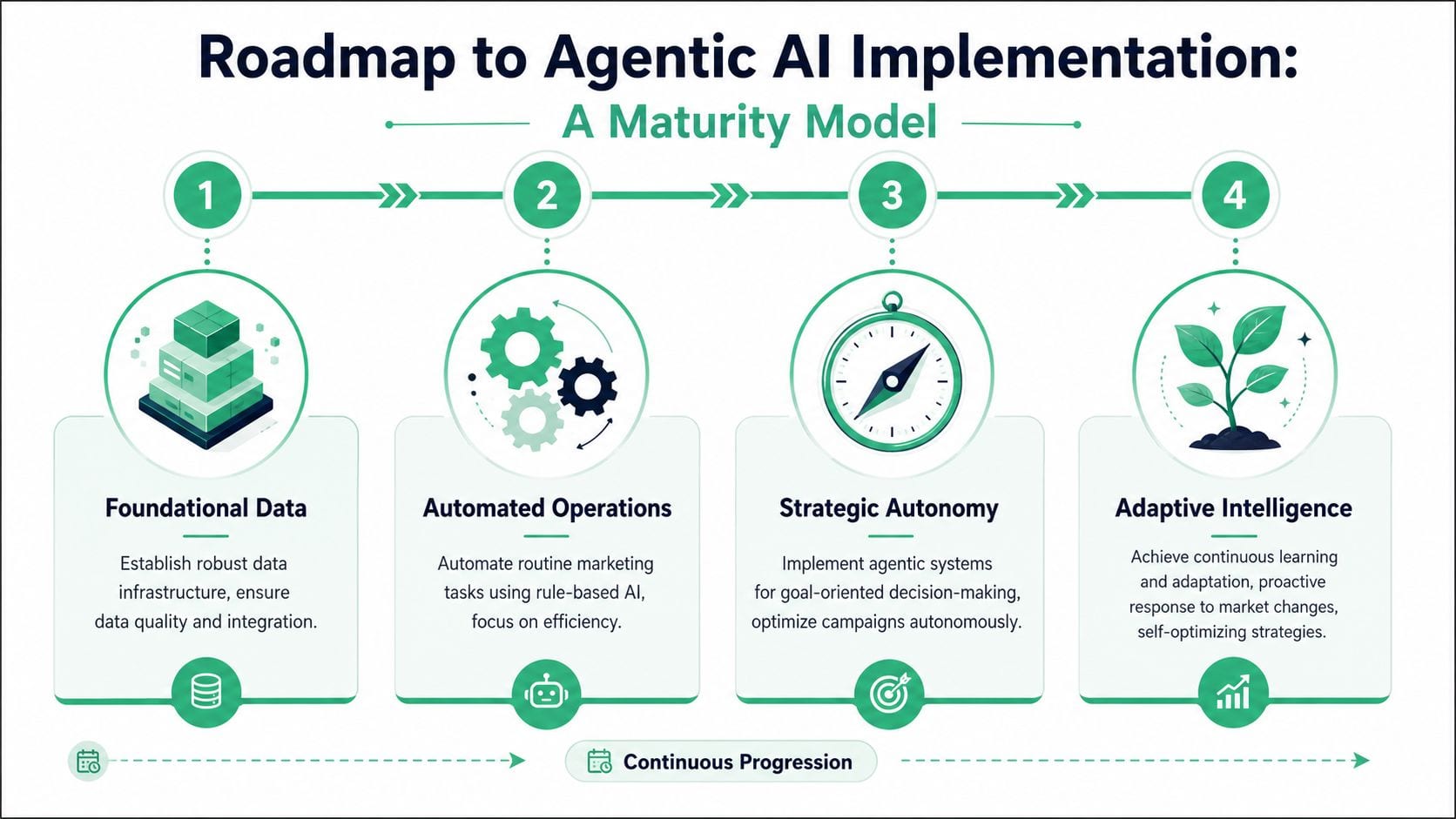
Stage 1 Foundational data
Start with instrumentation, identity rules, taxonomy, campaign tagging, and event governance.
This stage gets underestimated because it does not look cutting-edge on a roadmap slide. In practice, it decides whether agentic AI becomes useful or expensive. Teams need a clear source of truth for spend, sessions, conversions, audiences, and customer state. They also need a way to detect when those signals drift after a site release, app update, consent change, or vendor migration.
If the data layer is unstable, the agent is unstable. A strong automated marketing observability setup helps catch broken events, schema changes, and tagging issues before an agent turns them into budget or targeting mistakes.
Stage 2 Tool-assisted augmentation
Next, use AI inside existing human workflows. Let the system draft audience logic, summarize anomalies, recommend campaign variants, or flag accounts for review.
Teams quickly ascertain the readiness of their operating model. Weak prompts show up fast. So do unclear ownership, bad permissions, and conflicting definitions across analytics, CRM, and ad platforms. Those problems are cheaper to fix while a marketer still approves the action.
I usually treat this phase as a diagnostic step. If teams cannot explain why the copilot made a recommendation, they are not ready to let an agent execute it.
Stage 3 Single-agent automation
Choose one bounded workflow with clear inputs, a narrow action set, and outputs that can be verified. Lead enrichment works well. So does anomaly triage, negative keyword management, or budget pacing within fixed thresholds.
The goal is repeatability. The agent should complete a real task under constraints, log what it did, and produce a result the team can audit against business KPIs. Flashy demos do not matter much here. Stable performance does.
Field note: Teams that jump straight into multi-agent orchestration usually discover governance gaps after launch, when rollback is harder and mistakes affect live spend.
Stage 4 Multi-agent orchestration
Once single-agent workflows are stable, connect agents across a broader go-to-market process. One agent can monitor incoming signals. Another can generate tests. A third can execute changes inside approved limits. A fourth can evaluate outcomes and escalate exceptions.
The hard part is not model quality alone. It is coordination. Agents need shared definitions, clean handoffs, approval logic, conflict rules, and fallback behavior when data is missing or contradictory. Without that discipline, more autonomy just means faster error propagation.
A practical maturity checklist looks like this:
- Clear goals: Business outcomes are defined in operational terms, with success and failure conditions.
- Trusted data inputs: Core events, dimensions, identity logic, and consent signals are stable.
- Action boundaries: Each agent has explicit permissions, budget limits, and stop conditions.
- Review design: High-risk decisions route to humans. Low-risk actions can run automatically with logging.
This roadmap is conservative by design. Agentic AI can create a major advantage in marketing, but only if the data quality gap is handled first. Otherwise, teams automate bad assumptions and scale the wrong decisions.
Observability The Key to Trustworthy Autonomy
A lot of content about agentic AI focuses on what agents can do. Far less attention goes to what happens when their inputs are wrong.
That omission is dangerous. Existing coverage often overemphasizes autonomy while ignoring how poor data quality, including broken pixels, schema mismatches, and UTM errors, directly corrupts agent decisions. That gap becomes more serious because agentic systems operate at individual-level granularity, where small inaccuracies can become catastrophic for ROI, as noted in Sprinklr's discussion of agentic AI in marketing.
The data quality gap is where autonomy fails
Consider a simple example. A paid social campaign appears to be underperforming because conversion events stopped firing on a subset of landing pages after a front-end release. A human analyst might catch the discrepancy after comparing sessions, CRM records, and ad platform trends.
An autonomous agent doesn't “suspect” a tracking failure unless you've designed for that possibility. If it trusts the broken signal, it may cut budget to a healthy campaign, reallocate spend to weaker channels, suppress high-intent audiences, or trigger the wrong retention treatment.
That's the core liability in agentic AI marketing. The more autonomous the system becomes, the less tolerance you have for silent data errors.
What observability has to catch
A trustworthy setup needs more than dashboard monitoring. It needs continuous validation across the collection layer itself.
That includes:
- Event integrity: Missing, duplicate, or rogue events.
- Schema consistency: Property changes that break downstream logic.
- Campaign tagging: UTM mistakes that distort attribution and routing.
- Pixel health: Broken or missing marketing and analytics tags.
- Privacy controls: Potential PII leaks and consent misconfigurations.
This guide to automated marketing observability is useful because it frames observability as an operational control, not just a QA convenience.
A dashboard can tell you that performance changed. Observability tells you whether the data itself can still be trusted.
Why this matters before scale
Agentic systems act on live signals. That means they need live guardrails.
For agentic analytics to work, enterprises need well-structured data and enough context for agents to understand what the data means, according to Snowplow's explanation of agentic analytics. Clean, well-modeled tables with clear metrics and dimensions give agents a reliable starting point for reasoning over data and automating workflows.
Trackingplan's YouTube channel also has relevant material for teams building these controls. The channel includes videos on analytics governance, QA, and implementation monitoring, available through Trackingplan on YouTube.
Trust in autonomy doesn't come from confidence in AI alone. It comes from confidence that the system sees reality clearly enough to act.
Risks Privacy and the Future of Marketing Teams
A campaign agent looks efficient right up to the moment it reads a bad signal as truth. It shifts budget toward the wrong audience, suppresses high-value users because an event fired incorrectly, or pushes a retargeting workflow before consent was captured. At that point, the issue is no longer model quality alone. It is whether the team gave an autonomous system clean data, clear limits, and enough oversight to act safely.
That risk grows as AI becomes part of daily marketing operations, as noted earlier. More teams are using AI for analysis, targeting, orchestration, and execution. More autonomous decisions means more exposure when identity data is wrong, consent states drift across tools, or tracking breaks unobserved.
Privacy is where this gets serious fast. Agentic systems can connect customer data, campaign logic, and activation workflows across ad platforms, analytics tools, CDPs, and internal systems in seconds. If one part of that chain contains unauthorized personal data or misclassified consent, the agent can spread the mistake across multiple destinations before anyone notices. Trackingplan's guide to privacy and compliance is relevant here because privacy failures in autonomous marketing usually start as implementation failures.
Bias and compliance still matter, but the harder operational problem is control. Autonomous agents act on what the stack records, not on what the team intended to record. That is the data quality gap. If event names drift, product metadata arrives half-populated, or conversion signals disappear on one browser and not another, the agent keeps working anyway. It just works from a distorted version of reality.
That changes the shape of the marketing job.
The team still owns strategy, channel judgment, creative direction, and commercial trade-offs. But it also owns the system around the agents: the approval logic, the escalation paths, the spend limits, the suppression rules, the privacy constraints, and the conditions that trigger human review.
What strong teams will own
- Decision policies: The business rules and optimization priorities agents are allowed to pursue.
- Operating constraints: Budget caps, channel boundaries, approval thresholds, and exclusions.
- Exception management: Investigation of anomalies, edge cases, and high-impact actions before they spread.
- Data accountability: Ongoing checks that consent signals, event schemas, attribution inputs, and destination mappings are still correct.
Success will come from managing agents well. Teams need to know when an agent can act independently, when it needs tighter constraints, and when a human should step in immediately.
The marketing team does not disappear. It becomes the control layer for autonomous execution, with data quality and observability setting the limits of what autonomy can safely do.