
$7.55 billion to $199.05 billion by 2034 at a 43.84% CAGR is not a normal software curve. It's the projected trajectory of the market behind agentic AI, the layer that's turning marketing systems from assistants into operators, according to Basis Technologies' overview of agentic AI in marketing.
That shift is why agentic marketing deserves more than the usual “AI will change everything” treatment. The opportunity is real. So is the operational risk. Autonomous agents can build audiences, generate campaign assets, change targeting logic, launch actions across channels, and react faster than is possible through manual coordination. But if you let those systems act inside your Martech stack without observability, your dashboards drift, your attribution weakens, and your governance model begins to deteriorate unobserved.
Most articles stop at what agentic marketing is and why it matters. The harder question is the one data teams have to answer on Monday morning: how do you let autonomous systems move fast without breaking analytics, tagging, consent, and downstream reporting?
The Dawn of the Autonomous Marketer
The category is moving too fast to treat as a side experiment. The global agentic AI market is projected to grow from $7.55 billion in 2025 to $199.05 billion by 2034, a 43.84% CAGR, which signals that agentic marketing is becoming an operating model rather than a novelty, as outlined in Basis Technologies' market view.
That projection matters because agentic systems are different from the widely familiar assistive AI. Assistive tools wait for prompts, generate drafts, and ask a human to make the next move. Agentic systems take a goal, break it into tasks, act across connected tools, and keep adjusting toward the objective within defined boundaries.
What changed from assistive to agentic
The practical shift is simple. A copy assistant helps write an email. An agentic workflow can decide which audience should receive it, generate message variants, launch the sequence, watch response signals, and alter the next step based on what happened.
That changes the marketer's job. It also changes the data team's burden.
Practical rule: The more autonomy you give a system, the less you can rely on manual QA and after-the-fact dashboard checks.
Marketing teams that lived through the move from channel tools to integrated Martech stacks have seen a version of this before. The difference now is speed and scope. Autonomous systems don't just create more output. They create more points of failure across tracking plans, event schemas, UTM conventions, audience logic, and consent flows. That's why the broader Martech changes that defined 2025 matter less as trend watching and more as a warning that operational complexity has already outgrown old review processes.
Why the opportunity and the risk arrive together
Agentic marketing can remove a large amount of repetitive execution from the weekly workload. It can also introduce machine-scale inconsistency if the surrounding controls are weak.
A team can gain faster execution and lose reporting trust in the same quarter. That's the central tension. The winners won't be the teams with the most agents. They'll be the teams that can tell, in near real time, what those agents changed and whether the data still deserves confidence.
The New Paradigm of Agentic Marketing
Agentic marketing works best when you stop thinking of it as “better automation” and start thinking of it as a digital project manager with hands on the tools. It doesn't just recommend next steps. It interprets goals, inspects context, coordinates actions across systems, and keeps refining performance after launch. That description aligns with Trackingplan's explanation of agentic AI in marketing.
From rules to goals
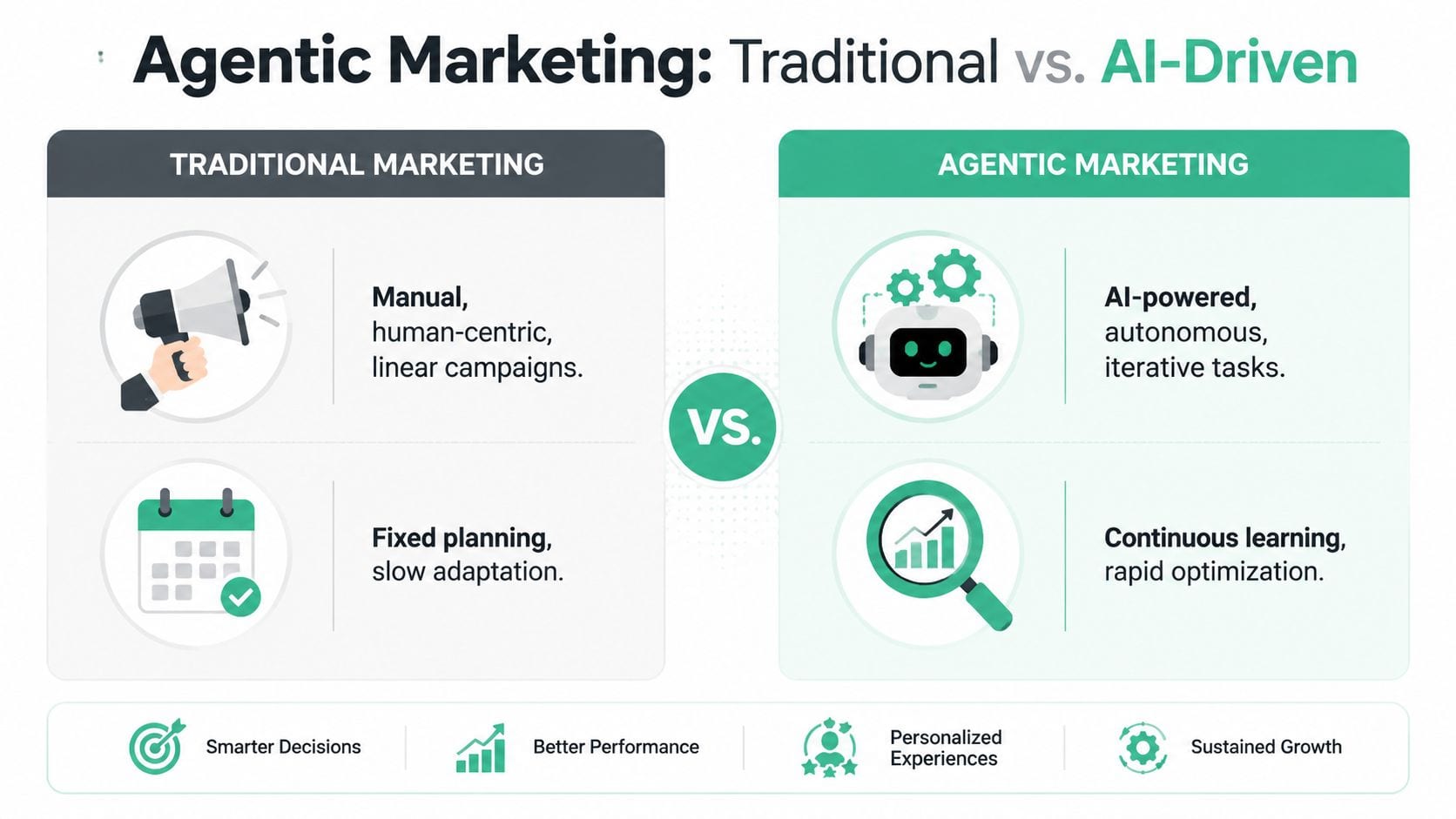
Traditional marketing automation is rule-based. Someone defines the triggers, the branches, the delays, and the outputs. If a lead opens email A, wait two days. If they visit pricing, add them to audience B. If they convert, stop the nurture.
Agentic marketing shifts the starting point. Instead of scripting every branch, the team defines the business objective and the guardrails. From there, goal-directed agents can plan, execute, and optimize campaigns by selecting audiences, designing strategies, and launching actions within marketer-defined boundaries, as described in CDP.com's glossary entry on agentic marketing.
The mental model that helps
A useful comparison is below.
| Model | Primary input | Execution style | Human role |
|---|---|---|---|
| Traditional automation | Predefined logic | Linear and rule-based | Configure steps |
| Agentic marketing | Business objective and guardrails | Adaptive and iterative | Set goals, limits, approval rules |
That distinction sounds subtle until you use it in practice. In one model, people design the path. In the other, people define the destination and the safe operating zone.
Agentic systems are only impressive when they can make decisions that would otherwise require a queue of human handoffs.
What it changes inside the team
The old bottleneck in campaign operations was coordination. Strategy sat in one tool, audience logic in another, creative in a separate workflow, analytics somewhere else, and approvals happened in chat threads or spreadsheets. Agentic marketing compresses those handoffs.
That's why it feels like a fundamental change instead of a feature update. The marketer is no longer only the person who launches campaigns. The marketer becomes the person who sets objectives, reviews constraints, approves escalation paths, and decides where autonomy is allowed to act without asking first.
What doesn't work is dropping agents into a fragmented stack and expecting coherence to emerge. If customer data is split across systems, event naming is inconsistent, and campaign taxonomy is loosely governed, autonomy amplifies those weaknesses. Agentic execution is only as reliable as the operating environment it inherits.
How Agentic Marketing Workflows Operate
The easiest way to understand agentic marketing is to follow a workflow from goal to iteration. Start with a straightforward commercial objective: acquire more enterprise pipeline for a SaaS product in a defined segment.
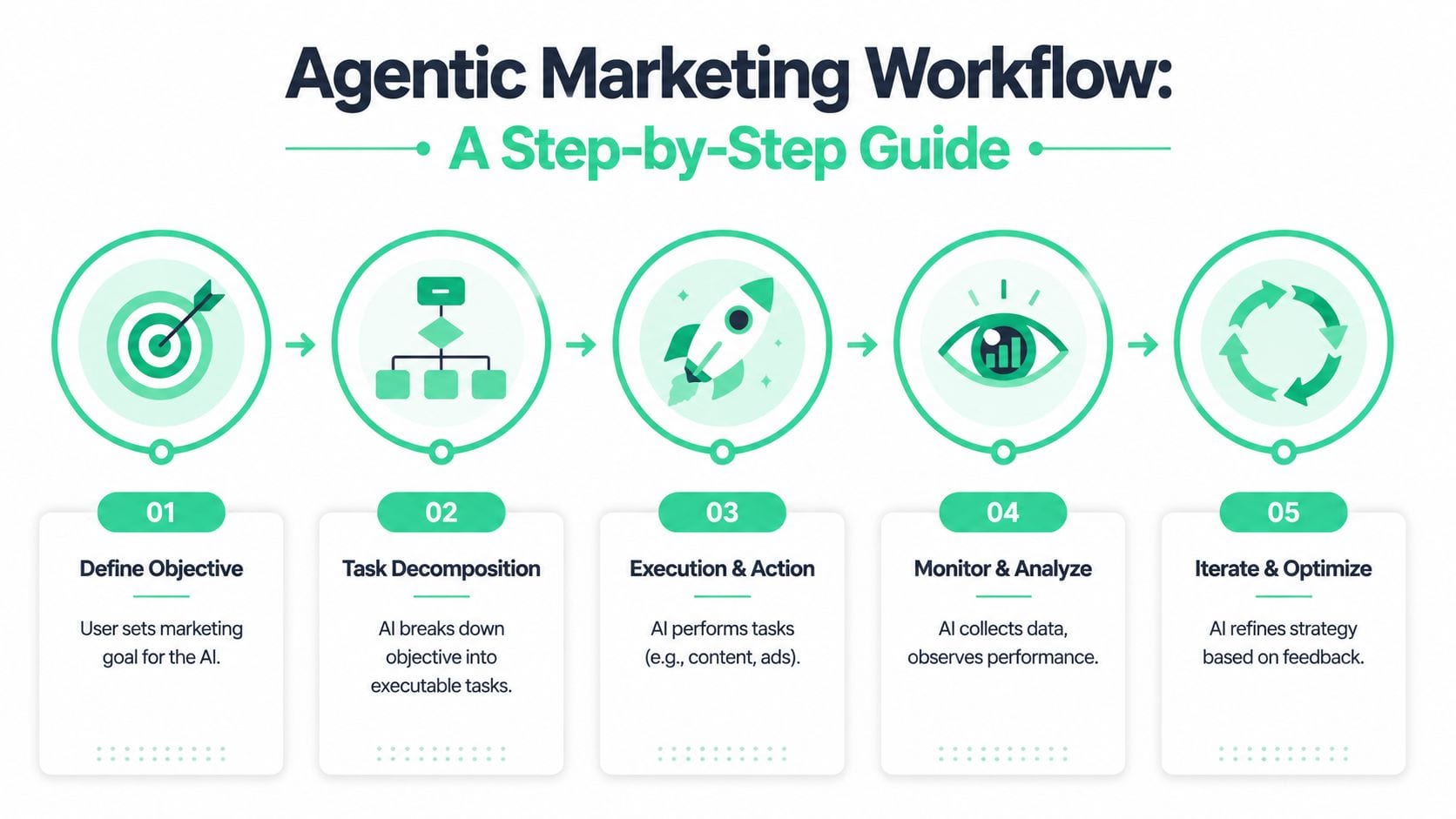
An agentic system begins with the brief, not the asset. It takes the target segment, the offer, the channel constraints, the conversion definition, and the brand guardrails. Then it decomposes the goal into executable tasks.
A realistic workflow in motion
A prospecting workflow might include:
- Lead discovery through source gathering and list creation
- Enrichment using company pages, LinkedIn profiles, directories, and public signals
- Qualification against firmographic and behavioral criteria
- Personalized outreach across email and social touchpoints
- Meeting routing when replies meet the threshold for sales follow-up
That pattern mirrors a startup implementation where teams built four distinct AI agents for lead list generation, enrichment, prospect qualification, and personalized outreach with meeting setup, described in this YouTube walkthrough on agent-driven startup workflows.
What the agent does after launch
The useful part starts after the campaign goes live. An agent can watch for intent signals, compare performance across audience slices, and alter creative or sequencing without waiting for the weekly growth meeting.
If a message angle underperforms for one segment, the system can reduce exposure there and promote a stronger variant elsewhere. If replies indicate a different use case than the one assumed in the original brief, the workflow can adapt its follow-up. Teams exploring optimizing with AI agents are often really exploring this loop: not just automation of tasks, but automation of adaptation.
The measurement side has to keep up. Otherwise, you end up with campaigns that are operationally fast but analytically opaque. A lot of organizations are now pushing toward analytics automation in modern teams because hand-checking events and tags can't match the speed of autonomous workflow changes.
A short demo helps make this feel less abstract:
Where this model is strongest
Agentic workflows tend to shine in environments with repeatable patterns and many small decisions. Prospecting, lifecycle branching, experimentation workflows, and campaign production are strong candidates.
Where teams get into trouble is giving broad autonomy to systems that touch analytics implementation, identity logic, or consent-sensitive flows without controls. The execution model is powerful. The blast radius is real. That's why workflow design can't be separated from observability and governance.
The Analytics Blind Spot of Agentic Marketing
The loudest claims about agentic marketing focus on speed, personalization, and efficiency. The quiet problem is the inability to discern agents' precise actions within the measurement environment.
That isn't a minor gap. It's structural. Marketing teams have zero visibility into how autonomous agents browse their sites, and 60% of B2B buyers use AI agents to research vendors in ways brands cannot observe, according to HUMAN Security's analysis of AI agents and brand visibility. If buyers increasingly arrive through agent-mediated interactions and your analytics stack can't recognize those touchpoints, your attribution model starts telling an incomplete story.
The observability problem nobody likes to own
Most Martech stacks were built to track human visitors through tags, pixels, server calls, and client-side events. Autonomous agents don't fit neatly into those assumptions.
Three problems show up fast:
- Attribution breaks: Agent-assisted research influences pipeline, but the path often disappears before it reaches reporting.
- Behavior looks distorted: Funnel stages appear weaker or noisier because non-human interactions don't map cleanly to standard visit models.
- Optimization gets misled: Teams tune campaigns against partial evidence because the invisible touchpoints never make it into the analysis.
If you can't observe the interaction, you can't govern it, and you can't trust the performance story built on top of it.
The concept of agentic analytics proves valuable. Measurement has to evolve from passive collection to active supervision of what agents trigger, modify, or influence across the stack.
The hidden mess inside the data layer
The site-visit blind spot gets most of the attention, but the more immediate operational pain often comes from data quality. Autonomous systems can generate campaign parameters, event properties, and segment definitions at a speed that human QA never catches in time.
In practice, that creates failures like:
- Rogue naming conventions that break standardized dashboards
- UTM drift where tags no longer align with channel taxonomy
- Unexpected payload changes that cause downstream reports to misclassify traffic
- Consent and privacy exposure when fields carry data they shouldn't
The dangerous part is silence. Broken pixels usually get noticed. Broken classification logic can sit inside reports for weeks. By the time someone spots the discrepancy, finance, growth, and leadership may already be using conflicting numbers.
Why standard QA stops working
Manual QA assumes a fixed launch sequence. Someone reviews the tracking plan, validates events, signs off, and monitors the first traffic. Agentic marketing doesn't behave that way. It keeps making adjustments after launch.
That means your analytics implementation is no longer a static artifact. It becomes a changing system, influenced by autonomous decisions, cross-tool dependencies, and real-time optimization. Traditional QA wasn't designed for that pace, and dashboard review is far too late in the process to act as a control layer.
Your Roadmap to Implementing Agentic Marketing
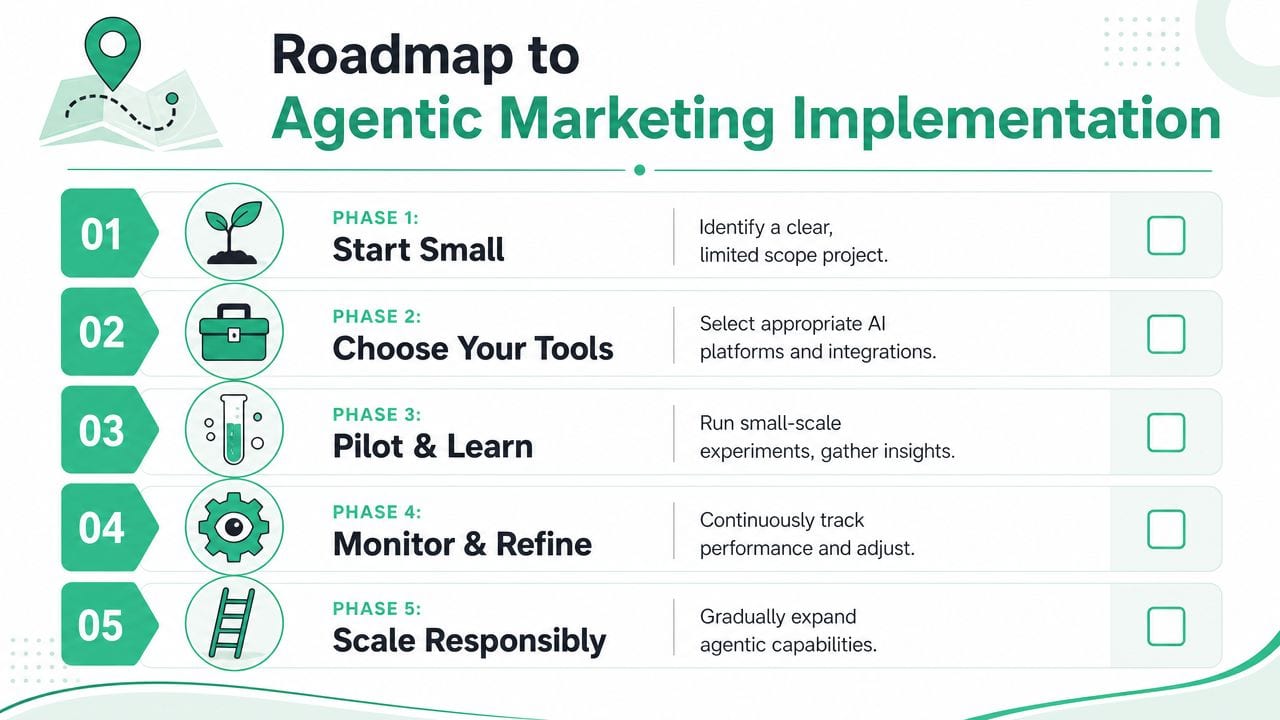
Rather than beginning with a fully autonomous campaign engine, teams should instead start with a narrow workflow where the business value is obvious and the risk is containable. That usually means a repetitive process with clear inputs, clear success criteria, and limited privacy exposure.
Start with workflow mapping, not model selection
McKinsey's guidance is useful here. Designing an agentic AI solution begins with a detailed taxonomy of marketing activities and the systems behind them, then moves into agent archetypes and the full set of agents needed across workflows, as described in McKinsey's piece on reinventing marketing workflows with agentic AI.
In practical terms, that means mapping:
| Layer | What to document |
|---|---|
| Business goal | The outcome the agent is allowed to pursue |
| Systems touched | CRM, CMS, analytics, data pipelines, ad platforms |
| Data dependencies | Required fields, source-of-truth rules, ownership |
| Guardrails | Approval thresholds, blocked actions, privacy limits |
Build guardrails before scale
Autonomous AI agents can cause a 35% increase in schema errors and event tagging inconsistencies in early deployments when they introduce non-standard property names or UTM violations, according to Braze's article on agentic AI marketing examples. That's why governance has to be in place before the pilot becomes a program.
The guardrails that matter most are usually unglamorous:
- Naming control: Lock event names, parameter patterns, and campaign taxonomy.
- Action boundaries: Decide which actions agents can execute directly and which require approval.
- Data scope: Define what customer fields can be used, transformed, or exported.
- Fallback rules: Establish what happens when confidence is low or a dependency fails.
Roll out in phases that teach you something
A sensible sequence looks like this:
- Begin with a contained use case such as lead enrichment or campaign QA support.
- Add cross-system actions only after the first workflow is stable.
- Expand to adaptive optimization once tracking and governance are reliable.
- Keep a human review layer for sensitive actions even when routine steps are autonomous.
The first production goal isn't maximum autonomy. It's repeatable trust.
What doesn't work is choosing a broad “AI transformation” initiative with vague ownership. Agentic marketing needs operators, analysts, and developers involved from the start. The workflow might be owned by marketing, but the failure modes almost never stay inside marketing.
Solving Agentic Challenges with Observability
If agentic marketing introduces a moving execution layer, then observability becomes the control plane. Without it, your team is left inferring problems from broken reports, missed conversions, or unexplained swings in campaign performance. That's too late.
What observability changes in practice
A dedicated analytics observability layer continuously inspects what your stack is sending. That includes the data layer, client-side events, server-side events, destinations, pixels, and campaign parameters. Instead of relying on someone to notice a dashboard anomaly, the system checks whether implementations still match the expected tracking plan.
That matters more in agentic environments because the implementation can change after launch. If an autonomous workflow introduces a new property, mutates an event schema, drops a pixel, or sends unexpected data, the issue needs to be detected at the moment it appears, not after a reporting cycle.
The control points that matter most
Strong observability should answer five questions clearly:
- What changed in the implementation
- Where it changed across web, app, or server-side flows
- Whether it violates schema, naming, or privacy rules
- Which destination is affected such as Google Analytics, Adobe Analytics, Amplitude, Mixpanel, or ad platforms
- Who needs to act based on ownership and root cause
That's the difference between monitoring and observability. Monitoring tells you that something looks wrong. Observability tells you what changed and why.
A deeper foundation on data observability in analytics operations helps here because the challenge isn't only data collection. It's maintaining implementation trust across many changing systems.
Why this becomes non-negotiable with agents
Agentic analytics changes measurement from a passive reporting function into an active system where intelligent agents work with users to convert data into insights and take autonomous actions, including extracting data from APIs and triggering models to find optimal paths, as explained in this video on agentic analytics.
That sounds ambitious, but the operational implication is straightforward. If agents can act on data, then teams need equally active mechanisms to validate the data those agents consume and produce.
For teams that want to see more examples and demos, Trackingplan's YouTube channel videos are worth browsing because the topic is easier to grasp when you can see event discovery, validation, and issue detection in context.
Good observability doesn't slow down autonomy. It makes autonomy safe enough to scale.
Without that layer, agentic marketing creates a black box inside the very systems leaders expect to measure. With it, the same autonomy becomes inspectable, governable, and far more credible across marketing, analytics, engineering, and compliance.
Your Strategic Role in an Agentic Future
Agentic marketing doesn't remove the need for marketers. It removes a growing share of the repetitive coordination and execution work that used to consume them.
The strategic role becomes sharper. Teams define goals, design guardrails, choose where autonomy is acceptable, and decide how performance should be interpreted when machines are continuously adjusting execution. Data teams become even more important because they're the ones protecting schema integrity, attribution trust, and privacy compliance while the system moves faster.
The long-term advantage won't come from handing everything to autonomous agents. It will come from building a disciplined partnership between human judgment and machine execution, where creativity sets the direction, governance sets the limits, and observability keeps the whole system honest.
If your team is moving toward autonomous workflows, Trackingplan gives you the control layer most agentic marketing stacks are missing. It automatically discovers analytics and Martech implementations across web, app, and server-side environments, validates them against your tracking plan, and alerts you to schema mismatches, rogue events, broken pixels, UTM issues, traffic anomalies, consent problems, and potential PII leaks before they distort your reporting. That's the kind of visibility you need if you want agentic marketing to scale without sacrificing data trust.