
Most marketing automation is already outdated. Not because it lacks features, but because it still waits for instructions while newer systems pursue goals on their own. That shift is happening fast. The global agentic AI market is projected to grow from $5.25 billion in 2024 to $199.05 billion by 2034, a 43.84% CAGR and a 38-fold increase, according to agentic AI market projections and adoption data.
The exciting part is obvious. Autonomous systems can plan, execute, and optimize campaigns across channels without constant human prompting. The dangerous part gets less attention. If the underlying analytics are wrong, an agent doesn't just produce a bad dashboard. It acts on bad inputs, at speed, across budget, messaging, targeting, and attribution.
That is the essence of agentic AI in marketing. The question isn't whether agents can do useful work. They can. The question is whether your data stack gives you enough confidence to let them act.
The New Era of Agentic AI in Marketing
Agentic AI is changing marketing operations at the system level. It is shifting software from rule execution to goal-directed decisioning, and that changes what teams need from their stack.
One near-term signal comes from enterprise software adoption. Less than 5% of enterprise applications had task-specific agents in 2025, but that figure is projected to reach 40% by the end of 2026, according to Landbase's summary of agentic AI trends. That projection matters less as hype than as an infrastructure indicator. Vendors are redesigning products around agents that can decide and act inside workflows, not just sit beside them as assistants.
The operating model is different from classic automation. Traditional automation follows paths that a team mapped in advance. Agentic systems work from an objective, assess current conditions, choose from available actions, and keep adjusting as conditions change. In practice, that means campaign logic no longer lives only in if-then trees. It lives in the quality of the data, the constraints set by the business, and the controls around execution.
That last point gets missed too often.
A large share of marketing teams still run their programs through workflows, triggers, and branching logic built for stable conditions. Those systems work well when inputs are clean and customer behavior fits expected paths. Agents are built for a different job. They operate in messy environments with shifting signals, incomplete context, and real consequences when attribution, audience membership, or conversion events are wrong.
Why this is a structural shift
A lot of MarTech updates add features without changing accountability. Agentic AI changes accountability because the system can make and execute decisions that a human used to approve step by step.
With conventional automation, marketers define the sequence. With agentic systems, marketers define the objective, constraints, and acceptable risk. The software handles more of the decisioning inside those boundaries. That can improve speed and coverage. It also raises the cost of bad data, weak governance, and missing observability.
Here is the practical difference:
| Model | How it works | Limitation |
|---|---|---|
| Traditional automation | Follows prebuilt rules and triggers | Fails when conditions change outside the rule set |
| Predictive tooling | Scores, ranks, or recommends | Still relies on humans to turn insight into action |
| Agentic AI | Pursues a goal, selects actions, and adapts | Needs high-confidence data, monitoring, and clear controls |
The shift is not that software can now "do marketing." The shift is that software can make operational choices fast enough to spend budget, change targeting, suppress audiences, alter messaging, and influence pipeline before a human spots a problem. If the underlying metrics are delayed, duplicated, or misclassified, the agent will scale the mistake.
That is why I do not treat agentic AI as a creativity story first. It is a data control story first.
As noted earlier, adoption is already accelerating, and teams are expanding agent use into revenue workflows. That raises the competitive bar, but it also raises the governance bar. Speed without verification is not an advantage. It is exposure.
For leaders working through that balance, Samuel Woods offers a useful framing for how to build bionic marketing systems that combine human judgment with autonomous execution.
Practical rule: If your stack can automate tasks but cannot verify live data quality before action, you are not ready for agentic marketing. You are giving faster decision rights to a system you cannot fully trust.
What Exactly Is an AI Agent in a Marketing Context
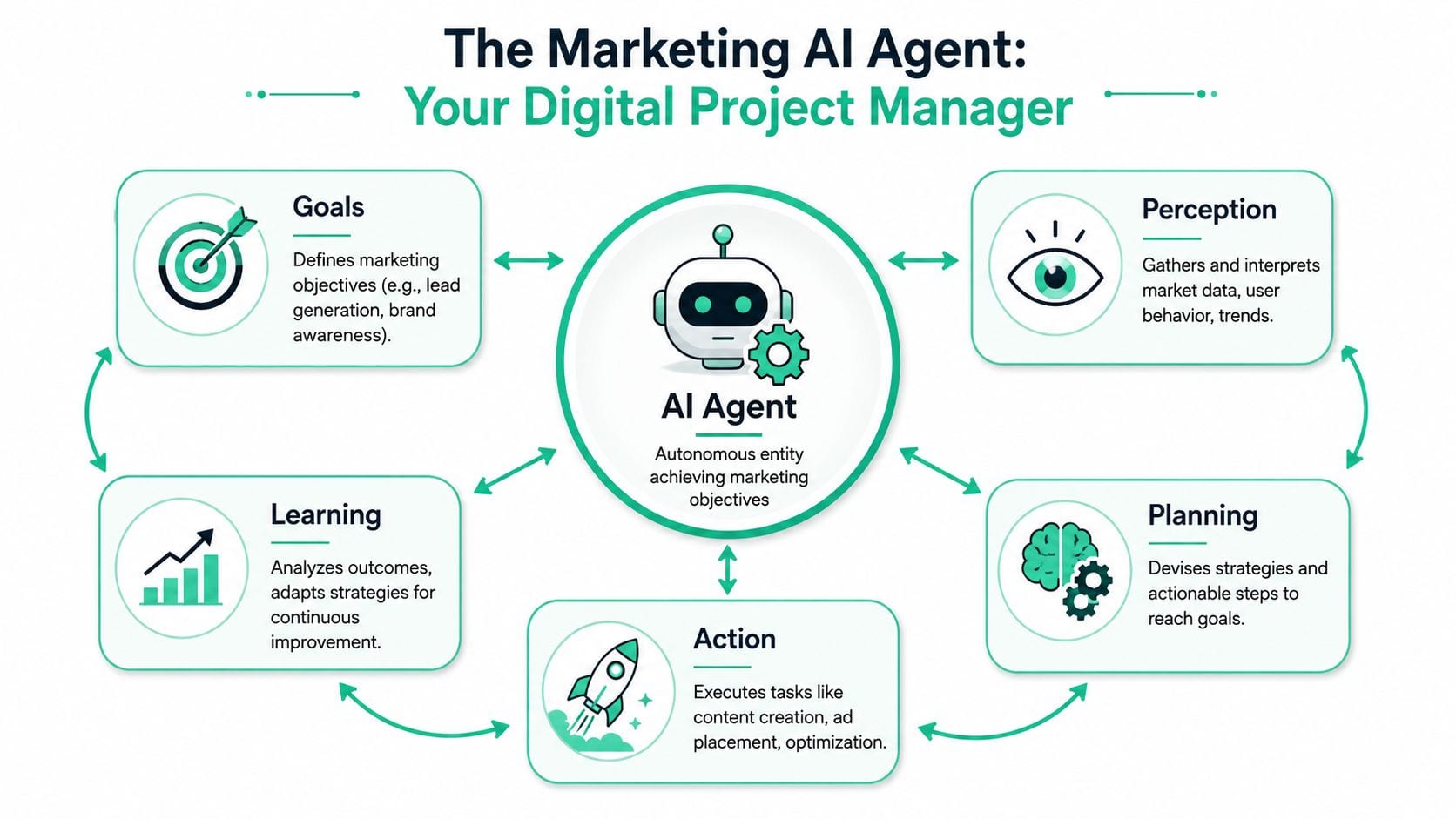
An AI agent in marketing is best understood as a digital project manager with hands on the tools. It doesn't just suggest what to do next. It can interpret a goal, inspect the available data, coordinate actions across systems, and keep adjusting after launch.
That is the key difference from the AI commonly used.
The four parts that matter
An agent usually needs four things to be useful in a real marketing environment.
-
A goal
Not a prompt. A goal. That might be improving lead quality, reducing churn, increasing qualified demo volume, or improving retention among a defined customer segment.
-
Business context
The agent needs access to the facts humans use when they make decisions. Audience definitions, campaign performance, CRM status, product usage signals, brand constraints, and commercial priorities all belong here.
-
Tool access
A real agent connects to execution systems. That can include ad platforms, email platforms, analytics tools, CDPs, CRM systems, content workflows, and experimentation tools.
-
Authority to act
If the agent can only generate recommendations, it's closer to an assistant. If it can launch variants, shift targeting, suppress outreach, or reallocate spend inside policy limits, it's acting as an agent.
How agents differ from chatbots and classic automation
Confusion typically arises. A chatbot responds to prompts. A predictive model scores a likelihood. A workflow engine waits for a trigger.
According to Braze's explanation of agentic AI marketing, agentic AI marketing systems shift from static rule-based automation ("if X, then Y") to dynamic, goal-driven decisioning ("predict and execute"), where agents continuously monitor customer behaviors, campaign performance, and contextual signals to reason over data and take action instantly without human prompts.
That means the useful mental model isn't "smart chatbot." It's "operator."
A simple comparison
- Chatbot: answers a question
- Predictive model: estimates an outcome
- Automation workflow: executes a predefined sequence
- AI agent: reasons about the situation, chooses an action, executes it, then learns from the result
For leaders who need a broader frame before they hand agents any operational authority, this guide for enterprise leaders is a helpful complement to the marketing-specific view.
An agent becomes valuable when it can handle ambiguity. Marketing is full of ambiguity, which is why agents are powerful and risky at the same time.
Real-World Marketing Use Cases for AI Agents
The easiest way to judge agentic AI in marketing is to ignore the demos and look at workflow change. What used to require several specialists, several tools, and a lot of waiting can now be coordinated by software that reacts to live inputs.
Enterprise teams are already using agentic systems to execute multi-step workflows across the marketing stack, coordinate tools and approvals in real time, and respond to performance signals without adding headcount, as described in Moveworks' enterprise marketing use cases.

Campaign orchestration across channels
Before agents, multi-channel orchestration usually meant a weekly planning rhythm. Paid media checked pacing. CRM checked nurture performance. Content checked asset readiness. Analytics checked whether any of it could be measured cleanly.
With an agentic setup, the operating model changes. The system sees campaign status across channels, compares it against the objective, and decides what to do next. It might launch a new email variant, pause a low-intent audience in paid social, increase pressure on a high-performing segment, and update the journey path for customers showing product interest.
The key difference isn't just speed. It's continuity. Work doesn't wait for the next team handoff.
Real-time journey management
Lifecycle marketing is full of delays created by organizational boundaries. The CRM team owns one part, product owns another, paid media owns another, and no one sees the full customer state in one place.
Agents are useful here because they can react to what a person just did, not what they did yesterday. If a customer stops engaging with onboarding emails but starts exploring high-value product pages, the right next action may not be another email. It may be suppression from one stream, escalation into another, or a coordinated handoff to sales.
Teams exploring this broader shift in execution can compare it with existing AI-driven workflow improvements in digital marketing measurement and orchestration.
Creative generation with live adaptation
This is one of the most visible use cases, and one of the easiest to misunderstand.
Generating copy variants isn't agentic by itself. A copy generator is still a tool. The agentic behavior starts when a system decides which creative variants to produce, where to deploy them, how to match them to audience context, and when to retire weak performers without waiting for a human to intervene.
That can reduce the lag between insight and action. But it also raises a quality question. If the engagement signal is noisy or attribution is broken, the wrong creative may be promoted for the wrong reason.
Budget and bid adjustments
Paid media has always looked like a natural home for autonomous systems because the loop is tight and the actions are concrete.
In practice, this works best when the agent has access to more than channel-local metrics. If it only sees one platform's surface-level performance, it may optimize toward the easiest signal instead of the most meaningful outcome. If it sees customer quality, downstream conversion state, and suppression logic across the stack, it can make better decisions.
Operational advice: Never let an agent optimize spend against a metric you wouldn't trust in a board report.
Segmentation and lifecycle operations
Many teams still build segments manually, move lists between systems, and troubleshoot eligibility rules campaign by campaign. Agents can remove a lot of that repetitive work.
A capable agent can watch behavior, segment movement, consent state, campaign history, and product context, then adjust audience membership continuously. It can also trigger follow-up actions that fit the customer's current state instead of relying on static monthly definitions.
What works:
- Defined objectives: Agents perform better when the business goal is explicit
- Tight permissions: Narrow action scopes reduce operational risk
- Shared measurement logic: Marketing, analytics, and engineering need the same definition of success
What fails:
- Vague goals: "Improve engagement" invites noisy action
- Disconnected tools: Agents can't coordinate what they can't see
- Blind trust in platform reporting: Local optimization often hides cross-channel mistakes
The Data Engine Fueling Agentic AI
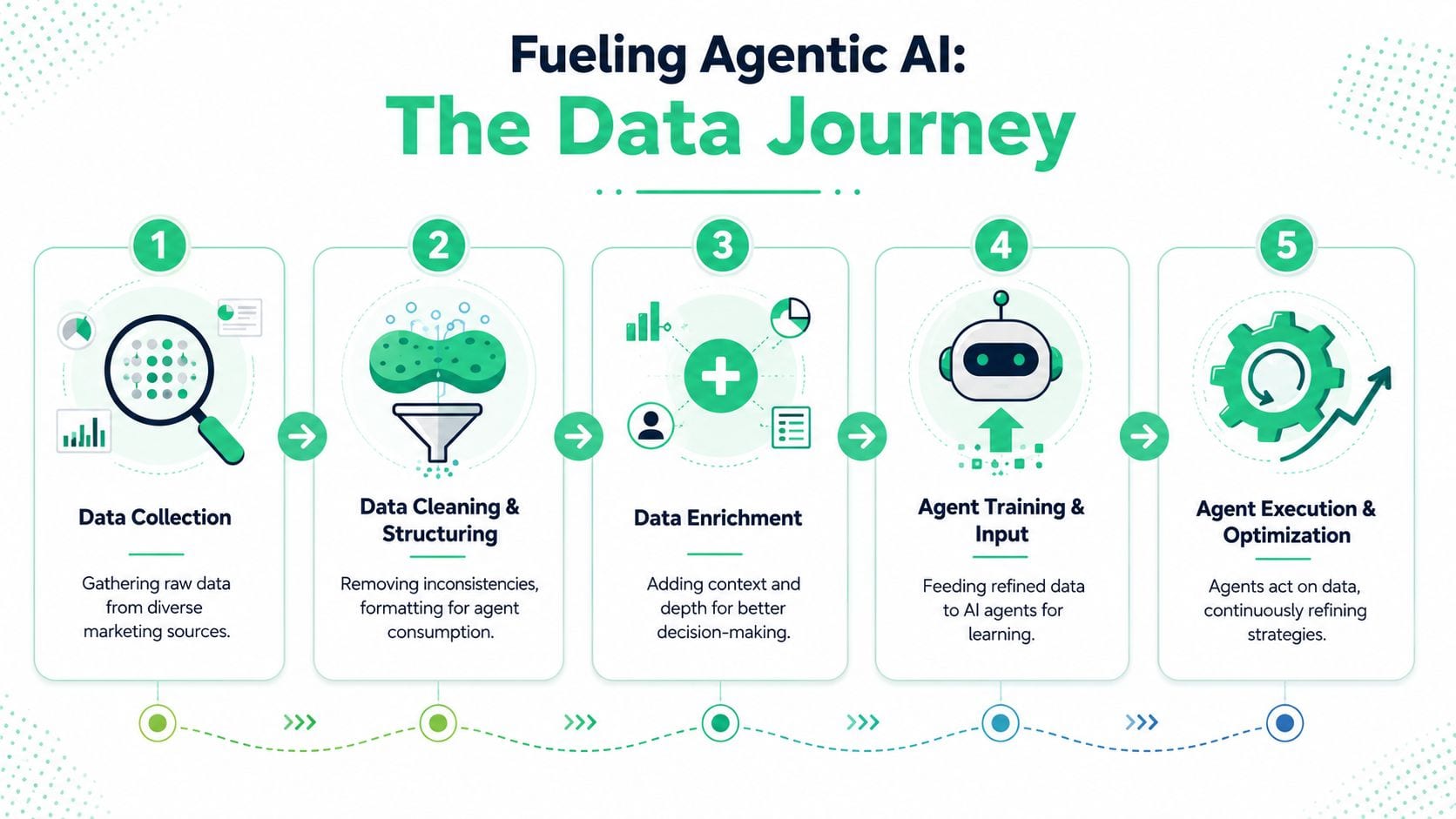
The fastest way to break agentic AI in marketing is to feed it slow, partial, or stale data. Autonomous systems don't need more dashboards. They need a decision environment that reflects reality quickly enough to support action.
That requirement rules out a surprising amount of the stack many teams still depend on.
Why batch pipelines don't fit autonomous execution
Traditional analytics architecture was built for reporting. Data lands in a warehouse, gets transformed, syncs back into activation systems later, and eventually shows up in dashboards. That workflow is acceptable when humans review the data and decide what to do next.
It's not acceptable when an agent is expected to learn and act continuously.
According to the CDP.com explanation of agentic marketing architecture, agentic AI in marketing requires a Closed Customer Intelligence Loop where campaign results flow back to the AI agent within seconds, not days, because traditional reverse ETL architectures that run in hours or days are too slow for autonomy.
What a closed loop actually requires
A closed loop isn't just "faster reporting." It means the agent can observe the result of its action quickly enough to adjust the next one while the context still matters.
That usually depends on three layers working together:
- Unified profiles: Customer state can't be split across isolated systems with inconsistent freshness
- Low-latency event flow: The agent needs near-immediate feedback from campaign and behavior signals
- Execution-ready access: The system needs direct, governed access to the tools where it will act
If one of those layers is weak, autonomy becomes guesswork.
Profile stores matter more than warehouses here
Warehouses are excellent for analysis. They're not always ideal for live decisioning. Querying across multiple source tables, waiting on transformations, or syncing delayed traits back into activation tools introduces enough lag to degrade agent performance.
That is why many teams shifting toward autonomous activation also revisit their customer data architecture and their approach to first-party data foundations. If the profile is fragmented or delayed, the agent will personalize against an outdated picture of the customer.
Reliable autonomy starts with data that is current enough to drive action, not just accurate enough to explain yesterday.
A practical readiness check
Before any team gives an agent campaign authority, it should be able to answer these questions:
| Question | Why it matters |
|---|---|
| Can campaign outcomes flow back in seconds? | Agents need immediate feedback to adapt |
| Is customer state unified across CRM, email, and commerce? | Split context leads to wrong decisions |
| Can the agent access execution tools directly and safely? | Recommendations alone don't create operational leverage |
| Are definitions stable across teams? | Inconsistent schemas create conflicting actions |
A lot of agentic ambition fails here. Not because the model is weak, but because the data plumbing was designed for analysts, not autonomous operators.
The Observability Imperative Why You Cannot Trust a Black Box
Agentic AI in marketing without observability is a liability. If an agent changes bids, suppresses audiences, rotates creative, or shifts channel mix, you need to know whether the decision came from valid data or from a broken event, a bad pixel, or a schema drift no one noticed.
That is the missing conversation in most agentic AI content.
The blind spot most teams still have
A lot of guidance on AI agents assumes that live signals are trustworthy. In production marketing environments, that assumption is weak.
The critical gap is stated plainly in Sprinklr's discussion of agentic AI in marketing: the major issue isn't whether agents can execute autonomous actions, but the lack of real-time analytics observability required to validate agent decisions. Teams can let agents react to live signals, but many still lack a way to observe, audit, and root-cause anomalies in those actions.
That problem gets concrete fast. An agent sees conversion volume drop and cuts spend. But the underlying issue wasn't demand. A tag failed after a release. Or the dataLayer stopped sending a key property. Or one region's consent implementation changed the event stream. Or a schema mismatch caused downstream tools to classify events incorrectly.
Without observability, the agent looks decisive while acting on fiction.
What observability needs to cover
For agentic systems, observability has to extend beyond model logs. Marketing teams need visibility into the data collection layer itself.
That means checking things like:
- dataLayer integrity: Are key variables present, correctly formatted, and firing at the right moment?
- Pixel health: Are analytics and attribution pixels firing consistently across pages, apps, and server-side flows?
- Schema consistency: Are event names and properties stable across releases and environments?
- Consent and privacy controls: Are events being dropped, altered, or over-collected because consent logic changed?
- Campaign metadata quality: Are UTMs and tagging conventions intact enough to preserve attribution chains?
Teams that want a broader foundation on this discipline should understand data observability in analytics environments before they push agents into production workflows.
Black-box autonomy is manageable in low-risk tasks. It is unacceptable when software can redirect budget or alter customer journeys.
Why manual QA isn't enough anymore
Manual analytics QA was always fragile. In an agentic environment, it's also too slow.
Humans can spot broken dashboards after the fact. They can't reliably inspect every event payload, every pixel, every destination mapping, and every release-induced schema change in time to prevent an autonomous system from acting on garbage. The moment the decision loop tightens, validation has to tighten with it.
This walkthrough from Trackingplan's channel shows the kind of monitoring mindset teams need when analytics reliability is part of operational control:
The seatbelt analogy is accurate
Agents don't just need intelligence. They need restraints, auditability, and instrumentation.
A practical deployment standard should include:
-
Pre-action validation
The system should verify that critical input signals are present and plausible before high-impact actions execute.
-
Continuous anomaly detection
When traffic drops, events disappear, or properties drift, teams need alerts before those issues corrupt downstream optimization.
-
Root-cause visibility
Knowing that performance changed isn't enough. Teams need to know whether the cause was user behavior, implementation failure, or data-routing error.
-
Decision traceability
If an agent suppresses a segment or changes budget allocation, teams should be able to inspect what input conditions triggered that move.
The market talks about autonomy as if control and speed are in tension. In practice, trustworthy autonomy requires more instrumentation, not less.
Implementation Patterns and Common Pitfalls
Starting by letting an agent run the entire funnel is not recommended. That's the fastest route to confusion, attribution fights, and operational distrust. A better pattern is to start with one bounded workflow where the objective is clear, the actions are reversible, and the inputs are already well understood.
The common mistake is thinking implementation starts with model selection. It usually starts with scope control.
A pattern that works
A solid first deployment often looks like this:
- Pick one narrow use case: For example, audience suppression, nurture-path adjustments, or creative variant routing
- Define one business objective: Not "improve performance." Choose something testable and specific in operational terms
- Limit tool permissions: Let the agent act in one or two systems, not the whole stack
- Set approval thresholds: Low-risk actions can run automatically, while higher-impact changes require review
- Monitor input quality from day one: If event integrity is uncertain, don't scale autonomy
This phased approach is especially important when agents interact with APIs and channel-specific systems. Teams working through platform dependencies in social environments may find useful parallels in PostPulse's piece on overcoming social API challenges.
The attribution problem appears earlier than people expect
One of the least solved issues in agentic AI in marketing is measurement. The problem isn't just whether performance improved. It's whether you can isolate what the agent contributed.
The Braze examples article on agentic AI measurement challenges captures the issue well: the unresolved question is how to measure ROI when the agent automates the entire journey, especially because the last-mile attribution problem gets worse when agents suppress outreach or shift budgets mid-flight.
That matters operationally. Standard attribution models assume relatively stable channel behavior. Agents violate that assumption. They can remove touches that would otherwise appear in the path, introduce new variants dynamically, and alter pacing while the customer is still moving.
Pitfalls that show up in real deployments
What doesn't work usually follows a familiar pattern.
| Pitfall | What it looks like in practice | Better approach |
|---|---|---|
| Ambiguous goals | The agent chases soft engagement signals without commercial relevance | Define business outcomes and acceptable proxies upfront |
| Weak data QA | Broken events quietly steer actions | Validate instrumentation before autonomy expands |
| Excessive scope | One agent gets too many permissions too early | Start with bounded actions and clear rollback options |
| Attribution blindness | Teams can't explain why results changed | Align measurement logic before launch |
Start with a workflow where a human expert can still review the decision trail. If no one can explain what the agent did, you don't have automation maturity yet.
The cross-functional launch sequence
The best implementations are collaborative, not model-led.
Marketing defines the objective and guardrails. Analytics defines the measurement logic and input dependencies. Engineering or implementation teams verify event quality, destination behavior, and system permissions. Then everyone agrees on what counts as safe autonomous action.
That sounds slower than an AI pilot deck. It is. It also produces systems people will trust.
Preparing Your Team for an Agentic Future
Agentic AI in marketing is becoming part of how modern teams operate, not a side experiment. Some projections already point to one-fifth of all marketing roles being held by AI agents by 2028, while 68% of customer service and support interactions with vendors are projected to be handled by agentic AI, according to legal analysis citing industry studies on digital advertising impacts.
The teams that benefit won't be the ones that adopt autonomy fastest at any cost. They'll be the ones that build trust first. That means reliable collection, stable schemas, unified customer context, clear action boundaries, and continuous validation of what the system is seeing.
Marketing teams also need new habits. They need people who can inspect decision flows, challenge noisy signals, and work comfortably across analytics, operations, and AI-enabled execution. This is one reason the role of the AI data analyst in modern teams is becoming more relevant. Someone has to translate system behavior into business confidence.
Autonomy is powerful when the data foundation is verifiable. Without that, you're not building an intelligent marketing function. You're scaling uncertainty.
Trackingplan helps teams make autonomous marketing safer by giving them continuous visibility into the analytics and attribution data that agents depend on. If you're preparing for agentic workflows, Trackingplan gives marketers, analysts, developers, and agencies a practical way to monitor data quality, catch implementation issues early, and build the trust required to let AI act with confidence.