
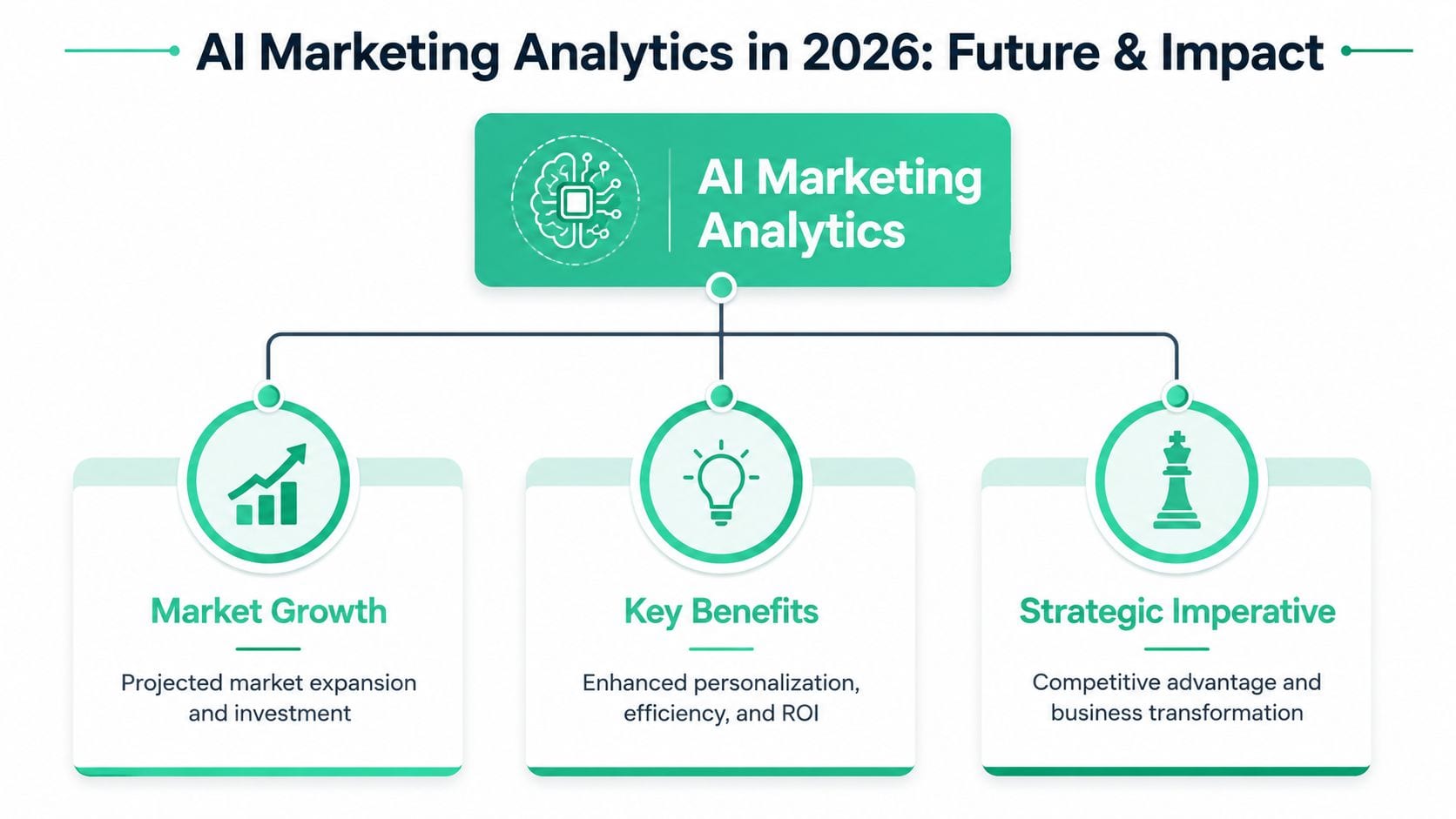
The fastest way to misunderstand AI in marketing is to treat it as a smarter dashboard. It isn't. The category itself is expanding at a pace that shows how seriously companies now take it. The global Artificial Intelligence in Marketing market is projected to grow from USD 20.44 billion in 2024 to USD 82.23 billion by 2030, at a 25.0% CAGR, while nearly 92% of firms plan to increase their AI budgets and 65% of CMOs expect AI to significantly transform their roles by 2026 according to Grand View Research's artificial intelligence in marketing market report.
That growth matters because teams often don't need more reports. They need systems that help them decide what to do next, sooner, with fewer mistakes. That's where AI marketing analytics starts to earn its keep. But it only works when the underlying data is trustworthy. Without that, the model just scales bad inputs faster.
What AI Marketing Analytics Means for 2026
Traditional business intelligence answers what happened. AI marketing analytics pushes into what will likely happen and what should we do about it.
A standard dashboard is like a road map. It shows the route you already took. AI marketing analytics is closer to a live GPS that spots traffic, predicts delays, and suggests a better route before you get stuck. For a marketing team, that means moving beyond retrospective channel reports into predictive audience selection, earlier anomaly detection, and faster campaign decisions.
What changes in practice
The biggest shift isn't that marketers suddenly become data scientists. It's that more of the decision loop gets compressed.
Teams can use AI to spot audience fatigue earlier, identify customers with a higher likelihood to purchase, and surface odd changes in behavior without waiting for an analyst to build a fresh report. Developers benefit too, because once the organization depends on predictive outputs, implementation quality stops being a back-office concern and becomes a revenue concern.
Practical rule: If your analytics setup can't reliably explain what happened yesterday, it won't reliably predict what happens next week.
Why 2026 is a useful marker
By 2026, the question won't be whether AI belongs in marketing. The question will be whether your team can operationalize it safely. The market projections and budget plans cited above show that leadership teams already see AI as a core operating capability, not a side experiment.
That changes how marketers, analysts, and engineers work together. Marketers define business use cases. Analysts validate signal quality. Developers make sure tracking, schemas, consent logic, and integrations don't inadvertently corrupt the model. The organizations that do this well won't just have better automation. They'll have better judgment at scale.
Core AI Use Cases Driving Marketing ROI
The easiest way to evaluate AI marketing analytics is to ignore the hype and look at what it changes in day-to-day work. Four use cases come up repeatedly because they tie directly to budget allocation, campaign efficiency, and customer value.
From channel guesswork to better attribution
Before AI, many teams fall back on last-click reporting because it's available and simple. The problem is that it over-credits the final touch and hides the influence of upper-funnel activity, remarketing, and email nurture.
With AI-assisted attribution, the model can evaluate how touchpoints work together across the journey. That doesn't remove the need for judgment, but it does produce a more realistic weighting of paid search, social, email, and direct traffic. If your team is exploring broader automation patterns, Trackingplan's perspective on agentic AI in marketing is a useful companion read because it connects orchestration with measurement discipline.
From broad segments to dynamic customer groups
Static segments age badly. “All returning users” or “all cart abandoners” sounds practical, but these groups often mix high-intent and low-intent people into the same treatment bucket.
AI improves segmentation by grouping users based on patterns in behavior, product interest, timing, and purchase likelihood. That's where personalization begins to pay off. AI-driven personalization can increase revenue by up to 41%, and shoppers engaging with AI recommendations convert 3 to 5 times more frequently, while baseline tools like GA4 include predictive metrics such as purchase probability and churn probability according to Omnisend's AI marketing statistics for ecommerce.
From backward-looking revenue to predictive value
Predictive LTV changes the timing of decisions. Instead of waiting to see which cohorts become valuable after the fact, teams can act earlier. Paid media teams can bid differently. CRM teams can change onboarding flows. Product marketers can tailor retention offers before a customer fades.
This is also where implementation quality gets tested. If refund events, subscription changes, or offline revenue aren't integrated properly, predictive LTV becomes theater.
From creative intuition to creative optimization
Creative still needs human judgment. AI doesn't replace that. What it does well is detect which messages, offers, formats, or landing page combinations resonate with specific audiences faster than manual review.
Teams evaluating delivery and automation patterns often also review implementation partners and service models. For that angle, Bridge Global's AI marketing solutions gives a useful look at how organizations are thinking about generative AI within marketing automation.
AI marketing analytics use case comparison
| Use Case | Business Goal | Required Data Examples | Key Business Impact |
|---|---|---|---|
| Attribution | Understand which touchpoints influence conversion | Ad platform data, web analytics events, CRM conversions, campaign metadata | Better budget allocation across channels |
| Dynamic segmentation | Build audiences based on behavior and likely intent | User events, purchase history, engagement signals, product views | More relevant targeting and stronger personalization |
| Predictive LTV | Identify future customer value earlier | Transaction history, retention signals, subscription or repeat purchase data | Smarter acquisition and retention decisions |
| Creative optimization | Improve message, offer, and asset performance | Ad creative metadata, engagement data, landing page behavior, conversion events | Faster testing cycles and stronger campaign efficiency |
When AI works in marketing, it usually doesn't look flashy. It looks like fewer wasted impressions, cleaner audience decisions, and less time spent arguing over reports.
Building the Data Engine for AI Analytics
Most AI marketing analytics projects don't fail because the model is too weak. They fail because the data engine underneath it is unreliable.
The efficacy of AI is strictly reliant on efficient data integration and the accuracy of the training dataset. AI marketing analytics utilizes ML algorithms to transform historical data using technologies like NLP, with reliable, automated data pipelines being a critical specification for enabling real-time processing across fragmented systems like CRM and web analytics, as explained in Improvado's guide to AI marketing analytics.
The ingredients you need
Start with the raw materials. Marketing teams usually need data from CRM systems, website and app events, ad platforms, email tools, ecommerce or sales systems, and sometimes offline conversion sources. If those sources disagree on naming, timing, or identity, the model inherits the disagreement.
That's one reason first-party data has become more important. It gives teams more control over collection and governance. For a grounded explanation of that foundation, see Trackingplan's guide to first-party data.
The machinery that makes it usable
A strong data engine does four things well:
- Collects consistently: It ingests events and records from web, app, CRM, and media sources without losing context.
- Cleans aggressively: It standardizes naming, resolves duplicates, and catches malformed payloads before they spread.
- Stores accessibly: It makes data available for both reporting and model training without creating five different versions of the truth.
- Refreshes quickly: It supports near real-time updates when decisions depend on current behavior.
If you're building this with marketers, analysts, and developers in the same room, use plain language for model types. Classification models answer yes-or-no style questions, such as whether a user is likely to churn. Regression models estimate a numeric outcome, such as expected future revenue. NLP helps systems analyze text from reviews, tickets, chats, or social comments. None of these models are useful if the event stream itself is broken.
What a practical stack looks like
A workable stack often includes a collection layer, a warehouse or cloud storage layer, transformation logic, and downstream activation in tools like GA4, ad platforms, or CRM systems. The exact vendors matter less than the operating model.
Good AI architecture is boring in the best way. Data arrives on time, fields mean the same thing everywhere, and nobody has to guess whether a drop in conversions is real or just a broken event.
Navigating Data Quality and Governance Risks
Many AI marketing analytics conversations grow excessively optimistic. The model gets all the attention. The data pipeline gets treated like plumbing. That's backwards.
87% of AI initiatives fail due to messy, siloed data, and without root-cause analysis of tracking errors, schema mismatches, or missing pixels, AI models amplify noise instead of signals according to the RevOps Co-op webinar on AI data quality and observability. That single point should change how teams prioritize implementation work.
What bad data looks like in the real world
Bad data rarely announces itself clearly. It shows up as small inconsistencies that later distort decision-making:
- Schema drift: An event property changes format between releases, so one team sees revenue as a number and another sees it as text.
- Missing pixels: A checkout or lead event disappears after a frontend update, so optimization models train on incomplete conversion data.
- Campaign tagging errors: UTMs don't follow naming conventions, which fragments attribution and audience logic.
- Identity fragmentation: CRM records, app events, and ad platform audiences don't resolve cleanly, so the same user looks like multiple users.
- Privacy and consent issues: PII leaks or misconfigured consent logic create compliance risk and contaminate downstream analytics.
These aren't edge cases. They're normal failure modes in active marketing stacks.
Why governance has to be operational
Governance often gets written as policy. AI needs it to function as a practice. That means naming standards, event ownership, release validation, change monitoring, and clear escalation paths when something breaks.
A helpful starting point is Trackingplan's guide to data governance for analytics, especially for teams trying to connect governance with day-to-day implementation reality rather than documentation alone.
Observability beats periodic auditing
Manual audits help, but they're too slow for AI-dependent systems. By the time someone notices a reporting issue in a weekly review, the damage has already reached models, audiences, and automated decisions.
What works better is continuous data observability and automated analytics QA. Teams need systems that detect broken events, schema mismatches, rogue tracking, consent misfires, and traffic anomalies as they happen. That's how you prevent garbage in, garbage out from becoming a board-level problem.
For added context, embedding a relevant explainer from Trackingplan's YouTube channel on analytics QA or data governance can help align marketers and developers around what “healthy data” looks like in production.
If an AI model gives a bad recommendation, most teams inspect the model first. In marketing operations, the better first question is often, “What changed in the data collection layer?”
Your Roadmap to Implementing AI in Marketing
Instead of a giant transformation program, teams should start with a use case that matters, a dataset they can trust, and a workflow they can improve without rewriting the whole stack.
A practical roadmap follows the same operating logic used by marketing intelligence platforms. These platforms move through aggregation, unification, AI-driven analysis, and activation, as described in AI Digital's overview of marketing intelligence platforms.
Phase 1 Strategy and assessment
Don't begin with tooling. Begin with the decision you want to improve.
Pick one business problem that has clear ownership and measurable consequences. Examples include reducing wasted spend in acquisition, improving remarketing audience quality, or identifying customers with higher repeat-purchase potential. If your team is also adapting to AI-native discovery environments, AI Search Visibility for Marketing Teams is a useful resource for thinking about how visibility and measurement are changing together.
Phase 2 Data foundation build-out
This is where aggregation and unification happen. Connect data sources, reconcile naming, and define canonical events and properties. Decide who owns schema changes. Decide how release validation works. Decide what counts as a blocking issue.
A lot of projects stall here because teams underestimate the operational work. That's a mistake. This phase is where you make later analysis believable.
Phase 3 Pilot and experimentation
Run a contained pilot with a narrow objective. Don't try to solve attribution, segmentation, forecasting, and creative optimization all at once.
Good pilots tend to have three characteristics:
- They use one trusted slice of data rather than every source in the stack.
- They target one decision workflow such as audience selection or churn-risk prioritization.
- They include a control condition so the team can compare outcomes against existing practice.
Phase 4 Scaling and integration
Once the pilot shows usable signal, expand carefully. Feed outputs into ad audiences, CRM workflows, or budget pacing logic. Document model assumptions in plain language so marketers and analysts know what they're acting on.
This is also the point where developers need change management discipline. A small implementation tweak can break the assumptions the model depends on.
Phase 5 Optimization and governance
Scaling isn't the finish line. AI marketing analytics needs monitoring, retraining decisions, issue escalation, and business review cycles. Some models decay because customer behavior changes. Some fail because the tracking changed and nobody noticed.
The fastest route to adoption is not the biggest launch. It's a pilot that produces one credible win and a process the team can repeat.
Measuring Success and Proving ROI
Teams often over-focus on whether the model is technically advanced. Executives usually care about whether the business got better. Both matter, but they belong in different buckets.
Separate model metrics from business metrics
Model performance metrics help analysts and data scientists judge whether a model is behaving reasonably. They're useful for validation and comparison, but they don't persuade a finance lead on their own.
Business outcome metrics are what prove value. Look at conversion quality, retention movement, budget efficiency, audience match rates, and the operational speed of decision-making. The right mix depends on the use case.
For a broader view of how to frame measurement strategically, strategic marketing measurement insights can help teams avoid reporting theater and focus on decisions.
Use controlled comparisons
The cleanest way to prove value is to compare an AI-assisted workflow against a control. That might be an audience selected by predictive logic versus one selected by static rules. Or it might be an AI-prioritized retention flow against a standard sequence.
The measurement plan matters as much as the model. Trackingplan's guide to building a marketing measurement plan that drives results is useful here because it forces teams to define success before they flood the stack with new automation.
Translate outcomes into operating impact
Don't stop at “the model performed well.” Say what changed in the business. Did teams make faster budget decisions? Did fewer broken events reach production? Did audience targeting become more relevant? Did campaign reviews become less reactive?
That's the core value of AI marketing analytics. Not prettier dashboards. Better decisions, made with more confidence.
FAQ on AI Marketing Analytics
How is AI marketing analytics different from a standard BI dashboard
A BI dashboard mainly reports what already happened. AI marketing analytics adds prediction, pattern recognition, and action support. It's the difference between seeing that conversions dropped and getting an earlier signal about which audience, channel, or behavior pattern is likely causing the drop.
Can smaller teams realistically use AI marketing analytics
Yes, if they narrow the scope. A smaller team doesn't need a custom machine learning platform to get started. Tools like GA4 already offer predictive capabilities, and many teams can begin with one use case such as churn-risk audiences, product recommendation logic, or anomaly detection. The limiting factor usually isn't company size. It's data quality and implementation discipline.
How long does it take to see results
That depends on the use case and the health of the data. Teams can often see early value quickly when they focus on a contained pilot and use a dataset they trust. Teams with fragmented tracking, inconsistent schemas, or unclear ownership usually spend much longer fixing prerequisites before the model becomes dependable.
What's the biggest mistake teams make
Treating AI as a layer you add on top of unreliable analytics. If event collection, naming conventions, consent handling, and source integration are unstable, the model won't rescue the situation. It will operationalize the confusion.
If your team wants trusted AI outcomes, start with the data layer. Trackingplan helps marketers, analysts, developers, and agencies monitor analytics implementations, catch schema mismatches, broken pixels, traffic anomalies, campaign tagging issues, and potential privacy risks before those problems corrupt reporting or AI models. It's a practical way to protect the quality of the data your marketing decisions depend on.