
Many organizations still treat B2B demand generation like a bigger lead gen program. That's the wrong model. The category itself shows how far the discipline has moved: the global demand generation software market was valued at USD 4,486.39 million in 2022 and is projected to reach USD 8,350.8 million by 2028, growing at a 10.91% CAGR, according to The Insight Collective's demand generation statistics roundup.
That growth matters for one reason. Companies no longer see demand gen as a campaign layer. They see it as a revenue system that combines audience selection, content, paid distribution, sales coordination, analytics, and measurement.
The operational part is where many programs break. Teams launch good creative, publish strong content, and run paid campaigns across search, social, and retargeting. Then they try to make decisions on top of unreliable UTMs, missing events, duplicate conversions, and channel reports nobody fully trusts. In practice, modern B2B demand generation is a signal processing problem. If your signals are noisy, your strategy looks worse than it is, and your budget decisions get weaker every quarter.
What Is B2B Demand Generation and Why It Matters
B2B demand generation turns market attention into qualified pipeline through a coordinated system of messaging, distribution, sales follow-up, and measurement. The goal is not to collect more contacts. The goal is to create more revenue opportunities from the right accounts, with enough data integrity to know which investments are working.
That last part gets overlooked.
A lot of teams can launch campaigns. Fewer can trust the signal coming back from them. If attribution is broken, UTMs are inconsistent, conversion events fire twice, or account matching is weak, demand gen performance gets judged on bad inputs. Good creative still matters, but trusted measurement is what lets a team scale spend without wasting budget.
Lead generation sits inside that system. It captures explicit interest such as a demo request, webinar registration, or contact form submission. Demand generation covers the broader operating model that builds awareness before intent is visible, then routes engaged buyers into sales at the right time.
Why lead gen alone underperforms
A lead gen only mindset creates familiar failure points:
- Teams optimize for contact volume instead of pipeline quality: MQL counts rise while opportunity creation stays flat.
- Content gets gated before buyers have enough context: Early-stage prospects leave without learning why the problem matters.
- Sales gets a name, not a buying story: Reps see a conversion but lack channel, topic, and account-level context.
- Reporting over-credits capture channels: Branded search, retargeting, or direct traffic get credit for demand created earlier by content, paid awareness, or category education.
- Budget decisions drift away from reality: Weak tracking makes high-intent channels look stronger than they are and hides the programs building future pipeline.
That is why demand gen needs a wider operating view than contact capture alone. Teams that want sharper handoff mechanics can pair this with guidance on strategies for B2B lead generation.
What a revenue-focused program includes
The strongest programs do not treat channels as isolated bets. They run an integrated system where each motion has a job, each handoff is defined, and analytics are checked often enough to catch reporting errors before they distort spend decisions.
In practice, that usually looks like this:
| Motion | What it does | Business outcome |
|---|---|---|
| Content | Builds problem awareness, credibility, and buying confidence | Higher-quality engagement and stronger conversion later |
| SEO | Captures active research and compounds discoverability over time | Lower-cost inbound pipeline |
| Paid media | Reaches priority accounts and reinforces messages across the buying cycle | Faster coverage and more qualified traffic |
| Sales follow-up | Converts qualified engagement into meetings and opportunities | Pipeline creation |
| Analytics QA | Validates attribution, conversion tracking, account mapping, and source data | Budget decisions leaders can trust |
Analytics QA belongs in the model, not as an afterthought. If the team cannot verify source data, campaign naming, funnel definitions, and CRM syncing, it cannot separate true demand creation from reporting noise.
Practical rule: If a tactic cannot be tied to either future pipeline creation or current pipeline conversion, cut it or measure it better.
Understanding Demand Creation vs Demand Capture
The most useful idea in modern B2B demand generation is simple: only a small slice of your market is buying right now. A widely cited B2B Institute estimate says just 3% to 5% of the addressable market is actively looking to buy at any given time, while 95% to 97% is out of market, as discussed in this B2B Institute talk on in-market reality.
That single fact changes strategy.
If you spend everything on bottom-funnel conversion, you compete aggressively for the tiny group already in motion. If you ignore that in-market group, you miss revenue that's available now. Good demand gen does both, but it does them differently.
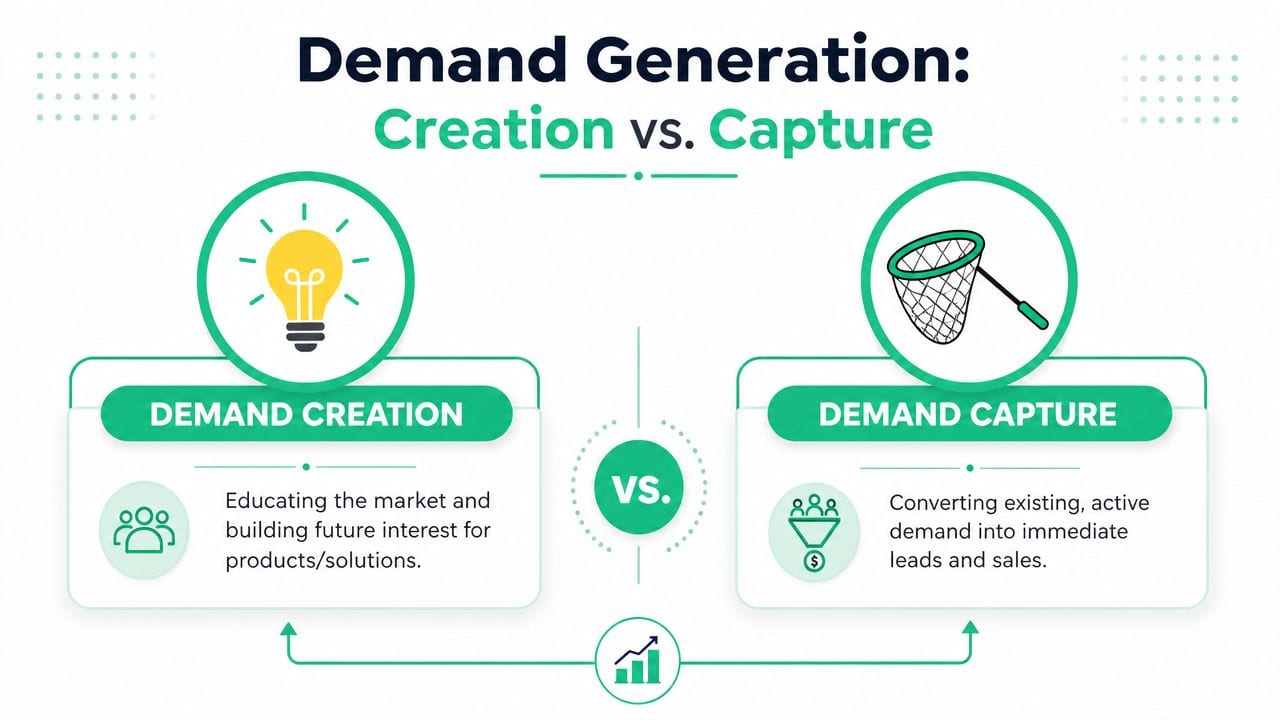
Demand creation
Demand creation is the work that shapes future preference before urgency exists. It helps buyers understand a problem, notice a category, and remember a vendor when timing changes.
This usually includes:
- Educational content: Category explainers, point-of-view pieces, webinars, podcasts, and opinionated articles.
- Audience building: Organic social, creator collaboration, communities, and newsletter distribution.
- Light retargeting: Repeated exposure that reinforces recognition instead of forcing conversion.
The mistake here is over-optimizing for immediate attribution. Creation rarely looks efficient in the short term. It still matters because it influences who makes the shortlist later.
Demand capture
Demand capture is different. Here the buyer already has intent. They're searching, comparing, validating, and trying to reduce risk.
Capture tactics usually include:
- High-intent SEO: Product-category pages, comparison pages, alternatives pages, use-case pages.
- Paid search: Tight alignment to solution-aware and vendor-aware queries.
- Bottom-funnel assets: Demo pages, implementation details, proof points, and clear conversion paths.
Demand creation builds memory. Demand capture converts memory into meetings.
Why teams confuse them
The operational problem is that many companies use one content calendar, one reporting model, and one success metric for both. That blurs trade-offs.
A webinar for category education should not be judged the same way as a branded search landing page. A thought leadership campaign should not be expected to convert like a “best software for X” page. When teams force both motions into the same KPI frame, they usually starve one of them.
The practical fix is to define separate objectives, separate audience logic, and separate measurement windows. One part of the system is trying to create future pipeline. The other is trying to collect current pipeline. They support each other, but they should not be managed as if they are identical.
Key Demand Generation Frameworks Explored
Frameworks matter because execution gets messy fast. Without one, teams pile channels on top of each other and call it strategy.
The classic funnel still has value. So does account-based marketing. The key question isn't which framework wins. It's which one matches the buying motion you need to influence.
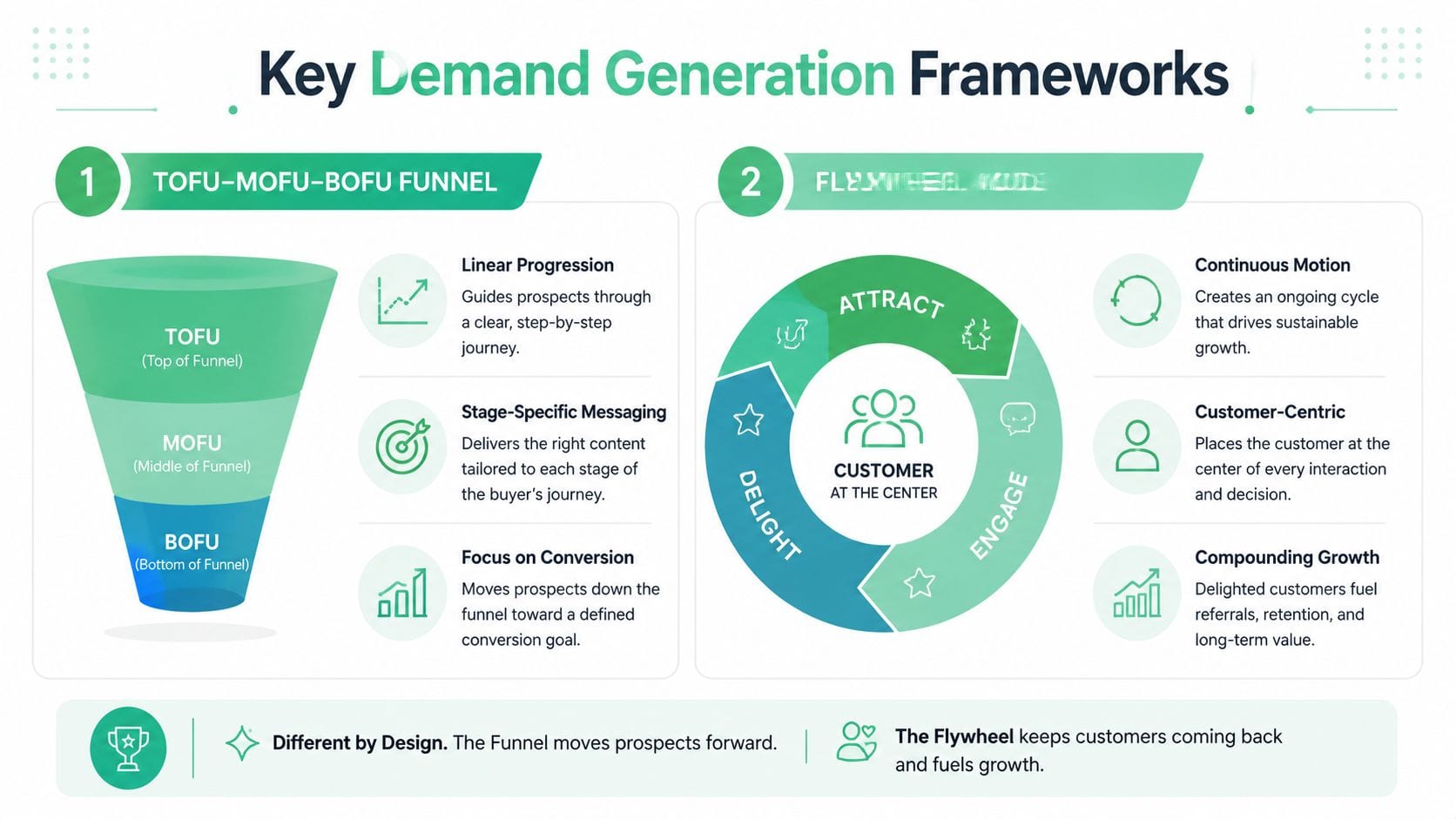
The funnel model
The traditional funnel is useful when you need broad market coverage and structured movement from awareness to conversion. It works especially well when:
- You sell to a large addressable market
- You need repeatable content production
- You rely on SEO and paid acquisition at scale
- You want clear stage-based planning for marketing and sales
Its strength is operational clarity. You can map channels and assets to awareness, consideration, and decision. Its weakness is that real buyers don't move neatly in order. They jump stages, involve peers, revisit evaluation criteria, and spend long periods inactive.
The ABM model
ABM flips the center of gravity. Instead of optimizing for lead volume, it focuses on account penetration and buying committee influence.
That approach works when:
- Deal sizes are large
- The ICP is narrow
- Multiple stakeholders shape the decision
- Sales and marketing need shared account plans
ABM is often stronger for precision. The challenge is scale. If your account selection is weak or your data is messy, the whole program turns into expensive personalization for the wrong companies.
A practical reference point is this set of account-based marketing examples, which shows how account-focused execution changes campaign design.
Here's a useful visual walkthrough from Trackingplan's channel that complements the framework discussion:
The hybrid model most teams need
Most SaaS and B2B services companies should run a hybrid model.
| Framework | Best use | Main risk |
|---|---|---|
| Funnel | Broad education and inbound capture | Too much focus on lead volume |
| ABM | High-value account penetration | Low scale if targeting is sloppy |
| Hybrid | Broad reach plus focused conversion in priority accounts | Operational complexity |
Operator's view: Use the funnel to shape market awareness. Use ABM to focus resources where the revenue concentration justifies it.
That hybrid setup works best when teams stop arguing about models and start assigning them to the right job. Broad content and paid media create familiarity. Account-focused orchestration turns that familiarity into pipeline where the commercial upside is highest.
Mapping Tactics and Channels to Funnel Stages
A demand gen plan gets expensive when channels aren't matched to buyer intent. Teams waste paid budget on educational audiences with demo CTAs, then publish bottom-funnel content in channels where buyers aren't evaluating anything yet.
One strategy source puts it clearly: effective demand generation separates the tech and content stacks for demand capture versus demand creation. Demand capture focuses on query-level SEO and ads for solution-aware buyers, while demand creation uses display and social to build awareness before intent appears, as explained in Braindonors' field-tested B2B demand gen strategies.
Top of funnel
Top of funnel is where buyers are learning, not selecting. They may recognize a pain point, but they usually aren't building a vendor shortlist yet.
Channels that fit:
- Thought leadership content: Strong opinions, category shifts, technical education, and market commentary
- LinkedIn and organic social: Short insights that introduce the problem and your point of view
- Podcasts and webinars: Good for nuanced topics that need explanation
- Display and paid social: Useful when the goal is reach inside a defined ICP, not immediate conversion
Good top-funnel offers are ungated or lightly gated. If every touch starts with a form, you lose too much early attention.
Middle of funnel
Middle of funnel is where buyers begin to define approaches. They're framing requirements, exploring methods, and comparing categories or solution styles.
Use assets such as:
- Deep guides and technical explainers
- Use-case pages
- Email nurture based on actual engagement
- Retargeting tied to content depth, not just page visits
A useful planning reference here is this breakdown of a channel marketing example. It helps teams think through how distribution choices change the role a campaign can play.
Bottom of funnel
Bottom of funnel is where generic awareness messaging fails. Buyers here need specificity.
The assets that usually perform best are:
- Comparison pages: “X vs Y,” alternatives, migration pages
- Product proof: Demos, implementation overviews, integration details
- Sales enablement content: Security answers, procurement support, stakeholder-specific materials
- High-intent paid search: Narrow query groups with clear message match
A “how to solve this problem” article and a “why choose us over another vendor” page can't be measured by the same standard. One creates movement. The other closes it.
A simple channel map
| Funnel stage | Buyer state | Best-fit channels | Best-fit CTA |
|---|---|---|---|
| Top | Learning | Social, display, podcasts, webinars, blog content | Subscribe, read, watch |
| Middle | Exploring | Retargeting, SEO education pages, email nurture, use-case content | Download, compare, engage |
| Bottom | Evaluating | Paid search, comparison SEO, demos, sales outreach | Book meeting, request demo |
The trade-off is straightforward. The lower the funnel, the easier it is to attribute impact and the harder it is to find net-new scale. The higher the funnel, the harder it is to measure cleanly and the more important it becomes for future pipeline.
Measuring Success with the Right KPIs
Most reporting stacks are built to count activity, not interpret buying signals. That's why teams end up presenting charts full of impressions, clicks, sessions, and form fills while leadership asks one question: did this create pipeline?
A better model is to treat measurement as a signal-processing system. One industry guide describes high-performing demand generation that way, using behavioral data such as website visits and content downloads, combined with intent data, to personalize campaigns and identify funnel bottlenecks based on observed actions rather than vanity metrics, as covered in Informa TechTarget's B2B demand generation guide.
What to track instead of vanity metrics
Not every useful metric has to be revenue. But every metric should have a plausible connection to revenue.
A practical reporting set usually includes:
- Leading indicators: Engagement from target accounts, return visits to key pages, deeper content consumption, branded search trends, demo page visitation
- Pipeline indicators: Opportunities created, pipeline sourced, pipeline influenced, sales acceptance quality
- Conversion diagnostics: Drop-offs between high-intent pages and forms, meeting-booked rate, routing quality, speed to follow-up
The point isn't to remove channel metrics. It's to put them in context. Click-through rate can help diagnose an ad problem. It cannot tell you whether the program is building revenue efficiently.
Build a signal hierarchy
The cleanest way to report B2B demand generation is to rank signals by commercial meaning.
| Signal type | Example | How to use it |
|---|---|---|
| Weak | Ad click, single page view | Directional only |
| Moderate | Repeat visit, webinar registration, multiple content views | Prioritize nurture and retargeting |
| Strong | Demo request, pricing page pattern, account-level engagement surge | Route to sales or high-intent programs |
This kind of hierarchy keeps teams from reacting too aggressively to weak inputs.
Measurement rule: Don't give weak signals strong consequences.
Attribution is useful, but limited
Attribution models help, but they can also create false certainty. First touch overstates discovery. Last touch overstates capture. Multi-touch is better in theory, but only if the underlying event data is reliable and the touchpoint rules are consistent.
That's why it helps to pair attribution with operational diagnostics. The leadership view should answer whether marketing contributed to pipeline. The operator view should answer where the journey broke.
For teams trying to formalize that reporting layer, this guide on how to measure marketing effectiveness is a useful complement to standard demand gen dashboards.
The best KPI framework is the one your sales, marketing, and analytics teams can all trust enough to act on.
Building Your Modern Demand Gen Tech Stack
A modern demand gen stack usually looks reasonable on paper. CRM. Marketing automation. CMS. Product analytics. Web analytics. Ad platforms. Maybe a customer data platform. The problem isn't usually tool count. It's whether the data moving between those tools is trustworthy.
That weakness shows up fastest in channels that don't leave neat website trails. Recent B2B strategy content points out a measurement gap around dark social and social-first research. Buyers discover vendors through communities, podcasts, webinars, and direct outreach before they ever fill out a form, as noted in Salesmotion's discussion of modern B2B demand gen strategies.
The core stack categories
At a minimum, these layers are needed:
- CRM: HubSpot, Salesforce, or another system of record for accounts, contacts, and opportunities
- Marketing automation: Nurture, scoring, routing, and lifecycle coordination
- CMS and website infrastructure: Where content, landing pages, and conversion paths live
- Analytics platforms: Google Analytics, Adobe Analytics, Amplitude, Mixpanel, or similar tools
- Media platforms: Google Ads, LinkedIn Ads, Meta, review sites, and retargeting tools
That list is familiar. What's usually missing is active QA.
Why observability matters more than another dashboard
Most demand gen reporting problems start upstream:
- UTMs are inconsistent
- Conversion pixels don't fire
- Duplicate events inflate results
- Consent logic blocks important measurement
- Schema changes break downstream reporting
- Offline and online handoffs don't reconcile cleanly
When that happens, teams debate channel performance using corrupted inputs. The result is bad optimization, mistrust between teams, and wasted spend.
A good stack needs an observability layer that checks whether data collection is still working after site updates, tag changes, template changes, or new campaign launches. If your business runs email heavily, even adjacent checks can matter. For example, before blaming a nurture sequence for weak response, it's often smart to validate deliverability with a tool like MailGenius spam checker.
Integration and governance
HubSpot often becomes the operating center for mid-market B2B teams because it connects acquisition, nurturing, attribution, and sales follow-up. That only works if the data arriving there is consistent. A technical reference like HubSpot integrations for analytics and tracking workflows is useful because it highlights how much of demand gen performance depends on implementation quality, not just campaign design.
Your dashboard is only as credible as the events, tags, and identities underneath it.
The teams that outperform here usually don't have more dashboards. They have fewer silent failures.
An Actionable Demand Generation Playbook
Teams usually do not miss pipeline because they lack ideas. They miss it because execution, measurement, and handoff rules are loose enough that nobody trusts the signal. The practical fix is an operating system for demand gen that ties campaign choices to buyer intent, sales action, and clean data.
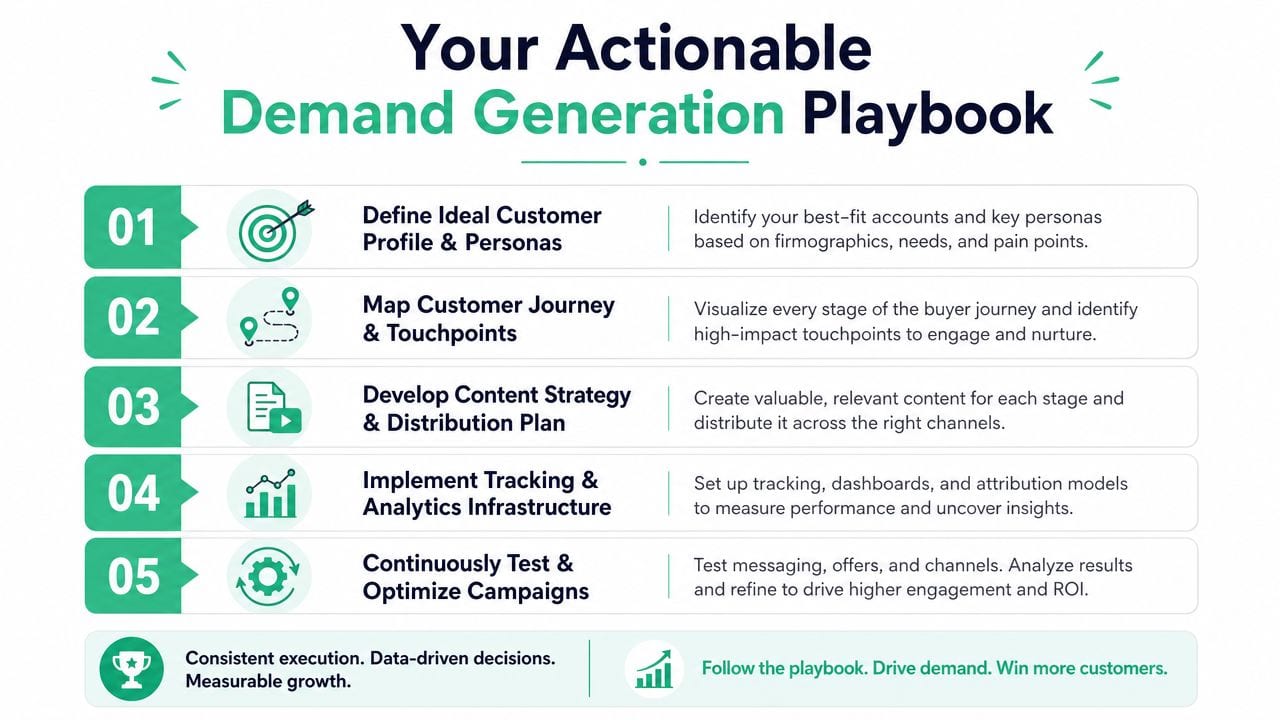
A practical launch checklist
Define the ICP clearly
Specify the account tier, buying committee, trigger events, and deal economics you want. If the ICP is broad, budget gets spread across traffic that may convert to leads but rarely turns into revenue.Separate creation from capture
Run awareness and in-market programs with different goals, budgets, and reporting views. This prevents educational content from being judged like a demo page and keeps high-intent channels focused on pipeline creation.Map channels to buyer state
Use thought leadership, social distribution, podcasts, and webinars to build familiarity before a prospect is ready to buy. Use search, review sites, comparison pages, and direct response offers when buyers are actively evaluating options.Instrument the journey before scaling spend
Confirm UTMs, form tracking, conversion events, lead routing, and CRM campaign sync before campaigns ramp. A channel can look efficient on paper and still fail if contacts are misclassified, routed late, or dropped before sales sees them.Review signal quality every week
Check for broken events, tagging drift, missing offline attribution, sudden conversion-rate swings, and mismatches between ad platforms, analytics, and CRM reports. This is the discipline that keeps optimization tied to reality.
A simple dashboard structure for leadership
Leadership does not need more charts. Leadership needs a clear view of whether demand is growing, whether capture is working, and whether the reporting is trustworthy.
Panel one: Demand creation
- Reach within ICP accounts
- Content engagement by audience segment
- Branded search trend
- Return visitor patterns
Panel two: Demand capture
- High-intent landing page performance
- Demo request volume and lead quality
- Pipeline created from in-market channels
- Sales follow-up status and speed to first touch
Panel three: Data trust
- Tracking issues detected
- Campaign tagging compliance
- Event health across core conversion points
- Attribution gaps under investigation
To build the capture side of your stack, consult curated lists of best lead generation products to evaluate options, then test them against your routing logic, CRM hygiene, and reporting model. A tool that creates more contact volume is useful only if those contacts can be scored, assigned, and tied back to pipeline with confidence.
The most impactful demand gen improvement is often making your measurement reliable enough to optimize the campaigns you already run.
If your team wants cleaner attribution, faster detection of broken tags and pixels, and more confidence in the numbers behind your pipeline reports, take a look at Trackingplan. It helps marketing, analytics, and data teams monitor tracking quality across web, app, and server-side environments so demand gen decisions are based on trusted data instead of guesswork.