
TL;DR:
- Data compliance in ecommerce involves adhering to privacy laws like GDPR, CCPA/CPRA, and India’s DPDP Act when handling customer data. It encompasses consent management, data security, retention, and responding to data subject requests to prevent fines and protect trust. Implementing continuous data governance, visibility tools like Trackingplan, and operational workflows ensures lawful and efficient data practices.
Data compliance in ecommerce is the set of legal obligations and operational practices that govern how customer data is collected, processed, stored, and shared under applicable privacy laws. Every online store that collects a name, email address, or payment detail is subject to these rules, whether it operates under GDPR in the EU, CCPA/CPRA in California, or India’s Digital Personal Data Protection Act. The stakes are concrete: regulatory fines, loss of customer trust, and broken analytics pipelines that distort every marketing decision downstream. This article explains the key regulations, how to embed compliance into daily operations, and how tools like Trackingplan help you stay ahead of enforcement without sacrificing data quality.
What is the role of data compliance in ecommerce?

Data compliance in ecommerce defines the boundaries of what you can legally do with customer information at every stage of the buying journey. It covers the moment a visitor lands on your site and a cookie fires, through checkout data collection, post-purchase email marketing, and long-term order record retention. The role it plays is not passive. Compliance shapes your consent flows, your data architecture, your vendor contracts, and your incident response readiness.
Customer expectations have shifted alongside regulation. Shoppers increasingly read privacy notices and abandon checkouts when consent banners feel manipulative. Compliance is therefore both a legal floor and a competitive signal. Brands that handle data transparently earn repeat business; those that do not face regulatory scrutiny and public backlash simultaneously.
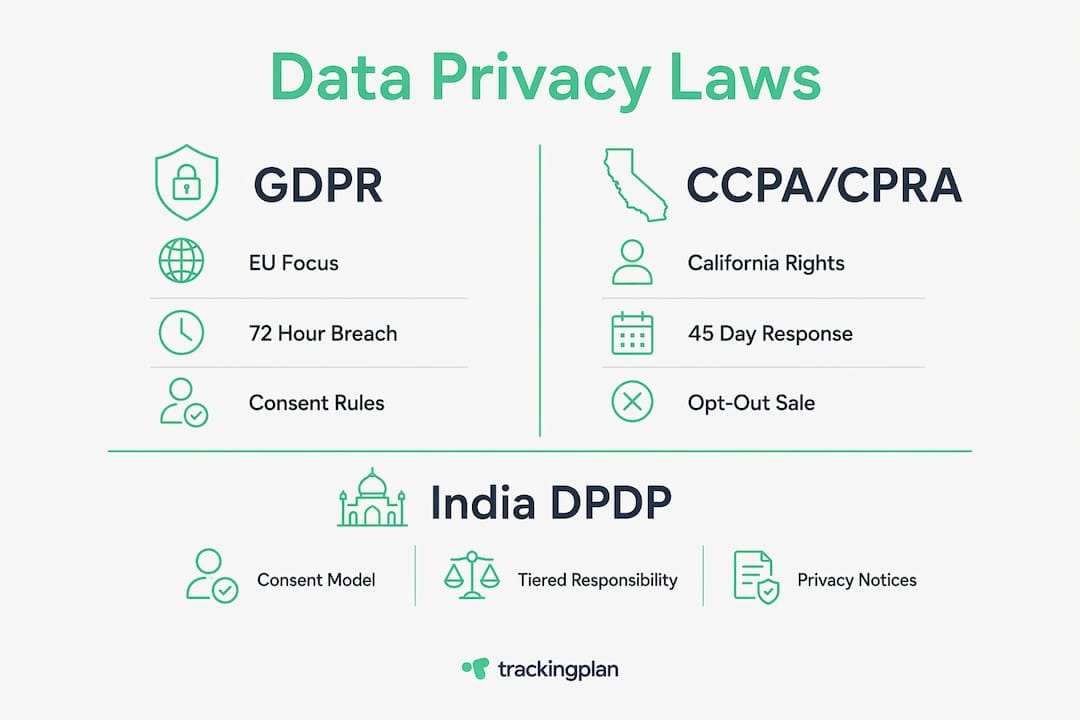
Three regulatory frameworks dominate global ecommerce compliance right now. GDPR applies to any business processing EU residents’ data, regardless of where the business is incorporated. CCPA/CPRA governs California consumers, and India’s DPDP Act creates obligations for businesses processing data of Indian citizens. Each framework has distinct requirements, but all three share a core principle: individuals have rights over their personal data, and businesses must honor those rights with documented, auditable processes.
What key data privacy regulations must ecommerce businesses comply with?
GDPR: the EU standard that set the global benchmark
GDPR requires ecommerce businesses to identify a lawful basis for every data processing activity before collecting any personal data. Privacy notices must include controller details, the Data Protection Officer contact, processing purposes and legal bases, data recipients, cross-border transfer safeguards, retention periods, and a full description of data subject rights. This is not a one-time document. Every new processing purpose requires a corresponding update to your privacy notice before data collection begins.
Cookie consent under GDPR and the ePrivacy Directive is where most ecommerce stores fail first. Non-essential cookies require prior, active consent with a genuine reject option, granular category selections, and the ability to withdraw consent at any time. Pre-ticked boxes and consent banners that make “Accept All” the only prominent button are violations, not gray areas.
CCPA/CPRA: California’s consumer rights framework
CCPA/CPRA grants California consumers the right to know, delete, correct, and opt out of the sale or sharing of their personal information. The operational pressure point is response time. Verifiable consumer requests must be answered within 45 days of receipt, and the clock starts at receipt regardless of whether identity verification is complete. Delaying a response because your workflow is not ready is itself a violation.
CPRA also introduced the California Privacy Protection Agency as an independent enforcement body, which means enforcement is no longer dependent on the Attorney General’s bandwidth. Businesses processing sensitive personal information, such as precise geolocation or financial data, face additional opt-out obligations.
India’s DPDP Act: the emerging compliance frontier
India’s Digital Personal Data Protection Act creates a tiered responsibility model for ecommerce. Ecommerce platforms are Data Fiduciaries for all data processed through their infrastructure, while individual sellers on those platforms are separately responsible as Data Fiduciaries for data they collect independently. This distinction matters enormously for marketplace operators like those running multi-vendor stores.
Data Fiduciary obligations under the DPDP Act include obtaining valid consent, issuing privacy notices in the user’s preferred language, establishing grievance mechanisms, and responding to data principal requests within 90 days.
Regulatory comparison at a glance
| Regulation | Jurisdiction | Response window | Key requirement |
|---|---|---|---|
| GDPR | EU/EEA residents globally | 30 days (extendable to 90) | Lawful basis for every processing activity |
| CCPA/CPRA | California consumers | 45 days (extendable to 90) | Right to opt out of sale/sharing |
| DPDP Act | Indian data principals | 90 days | Consent in user’s preferred language |
How to operationalize data compliance in ecommerce workflows
Compliance does not live in a PDF policy document. Sustainable compliance is built through workflows covering data visibility, risk assessment, governance, controls, and continuous monitoring, starting from a live data inventory. Without knowing what data you collect, where it goes, and who processes it, every other compliance effort is guesswork.
Here is a practical sequence for embedding compliance into your ecommerce operations:
- Build a live data inventory. Map every data collection point: checkout forms, newsletter sign-ups, live chat tools, analytics pixels, and ad tracking tags. Attempts to scale privacy programs without a live inventory consistently stall. Tools like Trackingplan automate this discovery across web, app, and server-side environments, surfacing tracking implementations you may not know exist.
- Implement a consent management platform. Choose a CMP that supports GDPR, CCPA, and DPDP requirements simultaneously. Platforms like OneTrust, Cookiebot, or Usercentrics each offer granular consent categories. For a detailed comparison, Trackingplan’s consent platform reviews cover the leading options for 2026.
- Configure Consent Mode correctly. Consent Mode synchronizes user consent signals with Google Analytics and Google Ads. After June 2025, Consent Mode cannot override CMP signals, making accurate CMP configuration a GDPR material requirement. Any misconfiguration means your analytics tools may collect data without valid consent.
- Execute data processing agreements with every vendor. Any third party that processes personal data on your behalf, including email service providers, payment processors, and analytics vendors, must sign a DPA that specifies processing purposes, security standards, and sub-processor obligations.
- Test consent propagation end to end. CMP consent choices must propagate accurately to downstream analytics and ad tools. A user who rejects tracking should trigger zero data collection in Google Analytics, Meta Pixel, and every other tag on your site.
Pro Tip: Use Trackingplan’s consent enforcement verification tools to confirm that rejected consent actually stops cookies from firing. This is the single most common compliance gap in ecommerce analytics stacks.
Cookie consent failures are where ecommerce compliance most frequently breaks down, specifically due to missing reject options and insufficient consent granularity. Fixing this is not a legal project. It is a technical configuration task that your analytics and marketing teams own.
What are the security and data retention best practices for ecommerce compliance?
Data security and retention are the operational backbone of any compliance program. Getting them wrong creates two distinct risks: a breach that triggers regulatory notification obligations, and a retention violation that either deletes data you were legally required to keep or holds data longer than permitted.
Separating data by retention category
Order data and marketing profile data carry different retention obligations. Invoice and transaction records must be retained for five years to satisfy tax and accounting law. Marketing consent records are valid only until the individual withdraws consent. Mixing these into a single customer record with a single deletion policy creates guaranteed violations in at least one direction.
The practical fix is to architect your customer database with separate retention flags per data category. Your CRM should distinguish between transactional records, behavioral analytics data, and marketing consent logs, each with its own automated deletion schedule.
Technical controls that reduce breach risk
- Encryption at rest and in transit. All personal data stored in your database and transmitted between systems must be encrypted. TLS 1.2 or higher for transit; AES-256 for storage is the current standard.
- Role-based access controls. Only staff with a documented business need should access personal data. Segment access by role: customer service agents see order history, not payment card data; marketing teams see consent status, not full purchase records.
- Audit logging. Every access to personal data should be logged with a timestamp and user ID. Logs are your first line of defense in a regulatory investigation and your primary tool for identifying unauthorized access.
- Vendor security assessments. Third-party processors are your liability. Conduct annual security reviews of every vendor with access to customer data, and document the results.
Building a 72-hour breach response capability
Ecommerce data breaches require notification to supervisory authorities within 72 hours of discovery under GDPR. That window is shorter than most teams expect. Without a pre-built incident response plan, you will spend the first 48 hours figuring out who owns the response instead of executing it.
Your incident response plan must define: who declares an incident, who notifies the supervisory authority, what information the notification must contain, and which individuals must be notified directly when the breach creates high risk to their rights. Document this plan, assign named owners, and review it quarterly.
Pro Tip: Developing incident response muscle memory through tabletop exercises and defined roles is the most effective way to reduce compliance risk from breaches. Run a simulated breach scenario with your team twice a year.
How can ecommerce businesses handle data subject requests effectively?
Data subject access requests, known as DSARs in GDPR contexts and consumer rights requests under CCPA/CPRA, are the most operationally demanding part of ongoing compliance. Every request requires you to locate all personal data held about an individual, compile it accurately, redact third-party information, and deliver a response within a legally defined window.
Here is a workflow that covers the full request lifecycle:
- Create a dedicated intake channel. A privacy request form on your website, linked from your privacy notice, is the clearest intake method. It sets expectations, captures the information you need for identity verification, and timestamps the request automatically.
- Verify identity without over-collecting. You need enough information to confirm the requester is who they claim to be, but you cannot demand excessive verification that effectively blocks the right. For most ecommerce requests, matching the email address and order history is sufficient.
- Search all data systems. Your response must cover every system that holds the individual’s data: your ecommerce platform, CRM, email marketing tool, analytics platform, customer support system, and any third-party processors. A live data inventory makes this step tractable.
- Apply selective redaction. Selective redaction removes third-party personal information from DSAR responses while preserving the requester’s own data. If an order record includes a delivery driver’s name or a customer service agent’s personal email, that information must be redacted before the response is sent.
- Deliver within the regulatory window. The 45-day CCPA/CPRA response clock starts at receipt, not at verification. Under India’s DPDP Act, the window is 90 days. Under GDPR, you have 30 days with a possible 60-day extension for complex requests. Missing these deadlines is a direct violation regardless of the reason.
Managing ongoing compliance as a program, not a project
Ecommerce compliance triggers at every customer touchpoint, from the first cookie on a product page to a post-purchase review request. Treating compliance as a one-time setup project guarantees gaps. Assign clear ownership: a Data Protection Officer or privacy lead for GDPR obligations, a designated privacy contact for CCPA, and a Grievance Officer for DPDP Act requirements.
Update your privacy notice every time you add a new processing activity, a new vendor, or a new marketing channel. Maintain your Records of Processing Activities document as a living record, not a static spreadsheet. Schedule quarterly reviews of consent rates, DSAR volumes, and vendor compliance status to catch drift before it becomes a violation.
For marketplace sellers operating under India’s DPDP Act, the compliance boundary is particularly important. Sellers who independently collect customer data carry separate Data Fiduciary obligations from the platform they sell on. A seller who collects buyer contact details for direct marketing is fully responsible for consent, notice, and data subject rights for that data, independent of the marketplace’s own compliance program.
Key takeaways
Data compliance in ecommerce requires documented processes, technical controls, and cross-functional ownership across every customer data touchpoint, from consent capture to breach notification.
| Point | Details |
|---|---|
| Regulations vary by jurisdiction | GDPR, CCPA/CPRA, and India’s DPDP Act each impose distinct obligations; map which laws apply to your customer base. |
| Consent management is technical | Cookie banners must block non-essential tracking before consent is given and honor rejections across all downstream tools. |
| Data retention needs segmentation | Separate transaction records (5-year retention) from marketing data (consent-based) to avoid simultaneous over-retention and premature deletion. |
| DSAR response windows are strict | CCPA gives you 45 days from receipt; GDPR gives 30 days; DPDP Act gives 90 days. Missing these deadlines is a direct violation. |
| Incident response must be practiced | A 72-hour GDPR breach notification window requires pre-assigned roles and rehearsed procedures, not improvised responses. |
Why compliance is the wrong word for what ecommerce businesses actually need
I have spent years watching ecommerce teams treat compliance as a legal department problem. They commission a privacy policy, install a cookie banner, and consider the matter closed. Then a regulator asks for their Records of Processing Activities, or a customer submits a DSAR, and the entire operation freezes because no one built the underlying infrastructure.
The word “compliance” implies a finish line. What ecommerce businesses actually need is a data governance practice, one that runs continuously, adapts to new regulations, and integrates with the way marketing, product, and operations teams work every day. The businesses I have seen handle this well share one trait: they treat privacy as a product requirement, not a legal afterthought.
The emerging enforcement environment makes this shift urgent. Regulators in the EU, California, and India are increasing enforcement actions and issuing fines that scale with revenue. The DPDP Act’s implementation in India will bring hundreds of millions of new data principals under formal protection, and ecommerce businesses that sell to Indian consumers need to build that compliance infrastructure now, not after the first enforcement action.
The practical starting point is always the same: know what data you have, know where it goes, and build consent and retention controls around that reality. Analytics tools that give you visibility into your tracking stack, like Trackingplan, are not just marketing utilities. They are compliance infrastructure. Understanding cookieless tracking strategies is increasingly part of that picture as third-party cookies continue to disappear and consent-based measurement becomes the only reliable option.
Compliance built on genuine data visibility is defensible. Compliance built on documents and good intentions is not.
— David
How Trackingplan supports ecommerce data compliance
Ecommerce teams managing GDPR, CCPA, and DPDP obligations need more than policy documents. They need real-time visibility into what their tracking stack is actually doing.
Trackingplan’s Privacy Hub gives you automated monitoring of consent enforcement, pixel behavior, and analytics implementations across your entire digital stack. You can verify that rejected consent actually stops data collection, detect tracking fires that occur before consent is captured, and audit your full data inventory without manual effort. For teams running Google Analytics alongside paid media, Trackingplan’s digital analytics tools integration surfaces compliance gaps in attribution and consent propagation before they become regulatory exposure. Explore how Trackingplan can simplify your compliance workflows and keep your data collection both accurate and lawful.
FAQ
What is data compliance in ecommerce?
Data compliance in ecommerce is the practice of collecting, processing, storing, and sharing customer personal data in accordance with applicable privacy laws such as GDPR, CCPA/CPRA, and India’s DPDP Act. It covers consent management, privacy notices, data retention, security controls, and data subject rights.
Which regulations apply to ecommerce businesses in 2026?
The three primary frameworks are GDPR for EU residents, CCPA/CPRA for California consumers, and India’s DPDP Act for Indian data principals. Each applies based on the location of your customers, not the location of your business.
How long do I have to respond to a data subject request?
GDPR requires a response within 30 days, extendable to 90 days for complex requests. CCPA/CPRA sets a 45-day window from the date of receipt. India’s DPDP Act allows 90 days. All clocks start at receipt, not at verification.
What happens if a cookie fires before consent is given?
Firing non-essential cookies before obtaining valid consent is a direct GDPR violation. Regulators treat pre-consent cookie fires as unauthorized data collection, which can trigger fines and enforcement action. Tools like Trackingplan detect pre-consent cookie fires automatically.
Do marketplace sellers have separate compliance obligations under India’s DPDP Act?
Yes. Sellers who independently collect customer data on a marketplace platform are Data Fiduciaries for that data, separate from the platform’s own compliance obligations. This means sellers must obtain their own consent, issue privacy notices, and handle data subject requests for any data they collect directly.