
TL;DR:
- Digital marketing analytics involves collecting and interpreting data from multiple channels to understand customer behavior and boost performance. Connecting tools like GA4 and HubSpot to AI-driven intelligence improves measurement accuracy and real-time decision-making. Teams must map tools to funnel stages, prioritize impactful KPIs, and continuously validate data quality to succeed in 2026.
Digital marketing analytics is the practice of collecting, analyzing, and interpreting data from digital channels to understand customer behavior and improve marketing performance. It pulls together signals from websites, paid campaigns, social media, email, and CRM platforms into a unified view of what drives revenue. Tools like Google Analytics, HubSpot, and Salesforce form the backbone of most analytics stacks, but the field has moved well beyond basic traffic reporting. The real competitive edge in 2026 comes from connecting those tools to AI-powered intelligence and building measurement systems that hold up under CFO scrutiny.
What tools and platforms define the digital marketing analytics stack?
The modern analytics stack is not a single tool. It is a layered system where each platform covers a distinct measurement need.
The five core categories every marketing team should cover are:
- Traffic and engagement: Google Analytics 4 (GA4) remains the baseline for session data, user behavior, and conversion events across web and app properties.
- SEO and organic search: Ahrefs, SEMrush, Moz, and Google Search Console track keyword rankings, backlink profiles, and organic visibility.
- Paid media: Google Ads, Meta Ads, and Amazon Ads each provide native reporting dashboards for impression share, click-through rate, and return on ad spend.
- Website UX: Heatmap and session recording tools reveal where users click, scroll, and drop off, adding behavioral context that raw numbers miss.
- CRM and account-level data: HubSpot and Salesforce connect marketing activity to pipeline stages and closed revenue, which is the only way to calculate true customer acquisition cost.
Effective marketing analytics requires mapping each of these tool categories to a specific funnel phase: acquire, convert to lead, and convert to deal. Teams that skip this mapping end up with data silos where paid media reports look great but nobody can explain why pipeline is flat. Integration matters as much as the individual tools. Native connectors to 100+ sources create a single source of truth and eliminate the manual reconciliation that wastes analyst hours every week.
Which metrics and KPIs should marketing professionals prioritize?
The most common mistake in digital marketing analytics is treating pageviews and sessions as success metrics. They measure activity, not impact.
Mature analytics teams structure their KPIs around the funnel:
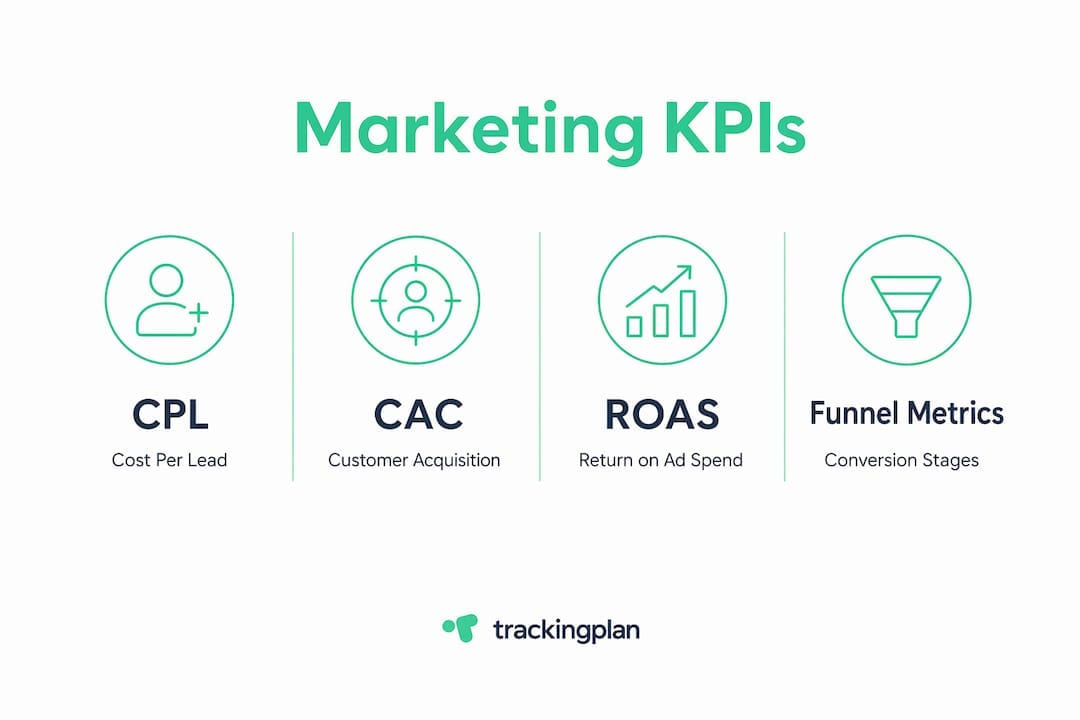
- Acquisition metrics: Cost per lead (CPL), click-through rate (CTR), and channel-level traffic volume show where leads come from and what they cost.
- Lead conversion metrics: Form submission rate, marketing qualified lead (MQL) volume, and lead-to-opportunity rate measure how well acquisition converts into pipeline.
- Deal conversion metrics: Customer acquisition cost (CAC), return on ad spend (ROAS), and pipeline contribution by channel connect marketing spend directly to revenue.
- Retention and lifecycle metrics: Cohort analysis and repeat purchase rate reveal whether acquired customers stay and grow.
Mature teams use user-level, journey-focused analysis that integrates CRM data with marketing signals, rather than relying on session-level aggregates. For B2B organizations, session-level data is especially misleading. A single enterprise deal may involve dozens of sessions across multiple stakeholders over months. Integrating marketing signals with CRM account stages is the only reliable way to calculate ROI in a long sales cycle.
Pro Tip: Build a single dashboard that maps each KPI to a funnel stage and a budget line. If a metric does not connect to either acquisition cost or revenue, remove it from the weekly report.
How do AI-native analytics platforms enhance digital marketing intelligence?
AI has changed what is possible for marketing teams without dedicated data science resources. The shift is not incremental. It is structural.
The defining capabilities of AI-native analytics platforms in 2026 include:
- Natural language querying: AI-powered platforms enable teams to ask questions in plain English and receive instant answers, removing the dependency on SQL-fluent analysts for routine reporting.
- Automated anomaly detection: Platforms flag unexpected drops or spikes in conversion rates, traffic, or spend without requiring manual threshold configuration.
- Root-cause analysis: When a metric moves, AI identifies the contributing factors automatically, cutting diagnosis time from days to minutes.
- Generative BI: Static dashboards are being replaced by dynamic, conversational interfaces that surface relevant insights based on current campaign context.
“AI democratizes marketing data by enabling non-technical team members to ask questions in natural language and get instant insights, shifting organizations from static dashboards to generative BI supporting real-time decision-making.” — AI Analytics Platform Capabilities
Warehouse-native platforms take this further. Teams integrating with Snowflake or BigQuery can achieve cross-functional insights in under 30 days, avoiding the sampling errors and data loss that come with traditional ETL pipelines. Speed matters here. A campaign decision made on Tuesday based on Monday’s data is materially different from a decision made in real time. The ROI impact of AI-driven tracking is measurable precisely because it compresses the feedback loop between data and action.
What are best practices for implementing digital analytics in 2026?
Sound implementation starts with data you can trust. Everything else depends on it.

Consolidate before you analyze
Consolidating data across five key categories is the foundation of any mature analytics practice. GA4 handles base traffic. Paid platforms cover spend and ROAS. SEO tools track organic performance. UX tools explain on-site behavior. CRM data closes the loop on revenue. Without all five, attribution is guesswork.
Prioritize data transparency over convenience
Black-box attribution models are a liability at the board level. Open-source or self-hosted platforms with inspectable SQL and raw data access close the trust gap that proprietary models create. When a CFO asks why the marketing attribution model credits a specific channel, you need to show the logic, not just the output.
Map tools to funnel stages
The table below shows how to align your stack to the three core funnel phases:
| Funnel phase | Primary tools | Key metrics |
|---|---|---|
| Acquire | GA4, Google Ads, Meta Ads, SEMrush | CPL, CTR, channel traffic volume |
| Convert to lead | HubSpot, landing page tools, UX analytics | Form conversion rate, MQL volume |
| Convert to deal | Salesforce, CRM reporting, attribution tools | CAC, ROAS, pipeline by channel |
Evaluate platforms on total cost of ownership
Per-seat pricing, API export availability, and data portability all affect long-term cost. Total cost of ownership and data portability are the two most underweighted factors in platform selection. A tool that is cheap per seat but locks your data behind proprietary exports will cost more in analyst time than a higher-priced platform with open APIs.
Pro Tip: Before signing any analytics platform contract, test the data export. Download a raw event file and confirm you can join it to your CRM data without vendor assistance. If you cannot, the platform owns your data more than you do.
Validate continuously, not just at launch
Analytics implementations break silently. Pixels fire incorrectly after a site update. UTM parameters get stripped by redirects. Tag manager rules conflict after a new campaign goes live. Optimizing attribution tracking for accuracy requires ongoing validation, not a one-time audit at setup.
Key takeaways
Effective digital marketing analytics requires clean data, funnel-mapped KPIs, and AI-powered monitoring to connect marketing spend to revenue with confidence.
| Point | Details |
|---|---|
| Build a five-layer stack | Cover traffic, SEO, paid media, UX, and CRM to get a complete funnel view. |
| Drop vanity metrics | Replace pageviews and sessions with CPL, CAC, ROAS, and conversion rates. |
| Demand data transparency | Use platforms with inspectable logic and raw data export for board-level reporting. |
| Adopt AI-native tools | Natural language querying and anomaly detection cut diagnosis time from days to minutes. |
| Validate tracking continuously | Analytics implementations break silently after site updates, so monitor them on an ongoing basis. |
What I have learned after years of watching analytics stacks fail
The most expensive mistake I see marketing teams make is not a tool choice. It is a measurement philosophy problem. Teams invest in GA4, HubSpot, and a paid attribution platform, then spend their weekly meetings debating which dashboard is right. The data is not wrong. The architecture is. Nobody mapped the tools to funnel stages before buying them.
The second pattern I see constantly is the trust collapse. A marketing team builds a beautiful attribution model, presents it to the CFO, and gets asked one question they cannot answer: “Can you show me the raw data behind that number?” If the answer involves a vendor’s proprietary algorithm, the model loses credibility immediately. Transparent metric logic is not a nice-to-have. It is the price of admission for board-level reporting.
The shift to AI-native analytics is real and accelerating. But I would caution against treating AI as a replacement for measurement discipline. Anomaly detection only works if the underlying data is clean. Natural language querying only returns useful answers if the events being tracked are correctly named and consistently fired. AI amplifies whatever data quality you already have. It does not fix bad tracking.
The teams that win in 2026 are the ones that treat data quality as infrastructure, not as a project. They monitor their tracking implementations the same way they monitor their servers: continuously, automatically, and with alerts that fire before a human notices something is wrong.
— David
How Trackingplan fits into a high-quality analytics practice
Accurate analytics starts with accurate tracking. Trackingplan monitors your entire analytics implementation automatically, detecting broken pixels, missing events, schema mismatches, and campaign misconfigurations across web, app, and server-side environments. Real-time alerts via Slack, Teams, or email mean your team knows about a tracking failure before it corrupts a week of attribution data. For teams managing complex Martech stacks, Trackingplan’s digital analytics monitoring tools and web tracking monitoring solutions provide the data quality layer that makes every other analytics investment more reliable.
FAQ
What is digital marketing analytics?
Digital marketing analytics is the process of collecting and analyzing data from digital channels, including websites, paid ads, email, and social media, to measure and improve marketing performance.
What are the most important KPIs in digital marketing analytics?
The most impactful KPIs are cost per lead (CPL), customer acquisition cost (CAC), return on ad spend (ROAS), and funnel conversion rates. Pageviews and sessions alone do not indicate revenue impact.
How does AI improve marketing analytics?
AI-native platforms enable natural language querying, automated anomaly detection, and root-cause analysis, reducing the time to diagnose campaign issues from days to minutes.
Why does data transparency matter in analytics?
Inspectable SQL and raw data access allow marketing teams to validate attribution logic for CFO and board-level reporting. Black-box models erode stakeholder trust.
How often should marketing teams audit their analytics implementation?
Analytics implementations should be monitored continuously, not audited quarterly. Site updates, new campaigns, and tag manager changes can break tracking silently and corrupt attribution data within hours.