
Your campaign launches on time. Spend ramps up. Dashboards look normal enough that nobody panics. Then, two weeks later, someone notices conversions fell off only in one region, one app version, or one consent state. The pipeline never crashed. Jobs stayed green. Data still arrived. But the numbers were wrong.
That's the failure pattern that hurts most. Silent failures don't announce themselves with a broken ETL run or a pager alert. They show up as missing events, shifted schemas, stale tables, duplicate rows, broken attribution, or a consent change that insidiously strips the signal your analysts and marketers depend on. By the time someone catches it, you're no longer fixing a technical issue. You're rebuilding trust.
That's why data pipeline monitoring tools matter. A 2023 report from the Data Leadership Council found that 82% of enterprises experienced at least one critical data pipeline failure in the previous year, with an average cost of $15,000 per incident due to downtime, lost revenue, and remediation efforts. The same report said teams using automated monitoring reduced average incident resolution time by 67% compared with manual processes, and reported a 30% improvement in data team productivity when analysts spent less time on root-cause debugging and more time on strategic work.
The harder truth is that “pipeline monitoring” now means more than warehouse freshness checks. Some teams need production observability across dbt, Snowflake, and BI. Others need pre-deployment QA to stop bad changes before merge. And many marketing and analytics teams need monitoring at the collection layer, where tracking can look healthy while being semantically wrong.
Here are the tools I'd shortlist, grouped by the job they do best.
1. Trackingplan
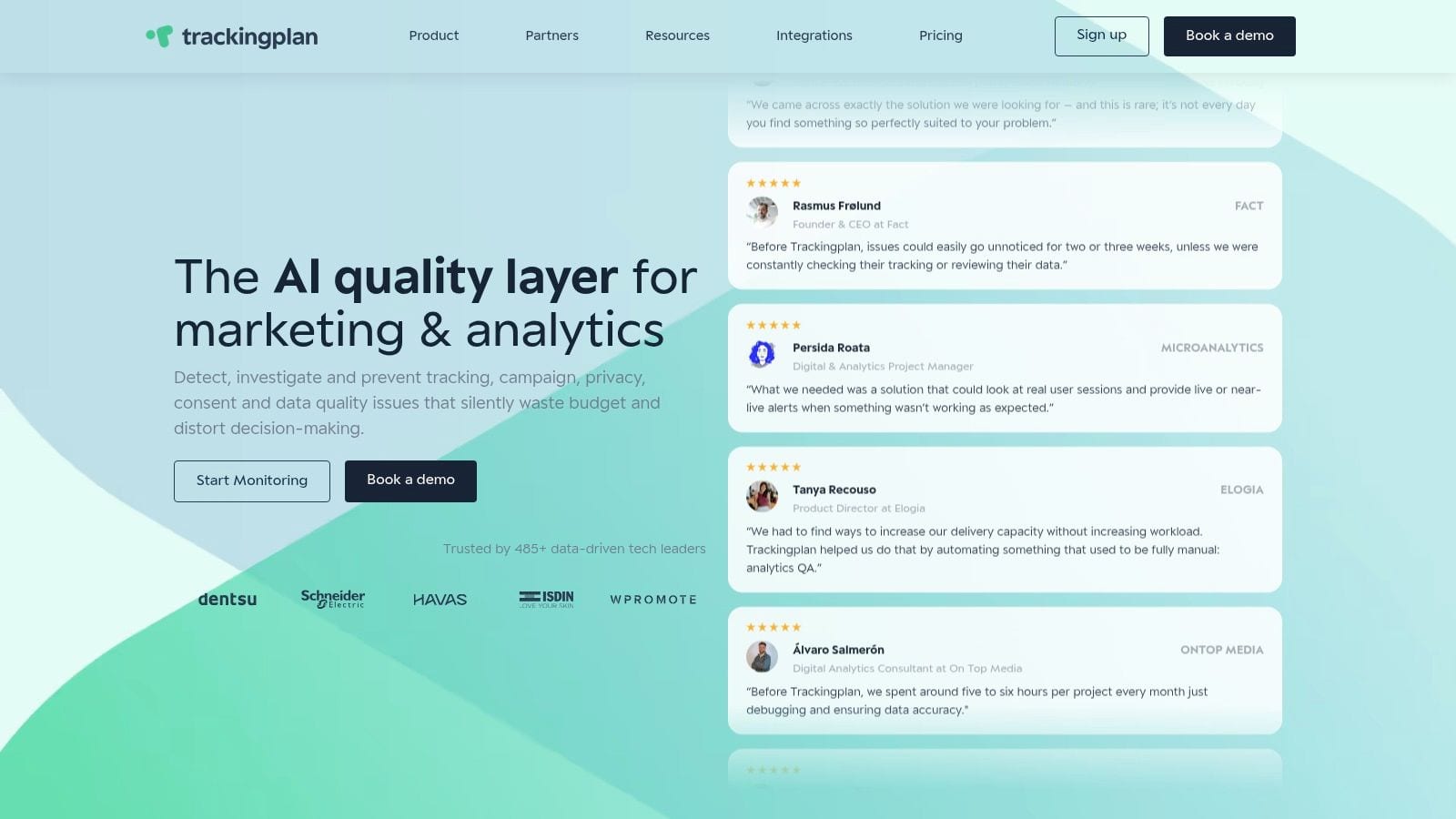
Trackingplan covers a part of the monitoring stack that warehouse-first tools often miss. It focuses on the analytics collection layer across web, app, and server-side implementations, where data can keep flowing while meaning subtly breaks. Missing events, renamed properties, broken pixels, consent drift, UTM errors, and accidental PII exposure all fit that pattern.
That distinction is important, since many analytics failures begin before the warehouse ever has a chance to surface them. Teams often evaluate data pipeline monitoring tools around freshness, schema drift, lineage, and incident workflows, but that leaves a real gap around event quality, attribution, consent, and pixel behavior. The industry commentary behind RudderStack's discussion of data pipeline monitoring points to the same issue: trust is often lost at collection time, not during transformation.
Where it fits best
Trackingplan fits teams that need front-end analytics observability more than classic production data observability or pre-deployment QA. That makes it a useful contrast with tools later in this list. Monte Carlo, Metaplane, and Bigeye are built around production monitoring in the warehouse. Datafold and Soda are stronger when the goal is to catch problems before release. Trackingplan is for the earlier point of failure, where instrumentation ships, traffic arrives, and the implementation is technically live but analytically wrong.
It is strongest when analysts, marketers, developers, and agencies all touch tracking quality, but no one wants to keep running manual QA passes after every release. It auto-discovers events, properties, destinations, pixels, and campaign signals from real traffic, then keeps checking them over time instead of relying only on synthetic tests or one-off audits.
That cross-functional angle matters in practice. Marketing asks whether the pixel fired. Analytics asks whether the payload still matches the spec. Engineering asks what changed after the release. Trackingplan is built around that shared workflow, and its data quality monitoring guide is a useful reference if your team is trying to define what should be monitored at the collection layer versus downstream.
Here's a useful product walkthrough from Trackingplan's YouTube channel:
Silent analytics failures usually start where data is collected, not where it's modeled.
What works in practice
The implementation story is one of its practical advantages. Trackingplan says setup takes minutes through a lightweight 10kb tag or mobile SDKs, which is far easier to test than a long observability rollout. It connects with common analytics and ad platforms including Google Analytics, Adobe, Amplitude, Mixpanel, Segment, and Snowplow.
A few things stand out day to day:
- Real-traffic monitoring: It observes what users trigger, not just what a synthetic script expected.
- Business-aware debugging: It goes beyond “event missing” and tries to show likely causes and downstream impact.
- Privacy checks: Consent monitoring and PII leak detection are part of the workflow, which helps teams that treat analytics QA and compliance as the same operational problem.
- Cross-team visibility: Agencies and in-house teams get a shared reference point instead of screenshots, spreadsheets, and Slack threads.
There are trade-offs. Signal quality depends on traffic volume, so high-traffic properties surface patterns faster than low-traffic sites. Pricing is not public either, which means smaller teams should validate fit through a trial or proof of concept before committing.
2. Monte Carlo
Monte Carlo is one of the clearest picks for production data observability at scale. If your main pain sits in warehouse tables, transformations, lineage, freshness, and downstream dashboard impact, this is the type of platform that usually makes the shortlist first. It's built for teams that need broad coverage and incident workflows, not just isolated quality checks.
The category itself shifted in this direction after the late 2010s. Historical data shows that early monitoring stacks such as Prometheus and Grafana were built primarily for system metrics, while the dedicated observability wave accelerated around 2019 with vendors like Monte Carlo and Soda focusing on freshness, schema drift, and completeness. A Gartner study cited in the verified data noted that 65% of organizations moved from generic infrastructure monitoring to specialized data pipeline monitoring tools within the prior three years, reflecting a real change in what teams expect from monitoring.
Why teams buy it
Monte Carlo is good when the question isn't “Did one table break?” but “What else did that break downstream?” Its lineage and impact analysis help triage incidents fast, especially when dozens of models and dashboards depend on the same upstream object. That's the difference between observability and scattered checks.
If your team is trying to formalize data quality monitoring practices, Monte Carlo fits that operating model well. It covers freshness, volume, schema, and distribution monitors, then layers incident workflows and root-cause analysis on top.
Practical rule: Buy Monte Carlo when your hardest problem is blast radius, ownership, and response coordination across a large stack.
Trade-offs
The upside is maturity. The downside is weight. Small teams often find enterprise observability suites too expensive and too broad if they mainly need a handful of critical checks.
A few practical considerations:
- Best for complex estates: Strong fit for large warehouse environments and many downstream consumers.
- Less ideal for lean teams: It can feel heavy if your stack and ownership model are still simple.
- Sales-led pricing: You'll need a real buying process, not a quick swipe of a card.
3. Metaplane
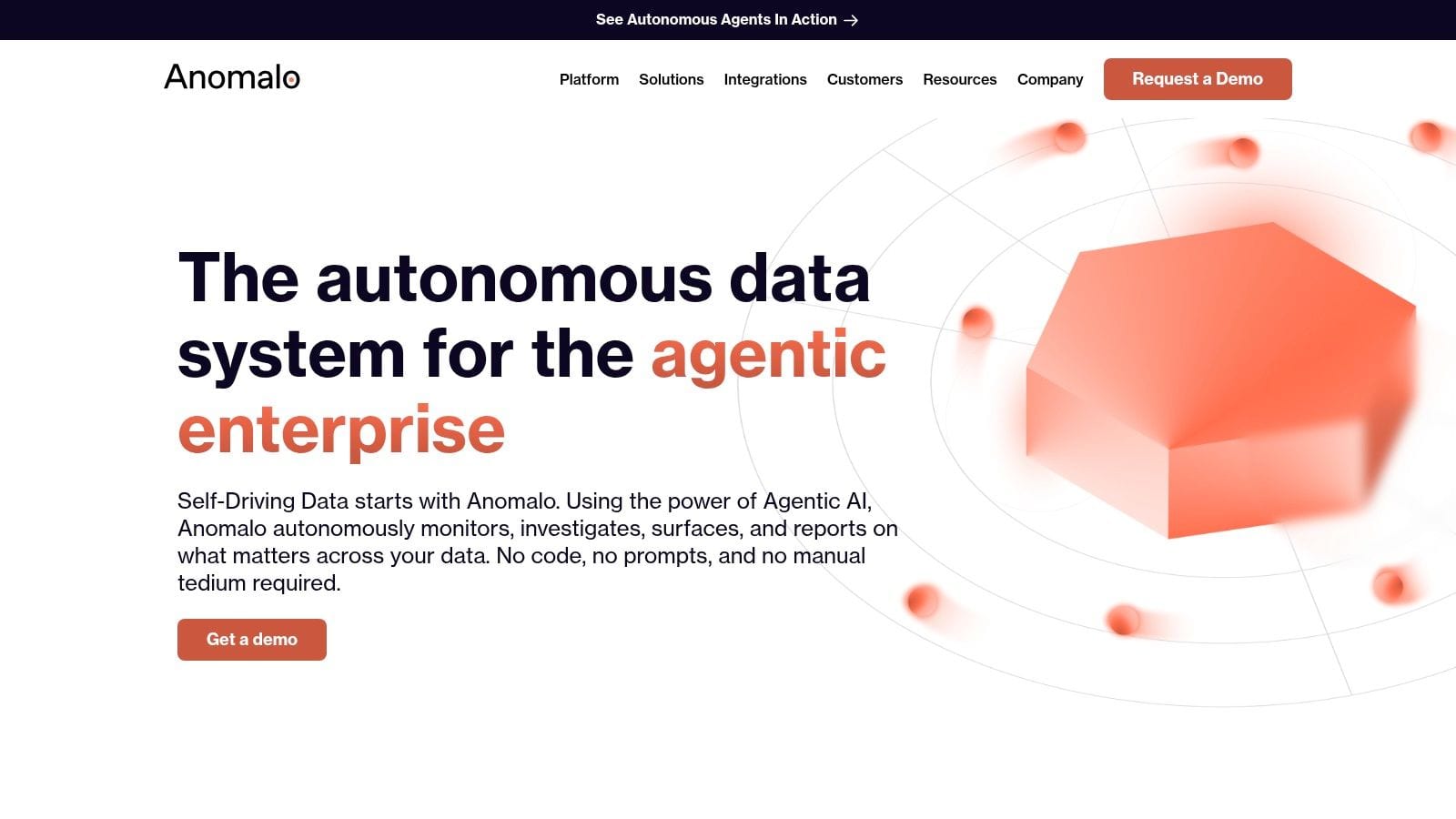
Metaplane is one of the better fits for teams that want modern data observability without immediately adopting the heaviest enterprise platform. It's often evaluated by analytics engineering teams using dbt, Snowflake, or Databricks who want fast onboarding, sensible monitors, and a product that feels self-serve.
That usability angle matters because specialized monitoring adoption has grown quickly. In the historical shift toward purpose-built observability, a 2022 Gartner study in the verified data reported a 50% reduction in “unknown unknowns” after organizations moved from generic monitoring to specialized tools. For teams that are still discovering what they should even monitor, that reduction is often more valuable than adding another alert channel.
Best fit
Metaplane tends to work well when you need broad core coverage without a long implementation cycle. Freshness, volume, schema, and distribution monitors are standard territory. The product also leans into auto-suggested monitors and an approachable experience, which helps mid-market teams move faster.
If your monitoring effort also sits inside a broader push for ownership and documentation, these data governance best practices are worth tying into the rollout. Good observability gets stronger when teams know who owns which model and what “healthy” means.
What to expect
Metaplane's practical advantage is friction, or rather the lack of it. You can usually get signal without building a giant process around the tool.
- Fast onboarding: Good fit for teams that want value early.
- Good UX: That sounds minor until your analysts and engineers both need to use it.
- Less enterprise depth: Large regulated environments may still prefer a heavier platform.
- Pricing path: Easy to start, less transparent once you grow beyond the entry point.
4. Anomalo
Anomalo appeals to teams that want anomaly detection to do more of the work for them. Instead of asking you to hand-author endless rules, it profiles tables and looks for missing, late, or unusual data patterns with a lighter manual burden. That's attractive when your team knows data quality is drifting but doesn't have the bandwidth to encode every failure mode upfront.
The broader market moved in this direction quickly. By 2023, ML-based anomaly detection had become standard in this tool category, and 78% of surveyed enterprises in the verified data said ML-powered alerts identified 20% more anomalies than traditional threshold-based methods. That doesn't make rule-based checks obsolete, but it does explain why tools like Anomalo resonate with understaffed teams.
Where it shines
Anomalo is a good choice when the hard part is coverage. If you have a lot of tables, inconsistent source behavior, and not enough time to write custom tests, automated profiling gets you to a useful baseline faster than a blank canvas approach.
Its model also works well for mixed teams where not everyone wants to live in SQL. If part of your operating model depends on automated detection surfacing weirdness for analysts, operations teams, or domain owners, Anomalo is easier to socialize than a purely code-centric workflow.
A related topic is real-time anomaly detection, especially if you're comparing thresholding with learned baselines across production pipelines.
Teams usually regret under-specifying anomaly detection less than they regret writing hundreds of brittle checks nobody maintains.
Trade-offs
The product's strength is also its limit. Highly opinionated automation won't satisfy every team.
- Great for quick coverage: Especially when rules debt is already high.
- Less ideal for highly custom validation: Some teams want precise, hand-crafted assertions.
- Sales-led pricing: You'll need a scoped evaluation, not a lightweight checkout.
5. Datafold
Datafold belongs in a different bucket from most of the tools on this list. It's not the obvious answer for production observability. It's the answer when you want to stop bad data changes before they ever reach production. That distinction matters, because plenty of teams buy a monitoring platform and then keep shipping preventable breakage through CI.
Datafold is best known for Data Diff, which compares data values across databases or pipeline states. That makes it strong for migration validation, refactors, dbt changes, and pre-merge checks. If your incidents often trace back to “the SQL looked fine, but the output changed,” Datafold addresses that much closer to the source.
Why this category matters
The market conversation often over-focuses on catching incidents after deploy. But shifting quality left is how mature teams reduce incident volume in the first place. In practice, Datafold complements production data pipeline monitoring tools rather than replacing them.
It's especially useful in scenarios like:
- Migration assurance: Verify that old and new pipelines produce equivalent outputs.
- CI for analytics engineering: Catch regressions before merge.
- Blast radius review: Use lineage and diffs together to review risky changes.
Trade-offs
Datafold isn't the platform you buy if your team wants one observability layer to monitor every production table and alert on freshness incidents. That's not the point.
Its strengths are narrower and very practical:
- Excellent pre-production QA: Great for dbt, migrations, and code review workflows.
- Developer-friendly: Strong fit for teams already living in CI/CD.
- Not enough on its own: You'll usually pair it with a production monitoring tool.
6. Soda
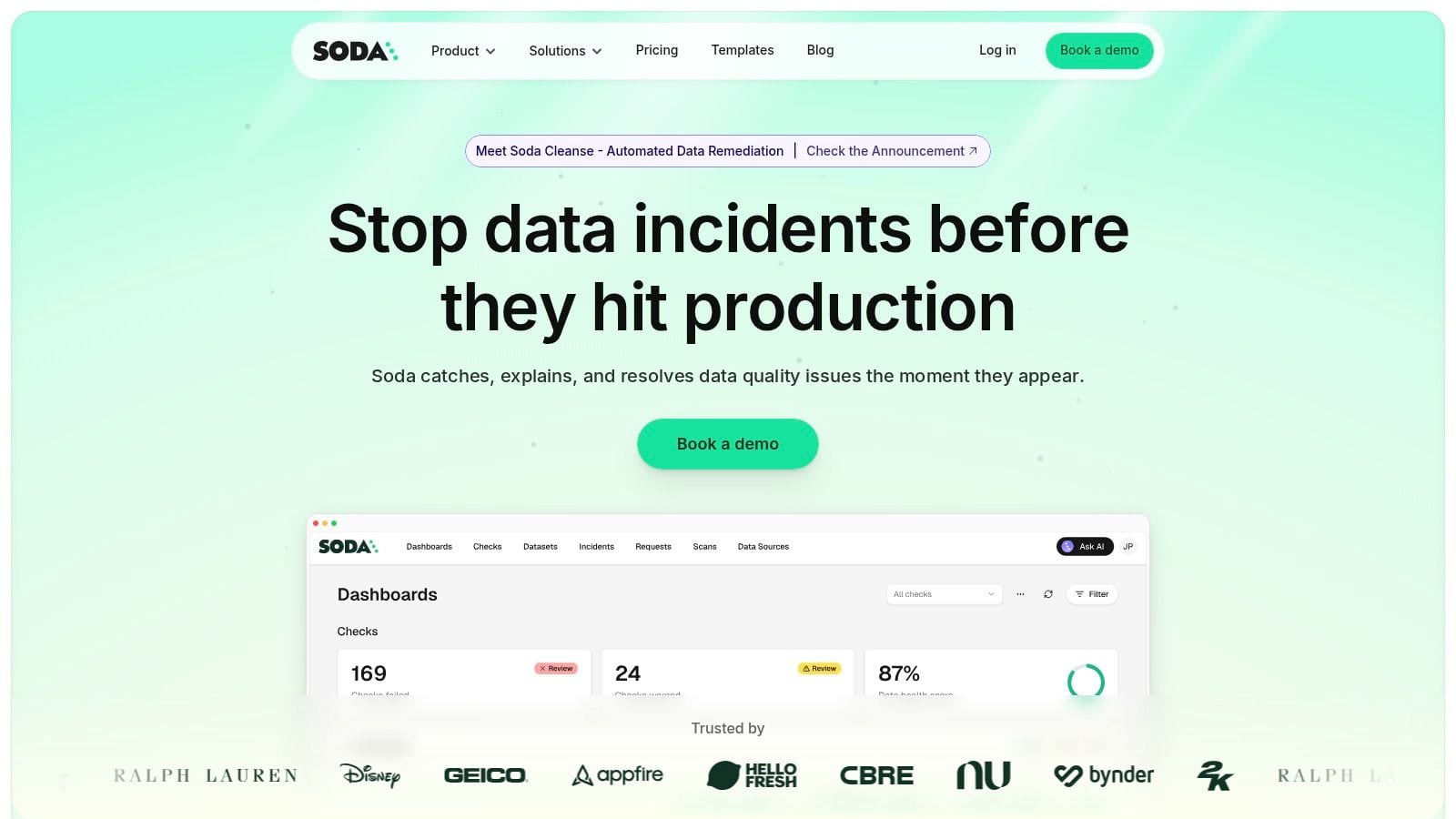
Soda is the tool I'd put in front of teams trying to move from “we run checks” to “we have agreements.” Its differentiator is the contract-centric workflow. Producers and consumers can define expectations, then use observability to verify whether those expectations hold in production.
That's a meaningful shift if your recurring problem is ambiguity rather than purely detection. A lot of incidents don't happen because nobody monitored a table. They happen because nobody agreed on freshness expectations, null tolerance, schema stability, or who should be alerted when a contract breaks.
Where Soda fits
Soda works well for teams that already think in terms of SLAs, ownership, and shared responsibility. The open-source plus managed cloud model is also attractive if you want some flexibility in how you adopt it.
I like Soda in organizations where:
- Data product thinking is maturing: Contracts help clarify what downstream users can rely on.
- Teams want a mix of open and managed: Soda Core gives technical teams a lower-friction entry point.
- Governance is becoming operational: Contracts force important conversations early.
What doesn't work well
Contract-centric monitoring sounds clean on paper, but it requires organizational maturity. If nobody owns the dataset, no contract is going to save you.
That leads to a simple trade-off:
- Strong when teams can define expectations upfront
- Weak when ownership is fuzzy and standards are still tribal knowledge
7. Acceldata
Acceldata is one of the more interesting options if you don't want monitoring to stop at reliability. Its appeal is broader operational coverage across data quality, pipeline performance, platform behavior, and cost optimization. For enterprise teams, that can be more useful than a narrower observability tool.
That angle matters because cost is still under-covered in most buying guides. The Seemore Data analysis of monitoring tools argues that buyers often get plenty of guidance on reliability and alerting, but much less help answering a harder question: how to monitor pipelines without building a second cost problem. That's one of the strongest reasons to consider a tool that surfaces spend and resource usage alongside data risk.
Why teams consider it
Acceldata is a fit when data engineering, platform, and finance concerns are colliding. If warehouse costs, idle processing, and bloated monitoring scope are part of the problem, broad visibility matters.
This can be especially useful in larger environments where one team owns quality, another owns infrastructure, and a third owns budget. A point solution may solve one of those problems while creating friction with the other two.
The best monitoring stack isn't always the one with the most checks. It's the one that makes ownership and cost visible enough to remove waste.
Trade-offs
The obvious trade-off is footprint. Broad platforms take more effort to implement and govern well.
- Strong for enterprise breadth: Reliability, performance, and cost in one operating layer.
- Heavier than point solutions: Expect more setup and stakeholder involvement.
- Budget fit: Usually better aligned with larger organizations than small teams.
8. IBM Databand
IBM Databand is a practical option for organizations that want pipeline runtime monitoring, SLA enforcement, freshness checks, and anomaly detection inside a procurement and support model they already trust. That usually means bigger companies, especially those already standardized on IBM or buying through cloud marketplaces.
This isn't usually the flashiest choice on the list. It's a steady one. If your organization values enterprise support, vendor consolidation, and formal purchasing channels as much as feature novelty, Databand becomes more attractive than many pure-play vendors.
Best use case
Databand is well suited to environments where pipeline runtime health is still the primary operational concern. Teams that need visibility into orchestration status, job failures, timeliness, and incident management often prefer a straightforward operational monitor over a more sprawling observability suite.
A good fit looks like this:
- Enterprise procurement matters
- Standardized support matters
- Operational SLAs matter more than a highly polished UX
Trade-offs
The interface and product feel may seem more utilitarian than newer vendors. That's not always a problem. But teams expecting a very modern self-serve experience may notice the difference.
The practical question is simple. If your buying process rewards stability and supportability, Databand is worth evaluating. If your team optimizes for product elegance and fast experimentation, other tools may feel easier.
9. Bigeye
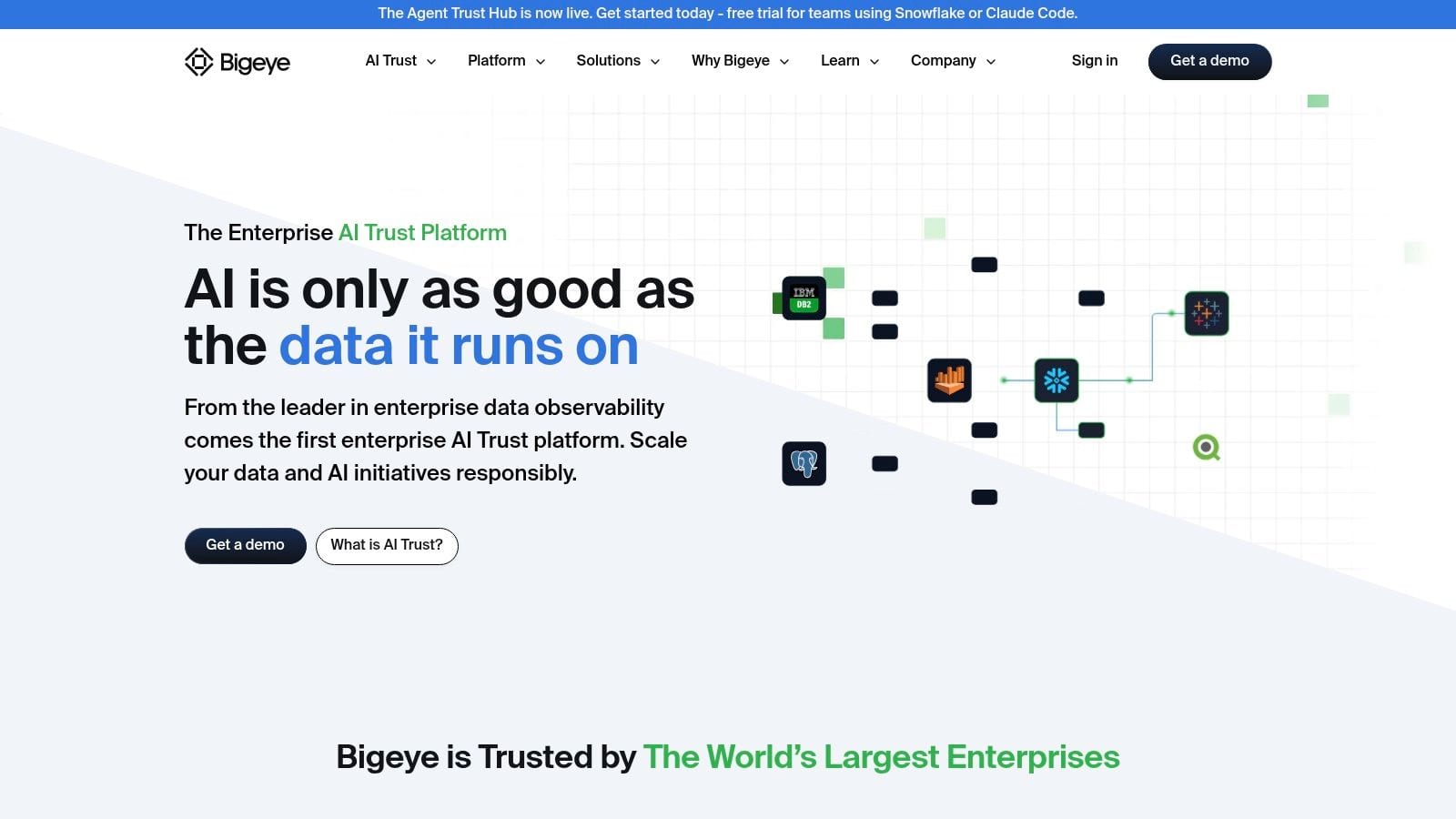
Bigeye sits in the enterprise observability camp, with a notable emphasis on security, governance, and controlled monitoring for sensitive data environments. That makes it relevant for teams in regulated industries where observability can't be separated from access control and compliance posture.
The category itself has become more enterprise-oriented over time. In the verified historical data, early adopters of specialized tools such as Bigeye and Metaplane achieved a 35% higher data trust score across analytics pipelines than non-adopters. The exact scoring model will vary by organization, but the broader point holds. Specialized observability is now part of trust architecture, not just a debugging convenience.
Where Bigeye stands out
Bigeye is attractive when your environment requires more than generic anomaly detection. Security and compliance expectations influence tool selection more heavily in industries where the data itself is sensitive and auditability matters.
That tends to show up in needs like:
- Table and column-level monitoring with control
- Lineage for investigation
- Security and governance features tied to observability
Trade-offs
Bigeye competes in a crowded enterprise category, so the decision usually comes down to stack fit, security requirements, and vendor preference more than obvious feature gaps.
In practical terms:
- Good fit for regulated environments
- Better for enterprise budgets than startup budgets
- May have a smaller ecosystem footprint than the category's biggest names
10. Sifflet
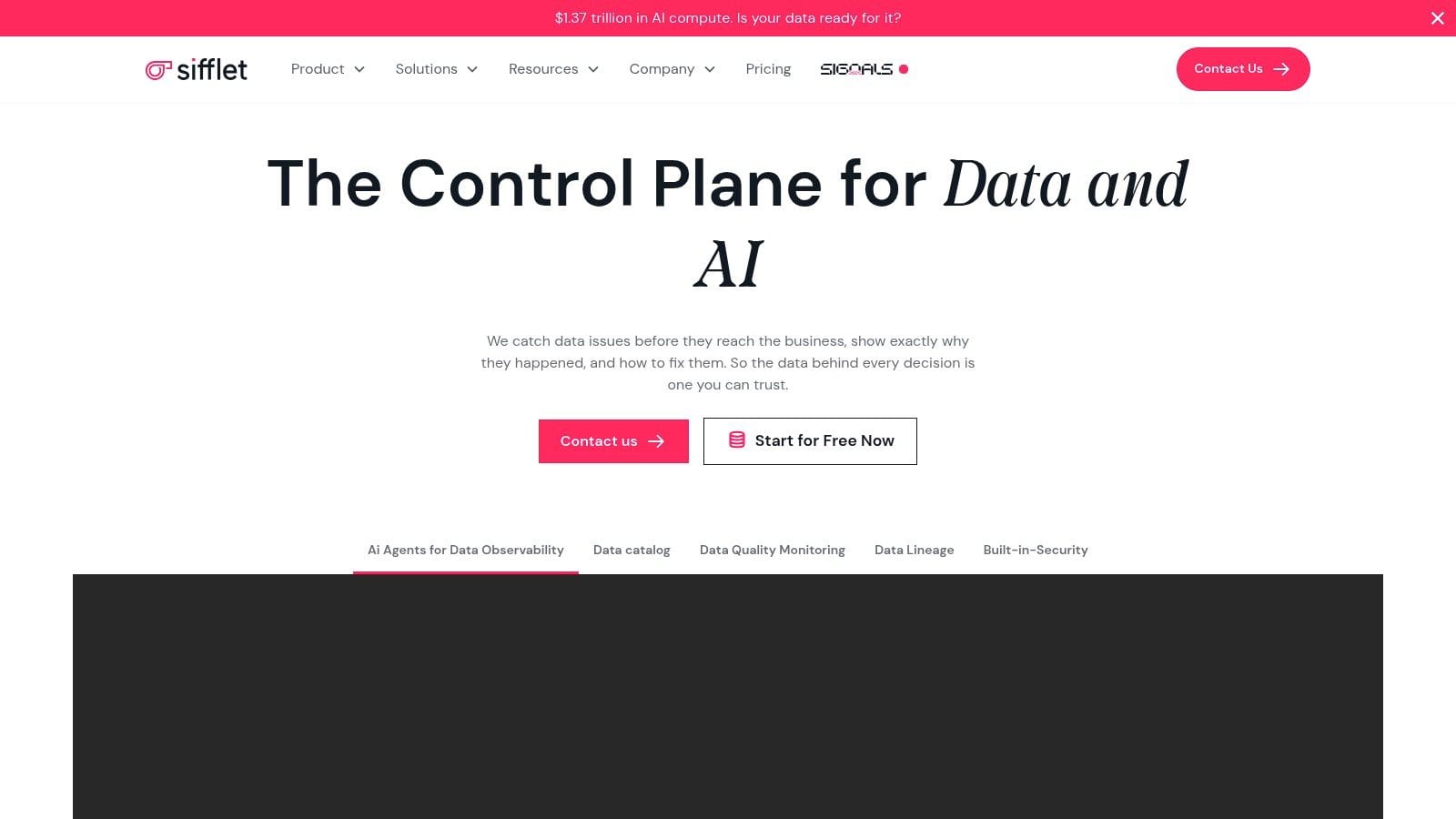
Sifflet is often evaluated by teams that want a capable observability layer without immediately defaulting to the largest incumbents. It covers the expected ground. Freshness, volume, schema, distribution, lineage, and alerting. The reason it enters deals is usually flexibility, especially around deployment and commercial fit.
That flexibility matters in a market that's expanding quickly. One forecast projects the global data pipeline monitoring market will reach USD 47.8 billion by 2035, growing at a 19% CAGR, with cloud-based deployment holding 86.3% share in 2025 and software and solutions holding 78.5% share, according to Market.us market projections for data pipeline monitoring. Buyers clearly prefer scalable, software-led monitoring models, but they still vary widely in how much platform they need.
Why it gets shortlisted
Sifflet usually appeals to teams that want a balanced feature set and a vendor willing to compete on packaging. That doesn't automatically make it cheaper in every case, but it does make it worth a look if the top two vendors feel oversized for your needs.
It's a sensible option when:
- You need full observability basics
- You want implementation flexibility
- You're price-sensitive but still need lineage and automated monitoring
Trade-offs
The main trade-off is market presence. In some regions and buying circles, there are fewer peer references and fewer third-party resources than with longer-established names.
That said, many teams don't need the loudest vendor. They need one that fits the stack, the process, and the budget.
Top 10 Data Pipeline Monitoring Tools Comparison
| Product | Core focus | Integrations & setup | Target audience | Key differentiator | Pricing & deployment |
|---|---|---|---|---|---|
| Trackingplan (Recommended) | Real-user analytics QA & observability (web, app, server) | Lightweight 10kb tag / iOS & Android SDKs; GA, Adobe, Amplitude, Mixpanel, Segment, Snowplow, ad platforms | Marketers, analysts, dev/QA, digital agencies | Always-on monitoring + AI-assisted root-cause + privacy-first alerts; business-impact estimates | 14-day Growth trial (no card); Enterprise PoC; pricing on request |
| Monte Carlo | Enterprise data observability (freshness, schema, distribution) | End-to-end lineage; integrates ingestion → warehouse → BI | Large enterprises, platform/data engineering teams | Mature platform with deep lineage and incident workflows | Quote-based, enterprise-oriented |
| Metaplane | Self-serve observability for modern analytics stacks | Quick onboarding; auto-suggested monitors; Slack/Teams alerts | Mid-market analytics teams (dbt/Snowflake) | Fast setup and UX; usage-based approach and free start | Free start tier; sales-led pricing beyond free |
| Anomalo | AI-driven data quality & anomaly detection | Auto-profiles tables; catalog integrations; little rules overhead | Teams needing automated anomaly detection with low setup | Out-of-the-box anomaly detection and automated hints for non-SQL users | Sales-led pricing |
| Datafold | Developer-centric data diffs for CI/CD & migrations | CI integrations (e.g., dbt); column-level lineage; diff UI/API | Data engineers, CI/CD teams, migration workflows | High-speed value-level diffs to catch regressions pre-deploy | Sales-led; focused on pre-production |
| Soda | Observability + enforceable data contracts | Open-source Soda Core + Soda Cloud; native modern stack integrations | Teams formalizing SLAs between producers & consumers | Contract-centric enforcement in pipelines; OSS + managed option | OSS available; managed cloud quote-based |
| Acceldata | Enterprise observability across reliability, performance & cost | Pipeline/platform monitoring; governance, RBAC, policy controls | Large enterprises needing reliability, cost & governance insights | Broad coverage including cost optimization and platform metrics | Quote-based; enterprise pricing |
| IBM Databand | Pipeline runtime monitoring, SLAs & freshness | Alerts, incident mgmt; marketplace deployment (e.g., AWS) | Organizations standardized on IBM or marketplace procurement | IBM-backed support and marketplace availability | Sales-led / quote-based |
| Bigeye | Enterprise-grade observability with security & compliance | Automated anomaly detection; table & column lineage; alerting | Regulated industries and security-focused teams | Strong security/compliance posture and mature monitoring | Quote-based, enterprise-focused |
| Sifflet | Cost-competitive data observability with flexible deployment | Automated freshness/volume/schema monitors; lineage & alerts | Mid-market teams seeking value and flexibility | Competitive pricing and balanced feature set | Flexible pricing / deployment; sales-led beyond basic tier |
From Reactive Firefighting to Proactive Trust
Choosing among data pipeline monitoring tools isn't really about buying alerts. It's about deciding where your organization loses trust first, then putting visibility there before the next issue lands in a dashboard, a quarterly review, or a campaign report.
For some teams, the answer is production observability. They need to know when freshness slips, schemas drift, row counts collapse, or a dbt model poisons half the BI layer. That's where tools like Monte Carlo, Metaplane, Anomalo, Bigeye, Sifflet, Acceldata, and IBM Databand fit. They're built for live systems, shared ownership, and the operational realities of keeping warehouse-centric pipelines trustworthy.
For others, the biggest win comes earlier. If bad SQL, migrations, and transformation changes keep causing incidents, Datafold is the more strategic buy because it prevents classes of failures that runtime monitoring only catches after damage has started. That's a different kind of maturity. It says the team doesn't just want to detect problems faster. It wants to ship fewer of them.
Then there's the blind spot many teams still underestimate. Front-end analytics observability. A pipeline can be technically healthy while the business signal is broken at collection time. Events can disappear, consent logic can change, pixels can stop firing, UTM conventions can drift, and nobody sees it because the warehouse still fills up. That's why Trackingplan belongs in a separate category rather than being treated as just another observability vendor. It addresses a different failure domain, and for marketing, product analytics, and attribution-heavy teams, that domain is often the one doing the most damage.
The market growth around this category shows that enterprises are taking monitoring seriously. A separate industry estimate cited in the verified data places the broader data pipeline tools market at USD 12.1 billion in 2024 and USD 48.3 billion by 2030 at a 26% CAGR, while another market study forecasts USD 43.6 billion by 2032 at a 19.9% CAGR, as summarized by Grand View Research's market overview. The important takeaway isn't the headline number. It's that monitoring is no longer a niche engineering add-on. It's becoming standard infrastructure.
That doesn't mean every team should buy the biggest platform. In practice, the wrong monitoring tool creates its own operational debt. It adds noisy alerts, duplicate checks, unclear ownership, and another interface nobody really trusts. The better choice is usually the tool that matches the failure mode you have.
If your main risk is silent breakage in tracking and attribution, start at collection. If your main risk is broken tables and downstream analytics trust, start in production observability. If your risk is shipping regressions, shift left first.
Good teams eventually do all three. They just shouldn't start with the wrong one.
If your biggest data quality problems start before the warehouse, Trackingplan is worth a close look. It gives analytics, marketing, and engineering teams continuous visibility into events, pixels, consent, UTMs, and attribution signals that standard data observability tools often miss. Start with the free trial or request a PoC if you need to validate it against a live implementation.