Unlock peak ad performance by boosting your Meta Event Match Quality. Our guide shows you how to diagnose issues, fix errors, and improve your EMQ score.
Imagine trying to deliver a package with a smudged address. You might know the general neighborhood, but the exact house remains a mystery. That’s what a low Meta Event Match Quality score does to your ad campaigns—it creates uncertainty, wastes your budget, and leaves you guessing.
This score is Meta's yardstick for how well it can connect your website's event data to actual user profiles. For any advertiser serious about performance, a high score isn't just a "nice-to-have"; it's non-negotiable.
Why Meta Event Match Quality Is Your Most Important Metric
In the world of advertising, it’s easy to get lost tracking metrics like click-through rates or cost-per-acquisition. But behind the scenes, there's a figure that has a massive impact on your entire campaign's success: the Meta Event Match Quality (EMQ) score.
Think of it like this: when a user takes an action on your site—say, they make a purchase—you send "clues" back to Meta. A high EMQ score means your clues (like a hashed email, phone number, and name) are so clear that Meta can instantly and accurately match that action to a specific user profile on its platform.
A low score, on the other hand, is like sending a blurry photo with a partial address. The connection is weak, the match is uncertain, and your ad spend gets wasted on shots in the dark.
The Real Cost of a Poor EMQ Score
A low EMQ score isn't just a technical hiccup; it's a direct hit to your bottom line. When Meta can’t confidently match events to users, a cascade of negative effects begins, undermining your entire campaign structure.
Here are the most significant consequences:
- Inaccurate Attribution: You lose sight of which ads are actually driving sales. Meta might underreport conversions, making your most profitable campaigns look like failures and leading you to cut budgets that are secretly working.
- Weakened Retargeting: If Meta can't reliably identify users who visited your site or added items to their cart, your retargeting audiences will be thin and incomplete. This means missing out on re-engaging warm leads who are just a step away from converting.
- Ineffective Optimization: Meta's algorithm depends on high-quality data to find more people like your existing customers. With poor matching, its ability to optimize ad delivery is crippled, often leading to higher costs and lower-quality traffic.
A high Meta Event Match Quality score ensures every dollar of your ad spend is working smarter, not just harder. It transforms your data from a vague collection of signals into a precise roadmap for Meta's delivery system, leading to better targeting, lower costs, and a clearer return on investment.
Understanding Your Event Match Quality Score
Meta calculates your EMQ score on a scale from 0 to 10, using data from the last 48 hours. This score reflects how well the customer information you send—from both the browser-side Pixel and the server-side Conversions API (CAPI)—matches up with real user profiles on its platform.
The table below breaks down what these scores mean in the real world and what you should do at each level.
| EMQ Score Range | Match Confidence | Impact on Ad Performance | Action Required |
|---|---|---|---|
| 8.0 - 10.0 | Excellent | Optimal ad delivery, accurate attribution, and lower CPMs. Your campaigns are running at peak efficiency. | Monitor and Maintain. Keep your tracking robust and watch for any dips. |
| 6.0 - 7.9 | Good | Solid performance, but with room for improvement. Some attribution and optimization potential is being lost. | Optimize. Review your data parameters. Ensure all recommended customer information is being sent and correctly hashed. |
| 4.0 - 5.9 | Fair | Significant data is being lost. Ad delivery is hampered, attribution is unreliable, and costs are likely inflated. | Investigate Urgently. Your tracking setup has critical gaps. Focus on improving both client-side and server-side data collection. |
| 0.0 - 3.9 | Poor | Your data is barely usable. Meta can't effectively optimize campaigns or attribute conversions, leading to wasted spend. | Immediate Overhaul. Your setup is fundamentally broken. A full audit of your Pixel, CAPI, and consent handling is necessary. |
A high score signals a healthy, reliable connection between your website and Meta's ad system—something that's absolutely essential for thriving in today's privacy-focused advertising world. For more on this, you can find great insights on how EMQ scores are calculated and their impact on advertising.
To build this kind of robust connection, start by diving into our guide to the Meta Conversion API.
How Meta Actually Calculates Your EMQ Score
Meta's Event Match Quality (EMQ) calculation isn't some mysterious black box. It’s a logical system that scores the evidence you send with each event. Think of it like this: for every conversion, Meta’s algorithm asks, "How many reliable clues do I have to connect this action back to a specific person on our platform?"
The strength of your score comes down to the quality and quantity of these clues, which Meta calls customer information parameters. The more high-quality data you provide, the more confident Meta becomes in its matching.
The Key Clues in Meta's Calculation
Not all data is created equal in Meta's eyes. Some parameters carry far more weight because they provide a unique, stable link between an on-site action and an individual’s Meta profile.
These are the most impactful parameters you can send:
- Hashed Email Address (em): This is the single most powerful parameter. It’s unique and directly tied to a user’s account.
- Hashed Phone Number (ph): Another high-value identifier that provides a strong, unique match.
- Hashed Name and Location: First name (fn), last name (ln), city (ct), state (st), and zip code (zp) act as powerful supporting evidence.
- Meta Click ID (_fbc) and Browser ID (_fbp): These cookies are crucial. They create a direct trail from an ad click to a conversion, linking a browser session right back into Meta's ecosystem.
This concept map breaks down the core components of what Meta Event Match Quality is and why it's so important for your ad performance.
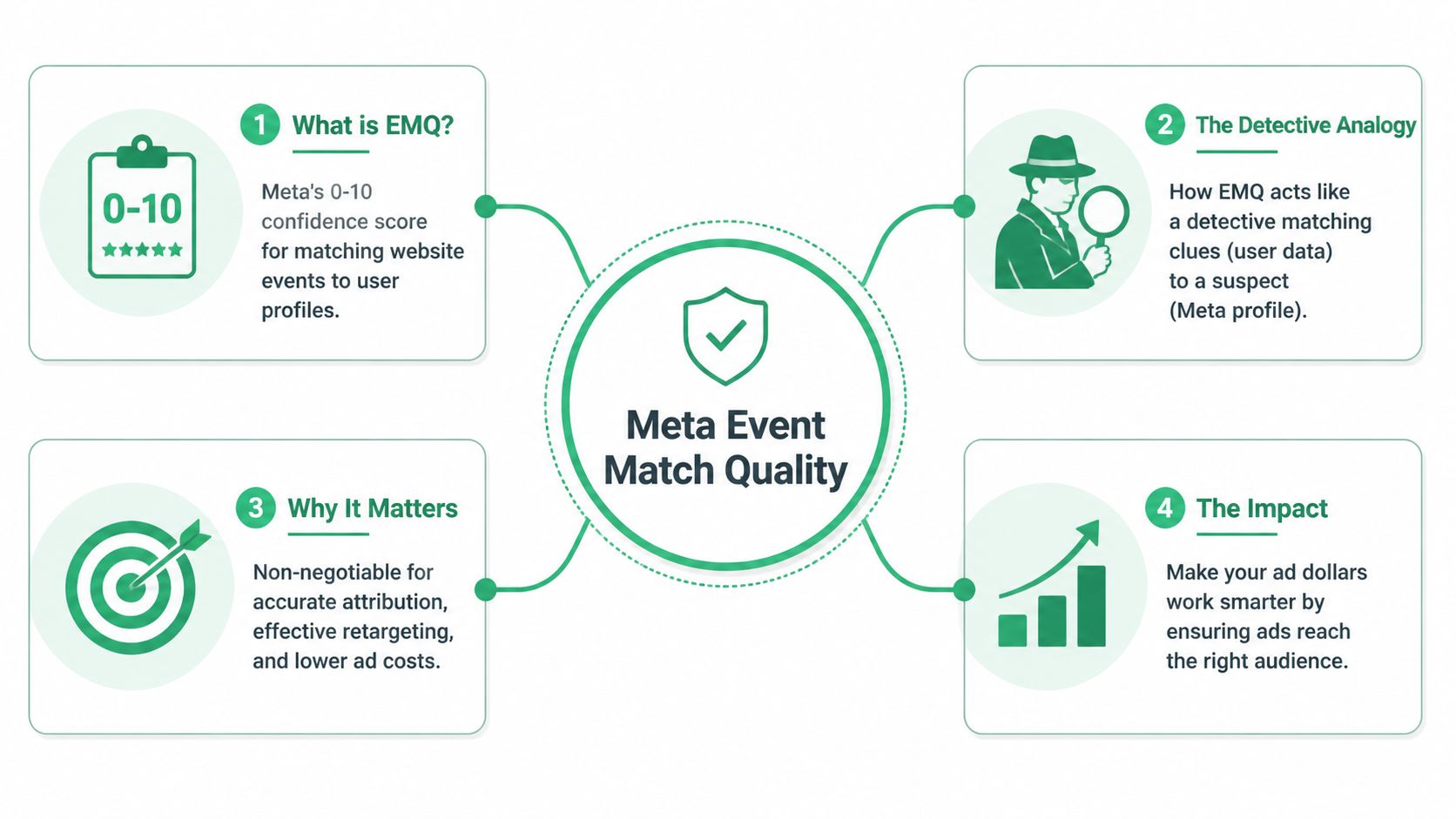
As you can see, EMQ is the bedrock of effective ad campaigns, influencing everything from attribution and delivery to your overall ad costs.
Pixel vs. CAPI and the Data Hierarchy
How you send your data has a fundamental impact on the clues Meta receives. A standard Meta Pixel running in a user’s browser is often limited. While it can capture click and browser IDs, it struggles to access rich customer details like emails or phone numbers, especially for anonymous visitors.
This is where the Conversions API (CAPI) becomes a game-changer. By sending data directly from your server, you can include information the Pixel simply can't access, like a customer's email from their user account. It’s why a hybrid approach—using both the Pixel and CAPI—is the gold standard for achieving a high EMQ score. To keep your CAPI setup in top shape, it's vital to perform regular health checks, and you can learn exactly how in our guide to Meta CAPI validation.
It's also worth noting that Meta's algorithm weighs events differently. A 'Purchase' event is scrutinized far more heavily than a simple 'PageView'. For a high-value action like a sale, Meta expects more robust customer data to feel confident about the match.
This difference in data quality has a direct financial impact. A 2026 case study showed a Shopify brand using CAPI saw a 25% uplift in attribution accuracy after boosting its EMQ from 5.2 to 8.1 by consistently hashing all emails and phones. The result? A 15% lower cost-per-acquisition in their Q4 campaigns. You can explore more data on how EMQ improvements directly boost ROI.
Finally, keep in mind that Meta's algorithm uses a recent data window—typically the last 48 hours—to continuously grade your setup, so consistency is key.
Finding and Fixing the Problems Hurting Your Score
A low Meta Event Match Quality (EMQ) score isn’t the problem itself—it’s a symptom. Think of it as a warning light on your dashboard, signaling that something is broken in the data pipeline between your website and Meta's servers. To fix it, you need to play detective and hunt down the exact source of the data loss.
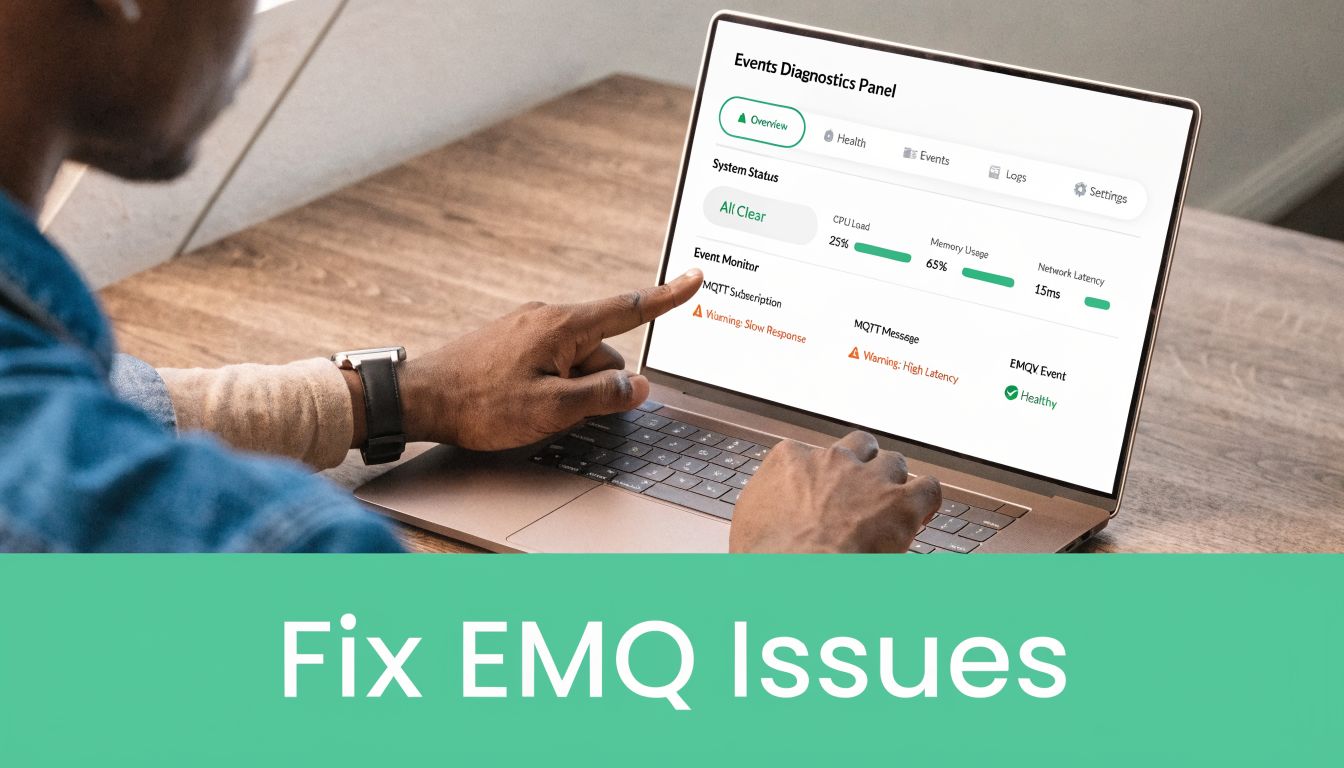
Your first stop is Meta's own Events Manager. Navigate to your dataset and click on the "Diagnostics" tab. This is where Meta gives you direct feedback on your setup, often calling out specific issues like deduplication problems or poorly formatted parameters. This dashboard is your starting point for moving from a vague "my score is low" to a specific "I know exactly what's broken."
Uncovering the Common Culprits
While every setup has its quirks, most EMQ issues boil down to a handful of common culprits. When you dig into your events, especially critical ones like 'Purchase' or 'InitiateCheckout', you’ll almost certainly find the root cause falls into one of these categories.
Start by looking at the EMQ scores for each individual event. You might notice your 'PageView' score is great, but your 'Purchase' score is tanking. That’s a huge clue. It tells you the problem is likely tied to the data you collect during checkout, not general site browsing.
Inconsistent Data Hashing
One of the most common—and damaging—issues is inconsistent data hashing. Meta requires customer information like email addresses and phone numbers to be hashed using the SHA-256 algorithm before it's sent over. Simple enough, right?
The trouble starts when your browser-side Pixel and server-side Conversions API (CAPI) don't hash the exact same string. For example, the Pixel might hash jane.doe@example.com while your CAPI setup, pulling from a database, hashes Jane.Doe@example.com (with spaces or different capitalization). To Meta, these are two completely different people. This mismatch kills your ability to deduplicate events, wrecking your match score.
The rule of thumb here is absolute consistency. The hashed value for a piece of customer data must be identical, whether it originates from the browser or your server. Any little deviation breaks the match.
Missing Customer Details and Data Gaps
Another major factor is simply not sending the data Meta needs in the first place. This often happens at the most important moments in the customer journey. For instance, if a user can check out as a guest without entering an email until the final payment confirmation, you’ve lost the chance to send valuable customer parameters with the 'InitiateCheckout' event.
This data loss is made worse by a few technical and privacy-related roadblocks:
- Ad Blockers and Privacy Settings: A huge chunk of users run ad blockers that stop the Meta Pixel from ever firing. On top of that, browser features like Safari's Intelligent Tracking Prevention (ITP) can block or strip data from the events your Pixel does manage to send.
- Schema Mismatches: This is a classic "lost in translation" problem. It happens when the data structure on your website (e.g., in the dataLayer) doesn't align with what your CAPI integration expects. Your server might be programmed to look for a field named
customer_email, but your website’s front-end calls ituserEmail. The result? A null value gets sent, and your event is missing key information.
Untangling these issues requires a thorough review of your entire tracking implementation. For a deeper look into this process, running a complete Meta Pixel audit can help you spot the hidden data gaps and inconsistencies you might have otherwise missed.
A Practical Framework to Improve Your Event Match Quality
Alright, you know why your Event Match Quality score matters. Now comes the real work: actually improving it. Getting your EMQ score up isn't about a single quick fix; it's about systematically building a data-rich and resilient tracking system.
Think of this as your hands-on checklist for turning your setup into a top-tier data-matching machine. Follow these steps, and you'll shift from just reacting to problems to proactively maximizing the value of every single event you send to Meta.
Start with a Hybrid Tracking System
If you do only one thing, do this: implement a hybrid tracking system. This means running the server-side Conversions API (CAPI) right alongside your browser-side Meta Pixel. While the Pixel is still great for capturing top-of-funnel actions, CAPI is the answer to all its modern-day weaknesses.
CAPI sends data directly from your server to Meta's. This simple change sidesteps the ad blockers, browser restrictions, and cookie limitations that are constantly chipping away at the Pixel's effectiveness, giving you a much more reliable and complete data stream.
The numbers don't lie. Global benchmarks from 2026 show just how big the gap is: Purchase events tracked with a CAPI and Pixel hybrid averaged an EMQ score of 8.2. For Pixel-only setups? Just 5.1. This data comes from an analysis of over 50,000 ad accounts by Upstack Data. You can discover more insights into hybrid tracking performance on YouTube.
The goal here isn't to ditch the Pixel. It's to reinforce it. When both CAPI and the Pixel work together—with proper deduplication, of course—you get a bulletproof system that captures the most events with the richest data possible.
Master Your Customer Parameter Collection
With a hybrid system in place, your focus shifts to the quality of the data you're sending. A high EMQ score is entirely dependent on sending as many correct customer parameters as you can, especially for your most important events like 'Purchase' and 'InitiateCheckout'.
Here’s your action plan:
Prioritize High-Value Parameters: Make sure you're consistently sending hashed versions of the email address (em), phone number (ph), first name (fn), and last name (ln). These are the pillars of good event matching.
Capture Data Earlier: Take a hard look at your user journey. Are you waiting until the final payment screen to ask for an email? You're missing a huge opportunity. Try to capture that information earlier—maybe when a user adds an item to their cart or through a lead form—so you can include it with events like 'InitiateCheckout'.
Don't Forget Browser and Click IDs: This is non-negotiable. Always make sure you're capturing and sending the Meta Click ID (
_fbc) and Browser ID (_fbp). These are absolutely essential for tying user sessions back to the ads they clicked.

Ensure Perfect Data Hashing and Formatting
This is where so many setups stumble. A tiny, seemingly insignificant inconsistency in how you format your data can completely torpedo your match score.
The cardinal rule of data matching is consistency. The hashed value for a user’s email must be identical whether it comes from the Pixel or CAPI. Any deviation—a stray space, a capitalization change—creates a mismatch and tells Meta these are two different events.
To get this right every time, stick to these best practices:
- Standardize Before Hashing: Before you even think about applying the SHA-256 hash, programmatically trim all leading and trailing whitespace and convert all text to lowercase. The string
john.doe@email.comhashes correctly;John.Doe@email.comdoes not. - Use a Single Hashing Logic: Your client-side (Pixel) and server-side (CAPI) processes must use the exact same logic for normalization and hashing. If they don't, you're just creating mismatches for Meta to sort through.
- Verify Parameter Mapping: Go into your CAPI gateway or integration and triple-check that your website’s data fields are mapped to Meta’s required parameters. A classic mistake is mapping your
user_emailfield to the wrong place, which means you're just sending a null value.
By bringing together a hybrid setup with an obsessive focus on data collection and formatting, you're building a powerful framework to systematically raise your meta event match quality and unlock better ad performance.
Automating Your EMQ Monitoring and Maintenance
Getting a high Meta Event Match Quality score is a huge win, but it’s definitely not a finish line. Think of your EMQ score as a living metric, one that shifts and changes with the real-time health of your data pipeline. A great score today doesn't guarantee a great score tomorrow.
Manually checking Meta's Events Manager every day just isn’t a sustainable or effective strategy. It's entirely reactive. By the time you notice a drop in your score, the damage to your ad campaigns and your budget has already been done. The hard truth is that data breaks happen all the time, often silently, and you need a system that catches them the second they occur.
This is where the idea of analytics observability comes into play. Instead of running periodic manual spot-checks, an automated system watches your entire tracking setup 24/7, acting as a permanent guardian of your data quality.
Moving Beyond Manual Checks
Picture your data pipeline as a complex highway system. Your events are the cars, and Meta is the final destination. A simple code deployment, a tweak to your server configuration, or even a third-party script update can create a massive, invisible traffic jam, stopping your data from reaching its destination.
An analytics observability platform like Trackingplan automates the entire monitoring process. It acts as a dedicated watchdog for your event data, giving you instant visibility into problems that might otherwise take days or even weeks to uncover.
This automated vigilance protects your meta event match quality from the most common points of failure, including:
- Sudden Event Drop-offs: Instantly knowing if a critical event like 'Purchase' suddenly stops firing altogether.
- Malformed Customer Data: Flagging when customer parameters are sent in the wrong format or are missing entirely.
- Schema Changes: Alerting you when your website's data structure no longer matches what your Conversions API setup expects.
- Broken Pixels: Identifying when an ad pixel is missing or has stopped working correctly, a critical issue you can learn more about with a dedicated ad pixel monitoring tool.
How Automated Alerts Save Your Campaigns
Let's walk through a real-world scenario. Your development team pushes a routine update on a Friday afternoon. Unbeknownst to them, the update accidentally changes how customer email addresses are formatted before being sent to the Conversions API. Suddenly, the hashing process fails, and every 'Purchase' event is sent without its most important identifier.
Your EMQ score plummets. Meta's algorithm, now flying blind, can no longer attribute sales correctly or find your best customers. Your campaign performance tanks over the weekend while your entire team is offline.
With an automated monitoring system in place, this silent failure becomes a managed incident. The moment the malformed data is detected, an alert is sent directly to your team's Slack channel.
Instead of discovering the disaster on Monday morning by digging through Events Manager, your developers get a notification within minutes of the deployment. They can pinpoint the exact cause of the error and deploy a fix immediately, saving your campaign performance and preventing thousands in wasted ad spend.
This proactive approach turns data quality management from a reactive chore into an automated, real-time function of your marketing operations. For growth marketers, this level of precision has a direct impact on the bottom line. A high EMQ unlocks 15% more granular targeting, according to Meta's own diagnostics. Meanwhile, developers using tools like Meta Pixel Helper have spotted 22% parameter mismatches before launch, which can be fixed with schema validations. Trackingplan’s integrations catch these issues in real time, which is critical when you consider that poor EMQ contributed to an estimated $20 billion in misattributed ad spend globally. You can discover more insights about data validation on YouTube.
Best Practices for Maintaining a High Score Long-Term
Getting a great Meta Event Match Quality score is a fantastic start, but the real work is keeping it there. Think of it less like a one-time project and more like an ongoing commitment to data quality. This means building a sustainable strategy on a solid foundation and staying vigilant.
The absolute cornerstone of this strategy is a hybrid tracking setup. There's no getting around it—running the Conversions API (CAPI) alongside the Meta Pixel is the only way to build a resilient system that can weather the storm of browser restrictions and ad blockers. This dual approach is your ticket to capturing the maximum number of events with the richest possible data.
Create a Single Source of Truth
To get consistent results, your development, marketing, and analytics teams have to be speaking the same language. The best way to make this happen is by creating and maintaining a standardized data dictionary or tracking plan. This document should be the definitive guide for every event and parameter you track.
This single source of truth is your best defense against schema drift, ensuring the data sent from the browser perfectly mirrors the data sent from your server. When everyone is working from the same playbook, you eliminate the guesswork that leads to mismatches and a falling Meta Event Match Quality score.
Prioritize Smart Data Collection and Regular Reviews
Long-term success also comes down to how you gather and handle user data.
- Privacy-Compliant Collection: Always be transparent about the user parameters you collect and make sure you have clear consent. This not only builds trust with your audience but also ensures the data you do collect is high-quality and usable.
- Regular Diagnostic Reviews: Make it a habit to review Meta's Events Manager at least once a month. Keep an eye out for any sudden drops in your scores, new diagnostic warnings, or inconsistencies between your events.
- Automated Monitoring: Use a tool like Trackingplan as your safety net. Manual checks are great, but they’re bound to miss things. An automated observability platform gives you 24/7 monitoring and acts as an early warning system, instantly flagging issues like schema mismatches or broken pixels before they can do serious damage to your EMQ score.
Understand the Law of Diminishing Returns
Finally, it's just as important to know when to stop optimizing. While chasing a perfect 10/10 score might feel like the ultimate goal, it’s often not the most strategic use of your team's time and resources. The effort it takes to get from an 8 to a 10 can be huge, often with very little impact on actual performance.
A consistent score between 7 and 8 is a strategic victory. Research from a 2026 Triple Whale report really drives this home, noting that jumping from an EMQ of 6 to 9 delivered just a 4% performance gain but demanded three times the implementation effort. The report also found that volume can be more important than perfection, as 5,000 events with a score of 6 optimized algorithms 12% faster than 4,200 events with a score of 9. You can learn more about these performance findings on YouTube.
Focus your energy on maintaining a stable, "good" to "excellent" score for your most critical conversion events. This balanced approach keeps your ads performing effectively without trapping you in a costly and frustrating chase for perfection.
Navigating the details of Meta Event Match Quality (EMQ) can bring up a lot of specific questions. Let's tackle some of the most common ones that marketers and advertisers run into.
What Is a Good Meta Event Match Quality Score?
While a perfect 10/10 is the technical maximum, the score you should really aim for is 6.0 or higher. This tells you Meta can reliably match the majority of your event data to user profiles.
Scores between 7.0 and 8.5 are excellent. At this level, you’re giving Meta's algorithm strong, consistent signals for campaign optimization and attribution. The truth is, the performance gains between a score of 8 and 10 are often minimal, so it's better to focus on consistently hitting that good-to-excellent range for your key conversion events like 'Purchase' and 'InitiateCheckout'.
A score below 5.0 is a clear warning sign. It suggests there are significant gaps in your data collection, which can severely limit ad delivery, inflate costs, and make your attribution data unreliable.
Will Implementing CAPI Automatically Fix My EMQ Score?
No, and it's a common misconception. Implementing the Conversions API (CAPI) is a critical step forward, but it's not a magic bullet for a low meta event match quality score.
Think of CAPI as a more reliable delivery truck. It ensures your data gets past browser restrictions and ad blockers, but it doesn't automatically improve the quality of the cargo inside. If you send incomplete, poorly formatted, or improperly hashed customer parameters through CAPI, your score will remain just as low. CAPI is the vehicle, but high-quality data is the fuel.
How Do Privacy Changes Like iOS 14 Affect EMQ?
Privacy updates like Apple's App Tracking Transparency (ATT) framework and browser features like Intelligent Tracking Prevention (ITP) are a huge headache for client-side tools like the Meta Pixel. They block third-party cookies and restrict access to user identifiers, which directly torpedoes your Pixel's ability to match events and, as a result, drags down your EMQ score.
This is precisely why a server-side solution like CAPI is so essential now. By sending event data directly from your server to Meta's, CAPI effectively bypasses many of these browser-level roadblocks. This lets you recover lost event data, maintain a clearer view of campaign performance, and shield your EMQ from the ongoing storm of privacy changes.
Can I Improve EMQ Without Personal Information?
Honestly, it’s extremely difficult. The most valuable parameters for achieving a high EMQ score are personal identifiers—specifically, a hashed email address or phone number. These identifiers provide a unique and stable link to a Meta user profile that other signals just can't replicate.
You can make some marginal gains by ensuring you always send other available parameters like the click ID (_fbc), browser ID (_fbp), and IP address. But on their own, they won't be enough to get you into the "good" or "excellent" score range. The most effective strategy is to collect those key user parameters in a transparent and privacy-compliant way after getting proper consent.
Don't let data issues undermine your ad performance. With Trackingplan, you can automate your analytics monitoring to instantly detect and fix the problems that hurt your Meta Event Match Quality. Get your free-forever account today and ensure your data is always working for you.