
TL;DR:
- Data quality assurance proactively validates and monitors data throughout its lifecycle to prevent errors and build trust. It involves defining standards across accuracy, completeness, consistency, timeliness, uniqueness, and validity, with organizational governance and automated tools supporting ongoing improvement. Implementing this as a continuous program, not a one-time project, ensures data reliably informs strategic decisions and reduces costly quality issues.
Data quality assurance (DQA) is the proactive, continuous process of validating, monitoring, and governing data to guarantee its accuracy, completeness, consistency, and reliability throughout its entire lifecycle. Unlike reactive cleanup, DQA builds systemic controls that prevent errors from reaching your analytics tools in the first place. Poor data quality costs organizations an estimated $600 billion annually, a figure that reflects lost revenue, failed AI models, and misdirected ad spend. For analysts and marketers relying on platforms like Google Analytics 4, Segment, or Snowflake, this guide to data quality assurance delivers the framework you need to build trust in your data from the ground up. Standards bodies like DAMA International and platforms like Ataccama define the benchmarks this field runs on.
What are the core dimensions of data quality?
Data quality measures six universal dimensions: accuracy, completeness, consistency, timeliness, uniqueness, and validity. Each dimension targets a distinct failure mode, and weakness in any one of them degrades the reliability of your entire analytics stack.
- Accuracy means data reflects the real-world entity it represents. A customer record showing the wrong email address is inaccurate, and every campaign sent to that address wastes budget.
- Completeness means no critical fields are missing. An order record without a transaction ID cannot be attributed to a channel, breaking your conversion funnel analysis.
- Consistency means the same data point carries the same value across every system. If your CRM records a user as “United States” while your data warehouse stores “US,” aggregations break silently.
- Timeliness means data is available when decisions require it. Real-time analytics demand near-instant data freshness; a 24-hour lag in ad performance data means you are optimizing against yesterday’s reality.
- Uniqueness means no duplicate records inflate your counts. Duplicate user IDs in a behavioral dataset will double your reported session counts and corrupt cohort analysis.
- Validity means data conforms to defined business rules and formats. A date field containing “N/A” or a revenue field storing negative values signals a schema mismatch that corrupts downstream aggregations.
These dimensions do not operate in isolation. A record can be accurate but incomplete, or consistent but outdated. Quality standards should be tailored to the specific business context, with real-time analytics requiring stricter timeliness and completeness than internal reporting. Chasing perfection across all dimensions for all data is inefficient. Focus your highest standards on the data that drives revenue decisions.
Pro Tip: Build a simple scoring matrix that rates each dimension from 1 to 5 for your top five critical datasets. This gives you a baseline to track improvement over quarters, not just gut feelings.

What foundational steps enable effective data quality assurance?
Before you write a single validation rule, three organizational prerequisites determine whether your program succeeds or stalls. Effective data quality management requires a formal governance framework that defines data owners, stewards, and custodians. Without named accountability, quality issues get passed around indefinitely.
The second prerequisite is documented data quality objectives tied directly to business outcomes. “Improve data quality” is not a goal. “Reduce null values in the campaign_source field to under 2% by Q3 to fix attribution reporting” is a goal. Specificity creates measurable progress and earns executive support.
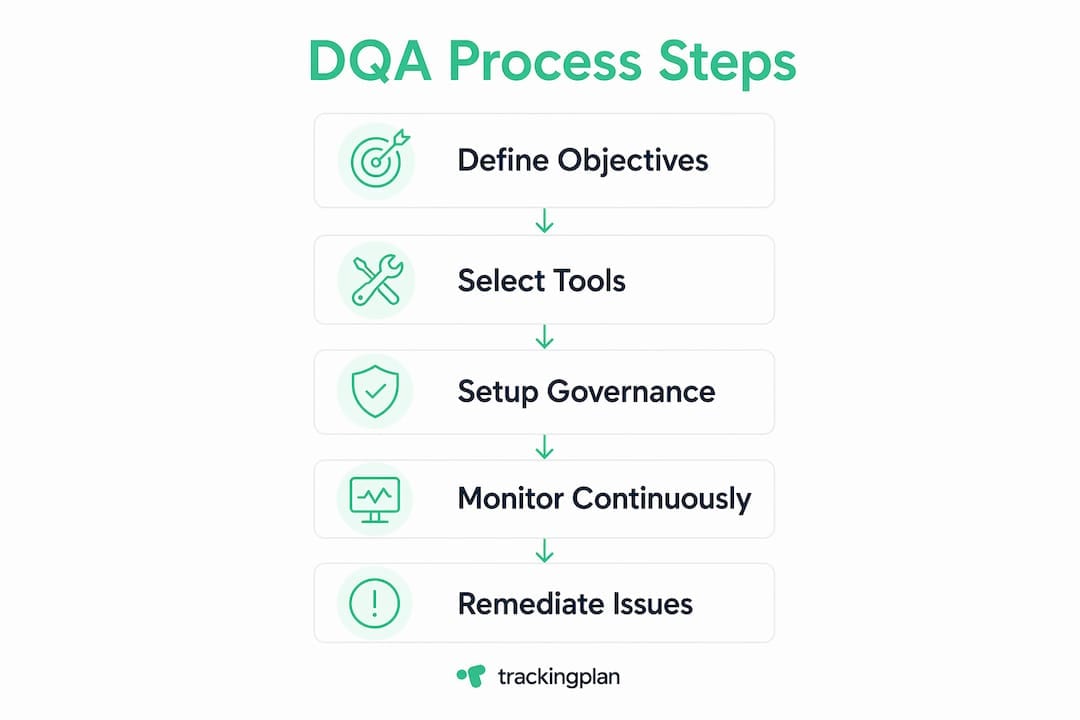
The third prerequisite is tool selection. Your stack needs profiling capabilities to assess baseline quality, validation capabilities to enforce rules, and monitoring capabilities to catch regressions. Platforms like Ataccama, Monte Carlo, and Trackingplan each cover different parts of this spectrum, from enterprise data governance to marketing analytics monitoring.
| Prerequisite | What it requires | Why it matters |
|---|---|---|
| Governance framework | Assign data owners, stewards, custodians | Creates accountability for quality outcomes |
| Quality objectives | Define measurable KPIs per dataset | Aligns quality work to business impact |
| Tool selection | Profiling, validation, monitoring coverage | Automates detection and reduces manual effort |
| Culture and training | Cross-functional workshops and documentation | Builds organization-wide quality mindset |
Cultural buy-in and data stewardship often have more impact on quality outcomes than purely technical solutions. A well-governed spreadsheet beats a poorly governed data lake every time. Invest in the human layer before you invest in the tooling layer.
How to execute a data quality assurance process step by step
A structured seven-step program transforms data quality from a one-time project into a continuous quality capability. Here is how to execute it.
-
Profile your data and establish a baseline. Run automated profiling across your critical datasets to measure current accuracy, completeness, and consistency rates. Tools like Ataccama and dbt generate profiling reports that expose null rates, value distributions, and format anomalies. You cannot improve what you have not measured.
-
Define quality rules and standards. Translate business requirements into explicit rules. “The user_id field must be non-null, unique, and match the UUID format” is a rule. Document every rule in a shared data catalog so engineers, analysts, and marketers reference the same definitions.
-
Cleanse and validate existing data. Address the backlog of known issues through deduplication, standardization, and format correction. This is a one-time remediation step, not the ongoing program. Treat it as clearing the runway, not as the flight itself.
-
Implement automated continuous monitoring. Embedding automated tests in ETL/ELT pipelines catches failures before data reaches analytics tools. Set threshold-based alerts for anomalies like sudden drops in event volume or spikes in null rates. Platforms like Trackingplan send real-time alerts via Slack or email the moment a tracking schema breaks.
-
Conduct root-cause analysis using data lineage. When an issue surfaces, data lineage mapping traces the source-to-target transformation path to identify exactly where the error was introduced. This cuts mean time to resolution from days to hours.
-
Report quality status and KPIs regularly. Publish a data quality scorecard to stakeholders on a weekly or monthly cadence. Include dimension scores, open issues, and trend lines. Visibility creates pressure for improvement and demonstrates the program’s value.
-
Iterate and enforce governance. Review rules quarterly, retire obsolete ones, and add new rules as business requirements evolve. Governance enforcement means violations trigger documented remediation workflows, not informal Slack messages.
Pro Tip: Start your monitoring program with the five events or fields that feed your most critical business dashboard. Instrument those perfectly before expanding coverage. Breadth without depth creates false confidence.
| Approach | Data quality control (DQC) | Data quality assurance (DQA) |
|---|---|---|
| Timing | Reactive, after errors occur | Proactive, before errors propagate |
| Method | Manual cleanup and correction | Automated rules, monitoring, governance |
| Outcome | Fixes individual issues | Prevents systemic failures |
| Scalability | Low, labor-intensive | High, scales with automation |
What are the common challenges in maintaining data quality?
The primary barrier to effective data quality is organizational culture, not technology. Business users who distrust data build manual workarounds in spreadsheets, which creates shadow datasets that diverge from the governed source of truth. This cycle is self-reinforcing: bad data drives distrust, distrust drives workarounds, workarounds create more bad data.
Data silos compound the problem. When your CRM, ad platform, and data warehouse each maintain separate customer records with no reconciliation layer, consistency failures are structurally guaranteed. Legacy systems often lack APIs or schema documentation, making automated validation nearly impossible without significant engineering investment.
The most dangerous mistake analysts make is confusing reactive cleanup with true assurance. Organizations that run quarterly data cleanup sprints believe they have a quality program. They do not. They have a firefighting rotation. Real assurance means the fire never starts.
“Data quality is not a data team problem. It is a business problem that the data team is best positioned to solve.” This framing shifts the conversation from technical debt to strategic risk, which is the language executives respond to.
Overcoming these barriers requires three parallel efforts. First, prioritize critical data assets rather than attempting to fix everything at once. Second, embed quality checks directly into your data pipelines so issues are caught at ingestion, not discovered in a dashboard. Third, run cross-functional training sessions that teach marketing, sales, and product teams why data entry discipline at the source determines analytical accuracy downstream. You can read more about building stakeholder support for data quality initiatives in Trackingplan’s guide on pitching data quality to leadership.
Which tools and technologies enable modern data quality assurance?
Automated data quality tools offer profiling, cleansing, monitoring, and governance integration to maintain trustworthy data at scale. The right combination depends on where your data lives and what failure modes matter most to your business.
| Capability | What it does | Example tools |
|---|---|---|
| Data profiling | Measures baseline quality across dimensions | Ataccama, dbt, Great Expectations |
| Rule-based validation | Enforces format, range, and logic rules | Great Expectations, dbt tests, Soda |
| Anomaly detection | Flags statistical deviations in real time | Monte Carlo, Trackingplan |
| Data lineage | Maps source-to-target transformation paths | OpenLineage, Ataccama, Collibra |
| Marketing analytics monitoring | Detects broken pixels, schema mismatches, tracking errors | Trackingplan |
AI-powered remediation is the most significant recent development in this space. Modern platforms now suggest fixes for detected anomalies rather than simply flagging them, which reduces the analyst time required to resolve issues. Continuous automated monitoring transforms data quality from a tedious manual task into a strategic advantage that compounds over time. Each resolved issue and each new rule added to the system makes the program more resilient.
For digital analytics specifically, the challenge is not just data warehouse quality. It is tracking implementation quality. Broken event schemas, missing UTM parameters, and misconfigured pixels corrupt attribution data before it ever reaches your warehouse. Trackingplan’s data monitoring best practices address this layer directly, covering the Martech stack from pixel firing to server-side event validation.
Pro Tip: Integrate your data quality tool with your team’s Slack workspace. Silent failures are the most expensive kind. Real-time alerts mean a broken tracking pixel gets fixed in hours, not discovered during the next monthly review.
Key takeaways
Effective data quality assurance requires proactive governance, automated pipeline testing, and continuous monitoring across all six quality dimensions to build analytics you can trust.
| Point | Details |
|---|---|
| Six quality dimensions | Accuracy, completeness, consistency, timeliness, uniqueness, and validity each address a distinct failure mode. |
| Governance before tooling | Assign data owners and stewards before selecting platforms; accountability drives outcomes more than software. |
| Embed tests in pipelines | Automated validation at ingestion catches errors before they reach dashboards or AI models. |
| Prioritize critical assets | Focus quality efforts on the datasets that directly drive revenue decisions, not all data equally. |
| Culture is the hardest part | Business user trust and cross-functional training determine whether quality programs succeed long-term. |
Why most data quality programs stall before they scale
After working with analytics implementations across dozens of organizations, the pattern I see most often is this: teams invest heavily in tooling, run a successful cleanup sprint, declare victory, and then watch quality degrade again within two quarters. The problem is not the tools. The problem is that they built a project, not a program.
The distinction matters enormously. A project has a start date, an end date, and a deliverable. A program has owners, metrics, feedback loops, and governance. Data quality assurance versus data quality control is exactly this distinction. DQC fixes today’s errors. DQA prevents tomorrow’s.
The second thing I have learned is that the data governance conversation is not optional. I have seen technically excellent monitoring setups fail because no one owned the alerts. When a Slack notification fires at 2 AM about a broken pixel, someone needs to be accountable for resolving it by morning. Without a named steward, the alert becomes noise, and noise gets muted.
The third insight is counterintuitive: starting small produces better long-term outcomes than starting broad. Teams that instrument their five most critical events perfectly, with documented rules, automated tests, and clear ownership, build the muscle memory and stakeholder trust needed to scale. Teams that try to monitor everything immediately build dashboards no one looks at. Depth before breadth. Always.
The data governance best practices that underpin a scalable program are not glamorous. They involve documentation, role assignments, and quarterly reviews. But they are what separates organizations that trust their data from those that argue about it in every meeting.
— David
How Trackingplan supports your data quality assurance program
Trackingplan is built specifically for the layer of data quality that most governance frameworks overlook: the analytics tracking implementation itself.
When a pixel fires incorrectly, a UTM parameter goes missing, or an event schema changes without notice, your attribution data breaks silently. Trackingplan’s AI-powered platform detects these issues automatically, sending real-time alerts via Slack, email, or Teams before bad data reaches your dashboards. Its automated audit and root-cause analysis capabilities map exactly where tracking failures originate, cutting resolution time dramatically. For teams managing digital analytics data quality across websites, apps, and server-side environments, Trackingplan replaces hours of manual QA with continuous, automated assurance.
FAQ
What is data quality assurance?
Data quality assurance is the proactive, ongoing process of validating, monitoring, and governing data to maintain its accuracy, completeness, consistency, timeliness, uniqueness, and validity. It differs from data quality control, which reactively corrects errors after they occur.
What are the six dimensions of data quality?
The six universal dimensions are accuracy, completeness, consistency, timeliness, uniqueness, and validity. Each dimension addresses a specific type of data failure that can corrupt analytics, AI models, or business reporting.
How do you implement data quality standards in a pipeline?
Embed automated validation tests directly in your ETL/ELT pipeline using tools like Great Expectations or dbt. This catches schema violations, null values, and format errors at ingestion, before bad data reaches downstream analytics tools.
Why does data quality matter for marketing analytics?
Poor data quality corrupts attribution, inflates or deflates conversion counts, and misdirects ad spend. Broken tracking pixels and missing UTM parameters are common root causes that go undetected without automated monitoring.
How often should data quality assessments be conducted?
Critical datasets feeding revenue dashboards or AI models require continuous automated monitoring with real-time alerts. Governance reviews and rule updates should occur at minimum quarterly to reflect evolving business requirements.