
Your marketing team launches a campaign expecting detailed insights, but broken analytics tags silently erase up to 25% of your data before you even notice. This data loss skews attribution models, distorts ROI calculations, and undermines your ability to optimize campaigns effectively. Monitoring analytics tags continuously ensures you capture reliable, complete data that drives confident marketing decisions and protects your investment in digital advertising.
Table of Contents
- Introduction To Analytics Tags And Their Importance
- Common Causes And Consequences Of Analytics Tag Failures
- Benefits Of Continuous And Automated Tag Monitoring
- Privacy And Compliance Advantages Of Tag Monitoring
- Common Misconceptions About Analytics Tag Monitoring
- Comparison Of Tag Monitoring Approaches And Tools
- Case Studies Demonstrating Real-World Impact
- Implementing An Effective Analytics Tag Monitoring Strategy
- Enhance Your Analytics With Trackingplan Solutions
- Frequently Asked Questions
Key takeaways
| Point | Details |
|---|---|
| Data loss prevention | Accurate tag monitoring prevents up to 25% data loss from broken or misconfigured analytics tags. |
| Faster issue resolution | Continuous monitoring decreases issue resolution time by 70%, minimizing revenue impact. |
| Compliance protection | Monitoring helps maintain privacy compliance and avoid fines averaging $2.8 million. |
| Automated efficiency | AI-driven tools outperform manual audits in speed, accuracy, and comprehensive error detection. |
| Proven ROI gains | Real-world implementations show monitoring boosts marketing ROI by 10% through better attribution. |
Introduction to analytics tags and their importance
Analytics tags are small snippets of JavaScript code embedded in your website or app that collect user interaction data. Every click, page view, conversion, and form submission gets tracked by these tags, feeding raw behavioral data into platforms like Google Analytics, Adobe Analytics, or Facebook Pixel. This data forms the foundation of every marketing decision you make, from budget allocation to campaign optimization.
Without accurate tags, you’re making decisions in the dark. Marketing teams rely on this data to understand which channels drive conversions, which campaigns generate ROI, and where users drop off in the funnel. When tags fail, you lose visibility into customer behavior and can’t attribute revenue to the right sources. What are web tags and how they function becomes critical knowledge for anyone responsible for marketing performance.
The risks of inaccurate tags extend beyond simple data gaps. Flawed data creates a cascade of poor decisions: you might cut a profitable channel because conversions aren’t tracked, or increase spend on underperforming campaigns that appear successful due to inflated metrics. Attribution models break down completely when tags fire inconsistently or capture incomplete information. Your entire marketing strategy rests on the assumption that tags work correctly, yet most teams never verify this assumption until problems become obvious.
Missed conversions represent the most direct financial impact of tag failures. When a purchase completes but the conversion tag doesn’t fire, you lose that data point forever. Multiply this across thousands of transactions, and the revenue impact becomes substantial. Poor attribution compounds the problem by crediting conversions to the wrong channels, leading you to invest in low-performing tactics while neglecting your best revenue drivers.
Common causes and consequences of analytics tag failures
Tag failures rarely announce themselves loudly. Most occur silently in the background, eroding data quality gradually until someone notices discrepancies in reports. Misconfigurations during implementation represent the most common culprit, where developers place tags on wrong pages, use incorrect parameters, or fail to update tags when site structure changes. Schema mismatches occur when your data layer sends information in a format the receiving platform doesn’t expect, causing events to be rejected or recorded incorrectly.
Site updates and redesigns frequently break existing tags without anyone realizing it. A developer removes a button that triggered an important event, changes a CSS class that a tag selector depends on, or updates the data layer structure without informing the analytics team. These changes happen constantly in active marketing environments, and each one carries the risk of breaking critical tracking. Data integrity in marketing analytics becomes impossible to maintain without systematic monitoring.
The consequences hit your bottom line hard. Broken analytics tags cause 20-25% data loss affecting marketing attribution across campaigns. This means one quarter of your customer interactions simply vanish from your reports, creating massive blind spots in your understanding of campaign performance. Attribution errors multiply as incomplete data forces models to guess which touchpoints deserve credit for conversions.

Manual audits catch only a fraction of these problems. A team member might spot-check tags quarterly or after major releases, but they can’t possibly test every tag on every page under every condition. Errors slip through consistently because manual processes lack the speed and coverage needed to maintain data quality in dynamic digital environments. By the time you detect tracking issues through manual review, weeks or months of corrupted data have already accumulated. You can learn to identify the signs your analytics is broken, but detection alone doesn’t prevent the initial data loss.
Benefits of continuous and automated tag monitoring
Continuous monitoring transforms tag management from reactive firefighting to proactive quality assurance. Instead of discovering problems weeks later through anomalies in reports, automated systems alert you the moment a tag breaks. This immediate detection minimizes data gaps to hours instead of weeks, preserving the completeness of your marketing dataset. You catch issues before they compound into significant blind spots that distort strategic decisions.
Automated AI-driven tools detect failures faster and more reliably than any manual process. They test tags constantly across your entire digital footprint, validating that every event fires correctly with proper parameters. Machine learning models identify subtle anomalies that human reviewers would miss, like gradual degradation in tag performance or intermittent failures that only affect certain user segments. Real-time monitoring reduces issue resolution time by 70%, improving attribution accuracy significantly and protecting revenue.
Better attribution accuracy directly improves marketing ROI. When you know precisely which channels, campaigns, and tactics drive conversions, you allocate budget more effectively. You stop wasting money on underperforming channels that only appeared valuable due to tracking errors, and you increase investment in genuinely profitable activities. This optimization compounds over time as cleaner data enables more sophisticated attribution models and predictive analytics.
Early detection prevents lost conversions and revenue slippage. A broken checkout confirmation tag might cost you conversion data on every purchase until someone notices. With continuous monitoring, you get alerted within minutes of the tag breaking, allowing your team to fix it before significant revenue goes untracked. This protection becomes especially valuable during high-traffic periods like promotional campaigns when every lost data point represents substantial revenue.
Pro Tip: Set up monitoring alerts in your team’s Slack or Teams channel so everyone sees tag failures immediately. This creates accountability and enables faster response times compared to email notifications that might sit unread.
You can debug analytics problems much faster when monitoring provides detailed context about what broke, when it broke, and what changed on your site at that moment. Instead of spending hours reproducing issues and investigating root causes, automated systems present you with the exact information needed to fix problems quickly.
Privacy and compliance advantages of tag monitoring
Tag monitoring extends beyond data quality into critical privacy and compliance territory. Analytics tags often collect personal information like email addresses, names, or behavioral data that falls under regulations like CCPA and GDPR. Monitoring systems detect when tags capture unauthorized personal data, alerting you before regulatory bodies discover the violation. This proactive approach prevents expensive legal problems and protects your brand reputation.
Compliance requirements demand precise control over what data you collect and how you handle it. Tag monitoring tracks data flow across your entire analytics stack, documenting exactly what information each tag captures and where it sends that data. This visibility becomes essential during privacy audits, where you must demonstrate compliance with data handling regulations. You can prove that no unauthorized data collection occurs and that all tags respect user consent preferences.
Companies avoid average fines of $2.8 million by implementing proactive compliance checks through tag monitoring. Privacy violations carry severe financial penalties, but the reputational damage often exceeds the direct fines. Customers lose trust in brands that mishandle personal data, leading to long-term revenue impact that dwarfs the immediate penalty. Monitoring helps you catch compliance issues before they become public incidents.
Integrating compliance workflows into monitoring systems reduces legal risks systematically. Instead of treating privacy as a separate concern from analytics quality, you address both simultaneously through unified monitoring. Alerts flag not only broken tags but also tags that violate consent management rules or capture sensitive data without proper authorization. This integration ensures compliance becomes part of your standard operating procedure rather than an afterthought.
Common misconceptions about analytics tag monitoring
Many marketing teams believe tags are set once during implementation and never need attention afterward. This myth causes massive data quality problems because tags break regularly due to site updates, platform changes, and configuration drift. The reality is that tags require constant validation to maintain accuracy. Every website change carries potential to break existing tracking, and without monitoring, you won’t discover these breaks until data anomalies become obvious.
Another prevalent misconception holds that manual audits provide sufficient oversight. Teams schedule quarterly tag reviews where someone checks a sample of tags across key pages, assuming this catches major problems. In reality, manual audits are slow, error-prone, and provide only snapshot visibility. They miss intermittent failures, don’t scale to cover all tags and pages, and rely on human attention that inevitably overlooks subtle issues. By the time the next manual audit occurs, months of corrupted data have accumulated.
Some marketers dismiss tag errors as minor technical issues that don’t impact ROI. This misconception ignores the direct connection between data quality and marketing performance. Errors cause measurable revenue loss through poor attribution, wasted ad spend on underperforming channels, and missed optimization opportunities. When you can’t trust your data, every strategic decision becomes a guess. The revenue impact of ignoring monitoring often exceeds the cost of implementing proper oversight by orders of magnitude.
Ignoring monitoring creates blind spots that erode marketing effectiveness gradually. You might not notice individual tag failures, but the cumulative effect degrades your understanding of customer behavior over time. Attribution models become less accurate, campaign optimization slows, and confidence in marketing analytics decreases across the organization. Eventually, teams start making decisions based on intuition rather than data because they’ve lost faith in their analytics.
Pro Tip: Calculate the value of your average conversion and multiply by 25% to estimate potential monthly revenue at risk from undetected tag failures. This financial perspective often justifies monitoring investments immediately.
Comparison of tag monitoring approaches and tools
| Monitoring Approach | Detection Speed | Coverage Scope | Accuracy | Cost | Best For |
|---|---|---|---|---|---|
| Manual audits | Days to weeks | Limited sample | Low to medium | Low direct cost, high time cost | Very small sites with minimal changes |
| Scheduled automated checks | Hours to days | Moderate coverage | Medium | Medium | Mid-size teams with budget constraints |
| AI-powered continuous monitoring | Minutes to real-time | Comprehensive across all properties | High | Higher subscription cost | Teams prioritizing data quality and ROI |
| Hybrid manual plus automation | Hours | Good coverage | Medium to high | Medium to high | Transition phase or specific compliance needs |
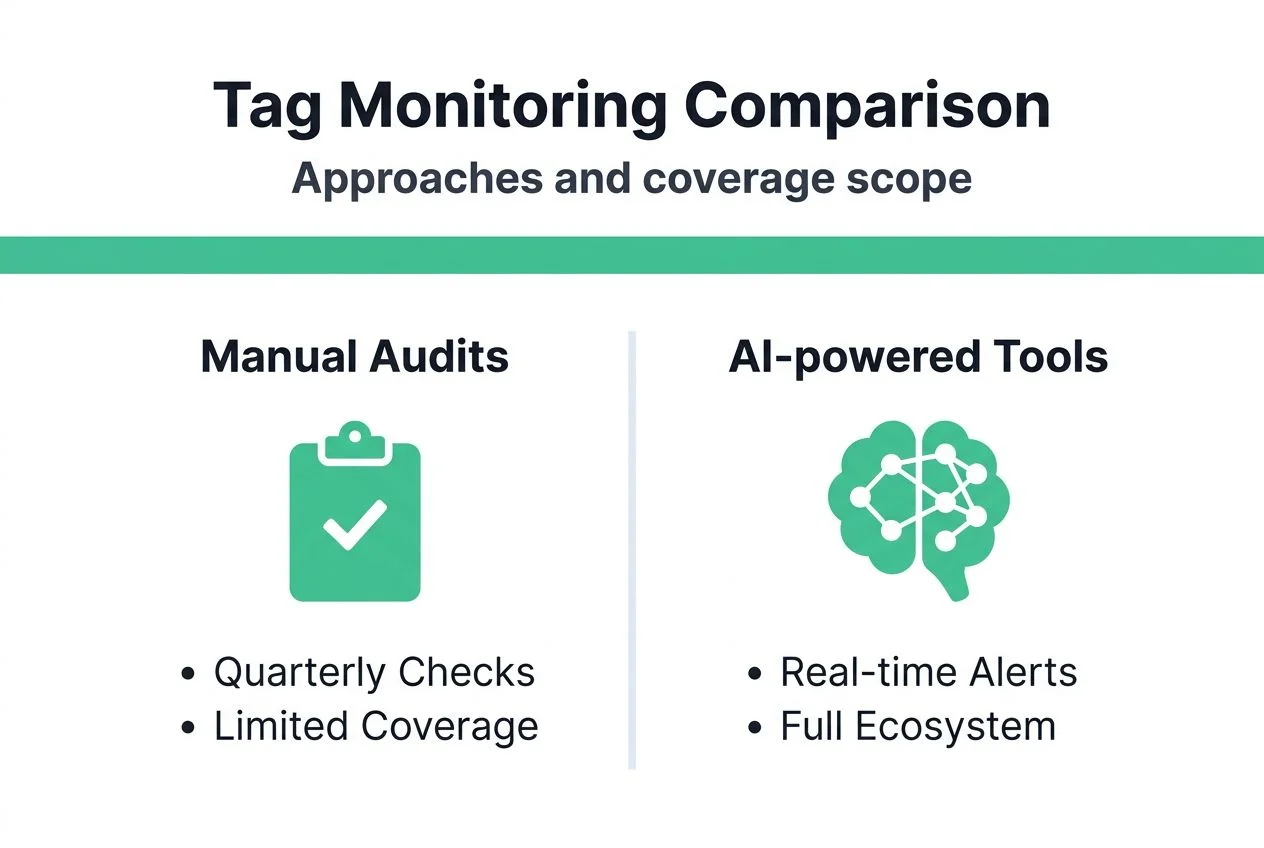
Manual audits represent the traditional approach where team members periodically test tags by triggering events and verifying data appears correctly in analytics platforms. This method catches obvious breaks but misses subtle issues like incorrect parameter values, intermittent failures, or problems affecting specific user segments. The delay between audits means broken tags can corrupt data for extended periods before discovery.
Scheduled automated checks improve on manual processes by running scripted tests on a regular cadence. These tools validate tag implementation automatically, reducing human error and increasing consistency. However, they still operate on delayed schedules, meaning tags might break immediately after a check and remain broken until the next scheduled run. Alerts arrive hours or days after failures occur, limiting your ability to minimize data loss.
AI-powered tools offer real-time detection with broad coverage across your entire digital ecosystem. They monitor tags continuously, analyze traffic patterns to detect anomalies, and alert teams the moment issues arise. Machine learning models identify complex failure patterns that simpler tools miss, and integration with compliance frameworks ensures privacy requirements stay met. The higher cost reflects comprehensive capabilities that protect significant revenue.
Different team sizes and budgets influence the ideal choice. Small teams managing simple websites might start with scheduled automation and upgrade as complexity grows. Enterprise organizations with multiple properties and substantial revenue at risk benefit most from AI-powered continuous monitoring that provides comprehensive protection and fastest issue resolution.
Case studies demonstrating real-world impact
A mid-size e-commerce brand struggled with attribution accuracy after noticing revenue discrepancies between analytics platforms and actual sales data. Investigation revealed broken conversion tags on checkout confirmation pages, causing significant underreporting. After implementing continuous tag monitoring, they gained 15% uplift in attribution accuracy and 10% ROI increase within three months by correctly attributing conversions to profitable channels.
| Metric | Before Monitoring | After Monitoring | Improvement |
|---|---|---|---|
| Attribution accuracy | 68% | 83% | +15% |
| Marketing ROI | $3.20 per dollar | $3.52 per dollar | +10% |
| Average issue detection time | 12 days | 45 minutes | -97% |
| Data completeness | 76% | 96% | +20% |
| Monthly conversion data loss | 2,400 transactions | 180 transactions | -92% |
Faster failure detection shortened periods of lost conversions dramatically. Previously, broken tags might go unnoticed for weeks during normal operations, causing thousands of conversions to go untracked. With real-time monitoring, the team received Slack alerts within minutes of any tag failure, enabling immediate fixes that preserved data completeness. This responsiveness proved especially valuable during promotional campaigns when conversion volumes spike.
The financial impact extended beyond direct ROI improvements. Better attribution enabled more sophisticated budget allocation across channels, reducing waste on underperforming tactics and increasing investment in high-converting sources. The team gained confidence in their analytics data, which accelerated decision-making and enabled more aggressive optimization testing. Marketing leadership could justify budget increases based on reliable performance metrics rather than approximations.
These results demonstrate that monitoring delivers measurable business value beyond theoretical data quality improvements. The combination of prevented data loss, faster issue resolution, and improved attribution creates compounding benefits that strengthen marketing performance quarter over quarter.
Implementing an effective analytics tag monitoring strategy
-
Conduct a comprehensive discovery audit to identify all deployed tags across your digital properties. Document every analytics tag, marketing pixel, attribution tracker, and conversion tag currently implemented. This inventory establishes your monitoring baseline and reveals tags you might have forgotten about or didn’t know existed. Many teams discover orphaned tags from discontinued campaigns or duplicate implementations that create data quality issues.
-
Set up automated AI-driven monitoring tools for continuous validation of all identified tags. Choose platforms that offer real-time detection, comprehensive coverage across web and mobile properties, and integration with your existing analytics stack. Configure the monitoring system to validate not just tag firing but also correct parameter passing, schema compliance, and data layer accuracy.
-
Configure real-time alerts integrated with team messaging platforms for prompt response to issues. Connect monitoring alerts to Slack, Teams, or your project management system so the right people see problems immediately. Set alert priorities based on tag criticality, routing high-priority conversion tags to immediate notification while batching lower-priority informational tags into daily summaries.
-
Train teams on root cause analysis and compliant issue resolution processes. Ensure developers understand how to investigate tag failures using monitoring dashboards, how to test fixes before deploying to production, and how to document resolutions for future reference. Include privacy compliance training so teams recognize when tag issues create regulatory risks requiring escalation.
-
Integrate privacy compliance checks into standard monitoring workflows. Configure monitoring to flag tags collecting personal data without proper consent, validate that tags respect user privacy preferences, and document data flows for audit purposes. This integration prevents compliance becoming a separate manual process that gets neglected during busy periods.
Pro Tip: Start monitoring your most critical conversion tags first rather than trying to monitor everything simultaneously. This focused approach delivers immediate value while you expand coverage across your entire tag ecosystem.
Best practices include establishing clear ownership for tag quality within your organization. Assign responsibility for monitoring alerts, issue resolution, and ongoing tag governance to specific team members rather than leaving it ambiguous. Regular reviews of monitoring data help identify patterns in tag failures, enabling proactive improvements to implementation processes that prevent recurring issues.
Enhance your analytics with Trackingplan solutions
Tracking data quality challenges require purpose-built solutions designed for marketing environments. Trackingplan offers automated tools for continuous tag monitoring and quality assurance that protect your marketing data investment. The platform discovers all tags across your digital properties automatically, eliminating manual inventory processes and ensuring comprehensive coverage from day one.
Integrations with major digital analytics tools ensure Trackingplan works seamlessly with your existing analytics stack. Whether you use Google Analytics, Adobe Analytics, Segment, or dozens of other platforms, monitoring operates without requiring changes to your current setup. This compatibility means you can start protecting data quality immediately without complex implementation projects.
The AI-assisted debugger accelerates issue detection and resolution, saving marketing costs through faster problem-solving. Instead of spending hours reproducing tag failures and investigating root causes, you get detailed diagnostic information showing exactly what broke, when it happened, and what changed on your site at that moment. This context enables developers to fix issues in minutes rather than days.
Comprehensive web tracking monitoring safeguards your data accuracy and compliance across all properties. Real-time alerts notify teams instantly when tags break, fire incorrectly, or violate privacy requirements. Explore Trackingplan solutions to transform tag monitoring from reactive troubleshooting into proactive quality assurance that protects your marketing ROI.
Frequently asked questions
What are analytics tags and why do they break?
Analytics tags are JavaScript code snippets that track user interactions on websites and apps, sending data to analytics platforms. They break due to site updates, misconfigurations, schema changes, or conflicts with other scripts. Regular monitoring catches these failures before they cause significant data loss.
How often should I monitor analytics tags?
Continuous real-time monitoring provides optimal protection compared to periodic checks. Tags can break at any moment due to site changes or platform updates, so constant validation ensures you detect and fix issues within minutes rather than discovering problems weeks later through data anomalies.
Can automated tools detect all tag errors?
AI-powered monitoring tools detect the vast majority of tag errors including firing failures, incorrect parameters, schema mismatches, and compliance violations. While no system catches 100% of issues, automated monitoring significantly outperforms manual processes in speed, accuracy, and coverage across complex digital environments.
How does tag monitoring help with privacy compliance?
Monitoring detects when tags collect unauthorized personal data or violate consent preferences, alerting teams before regulatory violations occur. It documents data flows for audit purposes and ensures tags respect privacy frameworks like GDPR and CCPA, helping companies avoid fines averaging $2.8 million for violations.
What is the ROI impact of fixing tag problems?
Fixing tag problems prevents up to 25% data loss, improving attribution accuracy by 15% and marketing ROI by 10% based on real-world implementations. Better data enables more effective budget allocation, reduces wasted ad spend, and increases confidence in marketing decisions that drive revenue growth.