
TL;DR:
- Third-party cookies are being phased out, prompting marketers to shift toward privacy-preserving APIs, first-party signals, and modeled data for accurate attribution and measurement. Effective cookieless tracking relies on combining server-side implementations, regulatory compliance, and organizational alignment, rather than solely on technology. Building a resilient, transparent measurement strategy requires ongoing validation, stakeholder communication, and adaptability to evolving privacy landscapes.
Third-party cookies are fading fast, and most marketing teams are somewhere between “we have a plan” and quietly hoping the problem resolves itself. It won’t. But here’s what the loudest voices in this conversation consistently get wrong: cookieless tracking doesn’t mean flying blind. In practice, it means shifting from third-party cookie dependence to first-party signals, privacy-preserving APIs, and modeled data. Done well, that shift can preserve most of what you actually need for attribution, audience targeting, and conversion measurement. This guide breaks down exactly how.
Table of Contents
- What is cookieless tracking? New essentials explained
- Core technologies and methods for cookieless tracking
- How consent and conversion modeling power cookieless measurement
- Limitations, trade-offs, and advanced planning for cookieless tracking
- Building your organization’s cookieless strategy: Practical tips
- Why most cookieless tracking advice misses the real organizational challenge
- How Trackingplan can support your move to cookieless tracking
- Frequently asked questions
Key Takeaways
| Point | Details |
|---|---|
| Cookieless tracking defined | It replaces third-party cookies with first-party signals, privacy APIs, and modeled analytics. |
| Server-side and consent solutions | Server-side tracking and advanced consent modes preserve reliable measurement even when cookies are blocked. |
| Modeling recovers lost data | Conversion and attribution modeling can recover most opt-out user data for marketing analysis. |
| Real-world limitations remain | User-level journey tracking and cross-device continuity are reduced compared to traditional methods. |
| Strategy matters most | Success relies on a holistic, flexible approach that adapts to technology, privacy, and organizational reality. |
What is cookieless tracking? New essentials explained
Let’s clear up the most common misconception first. When people say “cookieless tracking,” they almost always mean eliminating third-party cookies, not cookies altogether. First-party cookies, the ones your own domain sets and reads, remain fully functional and are still a cornerstone of modern analytics. The disruption is about cross-site tracking, the kind that let ad networks follow users from a news site to a shoe store to a travel booking page.
That cross-site model is being dismantled. Browsers like Safari and Firefox have blocked third-party cookies for years. Chrome, which holds the dominant share of browser traffic, completed its deprecation path for third-party cookies in 2024. What replaces that ecosystem isn’t a single technology. It’s a combination of approaches:
- First-party data collection: Events, identifiers, and behavioral signals your own properties generate and store
- Privacy Sandbox APIs: Browser-level tools that allow interest-based advertising and conversion measurement without exposing individual browsing history
- Server-side event routing: Moving data collection off the client browser and into a controlled server environment
- Modeled data: Statistical inference that fills gaps where direct measurement isn’t possible due to consent opt-outs or browser restrictions
The Privacy Sandbox Topics API is worth understanding specifically. It infers broad interest categories (think “sports” or “cooking”) from a user’s recent browsing, but critically, specific sites visited are never shared across the web. This protects individual identity while still enabling interest-based advertising. The Protected Audience API handles remarketing in a similar privacy-preserving way, and the Attribution Reporting API measures conversions without cross-site tracking.
“Cookieless tracking in practice usually means avoiding third-party cookies and relying on first-party signals plus privacy-preserving mechanisms.” This framing matters because it shifts the conversation from loss to adaptation.
If you want a broader view of what this transition looks like operationally, the strategies for combatting cookieless tracking and building a cookieless attribution strategy are worth reading alongside this guide.
Core technologies and methods for cookieless tracking
With the basics covered, we can now dig into the technologies and practical patterns organizations are using to make cookieless tracking both accurate and privacy-compliant.
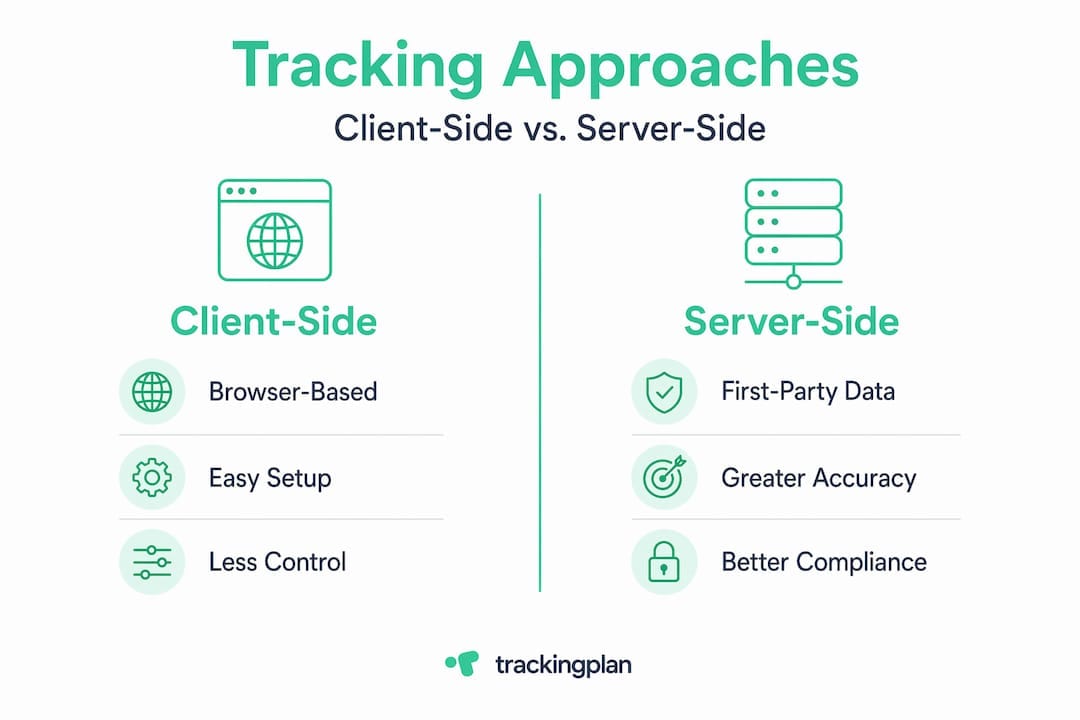
The single biggest architectural decision you’ll face is client-side vs. server-side tracking. Client-side tracking fires tags directly from the user’s browser. It’s fast to implement but increasingly unreliable: ad blockers, browser privacy settings, and cookie restrictions all chip away at data quality. Server-side tracking moves event processing to your own server environment, which means browser-level restrictions don’t apply in the same way.
Server-side tracking using tools like GTM Server-Side is one of the most common cookieless-leaning patterns analytics teams adopt. Events are sent from your server to ad platforms and analytics tools, bypassing client-side blocking. You control the data before it leaves your environment, which also gives you a natural checkpoint for consent enforcement.
Here’s how the core Privacy Sandbox APIs map to specific marketing use cases:
| API | Primary use case | Cookie equivalent it replaces |
|---|---|---|
| Topics API | Interest-based advertising | Third-party audience segments |
| Protected Audience API | Remarketing / retargeting | Third-party cookie-based custom audiences |
| Attribution Reporting API | Conversion measurement | Cross-site cookie-based attribution |
| Shared Storage API | Frequency capping, reach measurement | Third-party cookie storage |
These Privacy Sandbox APIs are structured as complementary tools, not a single replacement. You’ll likely use several in combination depending on your advertising and measurement goals.
Practical implementation steps for analytics teams:
- Audit your current tracking stack to identify which tags and pixels rely on third-party cookies
- Migrate high-priority conversion tags to server-side event routing using a first-party subdomain
- Implement a consent management platform (CMP) that supports Advanced Consent Mode v2 signaling
- Enable Privacy Sandbox APIs through your ad platform settings (Google Ads, DV360) where available
- Establish baseline metrics before migration so you can measure the actual data impact
Pro Tip: Before migrating any tag server-side, run both client-side and server-side versions in parallel for at least two weeks. This gives you a real comparison baseline and surfaces discrepancies before you decommission the client-side version. The goal of optimizing data accuracy depends entirely on knowing what you started with.
For a structured comparison of available cookieless tracking solutions, it’s worth reviewing options across server-side, consent, and API-based approaches before committing to a stack.
How consent and conversion modeling power cookieless measurement
Technology gets you only part-way. Consent and data modeling methods are now key to closing the gaps left by cookie opt-outs.

When a user declines tracking consent, traditional analytics simply drops that user from the data set. That’s a significant problem in markets like the EU, where opt-out rates can exceed 40% in some sectors. Advanced Consent Mode v2 changes the equation. When consent is denied, it sends cookieless pings that contain no cookies and no personal identifiers. These pings tell Google’s systems that a conversion-related event occurred, without identifying who triggered it. Google then uses site-specific modeling to estimate what those events represent in aggregate.
The practical result: Advanced Consent Mode v2 can recover an estimated 65 to 70% of attribution data that would otherwise be lost to opt-out traffic. That’s not perfect, but it’s far better than the alternative of treating opted-out users as if they don’t exist.
Here’s how the two consent mode configurations compare:
| Feature | Basic Consent Mode | Advanced Consent Mode v2 |
|---|---|---|
| Fires tags when consent denied | No | Yes (cookieless pings only) |
| Sends personal identifiers | No | No |
| Conversion modeling enabled | No | Yes |
| Attribution data recovery | Minimal | 65-70% estimated |
| Implementation complexity | Low | Medium to high |
Key things to understand about conversion modeling:
- It’s probabilistic, not deterministic. Models estimate behavior based on patterns from consenting users. Accuracy depends heavily on having enough consenting traffic to train the model.
- Site-specific calibration matters. A site with 80% consent rates will produce more accurate models than one with 40% consent rates, because the model has more direct data to learn from.
- Modeling doesn’t work well for niche audiences. If your consenting user base behaves very differently from your non-consenting users (common in B2B or high-sensitivity verticals), model accuracy drops.
For teams that haven’t yet validated their consent mode setup, validating consent mode properly is a prerequisite before trusting any modeled attribution data. And if you’re newer to how these models feed into broader measurement, understanding attribution modeling basics will give you the right mental model for interpreting the outputs.
Limitations, trade-offs, and advanced planning for cookieless tracking
Even with the latest technologies and modeling, there are realistic limits and trade-offs that teams need to anticipate.
The most significant limitation is user-level continuity. Traditional cookie-based tracking could stitch together a user’s journey across sessions, devices, and channels over weeks or months. Cookieless approaches trade off user-level persistence for compliance and reduced reliance on persistent identifiers. In practical terms, that means cross-device attribution becomes probabilistic rather than deterministic, and long consideration cycles (common in B2B, automotive, or high-ticket retail) become harder to measure accurately.
What modeling can and can’t do:
- Modeling can estimate aggregate conversion volumes with reasonable accuracy when consent rates are high
- Modeling cannot reconstruct individual user journeys or identify which specific touchpoints drove a conversion
- Modeling accuracy degrades as consent rates fall below roughly 60%, because the training data becomes too thin
- Server-side tracking benchmarks suggest that gains for analytics platforms like GA4 may be modest compared to the more significant recovery seen in marketing platform conversion data
Browser differences add another layer of complexity. Safari’s Intelligent Tracking Prevention (ITP) limits first-party cookie lifespans to seven days in some configurations. Firefox’s Enhanced Tracking Protection blocks many third-party requests by default. Chrome’s Privacy Sandbox APIs are still maturing. Your data quality will differ across browser populations, and that variance needs to be factored into reporting.
The teams that handle this best don’t try to eliminate the variance. They measure it, document it, and build it into how they interpret results.
Pro Tip: Build a quarterly scenario planning exercise into your analytics calendar. Model three scenarios: consent rates drop 10%, a major browser changes its privacy defaults, and a key ad platform deprecates a measurement API. For each, identify which metrics break and what your fallback is. This kind of planning is exactly what separates teams that adapt quickly from those that scramble. Pair this with a solid analytics privacy compliance framework and a clear view of how server-side tracking improves data accuracy under real-world conditions.
Building your organization’s cookieless strategy: Practical tips
With limitations in mind, here’s how digital marketing and analytics teams can proactively build or improve their cookieless measurement approach.
A robust cookieless strategy combines privacy-preserving APIs, cookieless consent signaling, and first-party or server-side event routing, while accepting that some cross-session tracking will be reduced. The goal isn’t to replicate the old cookie-based model exactly. It’s to build a measurement system that’s accurate enough to make good decisions and resilient enough to survive the next round of privacy changes.
Critical controls checklist:
- First-party data infrastructure: Ensure your CRM, CDP, or data warehouse captures and activates first-party identifiers (email hashes, logged-in user IDs) wherever users consent to share them
- Server-side event routing: Migrate conversion-critical tags to a server-side container with a first-party subdomain to reduce client-side blocking
- Advanced Consent Mode v2: Implement and validate that cookieless pings fire correctly on opt-out, and that modeling is active in your ad platforms
- Privacy Sandbox API readiness: Work with your ad platform partners to enable Topics and Protected Audience APIs where available
- Ongoing monitoring: Set up automated alerts for consent rate drops, tag failures, and data volume anomalies so issues surface before they distort your reporting
- Stakeholder communication: Document what your data covers, what it models, and where gaps exist. This is not optional.
Planning for edge cases includes monitoring consent rate shifts, browser privacy differences, and adjusting your modeling approach to context. A strategy that works well in Q1 may need recalibration by Q3 if a major browser update changes how your tracking fires.
Pro Tip: Set explicit expectation windows with stakeholders before you migrate. Tell them: “For the first 30 days post-migration, modeled data will be less stable as the system calibrates. Here’s the range of variance we expect, and here’s when we’ll reassess.” This prevents the knee-jerk reaction of reverting changes when numbers shift during a normal calibration period. For a side-by-side look at how different approaches stack up, comparing cookieless solutions across dimensions like accuracy, complexity, and compliance is a useful exercise before finalizing your stack.
Why most cookieless tracking advice misses the real organizational challenge
Here’s the uncomfortable truth that vendor webinars and conference talks consistently skip: the technology is not the hard part. The hard part is getting your organization to agree on what “good enough” measurement looks like in a world where perfect data no longer exists.
Most teams that struggle with cookieless tracking aren’t struggling because they chose the wrong API or skipped server-side migration. They’re struggling because their reporting culture was built on deterministic, user-level data, and no one has had the honest conversation about what changes when that data becomes modeled and probabilistic. Executives still want last-click attribution reports. Media buyers still want audience reach numbers that match their gut feel. And analytics teams are stuck in the middle, trying to explain why the numbers look different now.
The teams that are genuinely succeeding at improving attribution in a cookieless world share one trait: they invested as much in internal alignment as they did in technical implementation. They ran workshops with their media and finance teams before migrating, not after. They defined in advance which metrics would be modeled and what confidence intervals were acceptable. They built validation processes that run continuously, not just at launch.
Buying another tool doesn’t fix a reporting culture problem. And relying on vendor promises about data recovery rates without validating those claims in your own environment is how teams end up with false confidence in flawed data. The 65 to 70% attribution recovery figure from Advanced Consent Mode v2 is a benchmark average, not a guarantee. Your actual recovery depends on your consent rates, your traffic mix, your vertical, and how well your implementation is configured.
Disciplined validation is the real differentiator. Teams that run parallel tracking setups, audit their consent mode pings regularly, and monitor for data drift are consistently outperforming those that set it and forget it. The technology enables the outcome. The process sustains it.
How Trackingplan can support your move to cookieless tracking
Ready to put these principles into practice? Transitioning to cookieless tracking without a validation layer is like switching to a new measurement system without calibrating it first. You might be collecting data, but you won’t know if it’s accurate.
Trackingplan gives analytics and marketing teams the monitoring infrastructure to make that transition confidently. The platform automatically audits your digital analytics integrations, detects missing or misfiring tags, validates consent mode pings, and surfaces data quality issues before they corrupt your reporting. For teams managing web tracking monitoring across multiple properties or server-side environments, real-time alerts mean you catch problems in hours, not weeks. And with built-in privacy compliance resources, you have the tools to stay ahead of evolving data privacy requirements without manual audits eating your team’s time.
Frequently asked questions
How does cookieless tracking affect marketing attribution accuracy?
Cookieless tracking reduces user-level attribution accuracy, but Advanced Consent Mode v2 recovers an estimated 65 to 70% of otherwise lost attribution data through cookieless pings and site-specific modeling. Actual recovery depends on your consent rates and implementation quality.
Is server-side tracking necessary for cookieless analytics?
It’s not always required, but server-side tracking moves event processing to a first-party environment, which reduces client-side blocking and improves data reliability significantly for conversion-critical measurement.
What’s the main difference between traditional and cookieless tracking?
Traditional tracking uses third-party cookies for persistent, cross-site user identification, while cookieless tracking relies on first-party signals, browser-level privacy APIs, and modeled results to measure behavior without cross-site data sharing.
Does cookieless tracking fully replace cross-device or cross-session user stitching?
No. Most cookieless approaches deliberately reduce persistent identifiers, which makes full cross-device or cross-session stitching less feasible. Aggregate modeling can estimate behavior, but individual journey reconstruction is largely off the table.
How can I future-proof my organization’s tracking strategy?
Combine multiple privacy-preserving tactics including Privacy Sandbox APIs, server-side event routing, and flexible consent management so your measurement stack can adapt as browser privacy defaults and regulatory requirements continue to evolve.