
TL;DR:
- Data accuracy ensures marketing data correctly reflects real-world events, preventing attribution errors and stakeholder mistrust. Establishing validation rules, governance frameworks, and continuous monitoring at multiple pipeline stages is essential for reliable analytics, reducing costly reactive cleanup. Adopting layered testing and real-time audits supports proactive error detection, maintaining high-quality data and optimizing marketing decisions.
Data accuracy is defined as the degree to which data correctly represents the real-world values it is meant to capture, and in marketing analytics, a single broken tracking event can corrupt weeks of attribution reporting. Most teams discover inaccurate data after the damage is done: ad spend is misallocated, conversion rates look inflated, and stakeholders lose confidence in the numbers. The methods for accurate data collection go far beyond fixing typos. They require systematic validation, governance frameworks, and continuous monitoring built into every stage of the data lifecycle. This article walks through exactly how to do that.
How to ensure data accuracy: dimensions and standards
Data accuracy does not exist in isolation. IBM describes accuracy as one dimension within a broader set of data quality attributes, each of which must be measured and managed deliberately.

The five dimensions that matter most for marketing analytics teams are:
| Dimension | Definition | Marketing example |
|---|---|---|
| Accuracy | Data matches the real-world value it represents | A conversion event fires once per actual purchase |
| Completeness | No required fields are missing | Every session record includes a campaign source |
| Consistency | The same value appears the same way across systems | “google / cpc” in GA4 matches “Google CPC” in your CRM |
| Timeliness | Data is available when needed for decisions | Yesterday’s spend data loads before the morning standup |
| Uniqueness | No duplicate records exist | Each user ID appears once in the customer table |
Two ISO standards give these dimensions measurable teeth. ISO/IEC 25024 defines quantifiable targets for each dimension, including example thresholds such as 99.9% accuracy rates, giving teams a concrete benchmark rather than a vague aspiration. ISO 8000 goes further by specifying how to verify syntactic and semantic correctness, meaning data must not only be formatted correctly but must also mean what it is supposed to mean across systems. For marketing analysts, semantic correctness is the harder problem: a UTM source field that reads “google” in one pipeline and “Google Ads” in another is syntactically valid but semantically broken.
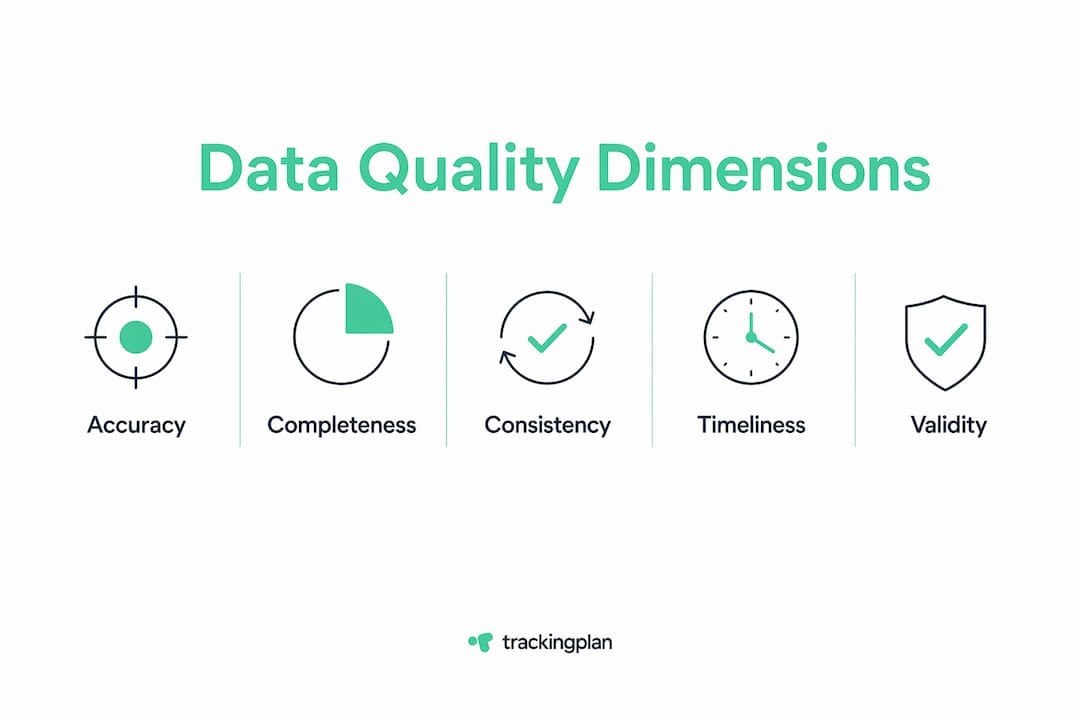
Ensuring data reliability starts with agreeing on which dimensions apply to your specific data products, assigning ownership, and setting measurable targets before any data flows into production.
What validation rules and governance frameworks actually prevent errors?
Validation is the first line of defense against inaccurate data, and it works best when applied at the point of entry rather than downstream. Tricentis identifies four core constraint types that every data team should enforce: NOT NULL for required fields, UNIQUE for deduplication, CHECK for range and format rules, and schema validation to confirm structure before ingestion.
For marketing analytics specifically, these constraints translate into concrete rules:
- Required fields: Campaign source, medium, and name must be present on every paid traffic event. A missing source field is what creates the “Direct/(none)” black hole in GA4.
- Uniqueness constraints: Order IDs, session IDs, and user IDs must be deduplicated before aggregation. Duplicate order IDs inflate revenue figures and make ROAS calculations unreliable.
- Format checks: Date fields must conform to ISO 8601. Currency values must be numeric, not strings. Phone numbers must match a consistent pattern before entering a CRM.
- Range checks: A session duration of 86,400 seconds or a conversion value of $0.00 on a paid checkout event should trigger an alert, not silently enter your reporting tables.
- Schema validation: Every event payload arriving at your data warehouse should be checked against a registered schema before it is written. Unexpected fields or missing properties should fail loudly.
Data governance gives these rules institutional weight. Without a governance framework, validation rules exist only in one engineer’s head and disappear when that person leaves. IBM emphasizes that sustaining accuracy requires comparing data against a trusted source of truth and assigning clear stewardship roles. In practice, this means appointing data stewards for each domain (paid media, web analytics, CRM), documenting rules in a shared data dictionary, and version-controlling those rules alongside your code.
Pro Tip: Treat UTM parameter conventions as contract fields. Document the exact taxonomy (source, medium, campaign, content, term) in your data dictionary, enforce it with UTM naming convention checks at ingestion, and alert on any deviation before it reaches GA4.
How to implement multi-layer testing and ongoing auditing
Validation rules at the point of entry catch many errors, but they do not catch everything. Data transformations, pipeline joins, and aggregation logic introduce new failure modes that only surface through structured testing and continuous monitoring. Deloitte UK Engineering recommends embedding quality checks at four distinct layers, treating data quality from day one rather than as a remediation task.
Here is how to structure that multi-layer approach:
- Unit tests for data operations. Write tests that verify individual transformations produce the expected output. If a dbt model is supposed to deduplicate sessions by user ID and date, a unit test should confirm that a known duplicate input produces a single output row.
- System tests for integrated pipelines. Test the full pipeline end to end using representative data. Confirm that a simulated purchase event in your tag manager fires the correct GA4 event, lands in BigQuery with the correct schema, and appears in your attribution report with the correct source.
- Automated referential integrity checks. Verify that foreign keys resolve correctly across tables. A session ID in your events table that has no matching record in your sessions table is a silent join error that skews every downstream metric.
- Continuous monitoring of data quality KPIs. Track pass rates, failure rates, and volume anomalies on a schedule. Tricentis recommends monitoring validation outcomes continuously as a core governance practice, not a quarterly audit.
The distinction between one-time audits and continuous assurance is critical. A quarterly data audit finds problems that have been silently corrupting reports for three months. Continuous monitoring finds the same problem within hours.
| Approach | Detection lag | Remediation cost | Best for |
|---|---|---|---|
| Quarterly audit | Up to 90 days | High (months of bad data) | Compliance reviews |
| Weekly data checks | Up to 7 days | Medium | Stable, low-volume pipelines |
| Continuous monitoring | Minutes to hours | Low (fast correction) | Marketing analytics, paid media |
Pro Tip: Define service-level objectives (SLOs) for your key datasets. For example, “conversion data must be 99.5% complete within 2 hours of the event.” Measurable SLOs give your team a clear standard to monitor against and a trigger for escalation when thresholds are breached.
Validation rules should also be treated as code. Version-control them in Git, review changes through pull requests, and integrate them into your CI/CD pipeline so that any change to a transformation is automatically tested before it reaches production.
Troubleshooting common data accuracy issues in marketing analytics
Even well-governed pipelines develop accuracy problems. Knowing where to look and what to fix is what separates teams that resolve issues in hours from those that spend weeks chasing phantom discrepancies.
The most frequent problems and their root causes include:
- Duplicate records. Twilio’s research shows that duplicate marketing records distort campaign results directly. The root cause is usually missing uniqueness constraints at ingestion or a merge operation that runs without a deduplication step. Fix it by enforcing UNIQUE constraints at the database level and adding a deduplication transformation before any aggregation.
- Missing or inconsistent UTM tags. A high percentage of “Direct/(none)” conversions in GA4 is the clearest signal of a UTM tagging problem. The cause is usually untagged email links, social posts shared without parameters, or redirect chains that strip query strings. Audit every traffic source against your UTM taxonomy and use a URL builder with enforced field validation.
- Broken attribution joins. When session IDs or user IDs do not match across systems, attribution models assign credit incorrectly. This often happens when a CRM uses a different user identifier than your analytics platform. Resolve it by establishing a canonical ID field and enforcing it as a required field at every ingestion point.
- Stale or incomplete data. Timeliness failures look like accuracy failures. If your cost data from Google Ads arrives 48 hours late, your ROAS calculation for yesterday is wrong even if the underlying numbers are correct. Set freshness alerts on every data source and treat a missed refresh as a data quality incident.
- Schema drift. A vendor updates their API and a field changes type from string to integer. Your pipeline silently fails or coerces the value incorrectly. Schema validation at ingestion catches this immediately. Without it, the error propagates to every downstream report.
For a structured approach to resolving analytics discrepancies, start by isolating the failure stage: collection, transformation, or display. Fixing a display metric without addressing the upstream collection error is the most common mistake teams make, and it guarantees the problem returns.
Key takeaways
Sustained data accuracy in marketing analytics requires layered validation, governance ownership, and continuous monitoring rather than periodic cleanup.
| Point | Details |
|---|---|
| Define quality dimensions first | Agree on accuracy, completeness, consistency, timeliness, and uniqueness targets before data flows to production. |
| Enforce validation at the source | Apply NOT NULL, UNIQUE, CHECK, and schema constraints at ingestion to stop errors before they propagate. |
| Test at multiple layers | Unit tests, system tests, and automated integrity checks each catch different failure modes that the others miss. |
| Monitor continuously, not quarterly | Real-time monitoring detects problems in hours; quarterly audits find problems that have corrupted months of data. |
| Treat UTM parameters as contract fields | Missing or inconsistent UTM tags are the leading cause of attribution inaccuracies in GA4 and similar platforms. |
Why reactive data cleanup is the most expensive strategy you can choose
I have worked with marketing analytics teams that run monthly data cleanup sprints, and every one of them eventually realizes the same thing: they are paying to fix problems that should never have existed. The cleanup cost is not just engineering hours. It is the ad spend decisions made on bad data during the weeks before anyone noticed the problem.
The teams that get this right share one characteristic. They treat data governance best practices as a design constraint, not an afterthought. Before a new campaign goes live, they define what events need to fire, what fields are required, and what the acceptable value ranges are. That specification becomes the schema. The schema becomes the validation rule. The validation rule gets tested in staging before anything touches production.
The harder cultural shift is getting business stakeholders to care about data quality before a crisis. In my experience, the most effective argument is not about data integrity in the abstract. It is about a specific dollar amount: “We reallocated $40,000 of paid search budget based on conversion data that turned out to be double-counted.” That conversation changes how quickly a team gets budget for proper monitoring infrastructure.
The collaboration between data engineers, analysts, and marketing operations is where most accuracy programs either succeed or fail. Engineers build the constraints. Analysts define the business rules. Marketing ops enforces the naming conventions. When those three groups work from the same data dictionary and review each other’s changes, the error rate drops substantially. When they work in silos, every handoff is a potential failure point.
Data stewardship is not a role you assign to one person. It is a practice that every person who touches data participates in. The teams that internalize that idea stop treating accuracy as a technical problem and start treating it as a shared professional standard.
— David
How Trackingplan helps marketing teams maintain accurate data

Trackingplan is built specifically for the accuracy problems that marketing analytics teams face every day. The platform automatically discovers and monitors every tracking event across your website, app, and server-side implementations, then alerts you via Slack, Teams, or email the moment a pixel breaks, a schema drifts, or a UTM parameter goes missing. Instead of discovering a broken GA4 event three weeks after a campaign launched, you know within minutes.
For teams managing digital analytics data quality, Trackingplan provides automated audit trails, root-cause analysis, and privacy compliance checks without requiring manual inspection of every data layer. It connects directly to your existing Martech stack and surfaces the issues that matter before they reach your dashboards. If you want to see how the validation and monitoring layer works in practice, the platform walkthrough covers the full detection-to-resolution workflow.
FAQ
What is data accuracy in marketing analytics?
Data accuracy means that every data point in your analytics system correctly reflects the real-world event it represents, such as a conversion, a click, or a session. In marketing analytics, inaccurate data leads directly to misattributed conversions and misallocated ad spend.
How do you validate data quality in a marketing pipeline?
Data validation applies constraints like NOT NULL, UNIQUE, and schema checks at each stage of the pipeline, from ingestion through transformation to reporting. The most reliable approach enforces these rules as code integrated into your CI/CD process.
Why does GA4 show so much “Direct/(none)” traffic?
A high volume of “Direct/(none)” in GA4 almost always indicates missing UTM parameters on paid or owned traffic sources. Auditing every campaign URL against a standardized UTM taxonomy and enforcing required fields at the URL-building stage resolves the majority of these cases.
What is the difference between data accuracy and data completeness?
Accuracy means a value is correct. Completeness means no required value is missing. A record can be complete but inaccurate (a wrong email address that is present) or accurate but incomplete (a correct email address with no associated campaign source).
How often should marketing data be audited for accuracy?
Continuous monitoring is the standard for marketing analytics because tracking validation outcomes in real time allows teams to catch and fix errors within hours rather than weeks. Reserve formal audits for compliance reviews or major infrastructure changes, not as a substitute for automated monitoring.