
Your marketing dashboard says the campaign was a win. Finance has a different number. The paid team is defending its attribution, the CRM owner is checking lead source fields, and someone in ops is exporting another spreadsheet to settle the argument. That is usually the moment a team realizes the problem is not reporting software, it is the absence of analytics governance.
How to implement analytics governance for marketing data starts with a simple shift in mindset. Governance is not a cleanup project you do once and forget. It is the operating model that keeps your data reliable as campaigns, tools, and definitions change. It gives your team rules for how data is created, labeled, validated, and used, so the same campaign does not become three different stories by the time it reaches the dashboard.
Marketing data governance combines policies, processes, technology controls, and assigned ownership to keep campaign data accurate and consistent. It also needs to be measurable, with governance KPIs such as error rates, breach-response times, and data accessibility satisfaction scores called out in marketing governance guidance (Improvado on marketing data governance). That matters because the point is not to produce more documentation. The point is to remove the friction that forces your team into endless validation meetings, duplicate QA, and confidence-killing debates.
Beyond Data Chaos to Trusted Marketing Insights
The fastest way to lose trust is for marketing to celebrate a campaign while finance, sales, or analytics shows a different result. That mismatch does more than create one awkward meeting. It tells the business that every number is provisional, which slows decisions and makes every launch harder to defend.
Governance keeps that pattern from becoming normal. It gives your team a shared set of rules for how data is created, labeled, validated, and used, so the same campaign does not become three different stories by the time it reaches the dashboard. The practical value is speed, not bureaucracy. When naming, ownership, and control are clear, people spend less time reconciling numbers and more time acting on them. For teams still trying to separate signal from noise, beyond just data visibility is the primary objective.
Governance is an operating model, not a cleanup task
The companies that get this right do not treat governance as a one-time audit. They build a structure, assign ownership, deploy policies, and keep checking whether those controls still work. Gartner's data governance guidance reflects that approach, and it fits marketing because the stack keeps moving. Web analytics, CRM, ad platforms, consent systems, and attribution tools all change quickly.
Practical rule: If your governance process depends on one person remembering to check everything manually, it will not survive the next campaign launch.
A lightweight, measurable setup works better. A data maturity assessment for marketing teams helps you see whether you are still relying on manual checks or are ready to standardize controls and monitoring. You do not need a perfect model on day one, but you do need a clear standard for the data that drives decisions.
That is where governance shifts from control to enablement. Your team can move faster when there is less ambiguity, fewer ad hoc checks, and no guesswork about which field means what. Good governance does not slow launches. It removes the roadblocks that create rework after launch.
Start Here Scoping Your Governance and Defining Objectives
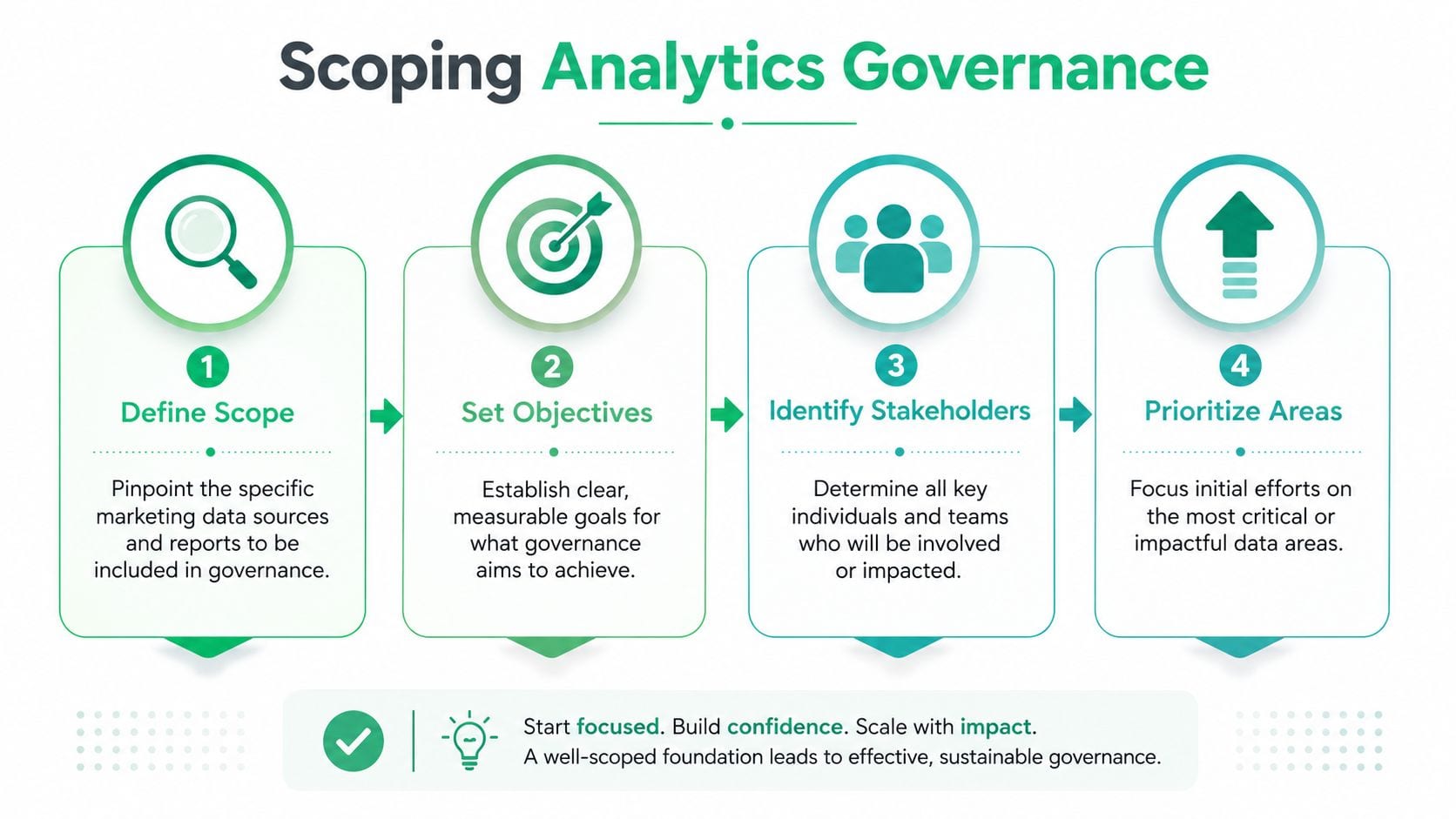
Starting small is the difference between a governance program that lands and one that dies in planning. If you try to cover every source, every dashboard, and every downstream use case at once, your team will spend months debating scope instead of fixing anything. A narrow start makes the work visible, testable, and easier to defend.
Pick one critical slice of the business
A practical first step is to define a single critical scope, such as one web property or one conversion funnel, then pair it with a lightweight tracking policy, an owner map, and automated baseline checks to surface issues early (Trackingplan on data quality governance). That kind of focus gives you a clean boundary. You know which events matter, which systems they touch, and where failure would hurt the business most.
If your team is unsure where to begin, use business impact, not volume, as the filter. The best first scope is usually the place where attribution, lead quality, or conversion reporting already causes discussion. You want a lane where cleaner governance will be noticed quickly.
Turn vague goals into decision-grade objectives
“Improve data quality” is too vague to manage. Replace it with objectives tied to business outcomes, such as fewer attribution disputes, cleaner campaign naming, or faster onboarding of new tools. The point is not to make the goal fancy, it's to make it actionable for marketing, product, analytics, and engineering.
Start with the data path that most affects revenue decisions, then expand only after the rules hold under real campaign pressure.
A simple scoping model helps. Your team can review the source, the event, the downstream report, and the owner in one pass. If any of those four pieces is unclear, the scope is still too broad.
For a deeper baseline on readiness, how to assess your data maturity level is a useful internal reference before you widen the program.
What to capture in the first governance brief
Use a short brief that answers four questions:
- What is in scope? Name the exact property, funnel, or channel.
- What must improve? Tie the work to one business outcome, not a wishlist.
- Who owns each piece? Assign a person, not a team label.
- How will you know it worked? Define the checks you'll review, not just the documents you'll store.
That brief becomes the anchor for the rest of the rollout. Without it, every discussion drifts toward abstract “best practices,” and that's where governance starts to feel like overhead instead of value.
Build Your Single Source of Truth with a Data Taxonomy
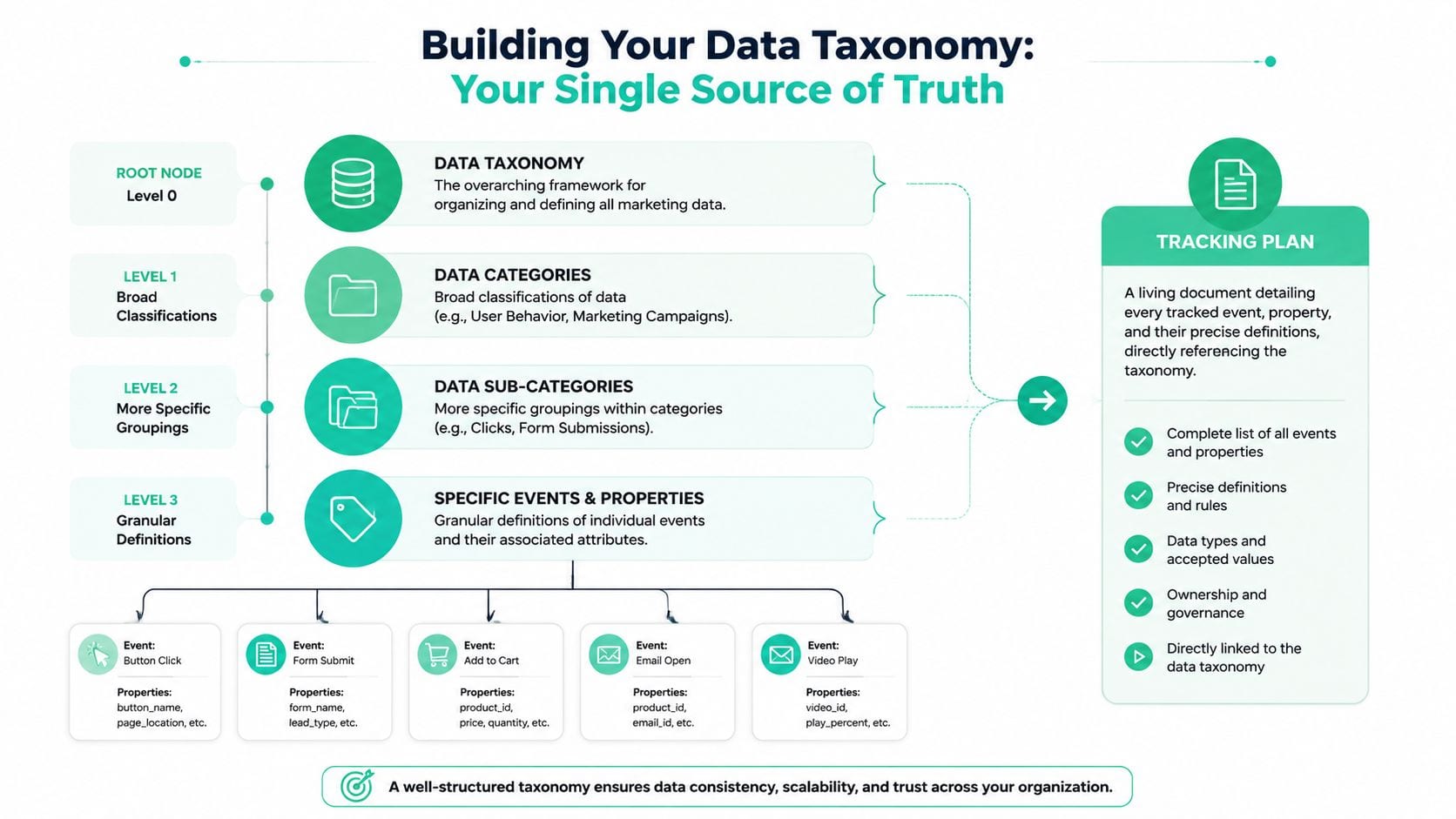
If your team uses the same word to mean different things, no dashboard can rescue you. A data taxonomy forces agreement on definitions before those definitions get embedded in reporting, activation, and attribution. Once the meaning is stable, the rest of the stack is easier to govern, and your team spends less time arguing about what a field was supposed to mean.
Start with naming conventions that remove ambiguity
Governance works when it is operationalized through explicit standards, including naming conventions, standardized fields such as campaign names, and defined refresh cycles, as outlined in the MarketingOps practical guide. That sounds basic, but it is usually where the first real gains show up. A campaign name that means the same thing in paid media, analytics, and CRM saves more time than a long policy document no one reads.
Use the taxonomy to define broad categories first, then subcategories, then specific events and properties. In an ecommerce checkout flow, that might mean separating user behavior, marketing campaign data, and transaction-related fields before you touch the tracking implementation. Your naming rules should make it obvious whether a field describes a source, a user action, or a downstream status.
Turn the taxonomy into a tracking plan
The taxonomy is the structure. The tracking plan is the working document that says exactly what gets captured, where it comes from, and why it exists. It should list the event name, trigger, required properties, and the destination systems that depend on it. That gives developers a blueprint and gives analysts a stable reference point when reports change.
A strong data dictionary helps too. If your team needs a practical definition of the role it plays in daily governance, what is the purpose of a data dictionary in managing organizational data is worth keeping handy. It gives your team a common reference for naming, field meaning, and ownership, which makes review cycles faster and reduces back-and-forth when someone proposes a new event.
Useful test: If two people can read the tracking plan and still argue about what the event means, the definition isn't ready yet.
Keep the rules lightweight enough to survive real work
A monthly data-health check focusing on one or two KPIs makes governance sustainable, rather than bureaucratic. That is the right cadence for a taxonomy too. You do not need to rework every field every week. You need a consistent way to catch drift before it spreads.
If your taxonomy includes address or user identity fields, consistent formatting matters outside analytics too. A practical resource on improve mail deliverability is a good reminder that standardization benefits every system downstream, not just reporting. The same cleanup that helps matching in analytics can also reduce avoidable friction in operational systems that depend on clean contact data.
The goal is simple. Your taxonomy should let every team answer the same question the same way. If it does not do that, it is not yet a source of truth.
Operationalize Governance with Clear Roles and Processes
A governance program falls apart when ownership is fuzzy. People assume someone else is checking the data, approving the change, or resolving the mismatch, and by the time the issue surfaces, no one knows who should fix it. Clear roles stop that drift before it starts.
Assign ownership where the data actually lives
A strong governance implementation treats governance as an operating model, not a one-time cleanup. Your team needs a structure for policies, decision rights, and accountability that fits how marketing data is created and used day to day. In practice, that means your marketing manager might own campaign data, your analyst owns measurement standards, and your developer owns implementation fidelity.
The important part is domain ownership, not org-chart ownership. If the person closest to the data cannot approve a change or escalate a defect, the process will bottleneck somewhere else. Keep the ownership map simple enough that anyone on the team can tell who to ping.
Use a RACI matrix for the real work
The cleanest way to avoid confusion is a small RACI. Use it for tasks that cause disagreement, such as approving a new marketing technology tool or updating the tracking plan. The matrix does not need to be elaborate. It needs to be visible and used.
| Task | Data Analyst | Marketing Manager (Data Steward) | Developer | Governance Council |
|---|---|---|---|---|
| Review tracking changes | Consulted | Accountable | Responsible | Informed |
| Approve new tool | Consulted | Responsible | Consulted | Accountable |
| Update event definitions | Responsible | Accountable | Consulted | Informed |
| Resolve ownership disputes | Consulted | Consulted | Informed | Accountable |
That structure works because it removes ambiguity. If a tool breaks attribution, the analyst can flag it, the steward can own the business context, the developer can fix the implementation, and the council can settle unresolved trade-offs. Nobody has to guess who has the final call.
For a practical framework on how roles and responsibilities support governance across systems, a data process agreement helps translate those responsibilities into day-to-day operating rules.
Keep cross-functional review practical
A governance council should not become a meeting factory. It should resolve exceptions, not rehash routine work. Quarterly reviews of ownership assignments are a sensible cadence when teams and tools evolve, and that cadence also helps keep access rules current.
If your stack touches sensitive or multi-source data, the governance conversation may overlap with broader platform controls. FalkorDB's discussion of multi-modal data for ethical AI is useful context for teams thinking about governance beyond marketing analytics.
The process should feel boring in the best way. When everyone knows their role, fewer decisions get stuck, and fewer issues get relabeled as emergencies.
Automate Trust with Continuous Validation and Monitoring
Manual QA holds up until your team starts shipping changes faster than a spreadsheet review can keep pace. After that, the review process becomes a bottleneck, and the gap between implementation and detection turns into reporting drift. For modern marketing stacks, automation keeps governance current.
Replace brittle audits with live checks
Governance should run through measurable control metrics, including regular reviews of ownership, error rate KPIs, and alert thresholds. Routine reconciliation across ad platforms, analytics, and CRM helps catch drift before it contaminates reporting. That is the right model because it focuses on control, not just documentation.
Manual checks miss issues that happen between launches. Broken pixels, rogue events, UTM convention mistakes, or schema mismatches often appear after a release goes live, not before. If your team waits for a monthly review, the reporting damage is already in place.
What automation should catch
The automated layer should watch for the issues that derail marketing data most often. That includes missing or broken pixels, duplicate or rogue events, destination mismatches, and inconsistencies between your tracking plan and what the site sends. It should also monitor consent or PII problems where relevant, because governance is about accuracy and control.
A practical option is Trackingplan, which continuously discovers your implementation and monitors analytics, marketing, and attribution pixels across web, app, and server-side stacks. It alerts teams when something breaks, and it keeps the tracking plan aligned with what is deployed. For teams building this out, a clear data quality monitoring practice is what keeps checks from becoming one-off cleanup work.
Use alerts carefully or they'll get ignored
Automation only works if people trust the signal. If every minor variation triggers an alert, your team will tune it out. Set thresholds that catch true defects and use escalation rules that route ownership clearly, so the right person sees the right issue quickly.
Here's the trade-off I see most often. Teams that rely on spreadsheet QA look thorough, but they are really just slower. Teams that automate badly create noise. The goal is disciplined monitoring that surfaces defects early without turning the workflow into an alert storm.
Rule of thumb: If the check can't run every day without human effort, it is not a control, it is a chore.
The final piece is reconciliation. Compare ad platforms, analytics tools, CRM, and warehouse outputs regularly so conversion-count drift does not get baked into dashboards. Once drift reaches reporting, cleanup gets harder and more political.
This short demo of the alert system is a useful reference for seeing how continuous monitoring can be surfaced in practice.
Making Analytics Governance a Sustainable Practice
Governance becomes durable when it stops feeling like a special project. The teams that keep it alive build it into the cadence of marketing work, so it shows up in planning, releases, reviews, and tool changes without needing a separate campaign to remind people it exists.
Keep the rhythm simple
The core pieces are already clear. Start with a defined scope, document the taxonomy, assign clear roles, and automate monitoring. Then make those pieces part of the normal workflow instead of extra work on top of it. A tracking plan review can live inside sprint planning. Ownership changes can be reviewed on a regular calendar. Exception reviews can happen when the council already meets for broader operational decisions.
Your team doesn't need a giant governance playbook. It needs a repeatable operating rhythm. That rhythm keeps standards current as campaign data, attribution, CRM logic, web analytics, and access rules change over time.
Use the checklist to keep momentum
A practical maintenance checklist keeps the program from drifting:
- Conduct regular audits to review quality, taxonomy adherence, and tracking plan accuracy.
- Keep documentation current so new events or field changes don't create hidden gaps.
- Provide ongoing training for new hires and refreshers for existing users.
- Establish a feedback loop so data issues get reported instead of worked around.
- Automate monitoring to validate pipelines and quality continuously.
- Celebrate milestones when the team resolves recurring issues and stabilizes reporting.
The point isn't ceremony. It's making governance visible enough that people respect it and lightweight enough that they'll follow it.
Build trust by making the rules live where work happens
Most governance programs fail because they live in documents, not in the workflow. Once the rules are embedded in reviews, validations, and alerts, they stop aging out as fast. That's what turns governance into a dependable part of marketing operations rather than a shelf-ware initiative.
If your team is ready to move from policy to practice, start with the narrowest scope you can defend, wire in automated validation, and make one person responsible for keeping the standards current. Then keep tightening the loop as the stack changes.
If you're ready to make governance operational instead of theoretical, take a close look at Trackingplan and map it against your current tracking plan, ownership model, and monitoring gaps.