
TL;DR:
- Last touch attribution assigns full credit to the final touchpoint before a customer converts.
- It works well for short sales cycles and specific campaigns like cart abandonment emails but fails to account for broader customer journeys.
Last touch attribution is a marketing attribution model that assigns 100% of conversion credit to the final customer touchpoint before a purchase or lead event. Also called last-click or last interaction attribution, it dominated digital measurement from 2008 through 2018 before the rise of multi-touch and data-driven approaches. The model remains relevant for specific conversion-focused tasks, but treating it as a complete picture of channel performance is one of the most common and costly mistakes in digital marketing attribution. This guide explains when last touch attribution works, where it fails, and how to fit it into a modern measurement framework.
What is last touch attribution and how does it work?
Last touch attribution gives full credit to the channel or campaign that drove the final click or interaction before a conversion. If a customer first sees a YouTube ad, then clicks a Facebook retargeting ad, and finally converts through a branded Google search, the Google search gets 100% of the credit. Every earlier touchpoint receives zero.

The model is simple to implement and easy to explain to stakeholders. That simplicity is its main advantage. No machine learning, no complex weighting, and no large data volume requirements. Any analytics platform can run it out of the box.
GA4 offers a variant called last-non-direct touch attribution, which assigns credit to the last non-direct channel before conversion. This protects paid channel data from being swallowed by direct traffic, but it still ignores the full user journey and creates a blind spot for top-of-funnel influence.
When to use last touch attribution effectively
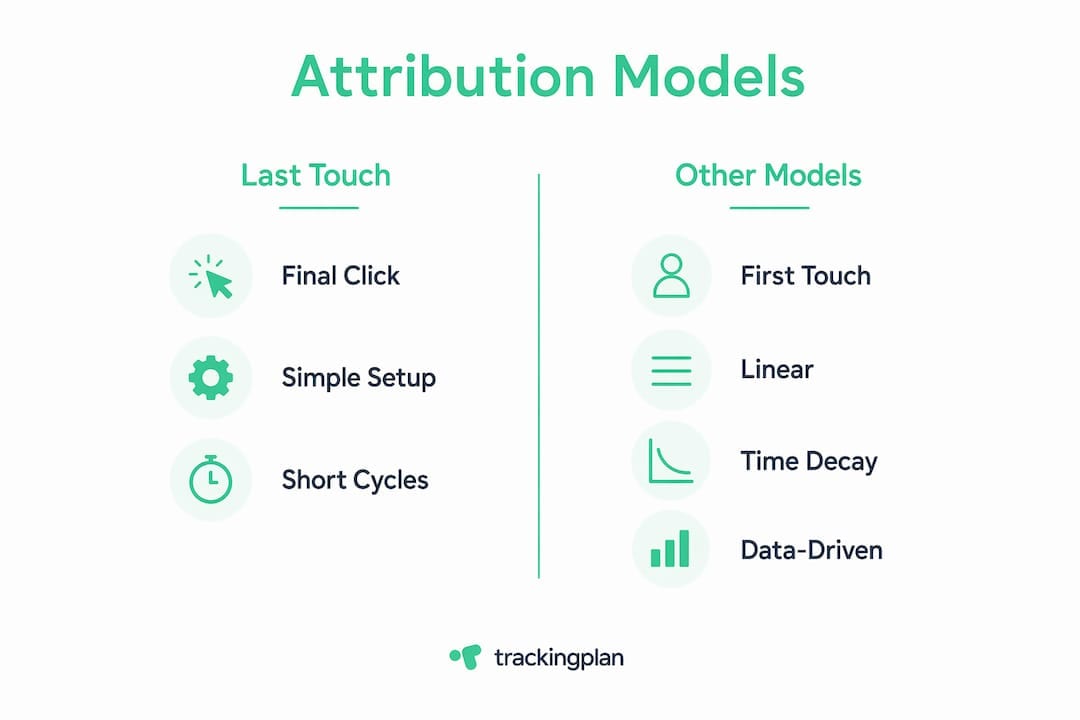
Last touch attribution is recommended for bottom-funnel performance monitoring and short sales cycle scenarios. It answers one specific question well: which channel closed the deal? That makes it genuinely useful in a narrow set of situations.
Where last touch attribution delivers real value:
- Cart abandonment email campaigns. When a user abandons a cart and converts after clicking a recovery email, the email deserves full credit. The journey is short and the causal link is clear.
- Direct-to-consumer (D2C) brands with one-session purchase cycles. A customer who discovers and buys a product in a single session gives you a clean, reliable last-touch signal.
- Landing page and creative testing. Last touch data tells you which specific ad or page variant closed conversions, making it a useful trigger for A/B testing decisions.
- Branded search monitoring. Tracking how often branded search terms close conversions helps you understand brand equity and direct intent.
The model breaks down fast when sales cycles lengthen or when multiple channels work together over days or weeks. Applying it to cross-channel budget allocation creates what analysts call an attribution death spiral. You defund the channels that build awareness, conversions eventually drop, and you blame the wrong variables.
Pro Tip: Use last touch attribution as a conversion optimization signal, not a budget allocation tool. Run it alongside incrementality testing to separate genuine demand creation from demand capture.
Limitations and common pitfalls of the last-click model
Last touch attribution systematically overcredits closing channels like email, branded search, and retargeting while starving upper-funnel channels like paid social and content marketing. The result is a budget allocation that amplifies low-funnel activity and cuts the demand creation that feeds it.
The core conceptual flaw is that last touch cannot distinguish between creating demand and capturing it. A branded search click often captures a customer who was already sold by a TikTok or YouTube ad. Last touch gives the search click all the credit and the video ad none. Over time, this pushes budget toward channels that look productive but are actually just harvesting intent built elsewhere.
The most damaging pitfalls follow a predictable pattern:
- Ignoring upper-funnel touchpoints. Awareness channels like display, video, and paid social build the intent that closing channels convert. Last touch makes them invisible in your reporting.
- Overcrediting retargeting. Retargeting ads often reach users who would have converted anyway. Last touch inflates their apparent contribution.
- Silent double counting across platforms. Meta claims conversions within a 7-day click and 1-day view window, while Google Ads runs its own independent attribution. Summing both platforms without deduplication inflates total reported conversions significantly.
- Privacy-driven data gaps. Cookie deprecation, iOS privacy changes, and consent management platforms all create holes in tracking. Last touch is especially vulnerable because a missing middle touchpoint can silently shift credit to the wrong channel.
- No incrementality signal. Last touch tells you what happened last. It tells you nothing about whether the channel caused the conversion or just witnessed it.
“Using last-touch attribution for budget decisions is like running a business on fiction. It ignores the multi-channel reality of how customers actually make decisions and systematically rewards the wrong channels.”
Marketing Attribution in 2026, Praxxii Global
How does last touch compare to other attribution models?
Attribution modeling covers a wide spectrum, from simple rule-based models to machine learning systems. Understanding where last touch sits helps you choose the right tool for each measurement task.
First touch attribution assigns all credit to the first channel a customer interacted with. It is the mirror image of last touch and equally blunt. It works for measuring top-of-funnel reach but ignores everything that closed the sale.
Linear attribution splits credit equally across every touchpoint in the journey. It is fairer than single-touch models but treats a brand awareness impression the same as a cart abandonment email.
Time-decay attribution weights touchpoints closer to conversion more heavily. It acknowledges that recent interactions matter more, but it still applies a fixed rule rather than measuring actual impact.
U-shaped (position-based) attribution splits credit between the first and last touchpoints, typically 40% each, with the remaining 20% distributed across middle interactions. It balances awareness and conversion credit without requiring machine learning.
Data-driven attribution uses machine learning to assign credit based on observed conversion paths. GA4 defaults to this model, but it requires 300–600+ monthly conversions to produce reliable outputs. Below that threshold, the model can be noisier than simpler rule-based alternatives. A full breakdown of how GA4 handles these models is available in Trackingplan’s GA4 attribution explainer.
| Model | Best use | Setup complexity | Data volume needed |
|---|---|---|---|
| Last touch | Conversion optimization, short cycles | Low | Low |
| First touch | Top-of-funnel reach measurement | Low | Low |
| Linear | Even credit across full journey | Low | Medium |
| Time-decay | Recency-weighted conversion analysis | Low | Medium |
| U-shaped | Balancing awareness and conversion | Medium | Medium |
| Data-driven | Incremental credit, complex journeys | High | High (300–600+ conversions/month) |
Incrementality testing sits outside the attribution model spectrum entirely. It uses holdout groups to measure whether a channel actually caused conversions, not just correlated with them. It is the most reliable way to validate what any attribution model reports.
Pro Tip: If your account generates fewer than 300 conversions per month, last touch or U-shaped attribution will give you more stable data than data-driven attribution. Scale into machine learning models as volume grows.
Practical guidance for using last touch alongside modern measurement
The most effective approach treats last touch as one signal in a broader measurement system, not the system itself. Here is how to apply it without falling into the common traps.
- Separate tactical from strategic decisions. Use last touch data to test landing pages, email subject lines, and ad creatives. Use multi-touch attribution or marketing mix modeling (MMM) for budget allocation across channels.
- Validate platform-reported conversions against backend data. Platform attribution windows differ significantly. Cross-reference your CRM or order management system against ad platform reports to catch silent double counting before it skews your analysis. Trackingplan’s guide on Meta Ads vs GA4 discrepancies covers this in detail.
- Account for attribution window mismatches. Set consistent attribution windows across platforms when possible. A 7-day click window in Meta and a 30-day click window in Google Ads will never produce comparable data.
- Run incrementality tests on your top-spending channels. A D2C brand that shifted budget based on data-driven attribution saw a 28% conversion gain and a 12% reduction in customer acquisition cost within three months. The insight came from discovering that TikTok and Instagram drove 45% of conversions while receiving only 20% of spend. Last touch alone would never have surfaced that gap.
- Use last touch as a creative testing trigger. When a specific ad or landing page consistently appears as the last touch before conversion, that is a signal worth testing further with conversion rate optimization methods.
- Monitor tracking quality continuously. Attribution data is only as good as the tracking underneath it. Missing pixels, broken tags, and schema mismatches silently corrupt your conversion data before any model sees it. Trackingplan’s tracking accuracy guidance covers the most common failure points.
Key Takeaways
Last touch attribution is a useful conversion optimization tool, but it fails as a budget allocation model because it ignores every channel that built the demand it measures.
| Point | Details |
|---|---|
| Narrow use cases only | Last touch works for cart abandonment emails, short sales cycles, and creative testing. |
| Avoid budget decisions | Using last touch for channel budget allocation creates systematic underfunding of demand-creation channels. |
| Double counting is real | Meta and Google Ads use different attribution windows, inflating total reported conversions when summed without deduplication. |
| Data volume gates models | Data-driven attribution in GA4 needs 300–600+ monthly conversions to outperform simpler rule-based models. |
| Validate with incrementality | Incrementality testing is the only method that confirms whether a channel caused conversions, not just correlated with them. |
Why I think most teams misuse last touch attribution
The honest problem with last touch attribution is not the model itself. The model is transparent about what it does. The problem is that teams use it for decisions it was never designed to support.
I have seen marketing teams cut YouTube and paid social budgets because those channels never appeared as the last touch before conversion. Within two quarters, branded search volume dropped, direct traffic declined, and the team could not explain why. They had defunded the channels building the demand that their closing channels were harvesting.
Last touch attribution is not going away. Its simplicity makes it the default in many platforms, and for certain tasks, that simplicity is genuinely the right tool. But the shift toward data-driven attribution and incrementality testing reflects a real need. Rule-based models apply fixed logic to a world where customer behavior does not follow fixed rules.
The pragmatic path in 2026 is to use last touch for what it does well, build incrementality testing into your quarterly measurement cadence, and invest in data-driven attribution only when your conversion volume justifies it. The teams that get this right are not the ones with the most sophisticated models. They are the ones who understand what each model measures and what it cannot.
— David
Trackingplan helps you trust your attribution data
Attribution models are only as reliable as the data flowing into them. A broken pixel, a misfired tag, or a schema mismatch can silently corrupt your conversion data long before any model processes it.

Trackingplan monitors your web tracking in real time, detecting missing pixels, broken tags, and campaign misconfigurations across your entire Martech stack. When something breaks, you get an alert via Slack, email, or Teams before bad data compounds into bad decisions. For teams running multi-platform attribution, Trackingplan’s digital analytics data quality tools give you the foundation that every attribution model depends on. Accurate attribution starts with accurate tracking.
FAQ
What is last touch attribution in simple terms?
Last touch attribution assigns 100% of conversion credit to the final channel or ad a customer interacted with before converting. Every earlier touchpoint receives zero credit.
When should I use last touch attribution?
Last touch attribution works best for short sales cycles, cart abandonment email analysis, and creative testing. It is not appropriate for cross-channel budget allocation.
How is last touch different from first touch attribution?
First touch attribution credits the first interaction in a customer journey, while last touch credits the final one. Both are single-touch models that ignore middle-of-funnel activity.
Does GA4 use last touch attribution by default?
GA4 defaults to data-driven attribution, not last touch. It also offers a last-non-direct touch variant, which assigns credit to the last non-direct channel before conversion rather than to direct traffic.
Why does last touch attribution cause double counting?
Meta and Google Ads each run independent attribution windows. Meta claims conversions within a 7-day click and 1-day view window, while Google Ads uses its own model. Summing both without deduplication inflates your total reported conversions.