
The team has the dashboards. It has the warehouse. It has a stack of tagged campaigns, attribution reports, product analytics views, and channel summaries. Yet the question that matters right now still takes too long to answer.
A marketer asks, “Which campaigns drove the best signup quality from new users last month?” An analyst opens three dashboards, checks filter logic, realizes one report uses sessions while another uses users, then pings the data team to confirm whether “signup quality” maps to activation or retained conversion. By the time the answer lands, the media budget has already moved.
That gap is why natural language analytics matters. Not because typing questions is novel, but because many teams don't have a tooling problem at the surface. They have an access problem, a consistency problem, and a trust problem underneath it.
Beyond the Dashboard Why We Need to Talk to Our Data
Traditional BI has always promised self-service. In practice, many teams still treat dashboards like vending machines. If the exact answer is already packaged, great. If not, someone has to build a new view, rewrite a query, or explain what a metric really means.
That's one reason adoption has remained stuck. Traditional business intelligence usage has historically reached only 20-30% of potential users inside organizations, according to Tellius on search-driven and natural language analytics. The gap isn't just training. It's friction.
The reporting bottleneck marketers know well
A performance marketer wants to compare paid social creative against branded search for first-time conversions. A lifecycle manager wants to know whether a recent landing page test affected demo intent by device. A growth lead wants the answer before the afternoon budget review, not next week.
When teams rely on rigid dashboards, simple business questions become workflow problems:
- Too many predefined views: Someone has to guess in advance what questions users will ask.
- Too much translation: Business language rarely matches table names, event labels, or field conventions.
- Too many handoffs: Analysts spend time answering routine questions instead of doing deeper diagnostic work.
The real pain isn't lack of data. It's the time spent converting business questions into the exact shape a tool will accept.
Natural language analytics changes that interaction. Instead of choosing between menu filters and memorized definitions, users ask questions in everyday language and get back charts, summaries, or follow-up prompts.
What changes when data becomes conversational
Used well, natural language analytics lowers the barrier for non-technical users without removing the analyst's role. It handles the repetitive front end of analysis so specialists can spend more time validating anomalies, designing better measurement, and improving decision quality.
For digital teams, that shift matters because most questions are iterative. You don't ask once and stop. You ask, refine, segment, compare, and pressure-test. A conversational model fits how marketers and analysts work far better than a fixed dashboard ever did.
Defining Natural Language Analytics
Natural language analytics is best understood as a data interface that lets people ask analytical questions in plain language and receive structured answers. Envision it like a skilled research assistant. You ask a business question in everyday English. The assistant figures out what you mean, retrieves the right data, applies the right logic, and returns something usable such as a chart, table, or concise explanation.
That's broader than a chatbot, and it's more specific than generic AI text generation.
The engine versus the full application
The technical foundation beneath natural language analytics is statistical natural language processing. That market is projected to grow from $1 billion in 2020 to $3.7 billion by 2027, with an annual growth rate of 20.1% from 2021 to 2027, according to Proxet's overview of statistical natural language processing. That growth matters because it reflects a wider shift toward tools that let non-technical users explore data with plain language instead of SQL.
For teams working across analytics and search behavior, the rise of conversational querying also overlaps with broader AI discovery patterns. A useful companion read is LLMrefs AI insights, especially if you're thinking about how user questions, retrieval, and answer quality connect across analytics experiences.
If you want a closer look at the product experience side, Trackingplan's guide to conversational analytics is also worth reviewing.
NLA vs NLP vs NLU vs NLG
A lot of confusion comes from lumping related concepts together. They aren't the same thing.
| Term | Role | Analogy |
|---|---|---|
| NLP | Processes human language so systems can work with it | The language engine that reads and parses the request |
| NLU | Interprets meaning, intent, entities, and context | The part that understands what you meant by “top campaign last quarter” |
| NLG | Produces human-readable output | The part that writes back a summary or explanation |
| Natural language analytics | Applies those capabilities to analytics workflows end to end | The full assistant that understands the question, runs the analysis, and returns the answer |
What natural language analytics is not
It isn't just a search bar on top of dashboards.
It isn't a generic large language model guessing at your business logic.
And it isn't automatically trustworthy because the interface feels intuitive.
Practical rule: If a tool can answer in fluent language but can't explain which metric definition it used, you're not looking at mature natural language analytics. You're looking at a polished risk surface.
The useful definition is operational. Natural language analytics takes a human question, translates it into analytical intent, executes against governed data, and returns a result that a team can act on.
How Natural Language Analytics Translates Questions to Answers
Natural language analytics looks simple from the outside. A user types a question and gets an answer. Under the hood, the process is much more structured, and that's a good thing.
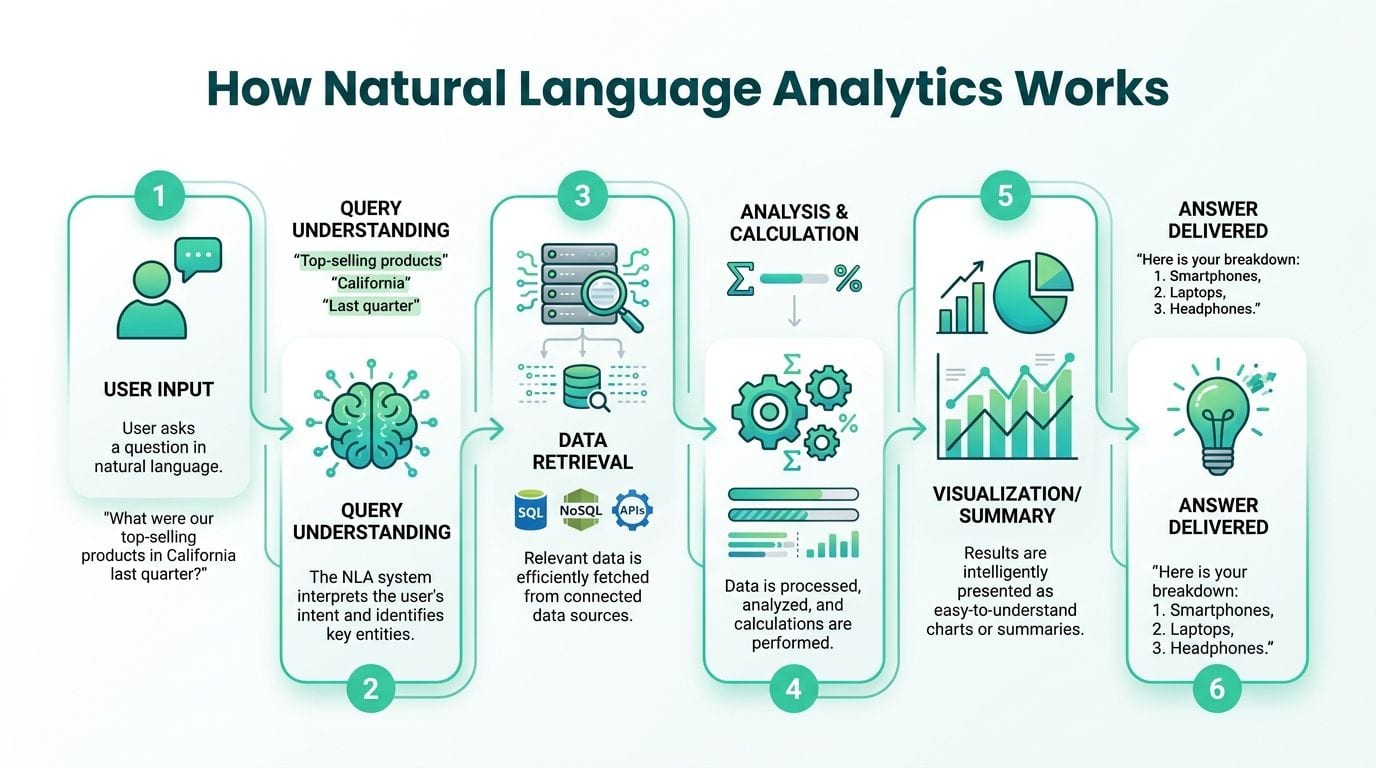
A typical pipeline includes Query Interpretation, Query Translation, execution against a governed semantic layer, and Result Visualization, as described in GigaSpaces on natural language analytics architecture. That sequence is what turns a plain-English question into something a warehouse can execute reliably.
Query interpretation
The first task is figuring out intent. If a user asks, “Show top-performing campaigns from last month,” the system needs to resolve several ambiguities:
- What counts as top-performing?
- Does last month mean the previous calendar month or the trailing thirty days?
- Is the user asking for spend efficiency, conversion volume, revenue, or some custom score?
This stage is where the system identifies entities, filters, date ranges, and likely metrics. It's also where weak implementations start to drift.
Query translation
Once intent is mapped, the platform converts that request into a structured query, often through text-to-SQL logic. At this point, language meets schema.
The translation layer has to know that “campaign” might map to a campaign dimension in one table, “signups” might correspond to a conversion event in another, and attribution logic may need to join multiple sources before any answer makes sense.
The semantic layer is the control point
This is the piece vendors often underplay. A governed semantic layer maps business language to approved metrics, dimensions, and definitions before query execution.
Without that layer, the model may still produce a plausible answer. It just won't be a dependable one.
A strong semantic layer does a few jobs at once:
- Standardizes business terms: “Revenue,” “qualified signup,” or “active user” resolves to one approved definition.
- Constrains interpretation: The system can answer within known logic instead of improvising against raw fields.
- Supports auditability: Analysts can verify how the answer was produced.
If the business says “top-performing campaign,” the system should resolve that to an explicit metric. It shouldn't invent a proxy because the phrasing sounded close enough.
Result delivery
Once the query runs, the output has to be useful, not just technically correct. Good natural language analytics tools return the answer in the right format for the question:
| Question type | Best response format |
|---|---|
| Comparison between channels | Ranked chart or table |
| Trend over time | Time series visualization |
| Anomaly explanation | Narrative summary with context |
| Follow-up segmentation | Conversational refinement |
Advanced tools also retain context, which matters in real workflows. If a marketer asks, “Break that down by region,” the system should understand what “that” refers to without forcing the whole query to be repeated.
Practical Applications for Digital Marketers and Analysts
Natural language analytics becomes useful when it shortens the distance between a business question and a trustworthy answer. For digital teams, that usually means less dashboard hunting and fewer analyst interrupts for routine questions.
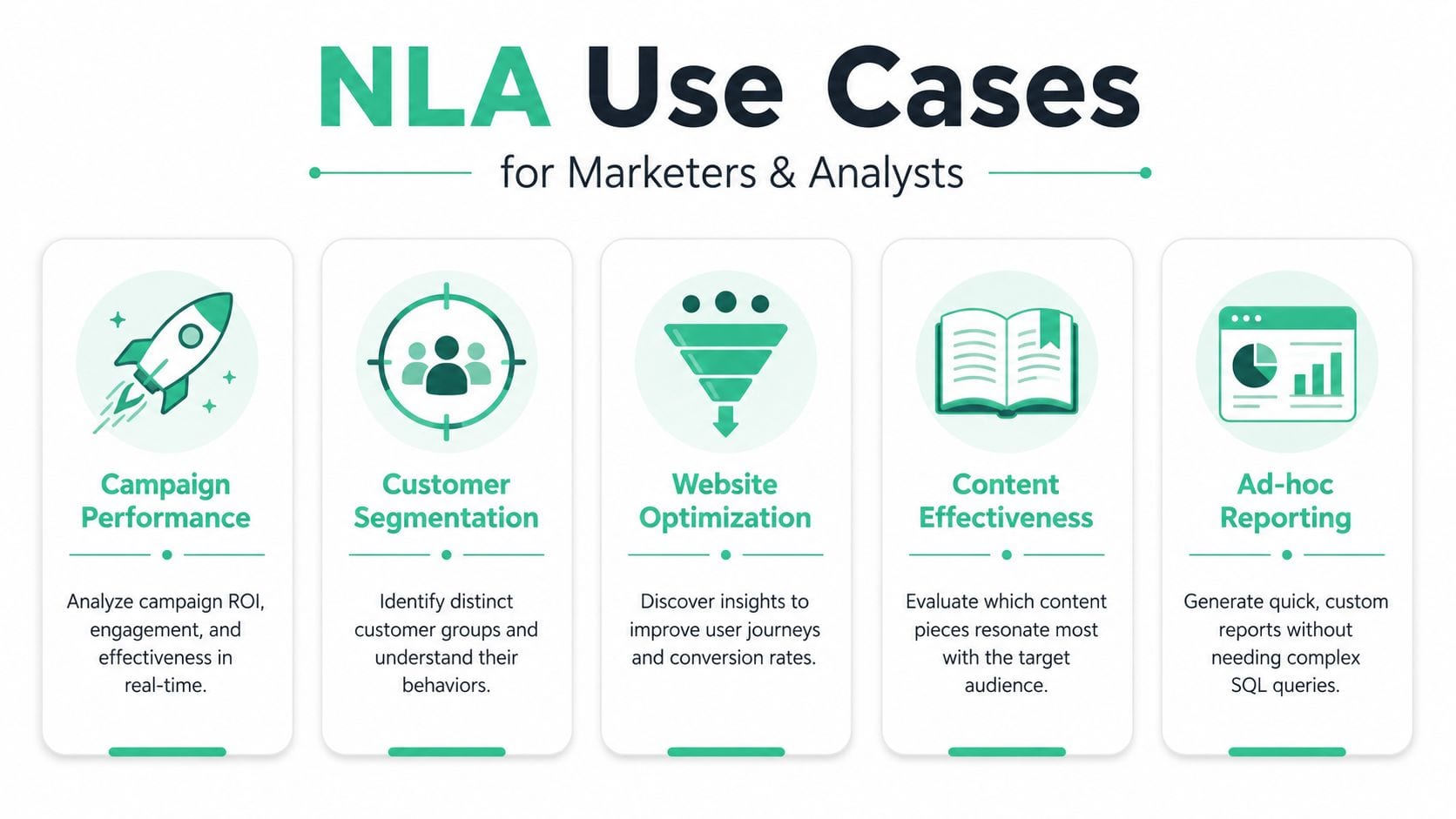
The interface patterns are also evolving. Market-leading analytics platforms now use three main UX patterns: direct natural language querying, proactive agents, and metric monitoring with anomaly alerts, as outlined in Trackingplan's review of AI-powered analytics tools for 2026. That matters because not every workflow starts with a typed question.
If you want to explore the broader tool category around this shift, Trackingplan's look at AI marketing analytics adds helpful context.
Campaign analysis without report sprawl
A paid media team often wants answers that cut across platforms, audiences, and conversion stages. In a traditional setup, someone opens separate dashboards for Meta, Google Ads, analytics attribution, and landing page performance.
With natural language analytics, the workflow gets simpler. A marketer can ask:
- Which campaigns drove the most signups from new users in Germany last month?
- Compare branded search versus paid social by assisted conversions
- Show landing pages with high spend but weak conversion rate
The improvement isn't that analysis becomes automatic. It's that the system handles the retrieval and first-pass structuring so the team can spend time on interpretation.
Faster insight from content and search behavior
Natural language analytics enables non-specialists to move faster.
A content lead can ask which blog topics correlate with assisted conversions. An SEO manager can explore on-site search terms to identify missing content or navigation gaps. A product marketer can scan open-text feedback themes and then segment them by device, plan type, or acquisition source.
Those aren't all the same analytical problem, but they share the same barrier in older tools. The user knows the business question but not always the path through the data model.
Proactive monitoring instead of reactive reporting
Direct querying is only one mode. Proactive agents and metric monitoring are often more valuable for busy teams because they surface unusual movement before someone asks.
Examples that matter in daily operations:
- Spend anomalies: A campaign's cost rises while conversion signals soften.
- Attribution shifts: A familiar acquisition mix changes after a tracking or landing page change.
- Content decay: Pages that usually assist pipeline stop contributing at the expected level.
- Journey friction: A funnel step starts underperforming by browser, app version, or traffic source.
Good natural language analytics doesn't just answer the question you typed. It should also reduce the number of important questions you fail to ask.
Practical use in mixed teams
The biggest gains usually appear in cross-functional environments. Marketers use it for fast checks. Analysts use it to triage requests. Product teams use it to validate whether a change affected behavior. Leaders use it to ask ad hoc questions without waiting for custom reporting.
That doesn't remove the need for careful analysis. It just means the first layer of exploration becomes easier to access and easier to repeat.
Implementing NLA A Focus on Data Quality and Governance
Many teams evaluate natural language analytics by testing the interface. That's the wrong place to start. The underlying implementation work sits underneath it, in event design, schema consistency, metric governance, privacy controls, and validation.
If the source data is messy, natural language analytics won't rescue it. It will make bad answers easier to retrieve.
What has to be clean before rollout
The minimum foundation is not glamorous, but it's essential.
- Event schemas need discipline: If one team sends
signup_completeand another sendsregistration_donefor the same action, the language layer has to compensate for tracking inconsistency it shouldn't be solving. - Metric definitions must be explicit: “Active user,” “qualified lead,” and “conversion” need approved business logic, not loose tribal knowledge.
- Naming conventions need stability: Natural language models can handle synonyms, but they work better when the underlying implementation isn't chaotic.
A lot of failed rollouts come from treating natural language analytics as a front-end feature instead of a governed analytics capability.
Validation matters more than fluency
Teams often get impressed when a tool returns a chart from a loosely phrased question. That's a shallow test. The better test is whether the answer remains correct when the request includes ambiguity, nested filters, or channel-specific edge cases.
That means validating:
| Governance area | What to check |
|---|---|
| Event collection | Core actions fire consistently across web, app, and server-side flows |
| Schema integrity | Properties keep the same format and meaning over time |
| Access control | Users only retrieve data they're permitted to see |
| Privacy | Queries can't expose PII or bypass consent controls |
| Metric logic | Standard business definitions apply across all outputs |
For teams tightening the upstream layer first, Trackingplan's data quality best practices is a useful operational reference.
The implementation mindset that works
Natural language analytics adoption is smoother when teams phase it.
Start with a narrow set of trusted use cases. Use high-confidence metrics. Review common user questions. Add interpretation previews and logging. Watch where people get confused. Tighten the semantic model before expanding to more open-ended questions.
Natural language analytics is only as trustworthy as the tracking, definitions, and permissions beneath it.
That's why governance isn't the thing that slows adoption. It's the thing that prevents a credibility collapse after launch.
Common Pitfalls and How to Avoid Them
The sales pitch around natural language analytics is usually simple. Ask a question. Get an answer. The operational reality is messier.
The most common failure mode is query ambiguity. A question sounds obvious to the person asking it, but the system has to guess what several words mean in context. That guess may be wrong, and the answer can still look polished enough to pass casual inspection.
Ambiguity is the core product problem
The strongest warning sign is user-reported inaccuracy. 68% of users report that natural language queries return incorrect or misleading results because of ambiguous phrasing, and enterprises that adopt NLA without safeguards such as clarification prompts see a 45% higher rate of analyst rework, according to OvalEdge on NLP in AI-driven analytics.
That's the gap vendors tend to gloss over. Fluency creates confidence. Confidence isn't the same as correctness.
What to look for in a serious system
When evaluating tools, ask whether the product does any of the following before it runs the query:
- Clarification prompts: Does it ask follow-up questions when “conversion,” “quality,” or “top-performing” could mean more than one thing?
- Interpretation previews: Can the user inspect how the system mapped the question to metrics, filters, and date logic?
- Refinement mechanisms: Can the user easily narrow, restate, or constrain the request without restarting the analysis?
- Conversation memory: Does the system preserve context accurately across follow-ups?
A surprising number of implementations still rely too heavily on inference. That's fine for lightweight exploration. It's risky for production reporting.
What teams should do internally
The practical response isn't to avoid natural language analytics. It's to adopt it with controls.
Create a list of approved business terms. Identify known ambiguous phrases. Log failed and misleading queries. Review the queries people ask most often, then improve the semantic layer around them. Teach users what the system can answer confidently and where analyst review still matters.
For teams building a stronger governance habit around analytics quality, the videos on Trackingplan's YouTube channel are worth browsing. They're useful if you want practical thinking on data quality, implementation issues, and the kind of upstream discipline natural language systems depend on.
A natural language interface should never hide uncertainty. The better product shows you where interpretation is strong and where it needs confirmation.
The Future of Data Interaction Is Conversational
The important shift isn't that dashboards are disappearing. It's that the dominant interaction model is changing. Teams are moving from navigating reports to asking questions, refining them, and working with answers in context.
That's why natural language analytics should be treated as a serious analytical layer, not a novelty feature. It can open data access to more people, reduce routine reporting friction, and make exploration faster. But it only works when the organization has already done the hard work on definitions, validation, permissions, and tracking quality.
For analysts and marketers, that's good news. This doesn't replace analytical judgment. It removes some of the repetitive translation work so teams can focus on diagnosis, experimentation, and strategy.
If you're also watching where this is heading next, Trackingplan's perspective on agentic analytics is a useful next read.
If your team wants trustworthy analytics answers, start upstream. Trackingplan helps teams monitor analytics quality across web, app, and server-side implementations, catch schema issues and broken pixels early, and keep the data layer reliable enough for modern analytics workflows, including natural language analytics.