
TL;DR:
- Unified marketing measurement combines MMM, MTA, and incrementality testing into a single system for better cross-channel insights. It reconciles conflicting outputs by assigning methods to decision contexts and emphasizing data quality for accurate results. Continuous calibration and trust in relevant methods guide effective budget decisions and foster transparency across teams.
Unified marketing measurement (UMM) is defined as a framework that synthesizes Marketing Mix Modeling (MMM), Multi-Touch Attribution (MTA), and incrementality testing into a single, reconciled analytics system. The industry also refers to this approach as integrated marketing analytics, though UMM has become the standard term among practitioners. Each methodology answers a different question about marketing performance, and combining them produces CFO-credible ROI metrics alongside CMO-ready channel insights. For marketing professionals and data analysts managing complex, multi-channel campaigns, UMM is the most reliable path to accurate budget decisions and measurable revenue impact.
What is unified marketing measurement and why does it matter?
Unified marketing measurement integrates MMM, MTA, and incrementality testing into one framework that delivers a reconciled view of marketing performance. No single method alone covers every blind spot. MMM analyzes all channels including offline media and long-term brand effects. MTA tracks individual digital touchpoints across the customer journey. Incrementality testing provides causal proof that a channel actually drove a conversion, rather than just correlating with one.
The business case is direct. Marketing teams that rely on a single methodology routinely misallocate budget because each method has structural limitations. MMM cannot attribute credit at the individual user level. MTA ignores offline channels entirely. Incrementality testing is expensive and slow when run in isolation. Triangulating evidence across all three methods produces more reliable insights than favoring any one approach.
Cross-channel measurement also matters because customer journeys now span paid search, social, connected TV, email, and in-store touchpoints. A framework that only measures digital channels will systematically undervalue offline investment and overweight last-click digital conversions. UMM corrects that distortion by design.
What are the core methodologies in UMM and how do they complement each other?
Each of the three core methodologies in UMM answers a fundamentally different question, and each covers different blind spots that the others cannot address alone.
Marketing Mix Modeling (MMM) uses aggregate, historical data to estimate each channel’s contribution to revenue. It handles offline media, seasonality, pricing, and competitor activity. MMM is the right tool for annual budget planning and long-term channel strategy. Its weakness is granularity: it cannot tell you which specific ad or audience segment drove a sale.
Multi-Touch Attribution (MTA) operates at the individual user level, tracking every digital touchpoint before a conversion. It answers tactical questions: which ad creative, which keyword, which audience drove the most conversions this week? MTA is built for daily and weekly optimization. Its weakness is scope: it is blind to offline channels and cannot prove causality.
Incrementality testing runs controlled experiments, typically geo-based or audience holdout tests, to measure the true causal lift a channel delivers. It answers the question MMM and MTA cannot: would these customers have converted anyway without the ad? Incrementality testing is the ground-truth validator in any UMM framework.
The three methods complement each other as follows:
- MMM sets the strategic budget envelope and long-term channel mix
- MTA optimizes tactical spend within that envelope on a daily basis
- Incrementality testing validates whether MMM and MTA outputs reflect real causal effects
Pro Tip: Run incrementality tests on your highest-spend channels first. The causal validation they provide will calibrate your MMM and MTA outputs faster than any modeling adjustment.
The combined picture is what makes marketing performance analysis credible to finance teams. Each method’s strength compensates for another’s gap.
How does UMM reconcile conflicting outputs and manage methodological biases?
MTA and MMM answer fundamentally different business questions and frequently produce conflicting channel attribution numbers. This is not a data quality problem. It is a structural feature of using methods with different scopes, time horizons, and data inputs. Managing that conflict is the core intellectual challenge of UMM.
The conflict typically surfaces like this: MMM credits brand search with modest incremental value because it controls for organic demand. MTA credits brand search heavily because it appears in nearly every conversion path. Neither is wrong. They are measuring different things. The UMM practitioner’s job is to reconcile these outputs into a single decision-relevant view.
Practitioners use several strategies to manage this:
- Assign each method to its appropriate decision context. Use MMM outputs for quarterly budget allocation. Use MTA outputs for weekly bid and creative optimization. Never use MTA to justify a major channel investment, and never use MMM to set daily bid strategies.
- Apply Bayesian techniques to combine model outputs. A Bayesian posterior distribution can formally integrate MMM priors with MTA likelihood estimates, producing a probability range rather than a single point estimate. This is technically complex and rare in practice, but it is the most rigorous reconciliation method available.
- Use confidence ranges, not point estimates. Presenting a channel’s contribution as a range (for example, 12–18% of revenue) is more honest and more useful than a single number that implies false precision.
- Match model bias to decision context. No attribution model is perfect; the goal is to select the model whose inherent bias aligns with the decision you are making. A last-touch model biases toward conversion channels, which is appropriate for evaluating bottom-funnel retargeting. A linear model distributes credit evenly, which is appropriate for evaluating awareness campaigns.
Pro Tip: Document which method drives which decision before you build your UMM framework. Teams that skip this step spend months arguing about conflicting numbers instead of acting on them.
Intellectual honesty about uncertainty is not a weakness in UMM. It is what separates credible measurement from the false precision that erodes trust between marketing and finance.
What practical steps do marketing teams take to implement UMM?
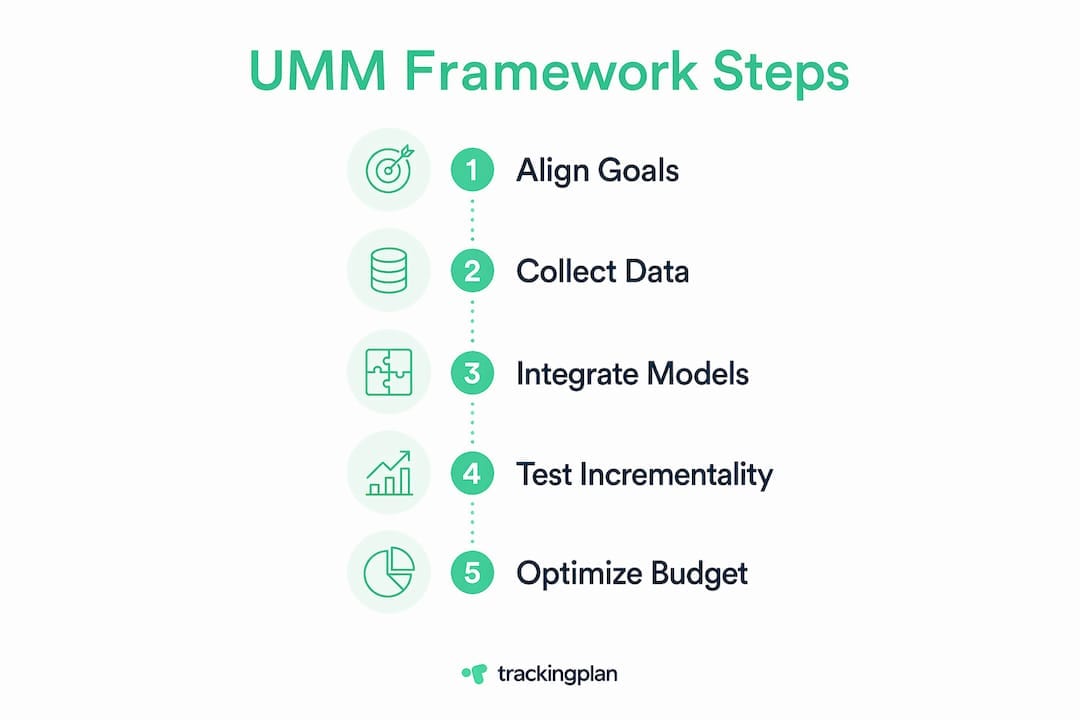
Successful UMM implementation starts with aligning on specific business outcomes before touching any data. Revenue, customer lifetime value, and new customer acquisition cost are the metrics that connect marketing measurement to finance. Teams that align on these outcomes first build frameworks that finance teams actually trust.

The data requirements for UMM are substantial. You need CRM data, financial transaction records, digital event tracking, offline sales data, and media spend logs. Gaps in any of these inputs degrade the quality of all three methodologies. Data quality is not a technical afterthought. It is the foundation that determines whether your MMM, MTA, and incrementality outputs are reliable enough to act on.
The practical implementation sequence looks like this:
- Audit your tracking layer first. Broken pixels, missing events, and schema mismatches corrupt MTA data at the source. Fix these before running any attribution model.
- Run MMM on at least 2 years of weekly data. Shorter time series produce unstable coefficient estimates, especially for seasonal categories.
- Start incrementality testing on your top two or three channels by spend. These tests take 4–8 weeks and require clean geographic or audience splits.
- Connect outputs to a shared dashboard. The goal is a single view where MMM, MTA, and incrementality results sit side by side, not in three separate reports.
- Calibrate confidence thresholds by funnel position. High statistical confidence (95%) is appropriate for lower-funnel conversion channels. Upper-funnel brand investments can operate at 50–60% confidence, supported by leading indicators like branded search volume and brand lift surveys.
Successful marketing teams treat measurement as a continuous optimization flywheel, integrating platform ROAS, back-end ROAS, and incremental ROAS to make agile budget decisions before hitting performance ceilings. This cyclical approach means measurement outputs feed directly back into the next planning cycle rather than sitting in a quarterly report.
Pro Tip: Build your UMM dashboard so that each methodology’s output is labeled with the decision it informs. This prevents analysts from applying MMM outputs to tactical bid decisions and vice versa.
The most common pitfall is treating UMM as a one-time project. The framework requires ongoing calibration as media mix, consumer behavior, and channel dynamics shift.
What are common attribution models and how do they fit into UMM?
Attribution models are the rules that assign conversion credit to marketing touchpoints. They sit primarily within the MTA layer of UMM, but their outputs feed into the overall reconciled view. Choosing the right model depends on your data volume, sales cycle length, and channel complexity.
The main model types range from simple to advanced:
- Last-touch attribution assigns 100% of credit to the final touchpoint before conversion. It is easy to implement but systematically blinds your strategy to upper-funnel channels that build demand.
- Linear attribution distributes credit equally across all touchpoints. It is fair but ignores the reality that some touchpoints matter more than others.
- Position-based (U-shaped) attribution gives more credit to the first and last touchpoints, with the remainder split across the middle. It suits businesses where acquisition and conversion are the key moments.
- Data-driven attribution uses algorithms, often Markov chains or Shapley values, to calculate each touchpoint’s actual contribution based on observed conversion paths. Data-driven models require thousands of conversions monthly to be statistically reliable. Teams with lower conversion volumes should use linear or position-based models until their data volume supports advanced algorithms.
Attribution models suit different sales cycles: multi-touch or data-driven models fit longer cycles and complex multi-channel environments, while simpler models work for short-cycle businesses. Understanding attribution modeling fundamentals is a prerequisite for applying any of these models correctly within a UMM framework.
Within UMM, attribution model outputs are tactical inputs, not strategic conclusions. They tell you which digital channels and creatives to optimize this week. MMM and incrementality testing tell you whether those channels deserve more budget next quarter.
Key takeaways
Unified marketing measurement produces credible, cross-channel marketing ROI by combining MMM’s strategic scope, MTA’s tactical granularity, and incrementality testing’s causal validation into one reconciled framework.
| Point | Details |
|---|---|
| Three methods, one framework | MMM, MTA, and incrementality testing each cover blind spots the others miss; combined they produce a complete performance view. |
| Reconcile by decision context | Assign MMM to budget planning, MTA to daily optimization, and incrementality testing to causal validation to avoid methodology conflict. |
| Data quality is foundational | Broken tracking, missing pixels, and schema errors corrupt MTA data at the source and degrade all downstream outputs. |
| Calibrate confidence by funnel | Use 95% statistical confidence for conversion channels and 50–60% for upper-funnel brand investments supported by leading indicators. |
| Treat measurement as a flywheel | Feed MMM, MTA, and incrementality outputs back into each planning cycle for continuous budget optimization. |
Why UMM is the most honest framework marketing has ever had
Most measurement debates I have seen inside marketing organizations are really arguments about which single number to trust. The paid search team trusts MTA. The brand team trusts MMM. The finance team trusts neither. UMM does not resolve that tension by picking a winner. It resolves it by making the tension explicit and productive.
The frameworks that actually change budget decisions are the ones that admit uncertainty. A confidence range of 12–18% for a channel’s revenue contribution is more useful than a point estimate of 15%, because it tells the CMO and CFO exactly how much precision the data supports. That intellectual honesty builds the kind of cross-functional trust that lets marketing teams move faster, not slower.
The future direction I find most compelling is the integration of AI with connected data platforms to automate the calibration layer in UMM. Right now, reconciling MMM and MTA outputs requires significant analyst time. As AI-assisted modeling matures, that reconciliation will happen continuously rather than quarterly. Teams that build clean, well-governed data infrastructure now will be positioned to take advantage of that shift. Teams that are still arguing about which single attribution model to use will not be.
The most underrated skill in marketing measurement is knowing which method to trust for which decision. UMM does not eliminate judgment. It gives you a structured framework for applying it.
— David
How Trackingplan supports accurate data for unified measurement
Every UMM framework depends on clean, reliable tracking data at its foundation. If your pixels are broken, your events are misfiring, or your schema has drifted, your MTA outputs are corrupted before any model touches them.

Trackingplan monitors your web tracking implementation in real time, detecting missing pixels, broken tags, schema mismatches, and campaign misconfigurations across websites, apps, and server-side environments. Alerts arrive via Slack, email, or Teams the moment an anomaly appears, so your team fixes issues before they corrupt a full reporting cycle. For teams building or maintaining a UMM framework, Trackingplan’s digital analytics quality tools provide the data integrity layer that makes every downstream model trustworthy.
FAQ
What is unified marketing measurement?
Unified marketing measurement is a framework that combines Marketing Mix Modeling, Multi-Touch Attribution, and incrementality testing into one reconciled system. It produces cross-channel marketing ROI metrics that are credible to both CMOs and CFOs.
How does UMM differ from standard marketing attribution?
Standard attribution models assign credit to touchpoints within a single methodology, usually digital-only. UMM integrates multiple methodologies, including offline channels and causal testing, to produce a more complete and accurate performance view.
When should I use MMM versus MTA?
Use MMM for quarterly budget allocation and long-term channel strategy. Use MTA for daily and weekly bid and creative optimization. The two methods answer different questions and should not be used interchangeably.
How many conversions do I need for data-driven attribution?
Data-driven attribution models require thousands of conversions per month to be statistically reliable. Teams with lower volumes should use linear or position-based models until their data supports advanced algorithms.
What is the biggest implementation risk in UMM?
The biggest risk is poor data quality at the tracking layer. Broken pixels and missing events corrupt MTA data at the source, which degrades the accuracy of the entire reconciled framework. Auditing your tracking implementation before building any model is the most important first step.